
Bristly Sedge (Carex comosa)
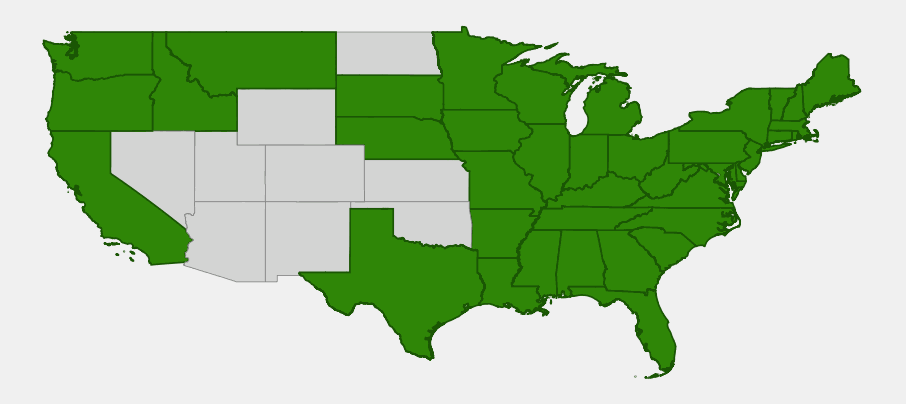
Carex comosa, known as Bristly Sedge, bottlebrush sedge, or longhair sedge in USDA PLANTS, is a large, clump-forming native sedge of marshes, swamps, pond and lake shores and other wetlands. It grows across most of the eastern United States and southeastern Canada, with scattered populations in the West from British Columbia and Washington to California, Idaho and Montana.
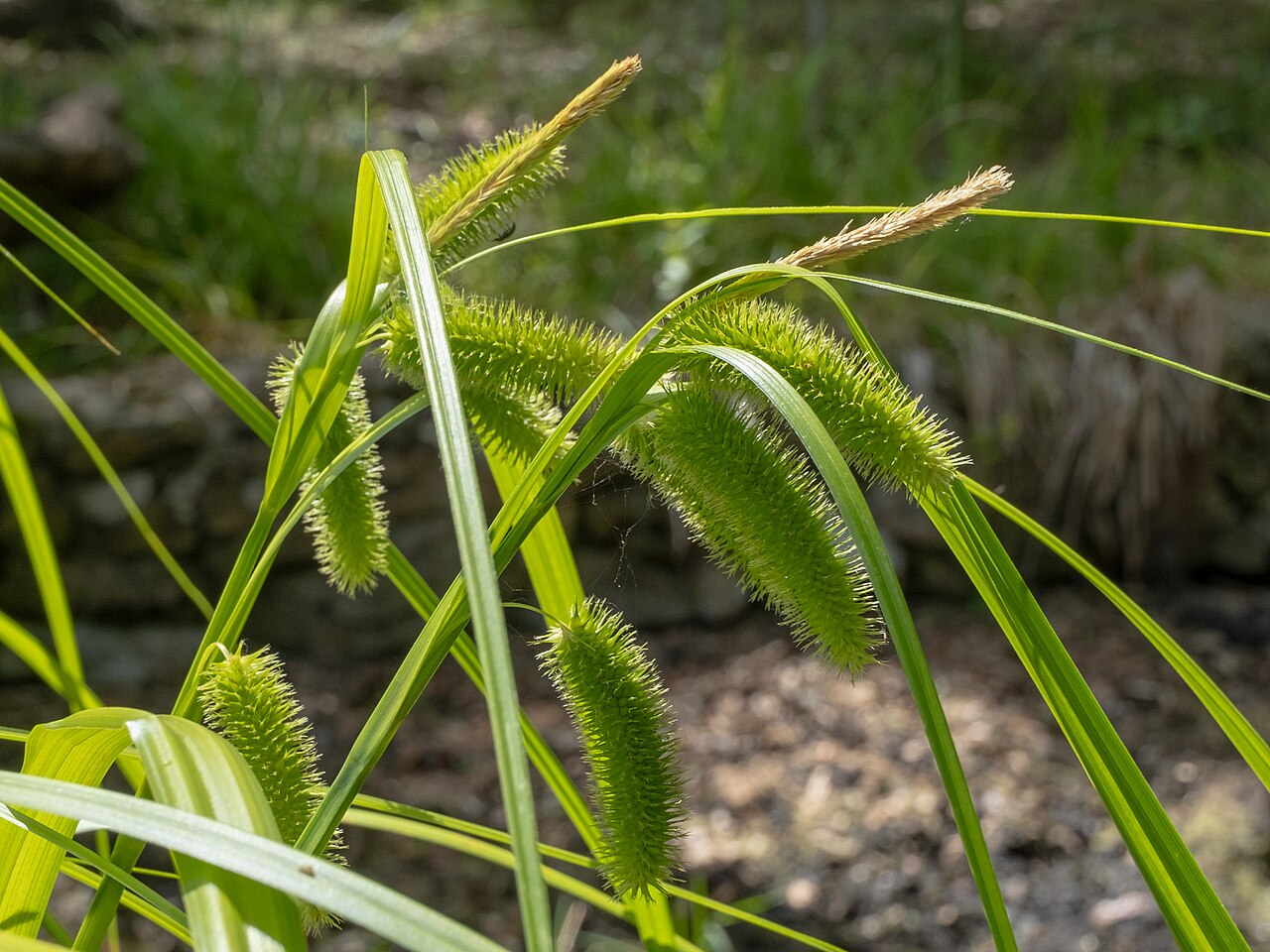
It is one of the most distinctive sedges. Its leafy clumps reach 2 to 4 feet tall, and in early summer it carries thick, cylindrical, bristly green spikes that droop on slender stalks like small bottlebrushes. The bristly look comes from the long, two-toothed beaks of its seed sacs, which spread in every direction.
Bristly sedge tolerates standing water better than most sedges, which makes it an excellent choice for pond edges, rain gardens, stormwater basins and wetland restoration. This guide covers how to identify it, how it differs from similar sedges, where it grows, how to grow it and its value to wildlife.
Identification
Bristly sedge is easy to spot in summer: a big, leafy clump at the water’s edge with several thick, bristly, drooping spikes. Look closely at the seed sacs to separate it from its look-alikes.
Growth Habit
Plants form dense clumps from short rhizomes, usually 2 to 4 feet tall. The flowering stems are sharply three-angled, rough on the angles and spongy at the base. The clumps stay green through the growing season and turn tan in fall.
Leaves
The leaves are flat, bright green and fairly wide for a sedge, about 1/4 to 1/2 inch across, with rough edges. They are often as long as or longer than the flowering stems. A long, leaflike bract grows from the base of the flower cluster and usually extends well beyond it.
Flowers & Spikes
Each flowering stem has a narrow male (pollen) spike at the top and usually three to six female spikes below. The female spikes are cylindrical, about 1 to 3 inches long and about 1/2 inch thick, and they nod or droop on slender stalks. The small flowers bloom in late spring to early summer, and the spikes are most conspicuous in summer as the fruits develop.
Perigynia
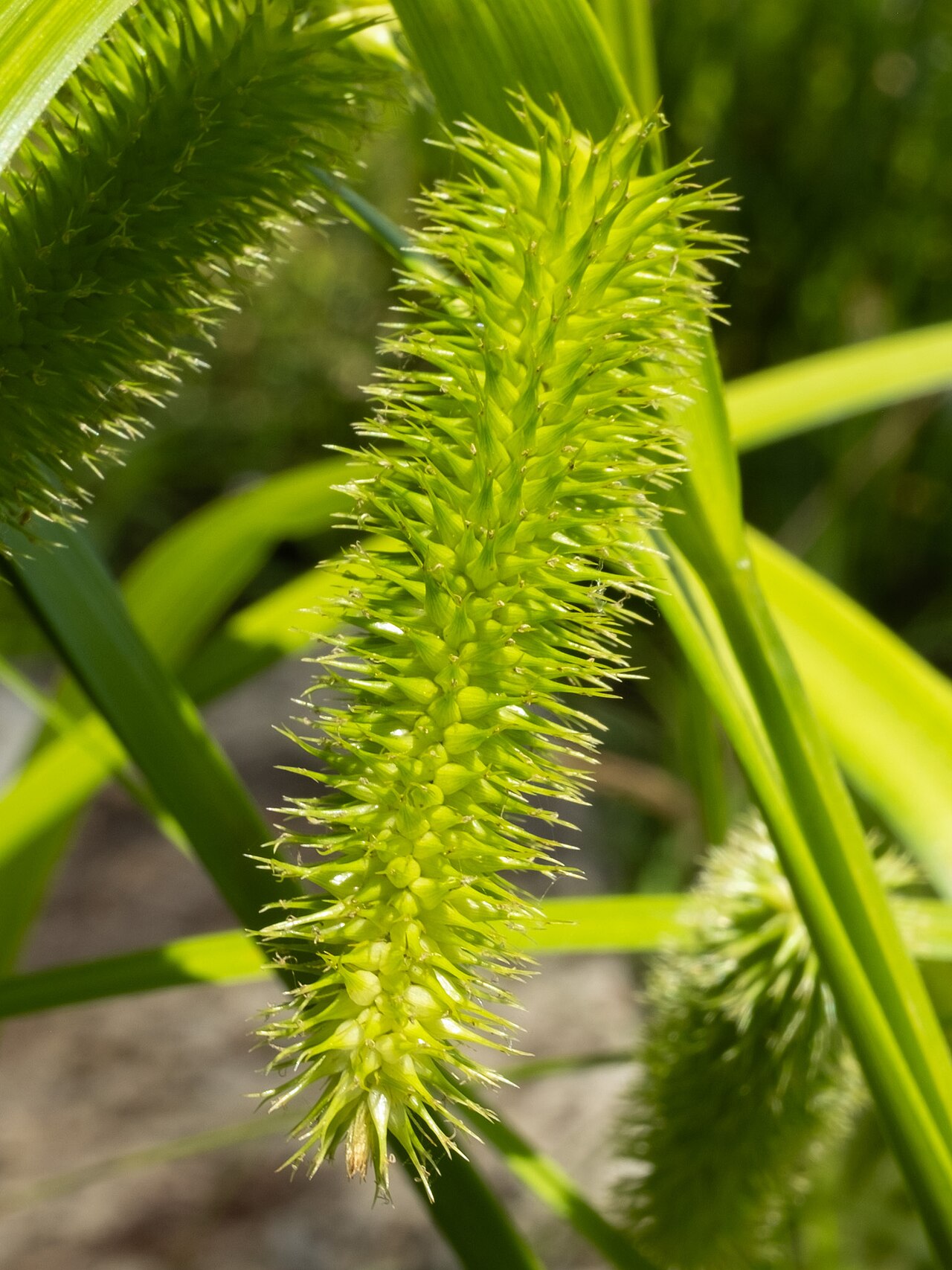
Each seed is enclosed in a small sac called a perigynium, about 1/4 inch long, which tapers into a long beak ending in two stiff, spreading to outward-curved teeth. These spreading beaks, together with the slender, rough awns of the scales, make the spike look bristly. The perigynia ripen from green to straw-colored in mid to late summer.
Look-alikes
Porcupine sedge (Carex hystericina), also called bottlebrush sedge, is smaller, with shorter spikes and perigynium teeth that are straight rather than spreading. Cyperus-like sedge (C. pseudocyperus) of the northern states has similar drooping spikes but shorter, straight teeth. Hop sedge (C. lupulina) and sallow sedge (C. lurida) have larger, inflated perigynia in fatter or more upright spikes. Fringed sedge (C. crinita) has drooping spikes but small, beakless perigynia with long-awned scales.
Quick Facts
| Scientific Name | Carex comosa Boott |
| Family | Cyperaceae (sedge family) |
| Plant Type | Clump-forming perennial sedge |
| Mature Height | 2–4 ft |
| Mature Spread | 1–2 ft |
| Growth Rate | Moderate to fast |
| Sun Exposure | Full sun to part shade |
| Water Needs | High; wet soil to standing water |
| Soil Type | Mucky, loamy, sandy or clay soils that stay wet |
| Soil pH | Acidic to neutral (about 5–7.5) |
| Bloom Time | May–July; fruits in summer |
| Flower Color | Green, inconspicuous |
| Fall Color | Tan |
| Fruit | Bristly spikes of long-beaked perigynia |
| Deer Resistant | Yes, seldom browsed |
| USDA Hardiness Zones | 3–9 |
Native Range
Bristly sedge is native to much of North America and parts of Mexico. USDA PLANTS lists it in 39 states and in British Columbia, Ontario, Quebec, New Brunswick and Nova Scotia. It is most common in the Northeast, the Great Lakes region and the Atlantic and Gulf coastal plains, from Maine and Quebec south to Florida and west to Minnesota, Iowa, eastern Nebraska and South Dakota, Missouri and eastern Texas.
In the West it is scattered and local, with populations in Washington and British Columbia, Oregon (including the Klamath basin and the Willamette Valley), northern California, northern Idaho and western Montana. It is ranked as rare or imperiled in several states, including California, Oregon, Idaho, Montana, Texas, Arkansas, Mississippi, Missouri, Tennessee and West Virginia, and historical in Kentucky, according to NatureServe.
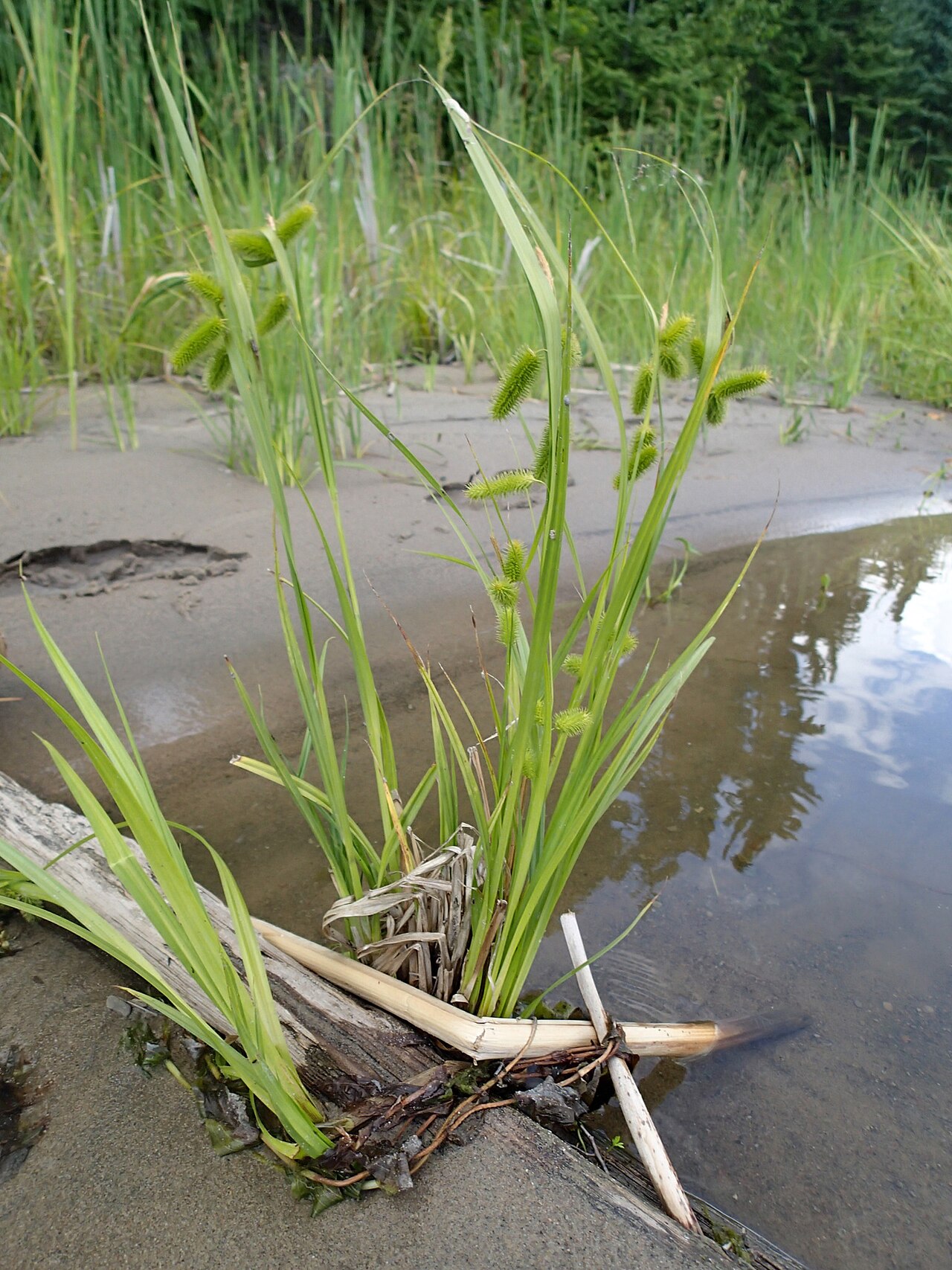
Typical habitats are marshes, swamps, wet meadows, sedge meadows, the shores of ponds, lakes and rivers, ditches and wet depressions, often in shallow standing water. It usually grows at low to moderate elevations, in full sun or light shade.
📋 Regional plant lists featuring Bristly Sedge: New York, Pennsylvania & Northern New Jersey · Idaho, Eastern Oregon & Eastern Washington · Ohio & Indiana · Montana & Wyoming · Michigan, Wisconsin & Eastern Minnesota · Kentucky & Tennessee · Nebraska, Kansas & Eastern Colorado · Connecticut, Massachusetts & Rhode Island · New Hampshire, Maine & Vermont · Maryland, Virginia & West Virginia · Delaware, Southern New Jersey & Long Island · Illinois, Iowa & Missouri · Alabama, Georgia & Mississippi · North & South Florida · North & South Carolina · Arkansas, Louisiana, Eastern Oklahoma & Eastern Texas · North Dakota, South Dakota & Western Minnesota · Western Oregon & Western Washington · California & Nevada
Growing & Care Guide
Bristly sedge is one of the easiest native sedges for wet places. It is widely sold by native plant nurseries in the East and Midwest as plugs, pots and seed. Give it sun and constant moisture, and it will form handsome, bristly clumps.
Light
Grow it in full sun to part shade. It flowers and fruits best in sun, and it tolerates the light shade of shrub swamps and woodland edges.
Soil & Water
It needs consistently wet soil: muck, loam, sand or clay that never dries out. It thrives at the edge of ponds and streams and tolerates standing water several inches deep, deeper than most sedges, as well as fluctuating water levels. In ordinary garden beds it struggles unless watered heavily. No fertilizer is needed.
Planting Tips
Plant plugs or potted plants in spring or early fall, 18 to 24 inches apart, along a pond margin, in a rain garden or stormwater basin, or in a wet meadow. It is an excellent choice for wet spots where water stands after rain, and its clumps help hold soil on shorelines. Combine it with blue flag iris, pickerelweed, swamp milkweed and other wetland plants.
Pruning & Maintenance
Little care is needed. Leave the foliage and spikes standing through winter for wildlife and winter interest, then cut back old growth in late winter or early spring before new shoots appear. Divide large clumps every few years if you want more plants. Remove invasive reed canary grass and common reed, which can overrun it.
Propagation
Grow it from seed or by division. Collect ripe spikes in late summer when the perigynia turn tan, and sow the seed in fall outdoors or give it two to three months of cold, moist stratification before spring sowing. Keep the seed surface moist and in light, as many sedge seeds need light to germinate. Mature clumps can be divided in spring.
Landscape Uses
- Pond and lake edges: thrives in wet mud and shallow water and holds the shoreline
- Rain gardens and stormwater basins: tolerates periodic flooding and standing water
- Wetland restoration: a fast, reliable native sedge for marshes and wet meadows
- Wildlife gardens: seeds for waterfowl and songbirds, cover for wetland animals
- Ornamental grass alternative: striking bottlebrush spikes in summer
Wildlife & Ecological Value
Bristly sedge supports a wide range of wetland wildlife, from caterpillars to ducks.
For Pollinators
Sedges are wind-pollinated, so bristly sedge does not offer nectar. However, sedges are host plants for the caterpillars of several native butterflies and moths, including some satyrs and skippers, which feed on their leaves.
For Birds
The seeds are eaten by ducks and other waterfowl, rails, sparrows and other wetland birds, and the dense clumps provide nesting cover and shelter for marsh birds.
For Mammals
Muskrats and other wetland mammals may eat the leaves and stems, and the clumps provide cover for small mammals along shorelines. Deer seldom browse it.
Ecosystem Role
Bristly sedge is part of the native sedge meadow and marsh community. Its dense roots stabilize mud and shorelines, slow water flow and trap sediment, and its clumps provide structure for invertebrates, amphibians and fish in shallow water. It is a common species in wetland restoration projects in the Midwest and East.
Cultural & Historical Uses
The species name comosa means “with a tuft of hair,” referring to the bristly, shaggy spikes. The species was described by the American botanist Francis Boott, a leading 19th-century authority on the genus Carex, who produced a large illustrated work on the sedges.
Its common names all describe the spikes: bristly sedge, bottlebrush sedge and, in USDA PLANTS, longhair sedge. The name bottlebrush sedge is also used for Carex hystericina, so the scientific name is the safest way to buy or identify it.
Bristly sedge is one of more than 100 sedges native to eastern North America and one of several on PlantNative, including tussock sedge, fox sedge and palm sedge. Sedges are often overlooked, but they are among the most important plants in wetlands.
Frequently Asked Questions
Is bristly sedge the same as longhair sedge?
Yes. USDA PLANTS uses the common name longhair sedge for Carex comosa. It is also called bristly sedge and bottlebrush sedge.
Can bristly sedge grow in standing water?
Yes. It tolerates shallow standing water several inches deep and fluctuating water levels, more than most sedges, which makes it a good choice for pond edges and stormwater basins.
How do I tell bristly sedge from porcupine sedge?
Bristly sedge is larger, with longer, thicker spikes, and the two teeth at the tip of each perigynium beak spread outward. In porcupine sedge (C. hystericina) the teeth are straight.
Does bristly sedge spread aggressively?
No. It forms clumps from short rhizomes and spreads slowly, though it may self-seed on wet, open ground.
Where does bristly sedge grow wild?
In marshes, swamps, wet meadows and on pond, lake and river shores across most of the eastern United States and southeastern Canada, with scattered populations in the Pacific Northwest, northern California, Idaho and Montana.

Looking for a nursery that carries Bristly Sedge?
Browse our native plant nursery directory: Alabama & Arkansas · California · Connecticut, Delaware, Florida & Georgia · Idaho, Illinois, Indiana & Iowa · Kentucky, Louisiana, Maine, Maryland, Massachusetts, Michigan, Minnesota, Mississippi, Missouri & Montana · Nebraska, New Hampshire, New Jersey, New York, North Carolina & Ohio · Oregon · Pennsylvania, Rhode Island, South Carolina, South Dakota, Tennessee, Texas, Vermont & Virginia · Washington · West Virginia & Wisconsin

