Palm Sedge (Carex muskingumensis)
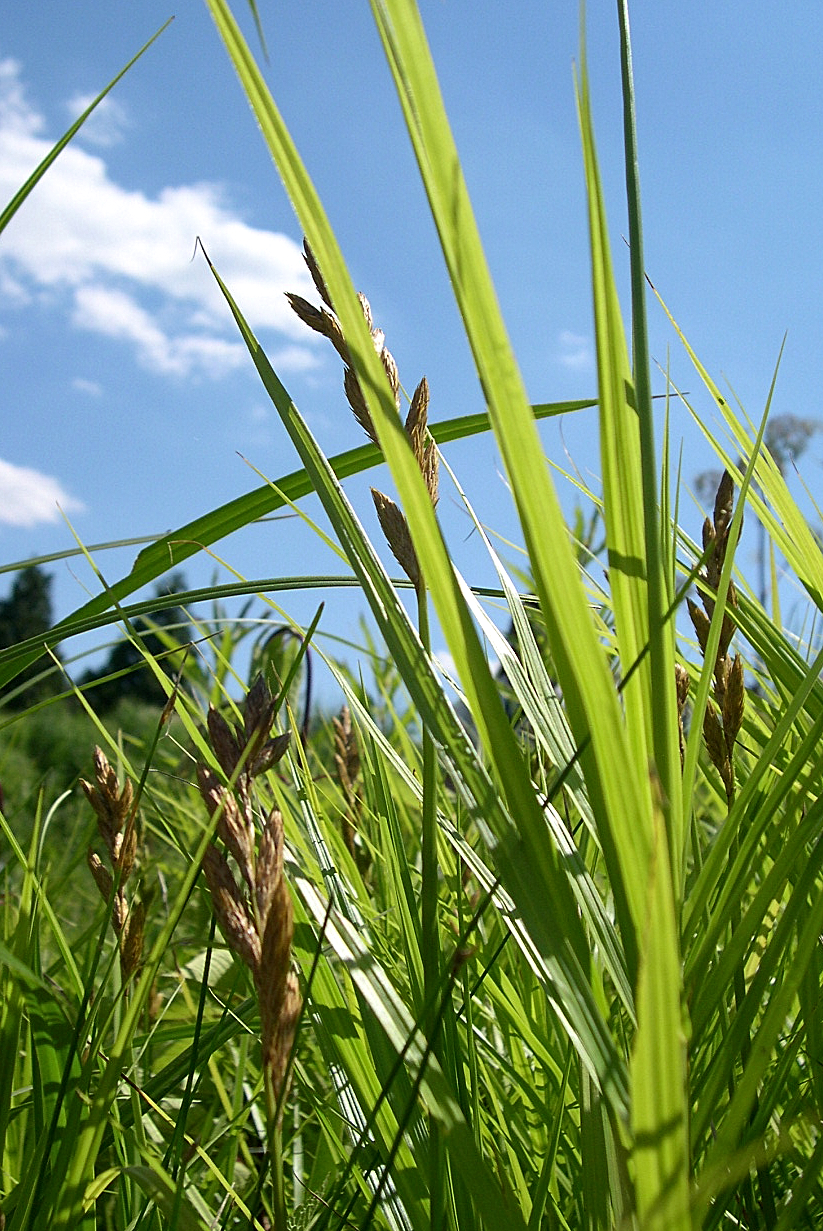
Carex muskingumensis, commonly called Palm Sedge or Muskingum Sedge, is a clump-forming native sedge of the Midwestern United States named for the Muskingum River valley in Ohio, where it was first described. Each stem carries tiers of narrow leaves radiating outward like the fronds of a miniature palm tree, giving the plant its common name and its best garden trait: a fine, airy texture that few other shade-tolerant groundcovers can match.
Palm Sedge grows naturally in wet bottomland woods, river floodplains, and sedge meadows, where it often forms loose colonies among ferns, sensitive fern, and other moisture-loving natives. It is a conservative species in the botanical sense — a reliable indicator of intact, high-quality wetland habitat rather than disturbed ground — which makes it a useful plant for both restoration plantings and rain gardens that need to handle occasional flooding.
In the home landscape, Palm Sedge has become a popular choice for shaded, damp spots that stump most other perennials: along downspouts, at the edge of a pond, in a rain garden basin, or under the dense shade of mature trees. Its bright green color holds through summer heat better than many ornamental grasses, and the plant spreads slowly by short rhizomes rather than aggressively seeding around the garden.
Identification
Palm Sedge forms dense, upright clumps of wiry, three-angled stems (culms) 16 to 39 inches tall, though garden specimens in average soil usually stay closer to 1.5 to 2.5 feet. The stems are noticeably stiffer and more upright than many woodland sedges, giving the clump a tidy, fountain-like habit rather than a floppy one.
Leaves
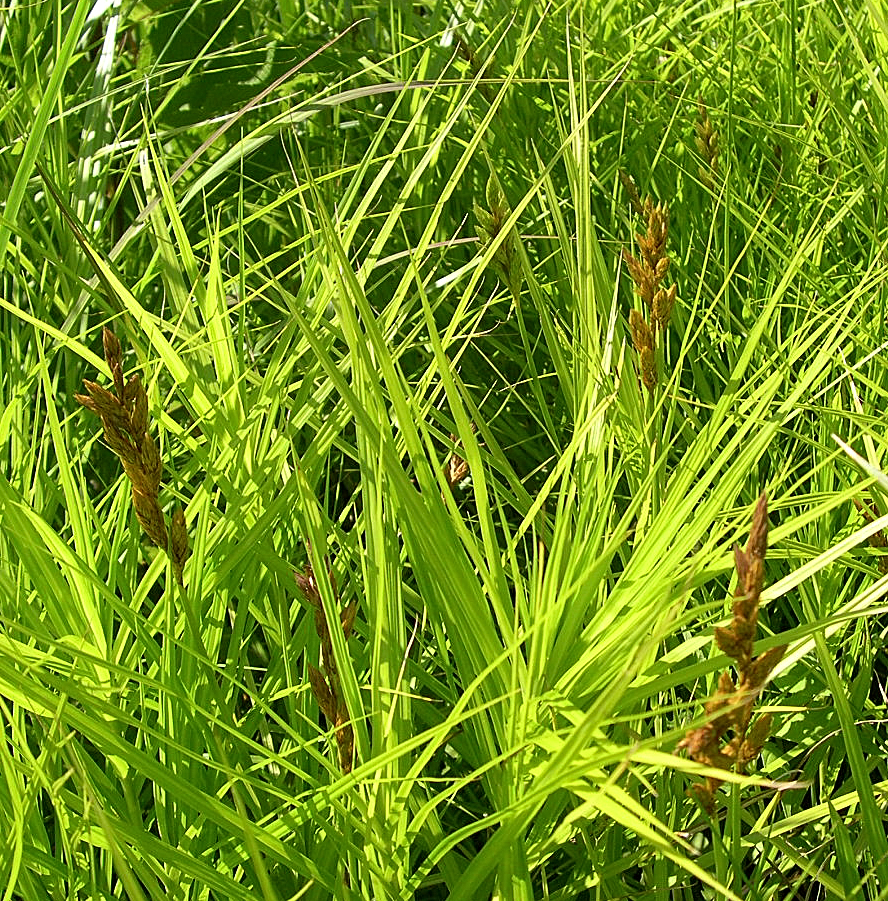
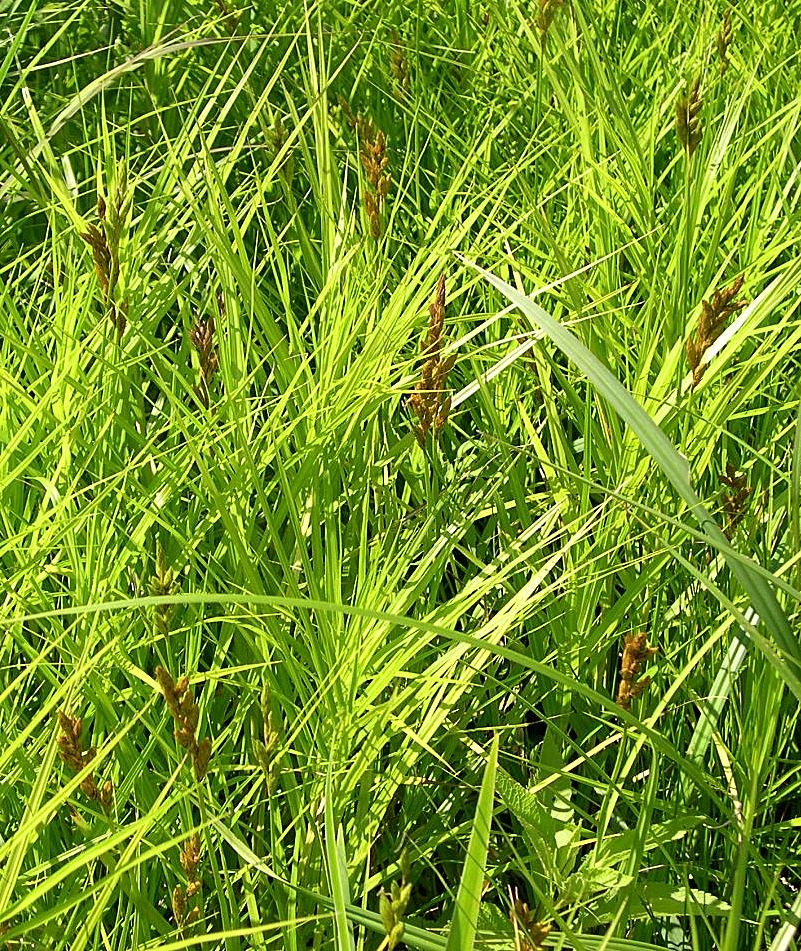
The leaves are the plant’s signature feature: narrow, bright yellow-green blades up to 10 inches long, arranged in tight whorls that spread evenly along the upper two-thirds of each stem. Seven to twelve leaves typically occur per fertile stem, radiating outward in a starburst pattern that resembles a tiny palm frond — hence the common name. Foliage stays fresh green through summer and often takes on bronze or tan tones in fall before going dormant.
Flowers & Fruit
Like all sedges, Palm Sedge produces inconspicuous, wind-pollinated flowers rather than showy blooms. In early to midsummer, slender brown flower spikes 2 to 3.5 inches long emerge above the leaf whorls on short branches, each spike packed with small, lance-shaped seed capsules (perigynia). The spikes mature to a warm tan-brown and add subtle textural interest rather than color.
Roots
Palm Sedge spreads by short, tough rhizomes, slowly expanding each clump outward into a dense patch over several years. It is not aggressive or weedy; established colonies stay where planted and simply thicken rather than running far afield, making it easy to combine with other perennials.
Quick Facts
| Scientific Name | Carex muskingumensis |
| Family | Cyperaceae (Sedge) |
| Plant Type | Perennial Sedge (Graminoid) |
| Mature Height | 1.5–3 ft |
| Mature Spread | 1.5–2 ft |
| Growth Rate | Moderate |
| Sun Exposure | Part Shade to Full Shade (tolerates more sun with steady moisture) |
| Water Needs | Average to Wet |
| Soil Type | Moist to wet; loam, clay or alluvial soils |
| Soil pH | 6.0–7.5 (neutral) |
| Bloom Time | Early–mid summer |
| Flower Color | Brown (inconspicuous) |
| Fall Color | Bronze-tan |
| Fruit | Small brown seed capsules (perigynia) in slender spikes |
| Deer Resistant | Yes (generally avoided) |
| USDA Hardiness Zones | 3–8 |
Native Range
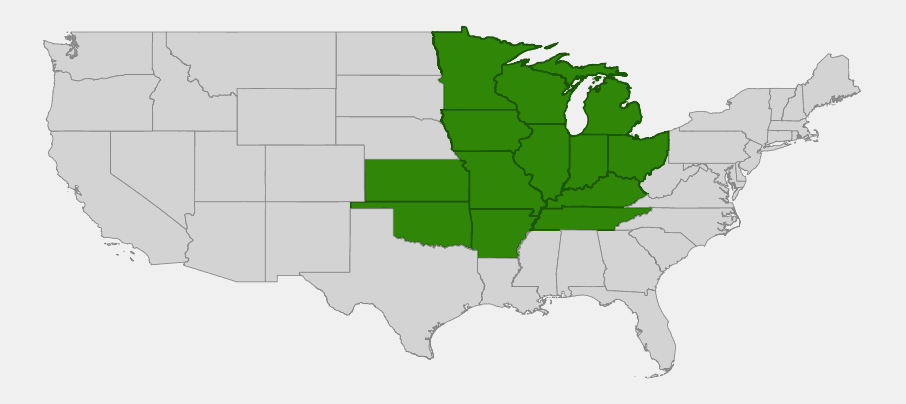
Palm Sedge is native to the Midwestern United States and adjacent Ontario, with its core range running from Minnesota, Wisconsin, Michigan, and Iowa east through Illinois, Indiana, and Ohio, and south through Missouri, Kansas, Arkansas, Kentucky, Tennessee, and the eastern edge of Oklahoma. It is most frequent in the Ohio and upper Mississippi River basins and becomes scarcer — known from scattered, often rare populations — at the southern and western edges of this range in Kentucky, Tennessee, Oklahoma, and Kansas.
Throughout its range, Palm Sedge grows in moist to wet deciduous floodplain forests, lowland woods, swamps, and sedge meadows, typically on seasonally flooded ground at low elevations. It is considered a fairly conservative species by botanists, meaning it tends to persist in higher-quality, less-disturbed wetland and floodplain habitat rather than colonizing degraded sites.
Palm Sedge has become a widely sold nursery plant, including variegated cultivars, and is planted as a shade-garden groundcover well outside this native range. Gardeners west of the Great Plains, in the Southeast outside its native footprint, or in the Northeast should treat it as a non-native ornamental rather than a regional native.
📋 Regional plant lists featuring Palm Sedge: Illinois, Iowa & Missouri · Ohio & Indiana · Michigan, Wisconsin & Eastern Minnesota · Nebraska, Kansas & Eastern Colorado · Kentucky & Tennessee · Arkansas, Louisiana, Eastern Oklahoma & Eastern Texas
Growing & Care Guide
Palm Sedge is one of the easiest native sedges to establish, as long as it gets the moisture and shade it expects from its floodplain-forest origins. Once settled in, it needs very little attention and reliably returns year after year without division.
Light
Palm Sedge performs best in part shade to full shade, the conditions it experiences under a floodplain forest canopy. It will also grow in full sun if the soil stays consistently moist to wet; in drier sunny spots the foliage tends to scorch and brown at the tips by late summer. For the cleanest-looking foliage all season, give it morning sun and afternoon shade, or dappled shade beneath trees.
Soil & Water
This sedge wants soil that stays evenly moist to wet and tolerates standing water for short periods, as it would along a flooding river. It adapts to clay, loam, and even compacted soils as long as moisture is adequate, and it is a reliable choice for rain garden basins that see periodic inundation. It does not tolerate prolonged drought; in dry years, supplemental watering keeps the clump full and green.
Planting Tips
Set out container plants in spring or fall, spacing clumps 12 to 18 inches apart for a continuous groundcover effect within two to three growing seasons. Mulch lightly to conserve moisture while plants establish. Palm Sedge combines well with other shade-tolerant wetland natives such as ferns, Wild Ginger, and Golden Ragwort, and its fine, upright texture makes a good contrast planted near broad-leaved woodland perennials.
Propagation
Established clumps can be divided in early spring just as new growth begins; dig the clump, pull or cut it into sections with healthy roots, and replant at the same depth. Palm Sedge can also be grown from seed, though germination is slow and uneven compared with division.
Landscape Uses
- Shade groundcover under trees where turf struggles
- Rain gardens and bioswales that see periodic flooding
- Pond and stream edges as a soft, textural border
- Woodland garden companion planted with ferns and spring ephemerals
- Container plantings for shaded patios, kept consistently moist
- Erosion control on moist, shaded slopes and low spots
Wildlife & Ecological Value
Like most native sedges, Palm Sedge contributes more to the food web than its unassuming flowers suggest, and its dense root systems play an important structural role in the wet habitats where it grows.
For Birds
The small seeds are eaten by sparrows and other seed-eating songbirds that forage through floodplain understory vegetation, and the dense clumps offer cover for ground-foraging birds close to water.
For Mammals
Various small mammals browse sedge foliage and use the thick tussocks for shelter, while the fibrous root mat helps stabilize soil along stream banks and seasonally flooded ground that larger wildlife depend on for travel corridors.
For Pollinators & Insects
Carex species, including Palm Sedge, serve as larval host plants for several native skipper butterflies, whose caterpillars feed on sedge leaves. Though the flowers are wind-pollinated and offer no nectar, the foliage itself is a quiet but important food source for these specialist insects.
Ecosystem Role
Palm Sedge is considered an indicator of intact floodplain and wetland quality — it tends to persist where natural hydrology and soil structure remain undisturbed. Its spreading rhizomes help hold soil in place on flood-prone ground, reducing erosion during high water, while its dense clumps slow runoff and filter sediment before it reaches streams.
Cultural & Historical Uses
Palm Sedge has no significant documented history of use by Indigenous peoples or early settlers as food, medicine, or material, unlike many showier native wildflowers. Its ecological role in floodplain forests — stabilizing soil and marking high-quality wetland habitat — has long been more notable to botanists than any practical use to people.
The plant’s modern popularity is almost entirely horticultural. Since the late twentieth century, Palm Sedge has been embraced by landscape designers for its distinctive whorled foliage and ease of care in difficult wet-shade sites, and it has become one of the more widely available native sedges in the nursery trade, including variegated selections bred for brighter foliage contrast.
Its species name honors the Muskingum River of eastern Ohio, where the plant was first collected and described by botanist Lewis David von Schweinitz in the early nineteenth century, reflecting the long tradition of naming Midwestern plants for the rivers and landscapes where early botanists found them.
Frequently Asked Questions
Is Palm Sedge the same as Palm Grass?
No. Palm Sedge (Carex muskingumensis) is a true sedge in the Cyperaceae family, distinct from true grasses (Poaceae). The “palm” in its name refers only to the whorled leaf arrangement that resembles tiny palm fronds, not any relationship to palms or grasses.
Will Palm Sedge spread aggressively in my garden?
No. Palm Sedge spreads slowly by short rhizomes, gradually thickening into a tidy clump rather than running or self-seeding aggressively. It is easy to keep within bounds and rarely needs dividing to control its size.
Can Palm Sedge handle standing water?
Yes, for short periods. In its native floodplain habitat it tolerates seasonal flooding, which makes it a good choice for rain garden basins and low spots that collect water after storms, as long as the soil also drains between events.
Does Palm Sedge need full shade?
Not necessarily. It tolerates full sun if the soil stays consistently moist to wet, but in drier or hotter sun exposures the leaf tips tend to scorch. Part shade with reliable moisture gives the best-looking foliage.
Is Palm Sedge evergreen?
It is semi-evergreen to deciduous depending on climate. In milder winters foliage may persist, while in colder parts of its range it dies back to the crown and resprouts vigorously each spring.

Looking for a nursery that carries Palm Sedge?
Browse our native plant nursery directory: Arkansas · Illinois, Indiana, Iowa & Kansas · Kentucky, Michigan, Minnesota & Missouri · Ohio & Oklahoma · Tennessee · Wisconsin