
Wild Allamanda (Pentalinon luteum)
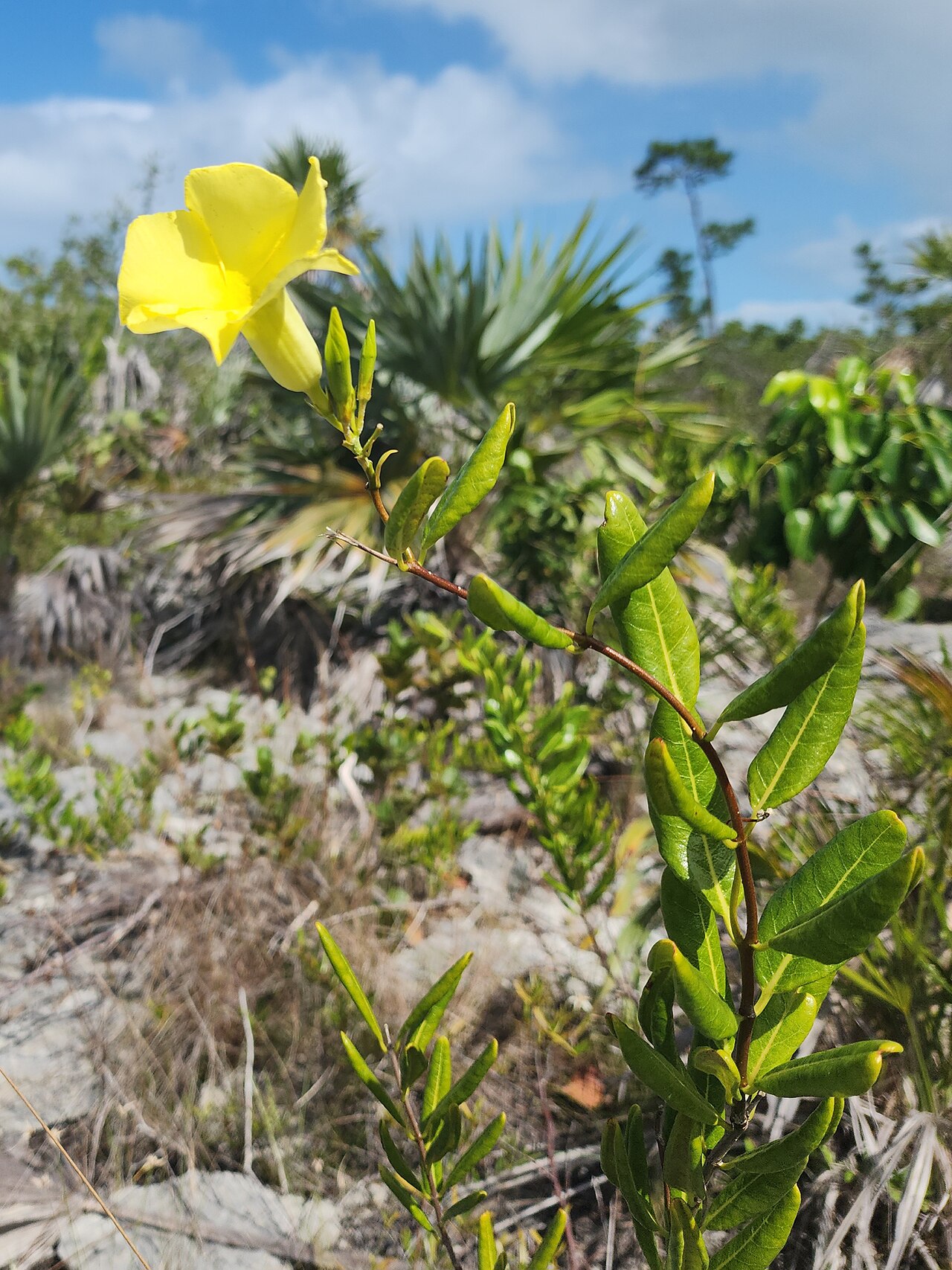
Pentalinon luteum, known as Wild Allamanda or hammock viper’s-tail, is a twining evergreen vine of south Florida pine rocklands, hammock edges and coastal thickets. It carries bright yellow trumpet flowers two inches or more across against glossy dark leaves, and in frost-free areas it can be found flowering in almost any month. Older books list it as Urechites lutea or Urechites luteus, and it is sometimes sold as yellow mandevilla.
It belongs to the dogbane family, Apocynaceae, and it behaves like it. Every part of the plant is full of thick white latex that oozes from any cut. The latex is toxic and irritating: it can raise a rash on sensitive skin, it is painful and potentially damaging in the eyes, and the plant should not be eaten by people or pets. Wear gloves when you prune it and wash afterwards. This is not a reason to avoid the plant, only to handle it sensibly, and it is why deer and rabbits leave it alone.
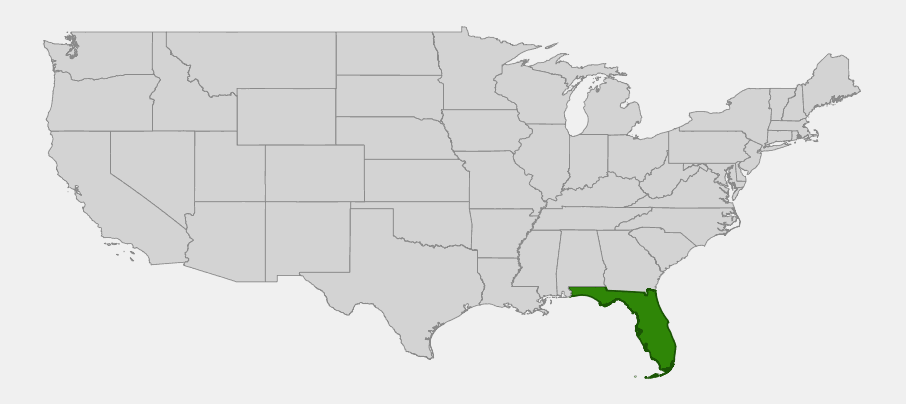
In the United States it grows only in south Florida, plus Puerto Rico and the U.S. Virgin Islands. It is one of the best native flowering vines available for a south Florida garden: heat-proof, drought-proof, salt-tolerant, evergreen, and in bloom for much of the year on a fence, arbor or hedge.
Identification
A yellow-flowered twining vine in south Florida is usually one of three things: this native, the common exotic allamanda, or a mandevilla. The leaf arrangement settles it quickly.
Habit & Stems
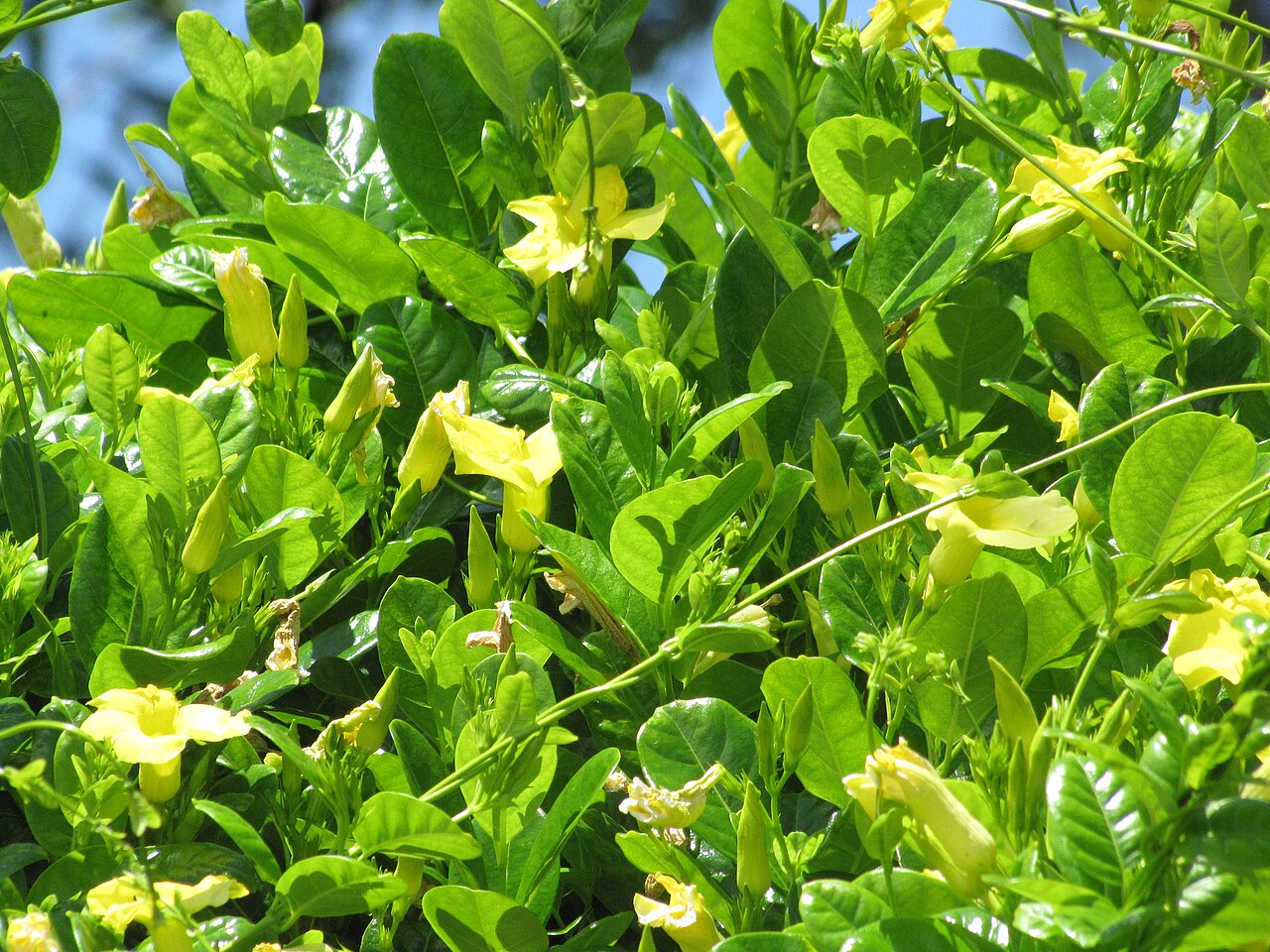
Wild allamanda is a woody, twining, evergreen vine. Given support it climbs 10 to 15 feet, and without support it sprawls into a mounded shrubby tangle 3 to 6 feet high, which is how it usually grows in open pine rockland. The stems are slender, green when young and tan to brown and somewhat woody with age, and they twine rather than cling, so they need wires, lattice or branches to climb. Cut any stem and thick white latex flows immediately. Growth is vigorous in warm weather and essentially stops in cool weather.
Leaves
Leaves are opposite, in pairs along the stem, which is the quickest way to separate it from exotic allamanda (Allamanda cathartica), whose leaves are arranged in whorls of three or four. Each leaf is oval to oblong, 1½ to 3 inches long, thick and leathery, dark glossy green above and paler below, with a rounded or shallowly notched tip that often ends in a tiny abrupt point. The margins are smooth and usually rolled slightly under. The foliage is evergreen and holds up well in full sun and salt wind.
Flowers
Flowers come in few-flowered clusters from the leaf axils. Each is a bright clear yellow trumpet about 2 to 2½ inches across, with a slender tube flaring into five broad lobes that overlap one another in a pinwheel, the way the flowers of the dogbane family typically do. Buds are twisted. The throat is slightly deeper yellow and the flowers have little scent. The main bloom season runs from spring into fall, with flowers appearing year-round in the warmest parts of the Keys and south Florida.
Fruit & Seeds
The fruit is a pair of slender, cylindrical, pointed follicles 4 to 6 inches long, joined at the base and spreading apart like a forked tail, which is where the name viper’s-tail comes from. They ripen from green to brown and split along one side. Inside are many flattened seeds, each with a tuft of silky hairs that carries it away on the wind, much like a milkweed seed. Fruit is often present on the same plant as open flowers.
Quick Facts
| Scientific Name | Pentalinon luteum (syn. Urechites lutea, Urechites luteus) |
| Family | Apocynaceae (dogbane family) |
| Plant Type | Evergreen woody twining vine; sprawling shrub without support |
| Mature Height | 10–15 ft climbing; 3–6 ft as a free-standing mound |
| Mature Spread | 6–12 ft |
| Growth Rate | Moderate to fast in warm weather |
| Sun Exposure | Full sun to part shade; best flowering in full sun |
| Water Needs | Low once established; drought tolerant |
| Soil Type | Sand, limestone, marl and shell; must drain freely |
| Soil pH | Slightly acid to strongly alkaline, about 6.0–8.5 |
| Bloom Time | Spring through fall; year-round in the Keys and south Florida |
| Flower Color | Bright yellow |
| Fall Color | None; evergreen |
| Fruit | Paired slender follicles 4–6 in long with silky wind-borne seeds |
| Deer Resistant | Yes; the toxic latex deters browsing |
| USDA Hardiness Zones | 10–11; damaged by frost in zone 9 |
Native Range
USDA PLANTS lists wild allamanda as native in the lower 48 states, Puerto Rico and the U.S. Virgin Islands, and its only mainland occurrence is Florida. The Atlas of Florida Plants maps it through the southern peninsula and the Keys, in counties from roughly Lee, Collier, Palm Beach and Martin south through Miami-Dade and Monroe. Beyond the United States it grows in the Bahamas, Cuba, Hispaniola, Jamaica, the Lesser Antilles and parts of coastal Mexico and Central America.
Its habitats are the dry, bright, limestone-based communities of extreme south Florida: pine rockland, the edges and openings of tropical hardwood hammocks, coastal strand and back-dune thickets, and the margins of rockland hammocks in the Keys. It tolerates salt wind and poor, rocky, alkaline soils, and it is unusually comfortable rooting directly into weathered limestone. It does not grow in wet ground.
Pine rockland is one of the most reduced habitats in the United States, with only a small fraction of its historic Miami-Dade extent remaining outside Everglades National Park and Big Pine Key, and wild allamanda is one of the species that depends on it staying open. The plant itself is not state-listed, but the community it lives in is fire-maintained and shrinking. Planting it in south Florida gardens is a small, direct way to keep the species common.
📋 Regional plant lists featuring Wild Allamanda: North & South Florida
Growing & Care Guide
Wild allamanda is one of the easier native vines for south Florida, with two caveats: it needs frost-free conditions and fast drainage, and the milky sap means you should wear gloves when you prune it.
Light
Full sun gives the heaviest flowering and the densest growth. It also does well in part shade at a hammock edge, where it climbs toward light and flowers more sparsely. In deep shade it survives but barely blooms.
Soil & Water
Any freely draining soil suits it, including the limestone, marl, shell and sand of south Florida. It is not fussy about fertility and does not need rich ground. What it will not take is wet feet; soggy soil kills it. Water new plants weekly for the first two or three months, then taper off. Established vines get by on rainfall and shrug off the dry season. A light application of a balanced slow-release fertilizer once in spring is plenty if you want faster cover; more than that produces leaves at the expense of flowers.
Planting Tips
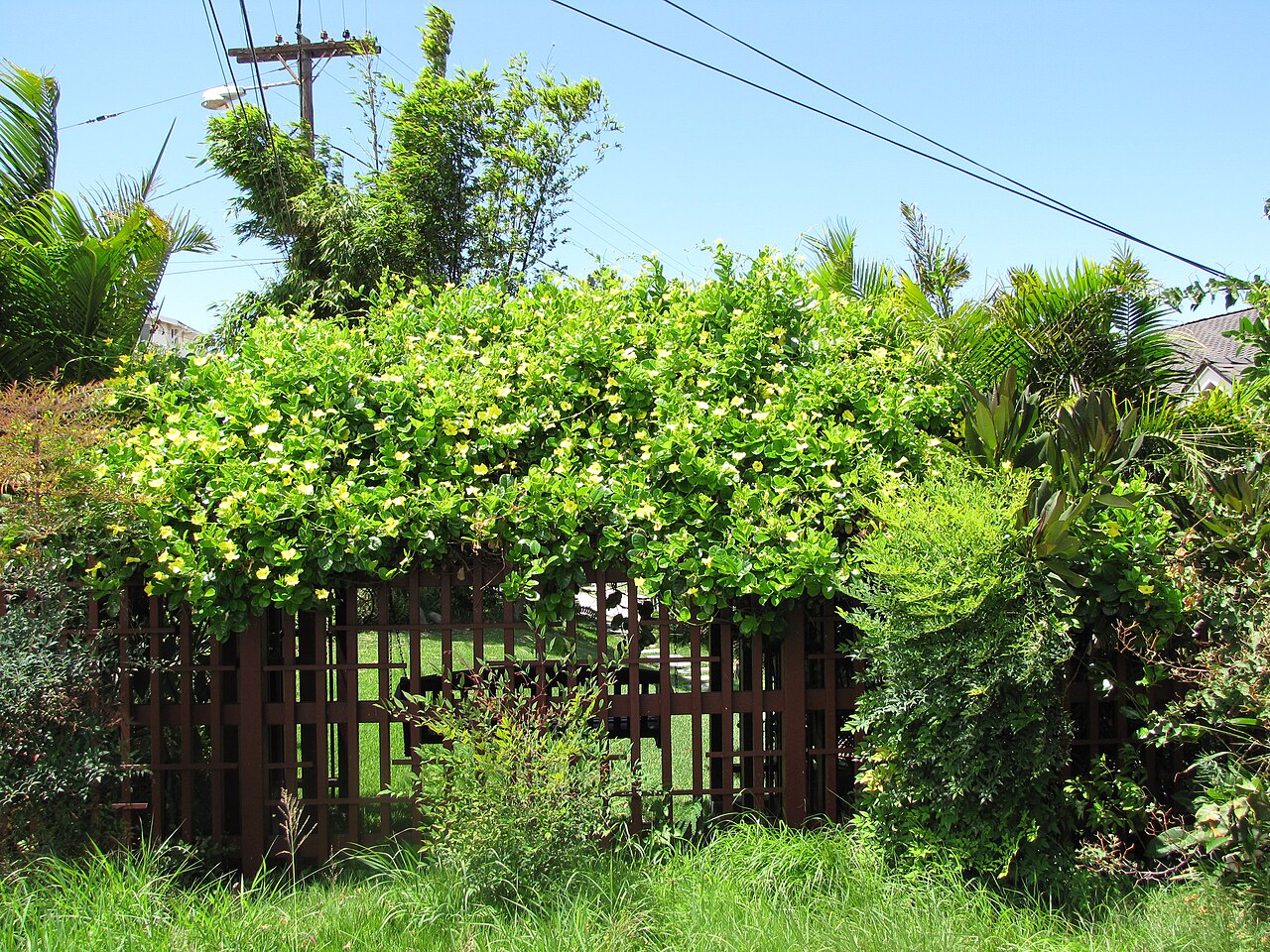
Plant from containers any time in frost-free areas, preferably at the start of the rainy season. Give it something to twine on: a trellis, arbor, chain-link fence, wires on a wall, or an open shrub. It does not cling to flat surfaces. Set it at least 3 feet from a path or seating area so people are not pushing through the sap-bearing stems. In zone 9 and colder, grow it in a large container and move it under cover for freezes, or treat it as a plant that will be knocked back and resprout.
Pruning & Maintenance
Prune in late winter before the main flush of growth, cutting back wayward stems and thinning the tangle. It flowers on new growth, so pruning improves bloom. Wear gloves and long sleeves and keep the sap off your skin and well away from your eyes; wash tools and hands afterwards. Pinch tips on young plants to encourage branching. Remove the long seed pods if you do not want seedlings, though it is not an aggressive self-sower.
Propagation
Seed is easy when fresh: collect pods before they split, separate the tufted seeds, and sow in a warm, bright place in a free-draining mix. Germination is usually good within a few weeks. Semi-hardwood cuttings taken in warm weather root under mist, though rooting is slower than for many vines and dipping cut ends in water briefly to stop the latex flow helps. Wear gloves for both. South Florida native nurseries carry it regularly.
Landscape Uses
- Trellises, arbors and fences: an evergreen native vine that flowers yellow for most of the year in frost-free gardens
- Butterfly and pollinator gardens: a dependable nectar source in bloom when little else is
- Pine rockland and hammock-edge restoration: a natural component of south Florida’s rockland communities
- Coastal landscapes: tolerates salt wind, limestone soils and drought behind the first dune
- Containers and large pots: manageable on a patio trellis, and portable in areas that get occasional frost
Wildlife & Ecological Value
Wild allamanda is a nectar plant rather than a food plant, and the toxic latex that keeps browsers off also keeps most insect herbivores away.
For Pollinators
The deep yellow trumpets are worked by butterflies, including sulphurs, swallowtails and hairstreaks, and by large bees that are strong enough to force into the tube. Because the vine flowers over such a long season, it provides nectar through the slow months when few other south Florida natives are blooming. The flowers are not fragrant and are visited mostly in full sun during the warmest part of the day.
For Birds
Birds do not eat the dry, wind-dispersed seeds, and the plant offers no fruit. The value is in structure: dense evergreen vine growth on a fence or in a thicket gives small birds cover and nesting sites, and the insects that visit the flowers are foraged by gnatcatchers, vireos and warblers.
For Mammals
The latex makes the plant unpalatable and mildly toxic, so deer, rabbits and rodents avoid it. That reliability is one of the practical reasons to plant it in areas with heavy deer pressure, including parts of the Keys.
Ecosystem Role
In pine rockland and at hammock edges, wild allamanda is part of the sprawling shrub and vine layer that fills openings between pines and palmettos. It resprouts after the low-intensity fires that maintain pine rockland, and its wind-borne seed lets it colonize new openings quickly. Within its communities it is a reliable dry-season nectar source, which matters disproportionately in a habitat with a long rainless period.
Cultural & Historical Uses
The plant has moved through several names. It was long known as Urechites lutea (or Urechites luteus), and that is the name in most older Florida floras and many garden references. Current treatments place it in Pentalinon, a small Caribbean genus of two species, where the name is Pentalinon luteum. The common name hammock viper’s-tail refers to the long paired seed pods that spread apart like a forked tail.
Wild allamanda is constantly confused with the exotic it is named after. Allamanda cathartica, yellow allamanda, is a South American shrub or scrambling vine widely planted in Florida; it has larger flowers and leaves in whorls of three or four, and it is a declared pest plant in some tropical regions. The native has paired, opposite leaves and smaller flowers. Nurseries also sell wild allamanda as “yellow mandevilla,” which adds a third layer of confusion, since true Mandevilla species are different plants in the same family.
The latex has a record of folk medicinal use in the Caribbean, as do many Apocynaceae, and the family is the source of several important and dangerous cardiac glycosides. None of that makes the plant safe to experiment with; the usual advice from Florida poison control resources for dogbane-family ornamentals is to keep them away from children and pets and to treat any sap contact seriously. Grow it for the flowers, handle it with gloves, and leave the chemistry alone.
Frequently Asked Questions
Is wild allamanda poisonous?
Yes, treat it as toxic. Like most of the dogbane family it carries milky latex in every part. The sap irritates skin, is painful and potentially harmful in the eyes, and the plant should not be ingested by people or pets. Wear gloves and long sleeves when pruning, wash afterwards, and site it away from where children play.
How do I tell it from the exotic allamanda?
Count the leaves at each node. Native wild allamanda (Pentalinon luteum) has leaves in opposite pairs. Exotic yellow allamanda (Allamanda cathartica) has leaves in whorls of three or four and larger flowers. The native also has distinctive paired seed pods 4 to 6 inches long.
Is Urechites lutea the same plant?
Yes. Urechites lutea and Urechites luteus are older names for Pentalinon luteum, and they still appear on nursery tags and in older Florida books. It is also sold occasionally as yellow mandevilla, which is a different genus.
How cold hardy is wild allamanda?
It is a zone 10 to 11 plant. Light frost burns the foliage and a hard freeze can kill it to the ground or outright. In zone 9 it is best grown in a container that can be moved under cover, or accepted as a plant that will be cut back by cold and resprout in spring.
Does it need a trellis?
To climb, yes. It twines rather than clinging, so it needs wires, lattice, a fence or an open shrub to wind around; it will not attach to a smooth wall. Without support it makes a sprawling, mounded shrub 3 to 6 feet high, which is how it grows naturally in pine rockland and is a perfectly good way to use it.

Looking for a nursery that carries Wild Allamanda?
Browse our native plant nursery directory: Florida