
Beach Morning-Glory (Ipomoea imperati)
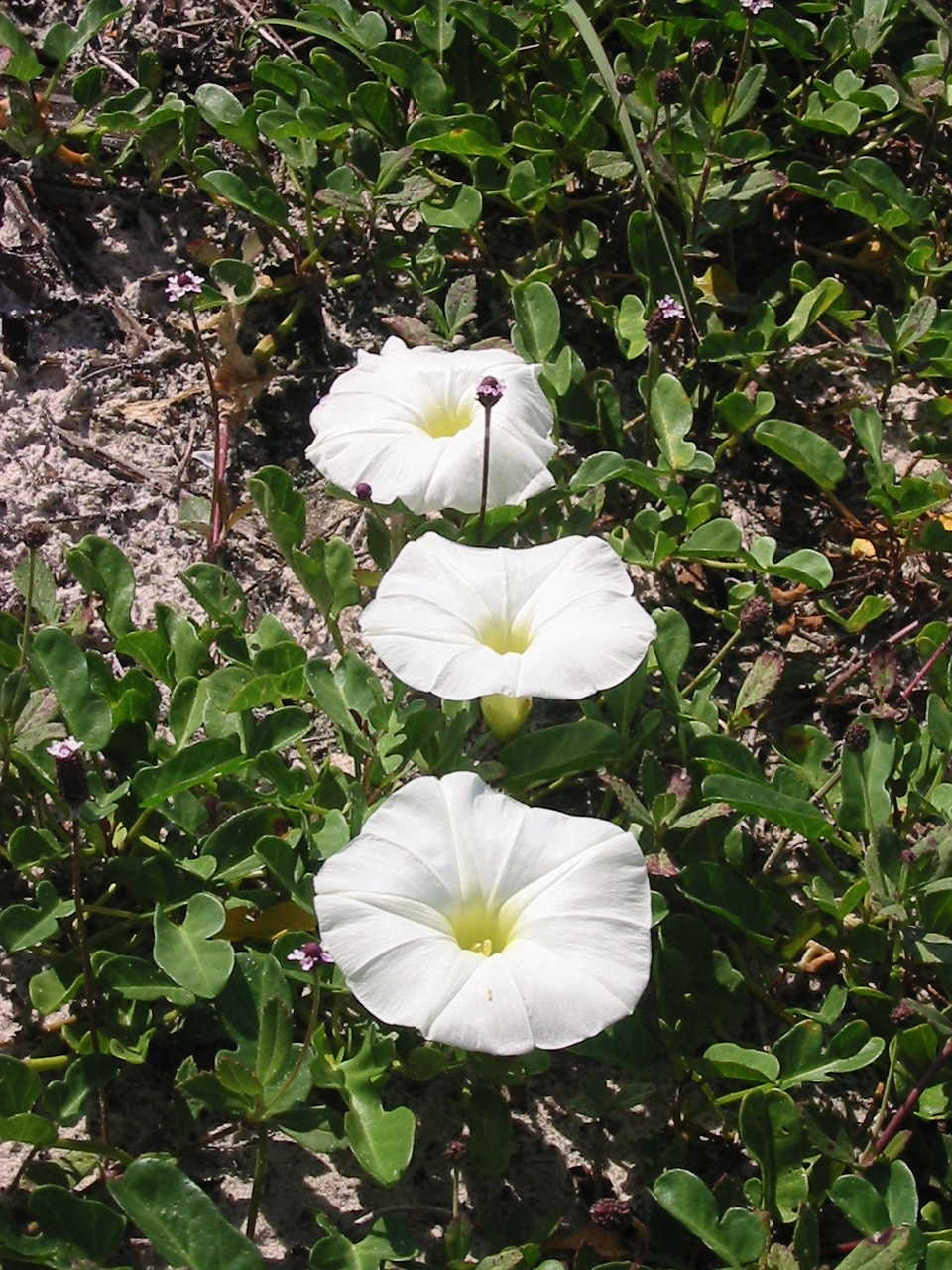
Ipomoea imperati, Beach Morning-Glory or fiddleleaf morning-glory, is a low, trailing vine of open beach sand with white funnel-shaped flowers and a yellow throat. It runs flat across the dune rather than climbing, roots as it goes, and is one of the earliest plants to recolonize a beach after a storm. Its older name, Ipomoea stolonifera, still appears in many field guides.
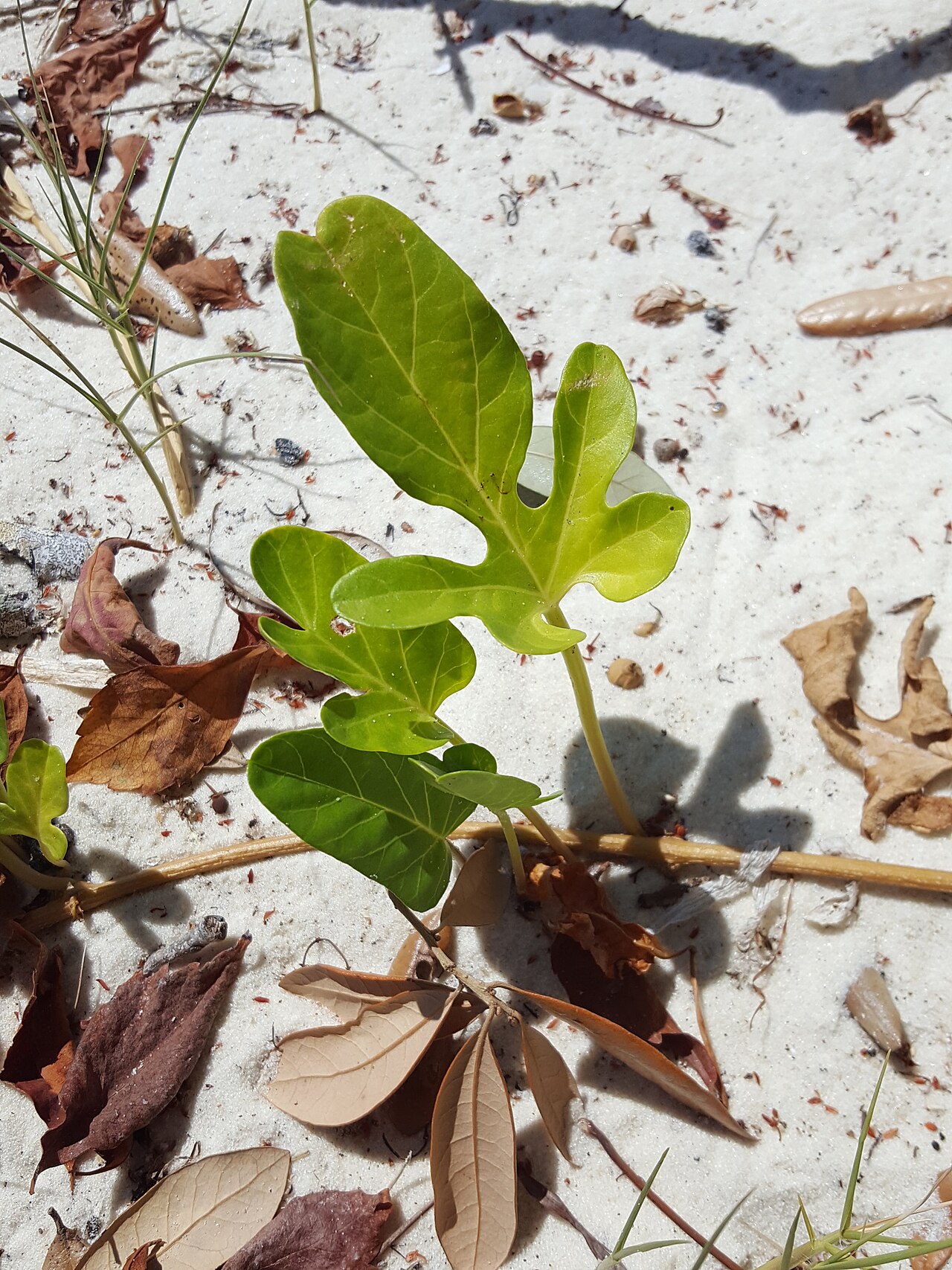
Florida has two common beach morning-glories, and they are easy to tell apart once you know what to look for. This one has white flowers and leaves that vary from oblong to deeply three- or five-lobed. Its larger relative, Railroad Vine (Ipomoea pes-caprae), which confusingly shares the name beach morning-glory, has pink to magenta flowers and thick leaves notched at the tip like a goat’s hoof, never lobed. They often grow side by side on the same dune.
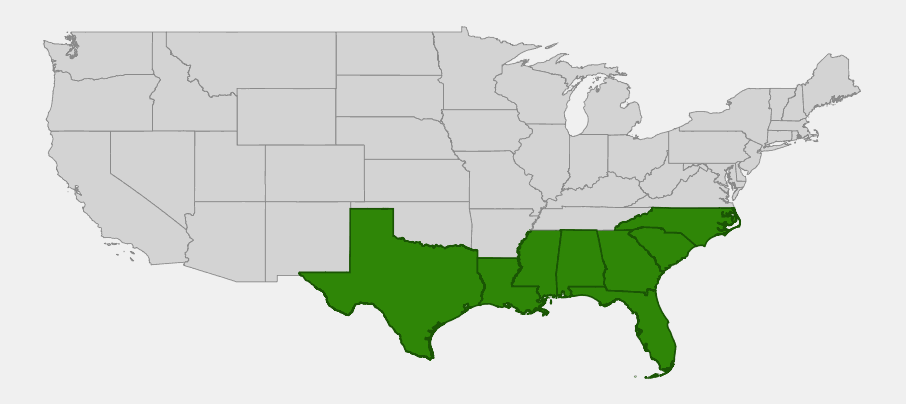
Beach morning-glory is native along the Gulf and south Atlantic coasts from Texas to North Carolina, and in Puerto Rico and the U.S. Virgin Islands. In Hawaii it is introduced rather than native. Where it grows, it is a serious dune builder: the running stems trap sand, the deep roots hold it, and a healthy mat can rebuild a blown-out dune face in a couple of seasons.
Identification
Look at the flower color first, then at the leaves. White flower and variable, often lobed leaves means Ipomoea imperati. Pink or magenta flower and a notched, two-lobed leaf means railroad vine.
Habit & Stems
This is a perennial trailing vine with slender, smooth, often reddish stems that run flat along the sand, rarely more than an inch or two above it, and root at the nodes. Individual runners reach 3 to 10 feet and sometimes more, and a colony is usually a connected patch of runners rather than a single plant. It does not climb and has no tendrils. Stems and leaves are partly buried by drifting sand and simply grow up through it. Below ground the roots are thick, fleshy and surprisingly deep, which is how the plant survives drought and storm scour.
Leaves
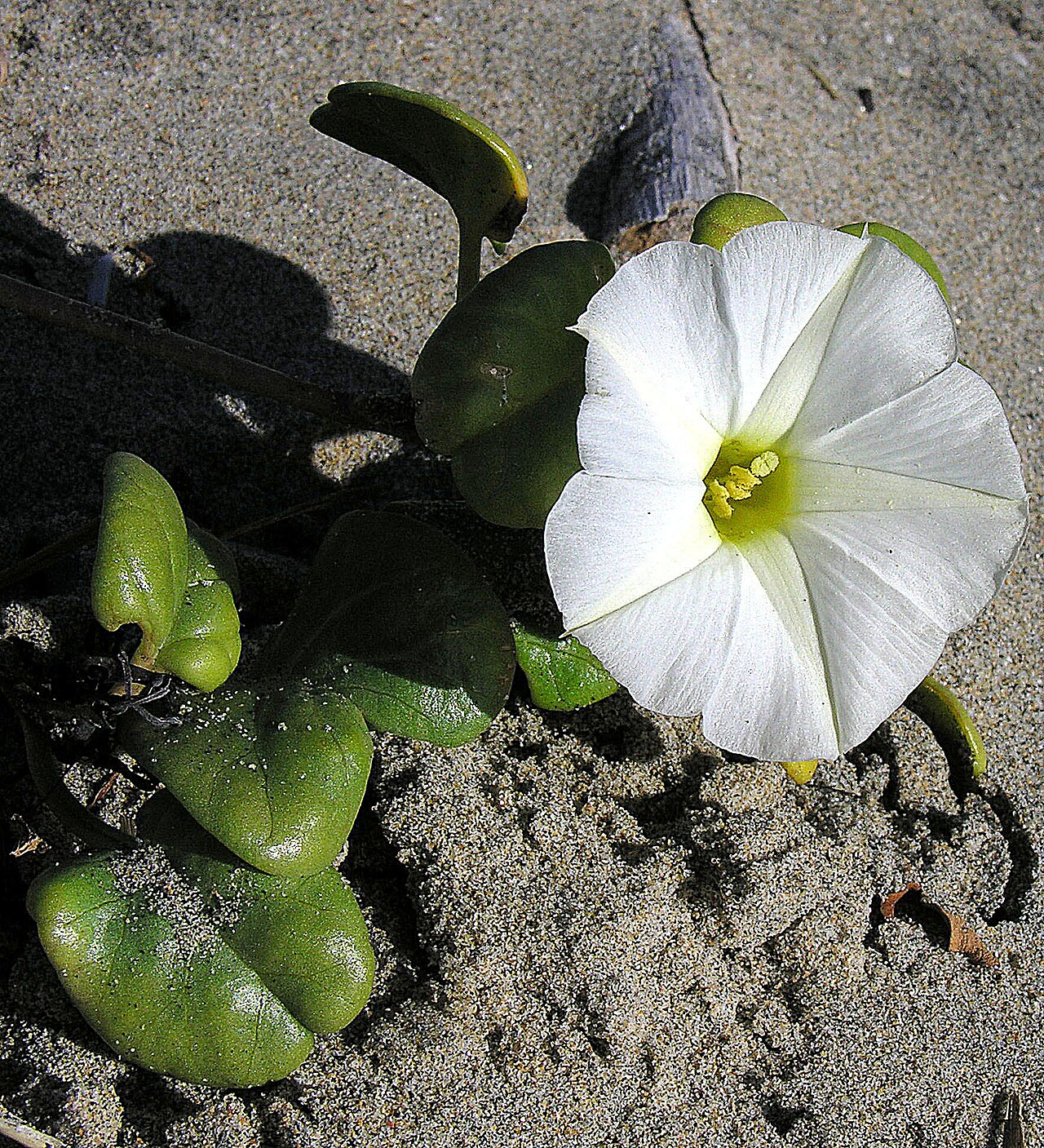
Leaf shape is the fun part: on one plant you may find plain oblong leaves, leaves slightly pinched in the middle like a fiddle, and leaves cut into three or five narrow lobes. They are alternate, 1 to 2½ inches long, thick and somewhat fleshy, dark green and glossy, with a short stalk and a rounded or slightly notched tip. The fiddle-shaped and lobed forms are the source of the alternative common name fiddleleaf morning-glory. Leaves on sun-baked open sand tend to be smaller and more deeply lobed.
Flowers
Flowers are borne singly on short stalks from the leaf axils. Each is a white funnel about 1½ to 2½ inches across and long, with a pale yellow or greenish-yellow throat and five faint pleats running up the outside. They open early in the morning and usually close by midday or early afternoon, and each flower lasts only one day. The main flush in Florida and along the Gulf is late summer into fall, though flowers can appear from spring onward in the subtropics.
Fruit & Seeds
The fruit is a rounded dry capsule about half an inch across, splitting into four parts and holding up to four seeds. The seeds are dark brown to black, angular, and covered in short dense hairs along the edges. They float and tolerate salt water, so ocean drift is one of the ways the species spreads along a coast. Most local expansion, though, is simply by runners rooting at the nodes.
Quick Facts
| Scientific Name | Ipomoea imperati (syn. Ipomoea stolonifera) |
| Family | Convolvulaceae (morning-glory family) |
| Plant Type | Perennial trailing vine; herbaceous, mat-forming |
| Mature Height | 2–4 in; it runs flat and does not climb |
| Mature Spread | Runners 3–10 ft or more; forms spreading colonies |
| Growth Rate | Fast |
| Sun Exposure | Full sun |
| Water Needs | Very low once established; highly drought tolerant |
| Soil Type | Loose beach sand and shell; requires sharp drainage |
| Soil pH | Neutral to alkaline, about 6.5–8.5 |
| Bloom Time | Mainly late summer into fall; spring onward in south Florida |
| Flower Color | White with a pale yellow throat |
| Fall Color | None; stems and leaves die back after hard frost and resprout from the roots |
| Fruit | Rounded capsule splitting into four, with up to four hairy-edged seeds |
| Deer Resistant | Moderately; rarely a target on open dunes |
| USDA Hardiness Zones | 8–11 |
Native Range
USDA PLANTS lists beach morning-glory as native in the lower 48 states, Puerto Rico and the U.S. Virgin Islands, and introduced in Hawaii. On the mainland it is restricted to the immediate coast: Texas, Louisiana, Mississippi, Alabama, Florida, Georgia, South Carolina and North Carolina. USDA also carries an outlying Pennsylvania record, far from any dune habitat and presumed adventive rather than part of the natural range. Worldwide the species occurs on warm beaches in the Americas, Africa, the Mediterranean and the Pacific.
In Florida it grows on both coasts, from the Panhandle around to the Atlantic shore and south through the Keys. It is a plant of the open beach berm and the seaward face of the foredune, the harshest terrestrial habitat on the coast: full sun, no shade, shifting sand, salt spray, and periodic burial or scouring by storms. It also occurs on the landward side of dunes and in interdune swales where sand is still bare and mobile.
The plant’s standing depends almost entirely on how the beach is managed. Raking, driving and heavy foot traffic break the runners; seawalls and development remove the habitat; beach renourishment buries it, though it often recovers because of its deep roots and seawater-dispersed seed. Where the dune is left alone, beach morning-glory is typically one of the first and most abundant plants to return after a hurricane.
📋 Regional plant lists featuring Beach Morning-Glory: North & South Florida · Alabama, Georgia & Mississippi · North & South Carolina · Arkansas, Louisiana, Eastern Oklahoma & Eastern Texas · South & West Texas
Growing & Care Guide
This is a dune plant, not a garden plant, and it is almost always used in restoration rather than ornamental planting. Where the conditions are right it needs nothing at all; where they are wrong it will not persist no matter what you do.
Light
Full sun, with no shade at all. Beach morning-glory grows in the most exposed position on the coast. In shade or even partial shade it thins out and disappears.
Soil & Water
Loose, deep, fast-draining beach sand, ideally with some shell. It does not want organic matter, mulch or fertilizer, and it will not tolerate soil that stays wet. Water new plantings for the first few weeks to get roots down, then stop; the deep fleshy roots reach moisture well below the dry surface sand, and established plants ride out months without rain. Irrigation and runoff encourage weedy competitors that the vine cannot outgrow.
Planting Tips
Plant rooted cuttings or container plants on the beach berm and the seaward dune face in spring or at the start of the rainy season, spaced 3 to 6 feet apart; the runners will close the gaps within a season or two. Plant it alongside sea oats and panic grass rather than on its own: the grasses build vertical dune height while the morning-glory binds the surface between them. Sand fencing helps new plantings establish. Keep foot traffic and vehicles off the planting, which is what usually determines whether it survives.
Pruning & Maintenance
None. Do not prune, mow, rake or tidy a beach morning-glory mat; the runners and rooted nodes are the whole point. After a storm, leave buried stems alone and let them grow up through the new sand. In north Florida and along the northern Gulf the top growth is killed by hard frost and resprouts from the roots in spring, so do not assume a brown winter mat is dead.
Propagation
Easiest from stem cuttings: take a length of runner with several nodes, lay it in moist sand so the nodes are in contact with the surface, and keep it damp until roots form, usually within a few weeks. Rooted sections can be lifted and transplanted. Seed germinates better after scarifying the hard coat, soaking overnight and sowing in warm sand. Several Gulf and Atlantic coast nurseries grow it as plugs for dune restoration contracts.
Landscape Uses
- Dune restoration: a primary sand binder planted with sea oats on rebuilt and storm-damaged dunes
- Erosion control: runners rooting at the nodes knit the loose sand surface together
- Coastal native landscaping: a flat, flowering groundcover for unirrigated beachfront sand where nothing else will grow
- Pollinator plantings: a morning nectar source on an otherwise flowerless open beach
- Beach and park demonstration plantings: an easy, recognizable species for interpreting dune ecology to visitors
Wildlife & Ecological Value
On an open beach, almost every flower matters. Beach morning-glory is one of the few reliable nectar plants between the tide line and the dune crest, and the mat itself is habitat.
For Pollinators
The open funnels are visited in the morning by bees, including bumblebees, long-horned bees and specialist morning-glory bees in the genus Cemolobus and related groups, as well as by butterflies and skippers. The flowers close by early afternoon, so pollination is concentrated in the first hours of the day. Morning-glory foliage is also used by several sphinx moth caterpillars, which feed at night on the leaves.
For Birds
Beach morning-glory is not a significant bird food plant. The value is structural: the low mat shelters the beach insects that shorebirds and migrating songbirds forage on, and the vegetated dune surface helps hold nesting habitat for species such as least terns and Wilson’s plovers that nest on open sand above the tide line.
For Mammals
Browsing is light, mostly incidental nibbling by rabbits and occasionally deer on back-dune plants. Mammal traffic matters more as a disturbance than as grazing pressure: runners break easily under feet, hooves and tires.
Ecosystem Role
Beach morning-glory is a primary dune builder and stabilizer. Runners spreading over bare sand slow the wind at the surface, trap grains, and root into each new layer of deposited sand, so the plant climbs with the growing dune. Its deep fleshy roots anchor the sand column against erosion. It is also one of the first colonizers after a hurricane: runners buried intact, surviving root crowns and drifted seed let the species re-cover a scoured beach quickly, which in turn lets sea oats and other dune species re-establish behind it.
Cultural & Historical Uses
The species was named Ipomoea imperati by Martin Vahl in 1794, honoring Ferrante Imperato, a sixteenth-century Neapolitan apothecary and naturalist. For much of the twentieth century American botanists used the name Ipomoea stolonifera, for the obvious reason that the plant spreads by rooting runners, and that name still appears in older Florida and Gulf Coast floras. The genus name Ipomoea comes from the Greek for “worm-like,” referring to the twining or creeping habit of its members.
Confusion with railroad vine runs deep. Both species are called beach morning-glory along the Gulf, both trail over open dune sand, and both flower in the same season. The practical distinction is flower color and leaf shape: white flowers and variable, often lobed leaves in I. imperati; pink to magenta flowers and thick, goat-foot-notched, never-lobed leaves in I. pes-caprae. Railroad vine also runs much farther, with stems reaching 30 feet or more.
Dune plants like this one went from being mowed and raked as beach weeds to being written into coastal protection policy. Florida and the Gulf States now regulate dune vegetation and plant species like beach morning-glory in post-storm dune restoration, because a vegetated dune absorbs surge energy and loses far less sand than a bare one. The simplest contribution a beachgoer can make is to stay on marked crossovers and off the vegetated dune.
Frequently Asked Questions
What is the difference between beach morning-glory and railroad vine?
Flower color and leaf shape. Ipomoea imperati, beach morning-glory, has white flowers with a yellow throat and leaves that range from oblong to deeply three- or five-lobed. Railroad Vine (Ipomoea pes-caprae) has pink to magenta flowers and thick leaves notched at the tip like a goat’s hoof, never lobed, and its runners are far longer. Both are native and both are called beach morning-glory in some places.
Is Ipomoea imperati the same as Ipomoea stolonifera?
Yes. Ipomoea stolonifera is an older name for the same species and still turns up in field guides and older floras. Ipomoea imperati is the accepted name.
Why do the flowers close by lunchtime?
Each flower lasts a single day and is adapted to morning pollinators. The funnel opens around sunrise, is visited by bees and butterflies through the cool early hours, and wilts closed by midday or early afternoon. A plant with no open flowers in the afternoon can be covered in them the next morning.
Can I plant beach morning-glory in my yard?
Only if your yard is open, sunny, unirrigated beach sand. It needs full sun, sharp drainage and no competition, and it will not persist in ordinary landscape beds, shade or irrigated turf areas. Its proper use is on dunes and in coastal restoration plantings.
Is it legal to walk on dune plants?
In Florida and most Gulf and Atlantic coastal states, dune vegetation is protected and walking on it is prohibited outside marked crossovers. Broken runners and crushed crowns are a leading cause of dune blowouts. Use the boardwalk, and keep vehicles and pets off planted dunes.

Looking for a nursery that carries Beach Morning-Glory?
Browse our native plant nursery directory: Alabama · Florida & Georgia · Louisiana & Mississippi · North Carolina · South Carolina & Texas