
Seashore Paspalum (Paspalum vaginatum)
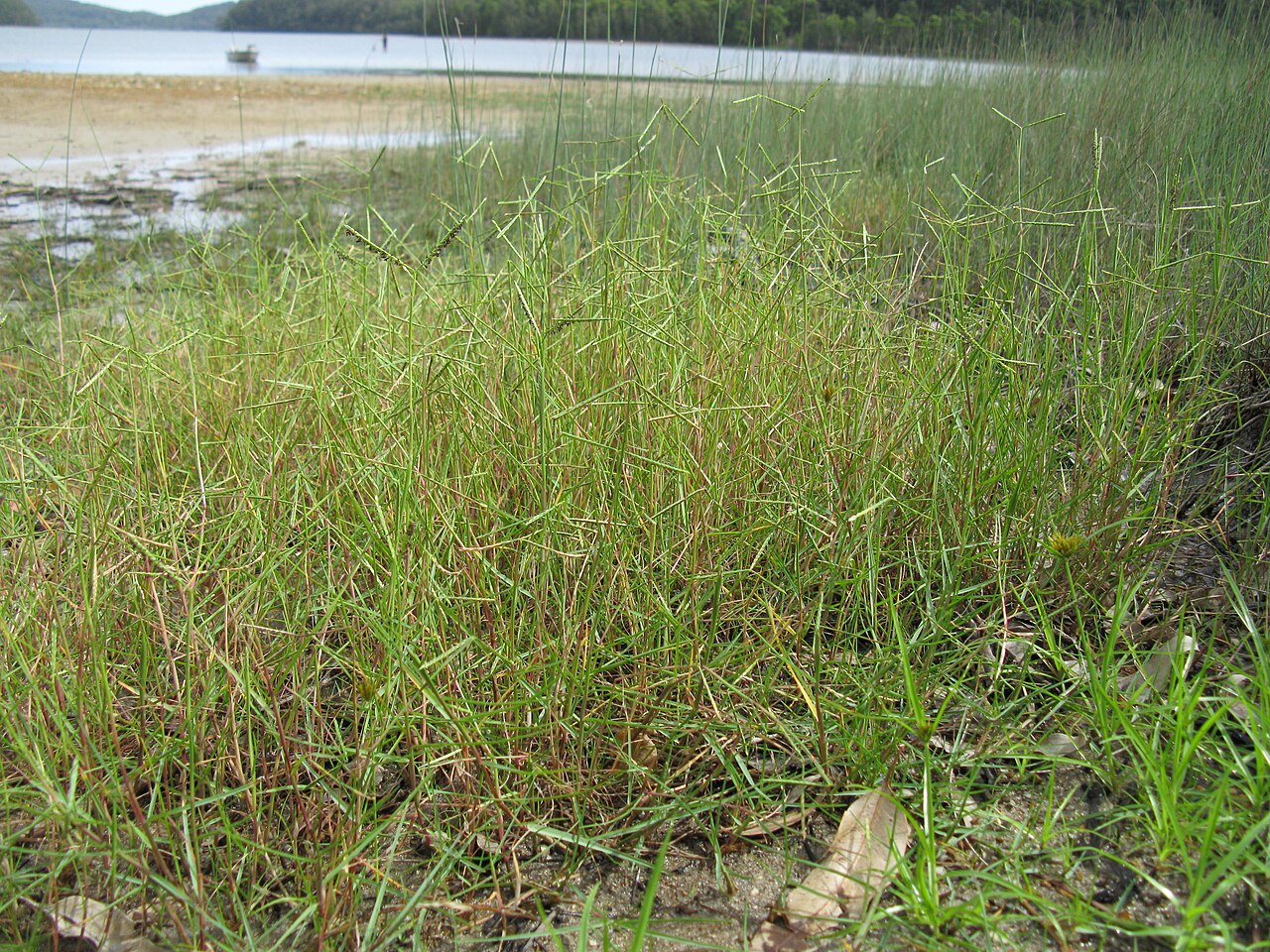
Seashore Paspalum (Paspalum vaginatum) is a low, creeping, warm-season grass of salt and brackish marshes, beaches and coastal flats. It is native to the tropical and warm-temperate Americas, including the southeastern United States from North Carolina to Texas, where it forms dense mats along tidal creeks, marsh edges and the backs of beaches. It belongs to the grass family (Poaceae).
Seashore paspalum spreads by both runners above ground (stolons) and rhizomes below, rooting at the nodes and knitting sand and mud into a tight turf. In summer and fall it sends up slender stems topped by a characteristic pair of flowering branches that spread in a narrow V. It is one of the most salt-tolerant grasses known, and plant breeders have turned it into a fine-textured turfgrass used on golf courses, sports fields and coastal lawns that can even be irrigated with brackish water.
Beyond its native range it has spread widely. USDA PLANTS lists it as introduced in Hawaii, and the California Invasive Plant Council describes rapidly expanding populations in southern California. Within the Southeast, though, it is a valuable native for stabilizing shorelines and for coastal lawns that do not need fertilizer or fresh water. This guide covers how to identify it, where it grows and how to use it.
Identification
In the wild, seashore paspalum is easiest to recognize in flower. The pair of short, spike-like branches at the top of each stem is distinctive, as is its habit of creeping across wet, salty sand and mud.
Growth Form
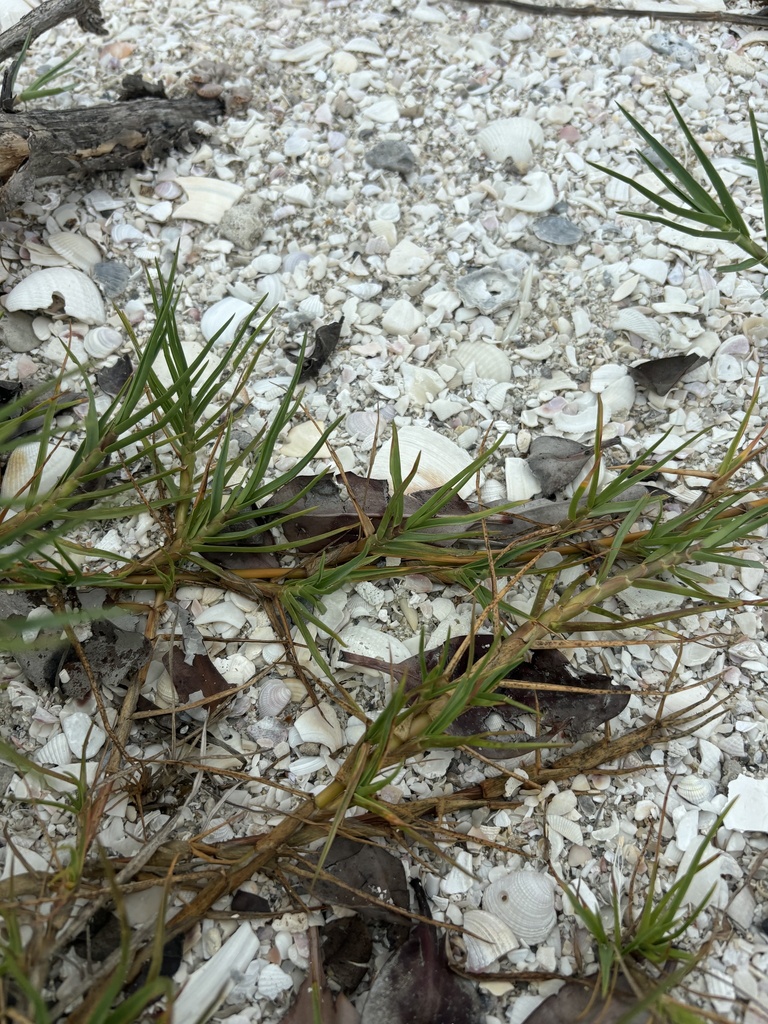
It is a perennial, mat-forming grass that spreads by long stolons and rhizomes, which can extend many feet and root at each node. Leafy shoots are usually only a few inches tall where mowed or trampled, and flowering stems reach about 4 inches to 2½ feet. Plants growing in standing water or tall marsh are taller and looser than those on open sand.
Leaves
The leaf blades are flat to slightly folded or rolled, up to about 7 inches long and 1/8 to 1/4 inch wide, smooth or with a few hairs near the base, and often bluish green. The leaf sheaths overlap closely along the stolons; the species name vaginatum, “sheathed,” refers to these prominent sheaths.
Flower Heads
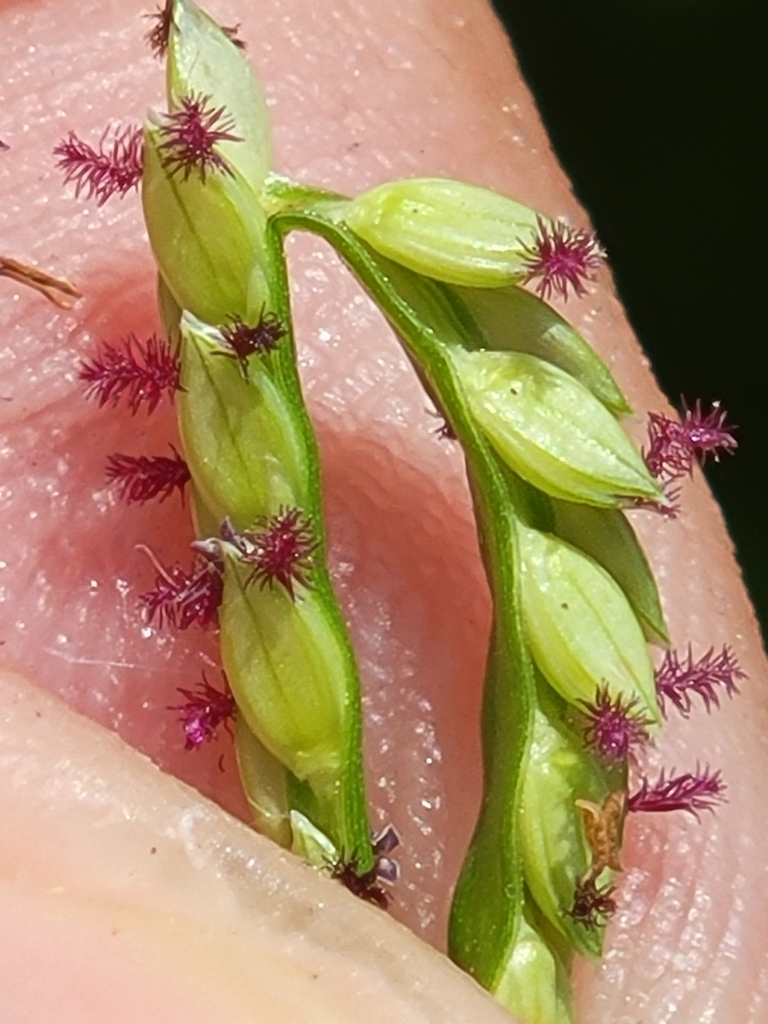
The inflorescence is usually a pair of erect to spreading branches (occasionally a third just below) at the top of the stem, each about 3/4 inch to 3 inches long. The small, flattened, smooth spikelets, about 1/8 inch long, are pressed in two rows along one side of each branch. At flowering, purple, feathery stigmas and yellow to purplish anthers dangle from the spikelets. The Lady Bird Johnson Wildflower Center gives a bloom season of August to December, and in Florida it can flower in most warm months.
Look-alikes
Knotgrass (Paspalum distichum) looks very similar and also has paired branches, but it typically grows in fresh water and its spikelets are slightly hairy rather than smooth. Bermudagrass (Cynodon dactylon), a non-native turfgrass, has three to seven finger-like branches instead of two. Seashore Dropseed shares the same habitats but has a narrow, spike-like panicle and stiff, two-ranked leaves.
Quick Facts
| Scientific Name | Paspalum vaginatum |
| Family | Poaceae (grass family) |
| Plant Type | Perennial warm-season, mat-forming grass |
| Mature Height | 4 in–2½ ft in flower; turf mowed to about 1 in |
| Mature Spread | Spreads indefinitely by stolons and rhizomes |
| Growth Rate | Fast |
| Sun Exposure | Full sun |
| Water Needs | Moderate to high; tolerates flooding and brackish water |
| Soil Type | Sand, mud, marl or clay; highly salt tolerant |
| Soil pH | About 4.0–9.0 |
| Bloom Time | Mainly summer to fall (August–December per the Wildflower Center) |
| Flower Color | Green spikelets with purple stigmas |
| Fall Color | Goes dormant and tan in cold winters |
| Fruit | Small grain (caryopsis); seed set is often low |
| Deer Resistant | No; grazed by wildlife and livestock |
| USDA Hardiness Zones | 8–11 |
Native Range
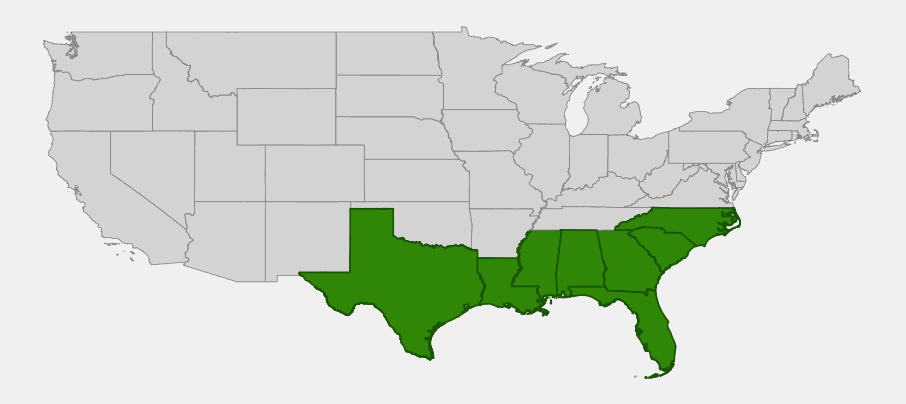
Seashore paspalum is native to the tropical and subtropical Americas. In the United States, USDA PLANTS lists it as native in the lower 48 states, Puerto Rico and the U.S. Virgin Islands, and as introduced in Hawaii. Its southeastern native range follows the coast from North Carolina through South Carolina, Georgia and Florida and west along the Gulf through Alabama, Mississippi and Louisiana to Texas. USDA also records it in California, where the California Invasive Plant Council treats it as introduced and spreading, so California is not shown as native range on the map.
In Florida it is found along both coasts, through the Keys and around inland waters with brackish influence. Typical habitats are the upper edges of salt and brackish marshes, tidal creek banks, the backs of beaches and overwash flats, mangrove edges, coastal ditches and the margins of brackish ponds. It is among the first plants to colonize bare, salty sand and mud.
Outside the Americas it has been introduced to warm coasts around the world, often deliberately for turf or erosion control, and in some places it has become weedy in wetlands and estuaries. Gardeners outside its native range, especially in California and Hawaii, should choose locally native grasses instead.
📋 Regional plant lists featuring Seashore Paspalum: North & South Florida · Alabama, Georgia & Mississippi · North & South Carolina · Arkansas, Louisiana, Eastern Oklahoma & Eastern Texas · South & West Texas
Growing & Care Guide
Seashore paspalum is sold mainly as named turf cultivars, by sod or sprigs, for salty coastal lawns, golf courses and athletic fields. Wild-type plants are also used in shoreline stabilization and marsh restoration in the Southeast. Either way it needs sun, moisture and warm weather, and it rewards those conditions with a dense, salt-proof cover.
Light
Full sun. It thins out in shade.
Soil & Water
It grows in almost any soil from sand to clay and tolerates a very wide pH range, salt spray, saline soils and periodic flooding. It is most vigorous where the soil stays moist, such as marsh edges, swales and irrigated lawns. Turf can be irrigated with brackish or recycled water, though quality is better with fresh water. In a natural planting, no fertilizer is needed.
Planting Tips
Plant plugs, sprigs or sod in late spring or early summer when soil is warm. For shoreline stabilization, set plugs about 12 inches apart in the zone just above normal high tide, where they will spread over bare sand and mud. For lawns, choose a cultivar suited to your use and buy sod or sprigs from a reputable supplier. Plant it only within its native range; on the Pacific coast and in Hawaii, use locally native alternatives.
Pruning & Maintenance
In natural areas it needs no maintenance. As a lawn it is usually mowed low, about 1/2 to 2 inches, and it tolerates foot traffic well. It can spread into adjacent beds and wetlands by stolons, so use edging where needed. In cold winters it goes dormant and turns tan, greening up again in spring.
Propagation
Most propagation is vegetative, by sod, sprigs or plugs, because many plants set little viable seed. Any piece of stolon with a node will root in moist soil. A few seeded turf cultivars are also available.
Landscape Uses
- Shoreline stabilization and living shorelines: binds sand and mud above the high tide line
- Salt-tolerant coastal lawns: a native turfgrass for salty, wet coastal yards within its native range
- Golf courses and sports turf: improved cultivars tolerate brackish irrigation and heavy use
- Marsh and dune restoration: early colonizer of bare, salty ground
- Brackish ditches and pond banks: holds banks where few other grasses persist
Wildlife & Ecological Value
Seashore paspalum is a modest-looking grass, but in coastal wetlands it is an important ground cover that holds sediment and feeds wildlife.
For Pollinators
Like most grasses it is wind-pollinated and offers little to pollinators, although small bees may collect its pollen.
For Birds
Dense mats shelter insects and small invertebrates that shorebirds and wading birds feed on, and seed-eating birds and waterfowl eat the seeds and tender shoots. Its open, low growth on marsh edges and flats provides foraging ground for many coastal birds.
For Mammals
It is grazed by livestock and by wild herbivores, and it has been used as forage on coastal pastures.
Ecosystem Role
As a pioneer of bare, salty sand and mud, it stabilizes sediments, slows erosion along tidal creeks and helps build the high marsh. Its tolerance of salt, flooding and even oil pollution has made it a candidate for restoring damaged coastal sites.
Cultural & Historical Uses
The Swedish botanist Olof Swartz described Paspalum vaginatum in 1788 from the West Indies. The genus name comes from an old Greek name for a kind of millet, and the species name refers to the prominent leaf sheaths. Common names around the world include biscuit grass, saltwater couch and silt grass.
In the late twentieth century, turfgrass breeders, notably at the University of Georgia, developed seashore paspalum into a range of fine-textured turf cultivars such as ‘Sea Isle 1’ and ‘SeaDwarf’. Its ability to tolerate salt spray and brackish irrigation made it popular on coastal golf courses around the world, and it is now used on sports fields, including Truist Park, the Atlanta Braves’ ballpark.
Its outstanding salt tolerance has also made it a subject of research on how plants cope with salinity, and its genome was sequenced in 2022. For gardeners on the Southeast coast, it offers a native option for lawns and shoreline plantings where conventional turf fails.
Frequently Asked Questions
Is seashore paspalum native?
Yes, in the southeastern United States, Puerto Rico and the U.S. Virgin Islands, according to USDA PLANTS. It is introduced in Hawaii, and the California Invasive Plant Council treats it as an expanding introduced grass in southern California.
Can seashore paspalum be watered with salt water?
It tolerates brackish and even seawater irrigation better than any other common turfgrass, though it looks best with fresh water. In the wild it grows where tides and storms regularly flood it with salt water.
How do I tell it from bermudagrass?
Look at the flower heads. Seashore paspalum usually has two branches forming a narrow V; bermudagrass has three to seven thin, finger-like branches radiating from the tip of the stem.
Is it a good lawn grass?
Within its native coastal range it can be an excellent salt-tolerant lawn, especially the improved cultivars. It needs full sun, warm weather and moisture, and it goes dormant in cold winters.
Will it spread into my garden beds?
It can. It spreads by stolons and rhizomes, so use edging along beds and avoid planting it next to natural wetlands outside its native range.

Looking for a nursery that carries Seashore Paspalum?
Browse our native plant nursery directory: Alabama · Florida & Georgia · Louisiana & Mississippi · North Carolina · South Carolina & Texas