
Saltwort (Batis maritima)
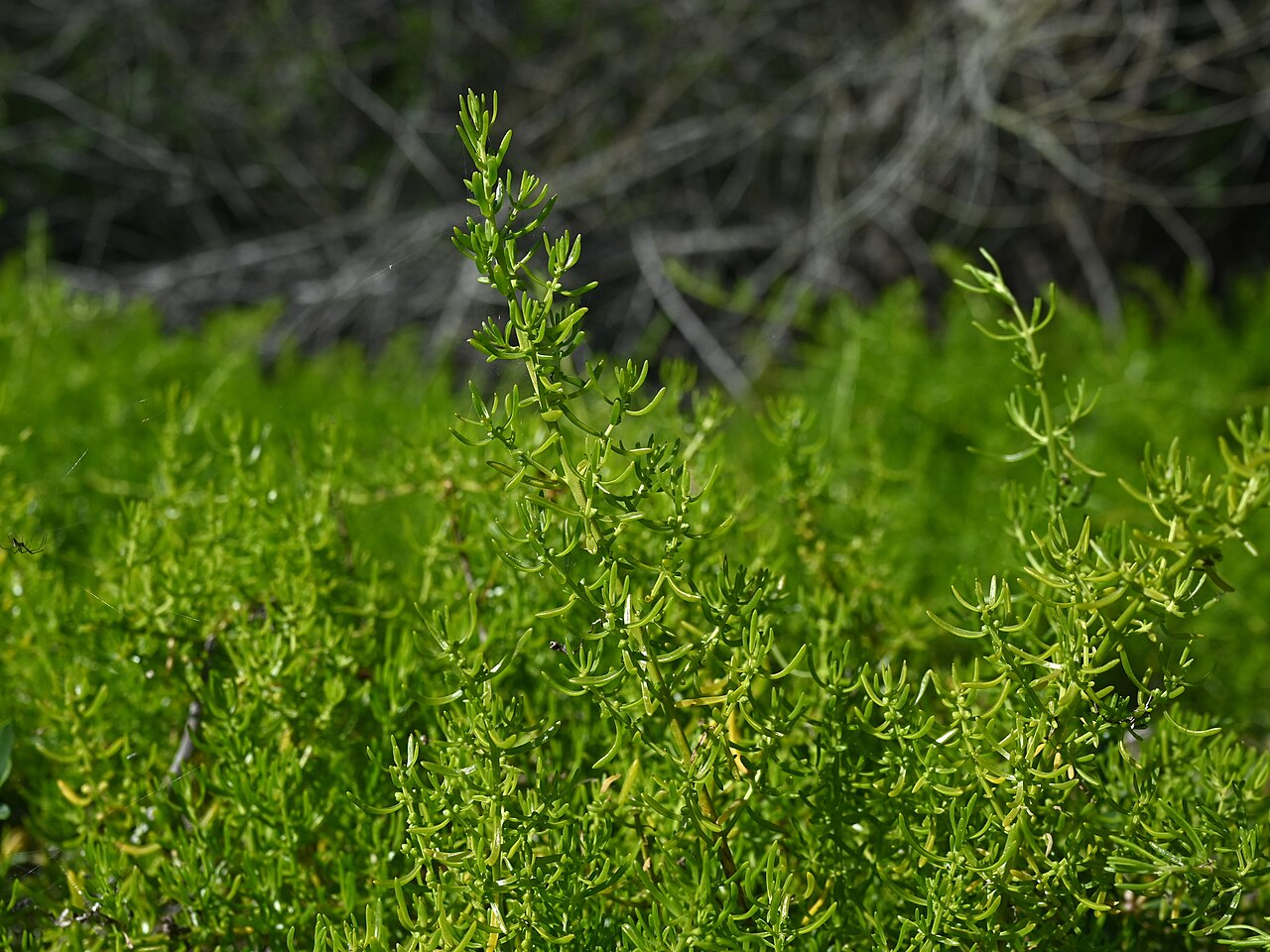
Batis maritima, known as Saltwort, turtleweed (the USDA PLANTS common name), beachwort or, loosely, pickleweed, is a low, succulent, evergreen shrub of tropical and subtropical salt marshes. Its sprawling stems carry pairs of bright yellow-green, fleshy, finger-like leaves that taste distinctly salty, and it often forms dense, knee-high mats on the edges of mangroves, salt flats and tidal marshes. It is one of the most salt-tolerant plants in North America.
Saltwort has an unusual family tree. It belongs to the Bataceae, a tiny family with just one genus and two species: this one, of the Americas, and Batis argillicola of northern Australia and New Guinea. Despite looking like the glassworts (Salicornia) that share its habitat and its nickname, it is not closely related to them. Its closest relatives are in the order that includes mustards and capers.
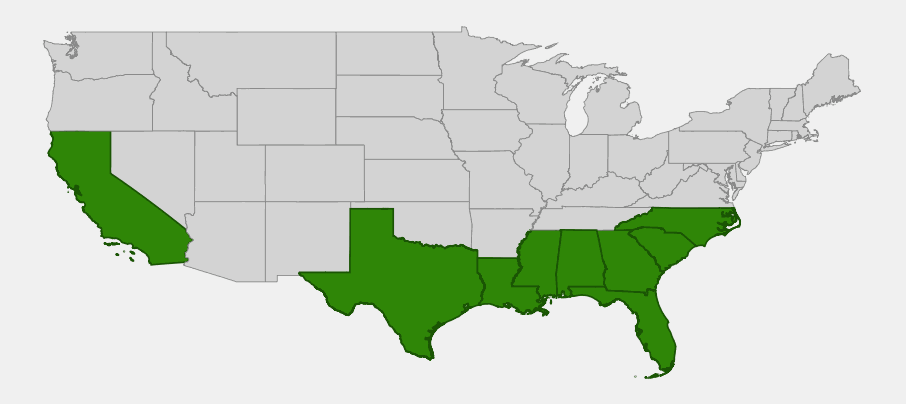
In the United States, saltwort grows along the Atlantic coast from the Carolinas to Florida, around the Gulf of Mexico to Texas, in a few salt marshes of southern California, and in Puerto Rico and the U.S. Virgin Islands. It is a valuable plant for coastal restoration, living shorelines and salt-tolerant landscaping, and its young shoots are edible. This guide covers how to recognize it, where it grows and how to use it.
Identification
Saltwort is easy to recognize once you know it: a sprawling, yellow-green succulent shrub of the high salt marsh with opposite, cylindrical leaves and woody, arching stems. It is often mixed with glassworts and sea oxeye.
Stems & Habit
Saltwort is a perennial subshrub, usually 1 to 3 feet tall and occasionally to about 5 feet. Its stems are woody at the base, pale tan to whitish and arching. Many stems lie along the ground and root where they touch moist soil, so a single plant can spread into a wide mat. Upright shoots are green and fleshy at the tips.
Leaves
The leaves are opposite, stalkless, succulent and almost cylindrical or slightly club-shaped, about ½ to 1 inch long. They are bright green to yellow-green and may turn yellowish or reddish in stressful conditions. They are filled with salty water and taste like pickles, which is the origin of the nickname pickleweed (also used for Salicornia).
Flowers
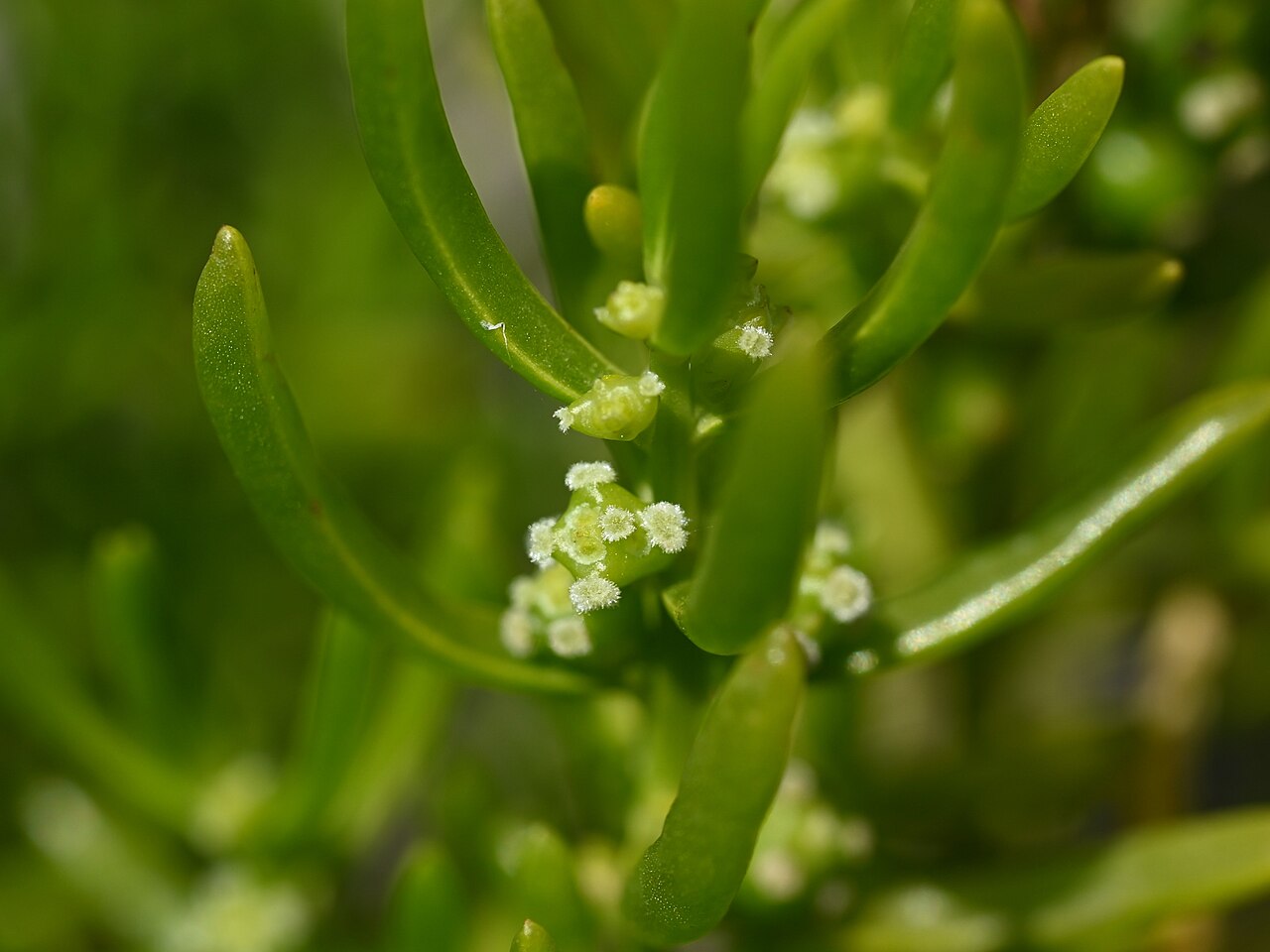
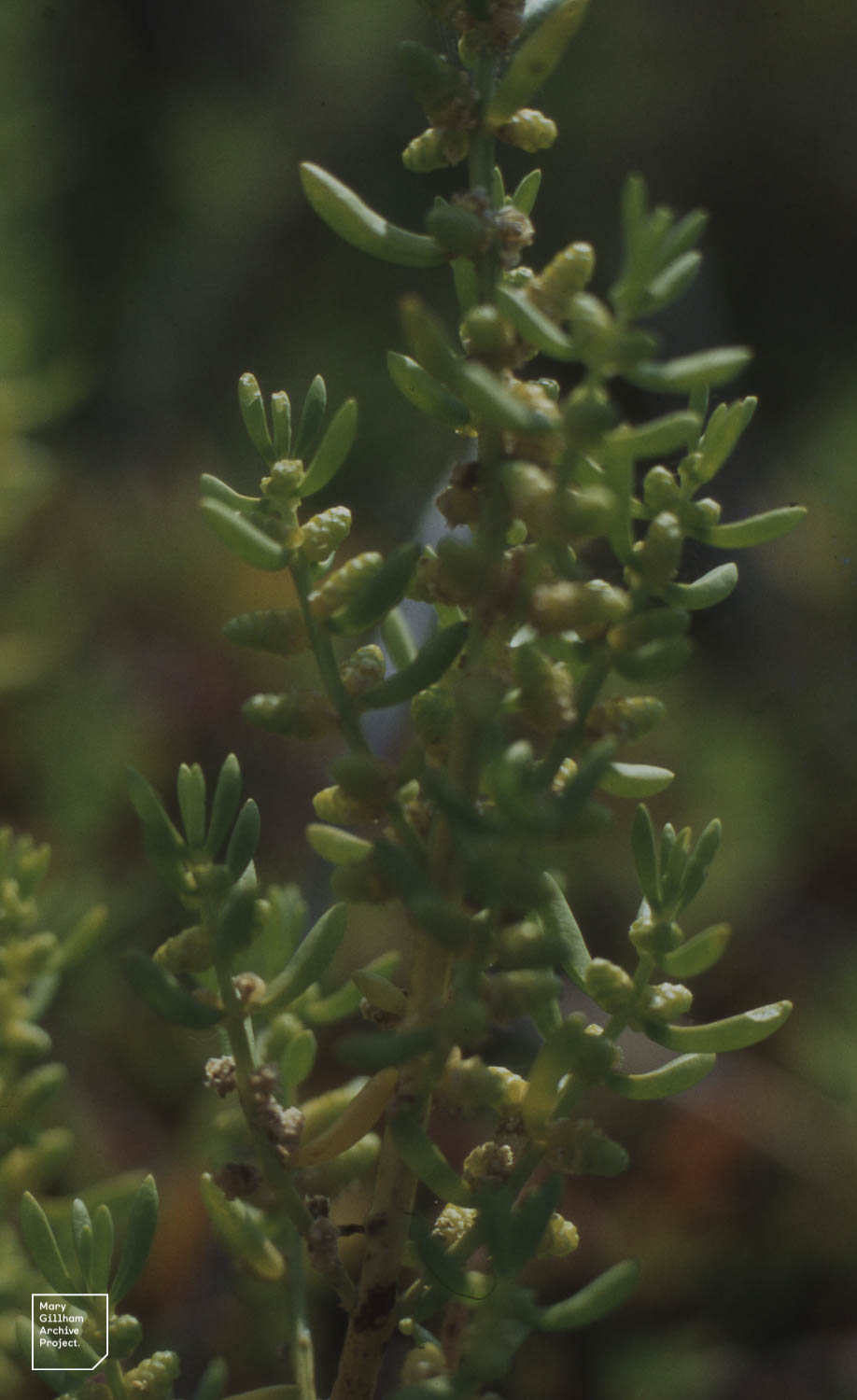
Saltwort is dioecious: male and female flowers are on separate plants. Both are tiny and gathered into short, cone-like spikes about ¼ to ½ inch long in the leaf axils. Male spikes have small white flowers with protruding stamens. Female spikes are greenish and fleshy. Flowering is mainly in summer in the northern part of the range and over much of the year in south Florida and the tropics. Pollen studies suggest that wind does much of the pollinating.
Fruit & Seeds
As the female flowers develop, the whole spike swells into a fleshy, greenish to yellowish multiple fruit about ½ inch long. Each contains several small, hard, dark seeds. The seeds can float in seawater for months and still germinate, which helps the species colonize new shorelines across the tropics.
Quick Facts
| Scientific Name | Batis maritima |
| Family | Bataceae (saltwort family) |
| Plant Type | Succulent evergreen subshrub; spreads by rooting stems |
| Mature Height | 1–3 ft (occasionally to about 5 ft) |
| Mature Spread | 3–6 ft or more; forms colonies |
| Growth Rate | Fast |
| Sun Exposure | Full sun |
| Water Needs | High; moist to wet, saline soil |
| Soil Type | Saline or brackish sand, mud, marl or clay; tolerates tidal flooding |
| Soil pH | About 6.5–8.5 |
| Bloom Time | Summer in the north; much of the year in south Florida |
| Flower Color | White (male), greenish (female); tiny |
| Fall Color | None; evergreen |
| Fruit | Fleshy greenish-yellow multiple fruit with small seeds |
| Deer Resistant | Yes; rarely browsed |
| USDA Hardiness Zones | 8b–11 |
Native Range
Saltwort is a plant of tropical and subtropical American coasts, from the southeastern United States and the Gulf of Mexico through the Caribbean to northern South America, and on the Pacific coast from southern California to Peru, including the Galápagos and Hawaii, where it is introduced. Its northern limit appears to be set by frost, and it grows mainly where hard freezes are rare.
In the United States, USDA PLANTS records it as native in North Carolina, South Carolina, Georgia, Florida, Alabama, Mississippi, Louisiana, Texas and California, as well as in Puerto Rico and the U.S. Virgin Islands. It is most abundant in Florida, especially in the south, and along the Gulf and south Texas coasts. In California it is uncommon and limited to a few southern coastal salt marshes. In Hawaii, where it was introduced, it is not native and has become invasive in coastal wetlands, where it crowds out native plants and degrades habitat for wetland birds.
Saltwort grows at or just above the high-tide line in salt and brackish marshes, on the landward edge of mangrove swamps, around salt pans and on tidal flats and lagoon shores. It tolerates salinities from brackish water to above that of seawater and is one of the first plants to recolonize bare mud after storms. It usually grows within about 3 feet of mean sea level.
📋 Regional plant lists featuring Saltwort: North & South Florida · Alabama, Georgia & Mississippi · North & South Carolina · Arkansas, Louisiana, Eastern Oklahoma & Eastern Texas · South & West Texas · California & Nevada
Growing & Care Guide
Saltwort is easy to grow in the right place: full sun, constant moisture and salt. It is mostly planted in coastal restoration projects, living shorelines and waterfront landscapes, and propagated plants are available from native and wetland nurseries in Florida and along the Gulf.
Light
Plant in full sun. Saltwort tolerates light shade at the edge of mangroves, but it becomes sparse and leggy under a closed canopy.
Soil & Water
It needs moist to wet soil and grows best in brackish to salty conditions, including soils flooded by spring tides. It tolerates sand, mud, shell and marl. In freshwater gardens it can survive but usually loses vigor and is outcompeted by other plants. Do not fertilize.
Planting Tips
Plant rooted cuttings or plugs 1 to 3 feet apart at or slightly above the normal high-tide line, where they will be flooded occasionally but not permanently. Planting in spring or early summer gives the longest growing season before winter. In a landscape, it can fill wet, salty swales or the margins of brackish ponds where few other plants survive.
Pruning & Maintenance
Little maintenance is needed. Plants can be trimmed to control spread or tidy growth along paths. A hard freeze can kill stems back, but plants usually regrow from the base or rooted runners. On permitted restoration or shoreline sites, follow local rules for work in tidal wetlands.
Propagation
Saltwort roots easily from stem cuttings. Stick 4- to 6-inch cuttings in moist sand or a sand and peat mix, and keep them wet and in sun. Watering with diluted seawater or brackish water is not necessary but helps toughen them. Rooted stems can also be separated from a mat. Seed germinates in moist, sandy soil but is seldom used.
Landscape Uses
- Living shorelines and salt marsh restoration: stabilizes high marsh and mangrove fringe soils
- Saline swales and brackish pond edges: fills wet, salty ground where most landscape plants die
- Coastal groundcover: a low, bright green mat for waterfront properties exposed to salt spray and flooding
- Edible landscaping: young shoots are eaten raw or pickled in moderation
- Wildlife plantings: cover and foraging habitat for marsh animals
Wildlife & Ecological Value
Saltwort may look like a simple green mat, but it is a key part of the high salt marsh and mangrove fringe, where it binds sediment and shelters many small animals.
For Pollinators
Saltwort is mainly wind-pollinated, and its tiny flowers are of little value to pollinators. Small insects sometimes visit the male spikes for pollen.
For Birds
Wading birds, rails and shorebirds forage among saltwort mats for crabs, snails and insects, and the dense cover is used by marsh-dwelling birds. In parts of its range, birds also eat the fleshy fruits.
For Mammals
Marsh rabbits and rodents use saltwort mats as cover, and some animals feed on the fruits and shoots.
Ecosystem Role
Saltwort helps build and hold the high marsh. Its rooting stems trap sediment and protect bare mud from erosion, and it is a pioneer on bare ground after hurricanes and storm surges. Fiddler crabs, snails and other invertebrates live among its stems, feeding fish, birds and other animals. Because it grows at the transition between salt marsh and upland, it will be an important plant to watch as sea level rises.
Cultural & Historical Uses
Carl Linnaeus named Batis maritima in 1759. The genus name comes from a plant name used by ancient Greek writers, and maritima means “of the sea”. Saltwort has gone by many names in many languages, including planta de sal, barilla, herbe-à-crabes and, in Hawaii, ʻakulikuli kai.
The name barilla, which is shared with other salt-marsh plants, recalls the old practice of burning such plants to make soda ash for glass and soap. In the Caribbean and along tropical American coasts, the salty young shoots have long been eaten raw in salads, cooked as a vegetable or pickled, and the plant has been used in traditional medicine.
Saltwort has also attracted interest as a possible crop for salty land, because its seeds are rich in oil and it grows where most crops cannot. In Florida and along the Gulf, it is widely used in salt marsh and mangrove restoration and in living shoreline projects that combine plants with oyster reefs or rock to protect coastlines.
Frequently Asked Questions
Is saltwort edible?
Yes. The young, tender shoots are edible raw or cooked and taste salty and crisp, like pickles. Eat it in moderation because of its high salt content, and only harvest where it is legal and the water is clean.
Is saltwort the same as pickleweed or glasswort?
No. “Pickleweed” is used for both saltwort and the glassworts (Salicornia and related genera), which grow in the same marshes. Glassworts have jointed stems with tiny scale-like leaves, while saltwort has distinct, fleshy, finger-like leaves in pairs.
Can I grow saltwort in a regular garden?
It grows best in moist, salty or brackish soil. In freshwater gardens it can survive with constant moisture but usually performs poorly. It is best suited to coastal properties, brackish ponds and restoration sites.
Is saltwort invasive?
It is native to the coasts of the southeastern U.S., the Gulf, southern California, Puerto Rico and the Virgin Islands. In Hawaii it is introduced and invasive in coastal wetlands, so it should not be planted there.
How cold-hardy is saltwort?
It tolerates light frost but is damaged by hard freezes. Its range reaches only the warmer coasts of the Carolinas and the Gulf, and plants in those areas can die back in cold winters and regrow from the base.

Looking for a nursery that carries Saltwort?
Browse our native plant nursery directory: Alabama · California · Florida & Georgia · Louisiana & Mississippi · North Carolina · South Carolina & Texas