Sea Oxeye Daisy (Borrichia frutescens)
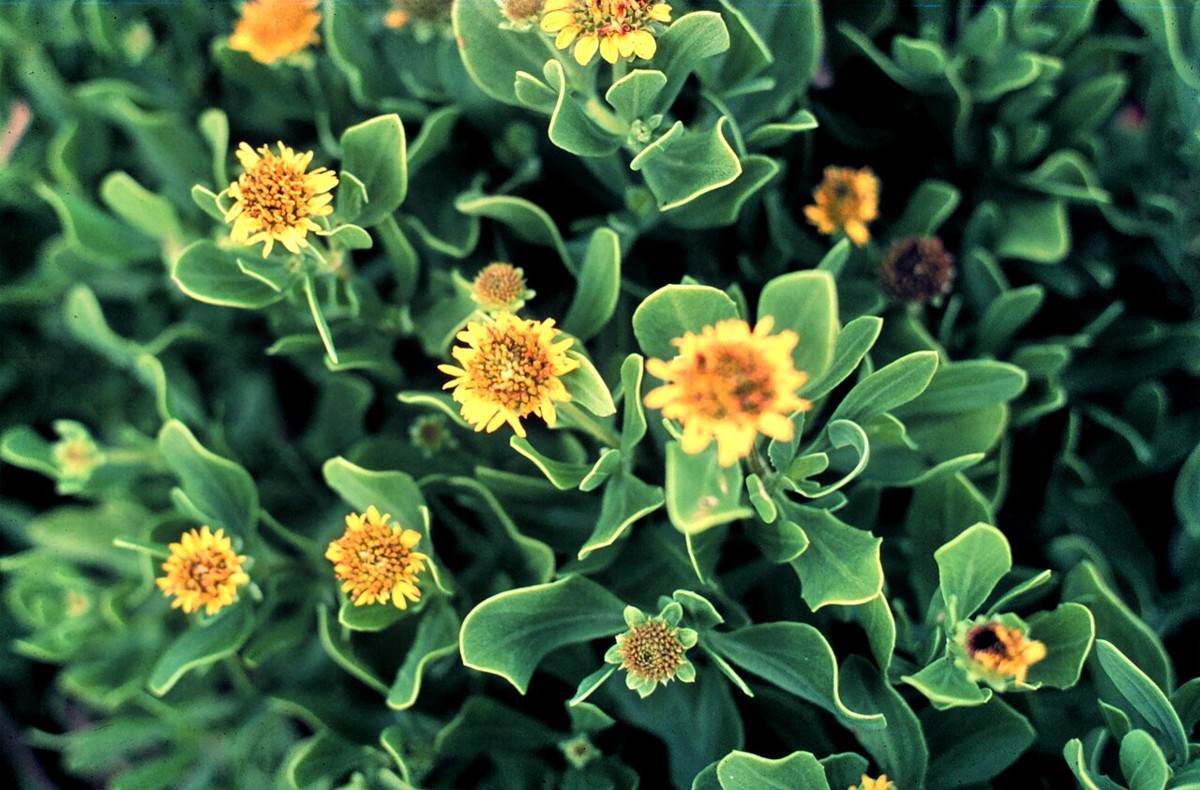
Borrichia frutescens, commonly known as Sea Oxeye Daisy, Bushy Seaside Tansy, or Sea Ox-eye, is a tough, woody-based perennial subshrub of Atlantic and Gulf Coast salt marshes. A member of the Asteraceae (aster/daisy family), it forms low, rounded mounds of fleshy, silvery gray-green leaves topped by bright yellow, daisy-like flowerheads through the warm season. Few native wildflowers handle true saltmarsh conditions — periodic tidal flooding, salt spray, and brackish soil — as gracefully as this one.
Growing 1 to 3 feet tall and often wider, Sea Oxeye Daisy spreads by both seed and rhizomes to form dense colonies along the upper edges of salt marshes, the landward side of dunes, and brackish ditch banks. Its thick, opposite leaves are covered in fine silvery hairs that reflect sun and reduce water loss, an adaptation shared with other true halophytes. The 1-inch yellow flowerheads, each with a ring of broad rays around a domed, often darker-gold disk, bloom nearly continuously from spring through fall in the Deep South.
Because it tolerates salt, periodic inundation, and poor drainage that would kill most garden perennials, Sea Oxeye Daisy is a workhorse plant for coastal landscaping, living shorelines, and marsh restoration projects from the Chesapeake Bay to the Texas coast. It is rarely offered at general nurseries but is a staple at coastal native-plant specialists.
Identification
Sea Oxeye Daisy forms a rounded, shrubby clump of stiff, branching stems, woody at the base and herbaceous toward the tips, reaching 1 to 3 feet tall and often spreading as wide through rhizomatous growth.
Stems
Stems are stout, pale gray-green, and branch freely from a woody crown. Older colonies form dense, tangled mounds that knit the upper marsh edge together and resist wave and wind erosion.
Leaves
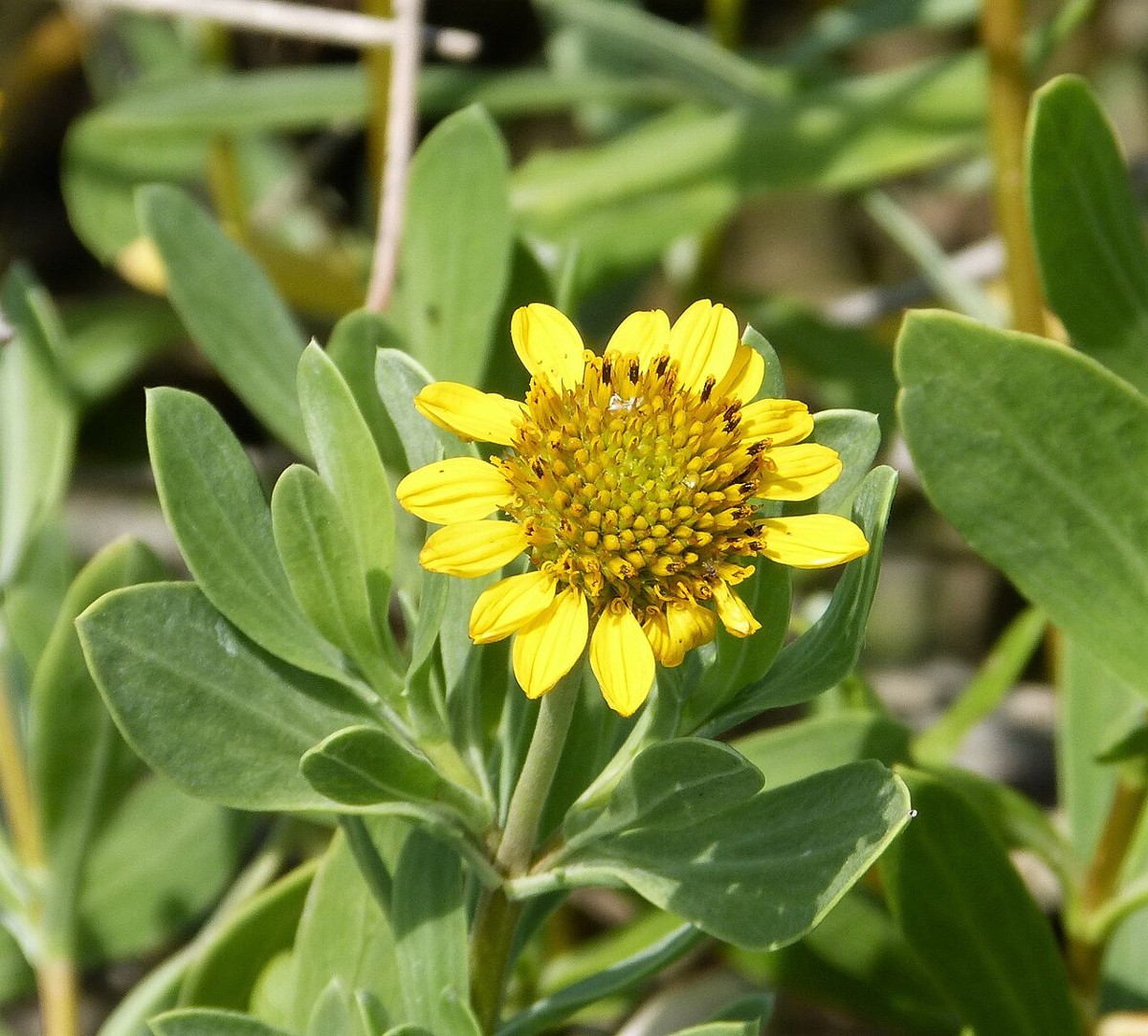
Leaves are opposite, thick and fleshy (succulent), 1 to 3 inches long, oblong to spoon-shaped, and covered in fine silvery-white hairs that give the whole plant a soft gray-green cast. This silvery pubescence is a key field mark distinguishing it from other marsh-edge composites.
Flowers
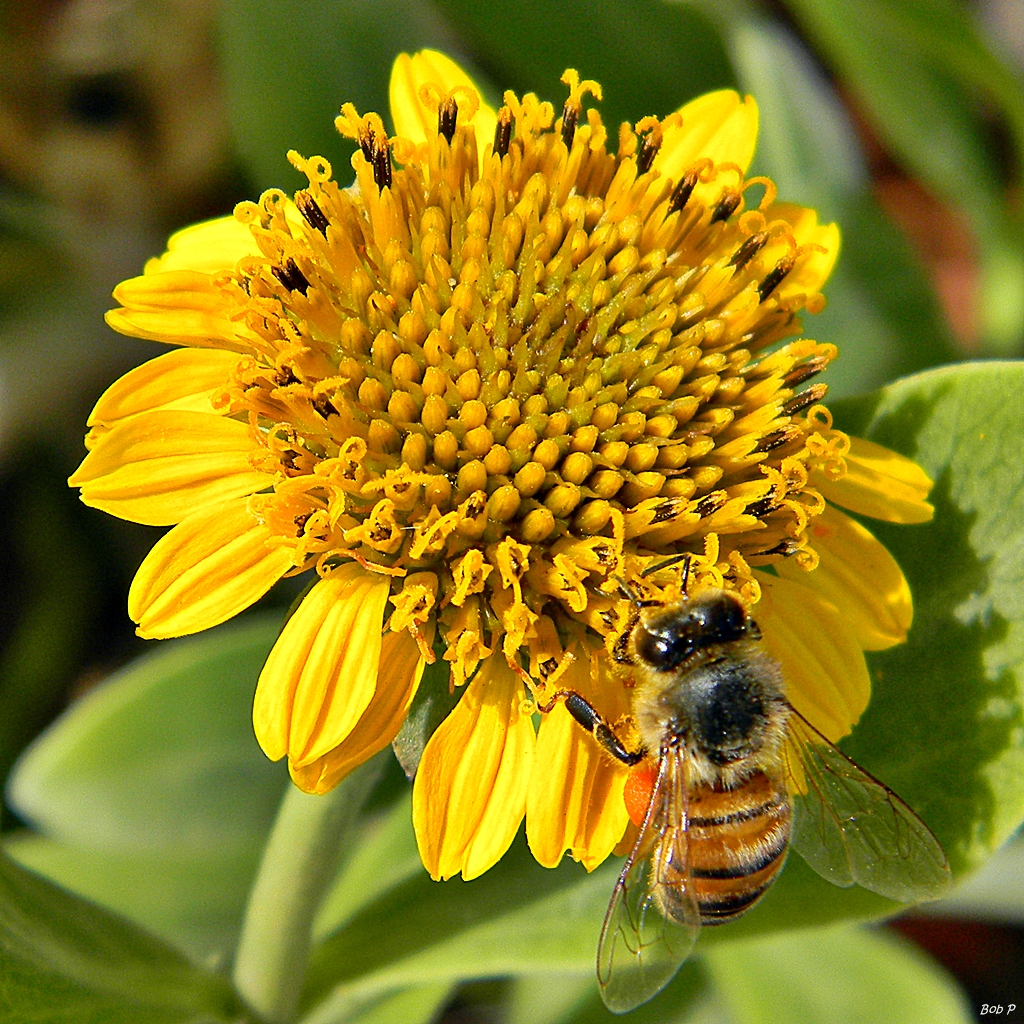
Flowerheads are solitary at branch tips, about 1 inch across, with 15 to 30 bright yellow ray florets surrounding a dome of yellow to golden-brown disk florets. Bloom occurs from spring through fall, with the heaviest flush in summer.
Fruit & Seeds
The fruiting heads mature into distinctive hard, thorny-looking burr-like structures as the chaffy bracts around each disk floret stiffen and persist — an unusual and recognizable feature of this genus. These capsules can float and are dispersed by tidal water as well as by birds.
Quick Facts
| Scientific Name | Borrichia frutescens |
| Family | Asteraceae (Aster/Daisy) |
| Plant Type | Evergreen Perennial Subshrub |
| Mature Height | 1–3 ft |
| Mature Spread | 2–4 ft |
| Growth Rate | Moderate |
| Sun Exposure | Full Sun |
| Water Needs | Low to Moderate; tolerates periodic tidal flooding |
| Soil Type | Saline to brackish marsh sand, mud or loam |
| Soil pH | 6.5–8.5 (tolerates high salinity) |
| Bloom Time | Spring – Fall |
| Flower Color | Yellow |
| Fall Color | None; evergreen gray-green foliage year-round |
| Fruit | Hard, burr-like seed heads |
| Deer Resistant | Yes |
| USDA Hardiness Zones | 8–11 |
Native Range
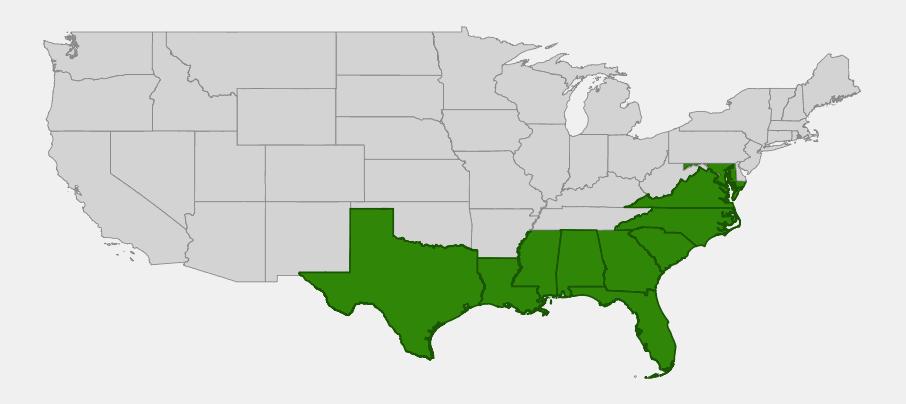
Sea Oxeye Daisy is native to Atlantic and Gulf Coast salt and brackish marshes from the Chesapeake Bay region of Maryland and Virginia south through North Carolina, South Carolina, Georgia, and Florida, then west along the Gulf Coast through Alabama, Mississippi, Louisiana, and the Texas coast down to the Rio Grande. County-level botanical records confirm genuinely native, wild populations are concentrated almost entirely along the immediate tidal coast rather than inland.
Within this coastal band, Sea Oxeye Daisy is a dominant plant of the marsh-upland transition zone — the slightly higher, less frequently flooded fringe above the smooth cordgrass (Spartina alterniflora) zone of the low marsh. It often grows in nearly pure stands along tidal creek banks, spoil islands, and the landward edges of salt pannes.
Because it is a true halophyte adapted to saline soil and occasional tidal inundation, Sea Oxeye Daisy does not naturally occur or persist inland away from tidal influence, and this guide’s regional lists reflect only the coastal counties where it is confirmed native.
📋 Regional plant lists featuring Sea Oxeye Daisy: Maryland, Virginia & West Virginia · North Carolina & South Carolina · Georgia, Alabama & Mississippi · Arkansas, Louisiana, Eastern Oklahoma & Eastern Texas · South and West Texas
Growing & Care Guide
Sea Oxeye Daisy is built for the hardest growing conditions on the coastal landscape, making it indispensable for sites where salt spray and brackish water rule out most other flowering plants.
Light
Full sun produces the densest growth and heaviest bloom. It tolerates light shade but becomes sparse and floppy without at least 6 hours of direct sun.
Soil & Water
This species is a true halophyte and actually needs some salinity to compete well — in average, unsalted garden soil it can be overtaken by more vigorous neighbors. It tolerates both standing brackish water and periods of drier soil between tides, making it ideal for the fluctuating moisture of marsh edges, swales, and rain gardens that receive occasional saltwater intrusion.
Planting Tips
Plant container stock in spring so roots establish before the first stressful summer heat. Space plants 2 to 3 feet apart; they will fill in via rhizomes within a couple of seasons. Ideal for the landward fringe of a living shoreline planting, just above the low-marsh cordgrass zone.
Pruning & Maintenance
Cut back by about a third in late winter to keep clumps compact and encourage fresh growth; otherwise maintenance is minimal. Established plantings need no fertilizer and little attention once settled into appropriate marsh-edge soil.
Landscape Uses
- Living shorelines and marsh-edge stabilization
- Salt-tolerant groundcover for brackish rain gardens and swales
- Coastal pollinator gardens
- Buffer plantings around tidal creeks and estuaries
- Erosion control on spoil islands and dredge-material sites
Wildlife & Ecological Value
As one of the few reliably blooming flowers right at the marsh edge, Sea Oxeye Daisy is an outsized contributor to coastal wildlife food webs.
For Pollinators
The flowerheads draw honeybees, native bees, and a variety of butterflies, including coastal skippers, which rely on it as a dependable nectar source where few other blooming plants grow directly at the marsh fringe.
For Birds
Marsh and shorebirds use the dense clumps for nesting cover and shelter from tidal flooding and predators, while seed-eating birds feed on the mature seed heads in fall and winter.
For Mammals
Marsh rabbits and other small coastal mammals use Sea Oxeye Daisy stands for cover, though the plant is not a primary browse species; its greatest wildlife value is structural, providing refuge above the tide line.
Ecosystem Role
Sea Oxeye Daisy’s dense, rhizomatous growth stabilizes the vulnerable high-marsh edge, trapping sediment and buffering upland areas from storm surge and erosion. Its presence often marks the ecological transition between tidal marsh and upland habitat, supporting species from both zones.
Cultural & Historical Uses
Sea Oxeye Daisy has little documented history of medicinal or culinary use, but it has long been recognized by coastal residents and naturalists as a reliable indicator of the high marsh zone — its presence signals ground just above the regular reach of the tides.
In recent decades, coastal restoration programs along the Atlantic and Gulf Coasts have increasingly specified Sea Oxeye Daisy in living shoreline and marsh-edge plantings, valuing its salt tolerance and root structure for erosion control as an alternative to hardened bulkheads.
Its cheerful, long-lasting yellow blooms have also made it a favorite of coastal photographers and a recognizable feature of salt marsh scenery from the Chesapeake to the Gulf.
Frequently Asked Questions
Will Sea Oxeye Daisy grow in a regular garden bed, away from the coast?
It can survive in ordinary garden soil, but it performs best and stays most compact where soil has some salinity or periodic brackish moisture. In rich, fresh garden soil far from the coast it tends to grow leggy and can be outcompeted by other perennials.
Does Sea Oxeye Daisy tolerate saltwater flooding?
Yes. It is one of the most salt- and flood-tolerant native flowering perennials, regularly growing where tides reach its roots, which is why it is so valuable for living shoreline and marsh-edge restoration.
What are the hard, bur-like structures on old flowerheads?
Those are the mature fruiting heads, formed as the stiff bracts around the seeds persist and harden. They are a distinctive identification feature of the genus Borrichia and can float, allowing tidal water to disperse seed.
Is Sea Oxeye Daisy invasive anywhere?
No. It is not considered invasive; it is a well-behaved native restricted mostly to saline and brackish marsh habitat, where it rarely becomes aggressive outside its natural coastal zone.
How much sun does Sea Oxeye Daisy need?
Full sun is best for compact growth and the heaviest bloom. It tolerates partial shade but becomes sparser and blooms less in low light.

Looking for a nursery that carries Sea Oxeye Daisy?
Browse our native plant nursery directory: Maryland, Mississippi & Louisiana · Virginia, South Carolina & Texas · North Carolina · Georgia & Florida · Alabama