
Saltmeadow Cordgrass (Spartina patens)
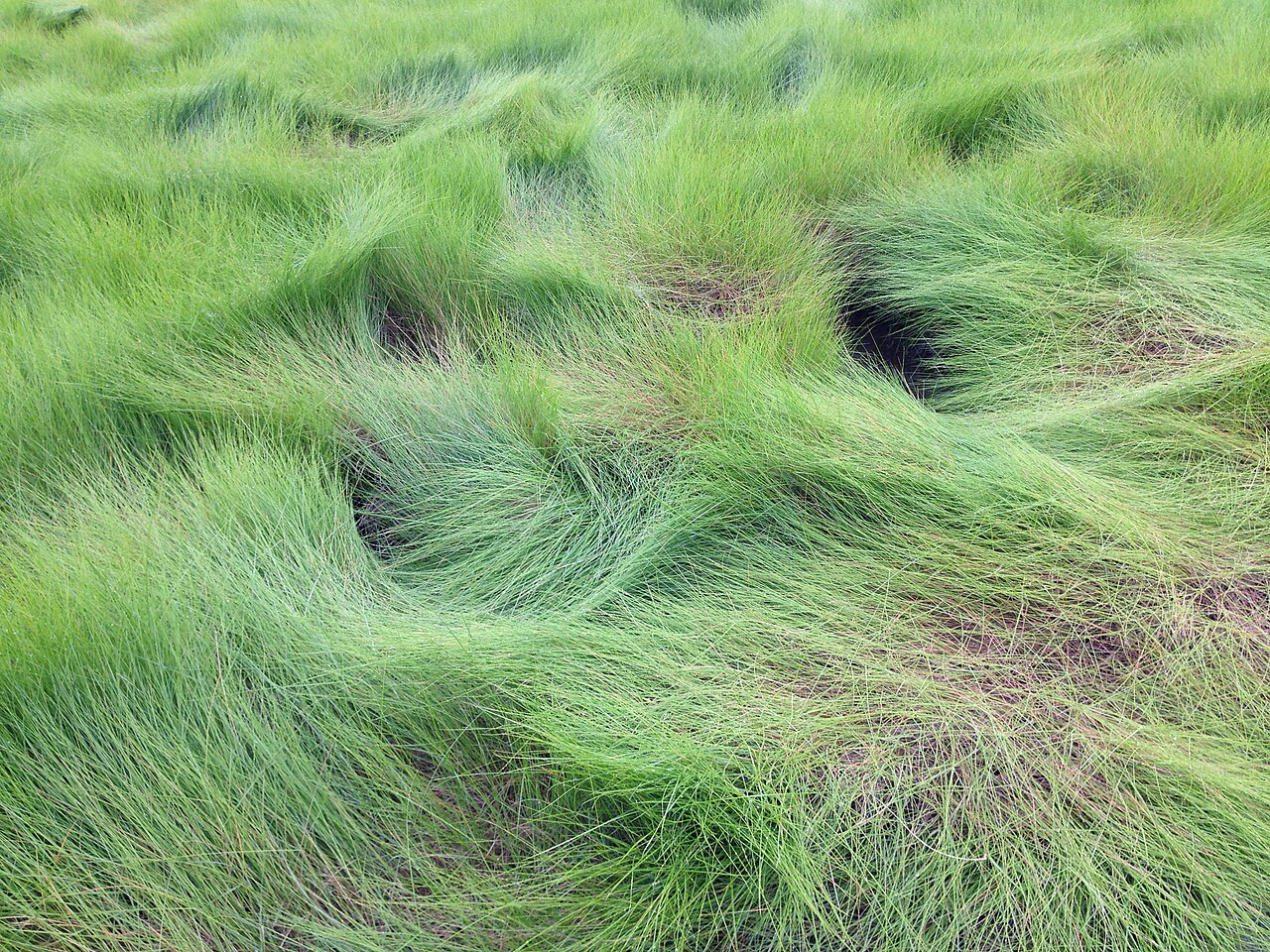
Spartina patens, known as Saltmeadow Cordgrass, marshhay cordgrass or salt hay, is the fine-textured grass that carpets the high salt marshes and back dunes of the Atlantic and Gulf coasts. It is a perennial in the grass family (Poaceae) that spreads by long, slender rhizomes into dense, springy mats of thin, wiry leaves, usually 1 to 3 feet tall. Wind and tides flatten the stems into swirling “cowlicks,” which make a saltmeadow cordgrass marsh easy to recognize from a distance.
Saltmeadow cordgrass is one of the most important plants of the coastal edge. It binds dune sand and marsh peat, tolerates salt spray and occasional flooding with seawater, and provides nesting cover for saltmarsh birds. For more than three centuries it was also an economic crop: coastal farmers from New England to the Delaware Bay mowed it as “salt hay” for livestock fodder, bedding and garden mulch. Recent DNA studies moved it to the genus Sporobolus as Sporobolus pumilus, but nurseries, restoration projects and most field guides still use Spartina patens.
This guide covers how to tell saltmeadow cordgrass from its relatives, including Smooth Cordgrass and Florida’s Sand Cordgrass, where it grows, how to use it in coastal gardens, living shorelines and dune plantings, and why it matters to wildlife.
Identification
Saltmeadow cordgrass is a fine, low, mat-forming grass, quite different in look from the tall, coarse cordgrasses. Its narrow leaves and its habit of lying down in swirls are the best field marks.
Rhizomes & Stems
The plant spreads by long, thin, scaly rhizomes and forms extensive colonies rather than distinct clumps. The flowering stems are slender, wiry and hollow, usually 1 to 3 feet tall and occasionally to about 4 feet on fresher sites. Many stems never stand fully upright. They bend near the base and lie in matted, wave-like swirls, especially in the high marsh.
Leaves
The leaves are very narrow, usually less than 1/8 inch wide when rolled, and the margins curl inward so the blade looks round and wire-like. They are bright green to grayish green in summer and turn tan in fall and winter, and the dead leaves build up into a thick thatch. The leaves feel smooth on the outer side and rough on the upper surface.
Flowers
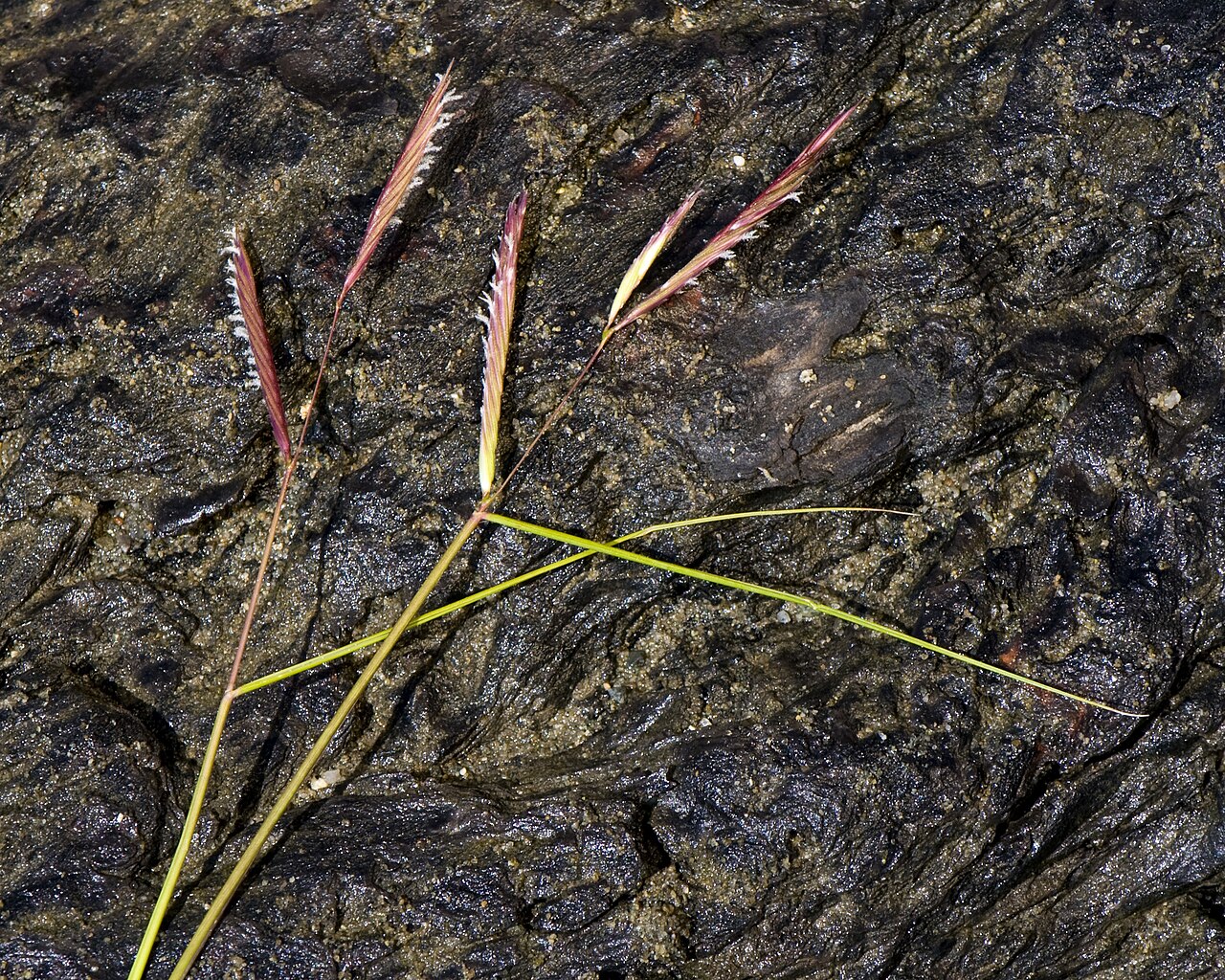
Flowering takes place from summer into fall (it can begin in spring in the far south). Each stem ends in a narrow panicle of usually 2 to 8 short spikes, each 1/2 to 2 inches long, that spread at an angle from the main stem. The small, flattened spikelets are crowded along one side of each spike, giving it a comb-like look, and the hanging anthers and feathery stigmas are often purplish. The flowers are wind-pollinated.
Similar Species
Smooth cordgrass (Spartina alterniflora) grows lower in the intertidal zone, is taller and coarser, and has flat leaves up to 1/2 inch wide. Saltgrass (Distichlis spicata) often grows mixed with saltmeadow cordgrass, but it has stiff, short leaves arranged in two neat ranks along the stem. In Florida, sand cordgrass (Spartina bakeri) forms large, tough bunches rather than spreading mats.
Quick Facts
| Scientific Name | Spartina patens (syn. Sporobolus pumilus, Spartina pumila) |
| Family | Poaceae (grass family) |
| Plant Type | Warm-season perennial grass, spreading by rhizomes |
| Mature Height | 1–3 ft (occasionally to 4 ft) |
| Mature Spread | Spreads indefinitely by rhizomes into colonies |
| Growth Rate | Moderate to fast once established |
| Sun Exposure | Full sun |
| Water Needs | Moist to wet; tolerates brief tidal flooding and salt spray, and drought on dunes |
| Soil Type | Sand, sandy loam, marsh peat or mud; saline to brackish soils |
| Soil pH | About 6.0–8.0 |
| Bloom Time | June–October in most of the range; earlier in the far south |
| Flower Color | Green to purplish (inconspicuous, wind-pollinated) |
| Fall Color | Straw tan to golden brown in fall and winter |
| Fruit | Tiny grain; seed set is often low |
| Deer Resistant | Moderately; browsed by deer, geese and feral horses |
| USDA Hardiness Zones | 4–10 |
Native Range
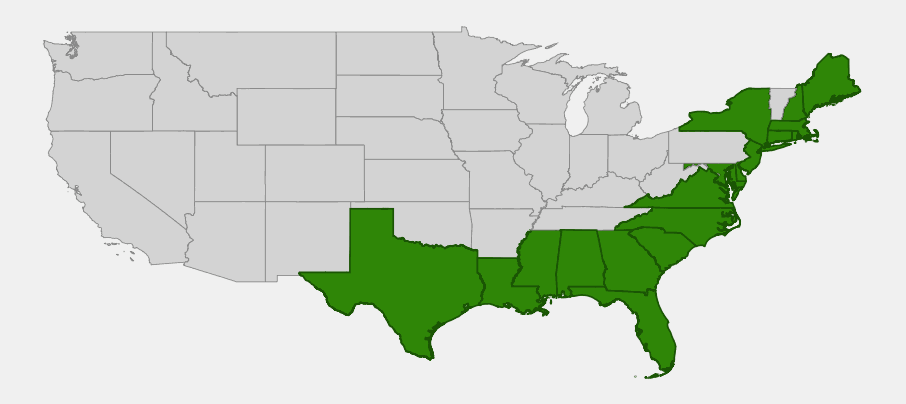
Saltmeadow cordgrass grows along almost the entire Atlantic and Gulf coasts of North America. The Lady Bird Johnson Wildflower Center summarizes its native distribution as coastal areas from Quebec to Texas, and USDA PLANTS lists it as native to Canada, the lower 48 states, Puerto Rico and the U.S. Virgin Islands. In Canada it grows in Quebec, New Brunswick, Nova Scotia, Prince Edward Island and Newfoundland. In the United States it occurs in every coastal state from Maine to Texas, and it continues through the Gulf of Mexico and the Caribbean.
In Florida it grows along both coasts and around the Keys, in high salt marshes, brackish marshes, the landward edge of mangroves, interdune swales and on the back side of dunes. It is most abundant in the high marsh of New England and the Mid-Atlantic, where it is often the dominant plant over large areas, and in the brackish and intermediate marshes of the northern Gulf Coast, especially in Louisiana.
A few scattered records farther inland, for example in Pennsylvania and Michigan, are either brackish tidal sites or plants that arrived along salted roads and railways. On the Pacific Coast, saltmeadow cordgrass is an introduced species and is considered invasive in parts of Washington, Oregon and California, where it competes with native marsh plants. Plant it only within its native coastal range.
📋 Regional plant lists featuring Saltmeadow Cordgrass: North & South Florida · Alabama, Georgia & Mississippi · North & South Carolina · Maryland, Virginia & West Virginia · Arkansas, Louisiana, Eastern Oklahoma & Eastern Texas · South & West Texas · New York, Pennsylvania & Northern New Jersey · Delaware, Southern New Jersey & Long Island · Connecticut, Massachusetts & Rhode Island · New Hampshire, Maine & Vermont
Growing & Care Guide
Saltmeadow cordgrass is one of the most useful plants for coastal properties. It is sold as plugs and bare-root sprigs by native and wetland nurseries, and released cultivars such as ‘Flageo’ and ‘Avalon’ are widely used for dune and shoreline stabilization. In a garden it can be used as a fine-textured, salt-proof groundcover where little else grows.
Light
Give it full sun. It thins and stops spreading in shade, and in the wild it gives way to shrubs such as marsh elder and wax myrtle where they overtop it.
Soil & Water
It grows in anything from pure dune sand to marsh peat and silty mud, and it tolerates salt spray, saline soils and occasional flooding by high tides or storm surges. On dunes it is quite drought tolerant once established; in the marsh it grows best where the soil is moist and flooded only at the highest tides. No fertilizer is needed in the garden. Restoration plantings on bare, nutrient-poor sand sometimes get a slow-release fertilizer at planting.
Planting Tips
Plant plugs or sprigs in spring or early summer, spaced about 12 to 18 inches apart for fast cover. On shorelines, place them in the zone between mean high tide and the highest spring tides, above any smooth cordgrass plantings. On dunes, set plugs deep enough to reach moist sand. Water new plantings until they root, unless tides do the job.
Pruning & Maintenance
Little maintenance is needed. In a garden setting you can mow or cut it back in late winter to remove the old thatch and keep it neat, though the tan winter thatch protects the soil and shelters wildlife. In living-shoreline projects, check new plantings after storms and replace any that wash out.
Propagation
It spreads readily by rhizomes. The easiest method is to divide established mats into small plugs with roots and rhizomes and replant them in spring. Seed is produced but often has low viability, so nurseries mainly propagate it vegetatively. Do not dig plants from wild marshes, which are protected wetlands in most states. Buy nursery stock.
Landscape Uses
- Living shorelines: planted in the high-marsh zone behind smooth cordgrass to slow erosion and trap sediment
- Dune stabilization: helps bind sand on back dunes and interdune swales alongside sea oats and other dune grasses
- Coastal groundcover: a fine-textured, salt-tolerant lawn alternative on waterfront properties exposed to salt spray
- Wetland restoration: a core species for restoring high salt marsh and brackish marsh
- Salt hay mulch: harvested hay is weed-seed-free and was long a favorite mulch for strawberries and vegetable gardens
Wildlife & Ecological Value
Saltmeadow cordgrass is a foundation plant of the high marsh. The dense mats it builds create the structure, cover and food web that many coastal animals depend on.
For Pollinators
Like other grasses, it is wind-pollinated and offers no nectar. Its marshes support many invertebrates, though, including planthoppers, grasshoppers and salt marsh snails, which feed birds and fish.
For Birds
The high marsh dominated by saltmeadow cordgrass is the main nesting habitat of the saltmarsh sparrow, which builds its nests in the dense grass just above the reach of ordinary high tides. Seaside sparrows, clapper rails, willets and northern harriers also nest or forage in these marshes, and waterfowl and sparrows eat the seeds in fall and winter.
For Mammals
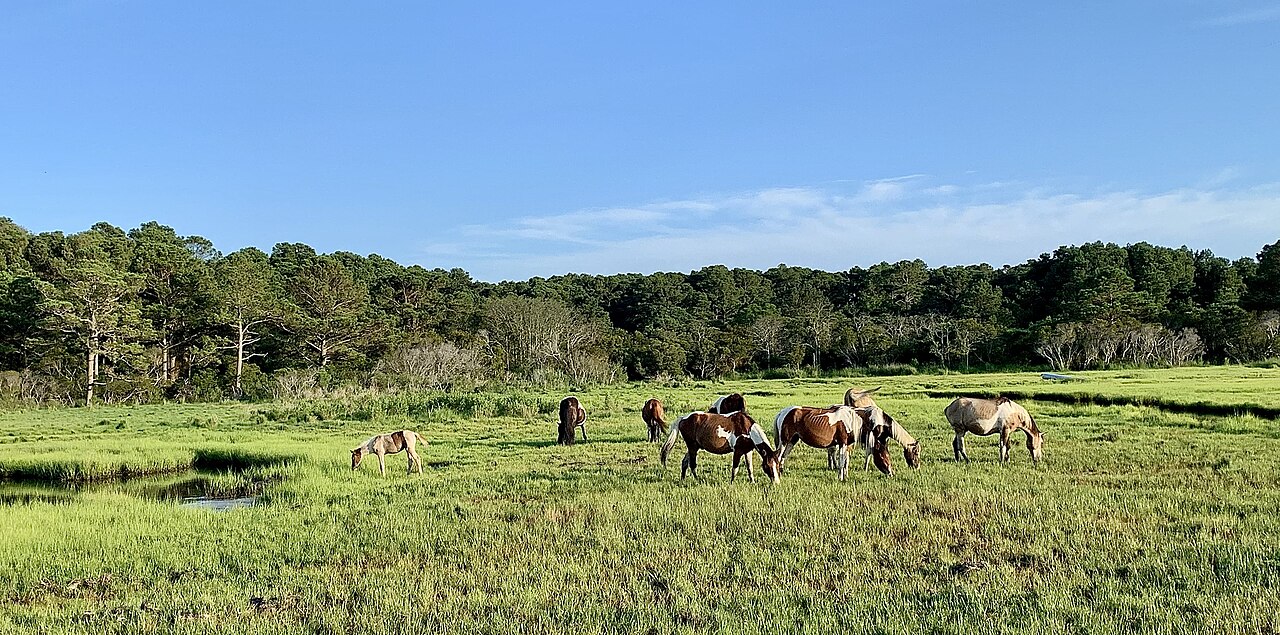
Muskrats, marsh rabbits and meadow voles use the mats for food and cover. Deer graze it, and the wild horses of Assateague and other barrier islands feed heavily on it.
Ecosystem Role
Its dense roots and rhizomes bind sand and peat and help marshes build up vertically by trapping sediment and organic matter. Saltmeadow cordgrass marshes filter runoff, absorb wave energy and storm surge, and store large amounts of carbon in their peat. Along many coasts, the high marsh is now being squeezed as sea level rises and smooth cordgrass moves upslope, which makes protecting and restoring saltmeadow cordgrass habitat increasingly important.
Cultural & Historical Uses
Salt hay was one of the first natural resources used by European colonists in New England. Coastal farmers mowed the high marsh in late summer, sometimes stacking the hay on wooden staddles above the reach of the tides, and fed it to cattle through the winter. Marsh rights were valued and passed down in wills. The salt hay industry persisted in New Jersey’s Delaware Bay marshes into the twentieth century, where diked “salt hay farms” were harvested for livestock bedding, packing material and mulch.
Because salt hay contains no viable seeds of upland weeds, it became a prized garden mulch for strawberries, asparagus and vegetable beds, and it is still sold for that purpose in some coastal areas. It was also used as packing material for glass and pottery and as insulation.
The plant was described in 1789 as Dactylis patens and later moved to Spartina. In 2014, botanists proposed combining Spartina with Sporobolus (dropseeds), and the accepted name in many recent databases is now Sporobolus pumilus. USDA PLANTS, the Atlas of Florida Plants and the nursery trade still use Spartina patens.
Frequently Asked Questions
What is the difference between saltmeadow cordgrass and smooth cordgrass?
Smooth cordgrass grows in the low marsh that is flooded by every tide and is tall, coarse and flat-leaved. Saltmeadow cordgrass grows higher up, in the zone flooded only by the highest tides, and is shorter and finer, with thin, rolled leaves that lie in cowlicks.
Is saltmeadow cordgrass the same as salt hay?
Yes. “Salt hay” is the traditional name for hay mowed from high marshes dominated by saltmeadow cordgrass, often mixed with saltgrass and black rush.
Can I use saltmeadow cordgrass as a lawn?
On a sunny, sandy waterfront lot it makes an excellent low-maintenance, salt-proof groundcover that can be mowed a few times a year. It will not take heavy foot traffic like turfgrass, and it looks shaggy rather than manicured.
Is Spartina patens invasive?
Not within its native range on the Atlantic and Gulf coasts. It has been introduced on the Pacific Coast, where it is considered invasive in parts of Washington, Oregon and California, and it should not be planted there.
Why is it also called Sporobolus pumilus?
DNA studies showed that the cordgrasses are closely related to the dropseeds, and many botanists now include Spartina in Sporobolus. Under that classification, saltmeadow cordgrass is Sporobolus pumilus. Both names refer to the same plant.

Looking for a nursery that carries Saltmeadow Cordgrass?
Browse our native plant nursery directory: Alabama · Connecticut, Delaware, Florida & Georgia · Louisiana, Maine, Maryland, Massachusetts & Mississippi · New Hampshire, New Jersey, New York & North Carolina · Rhode Island, South Carolina, Texas & Virginia