
Black Needlerush (Juncus roemerianus)
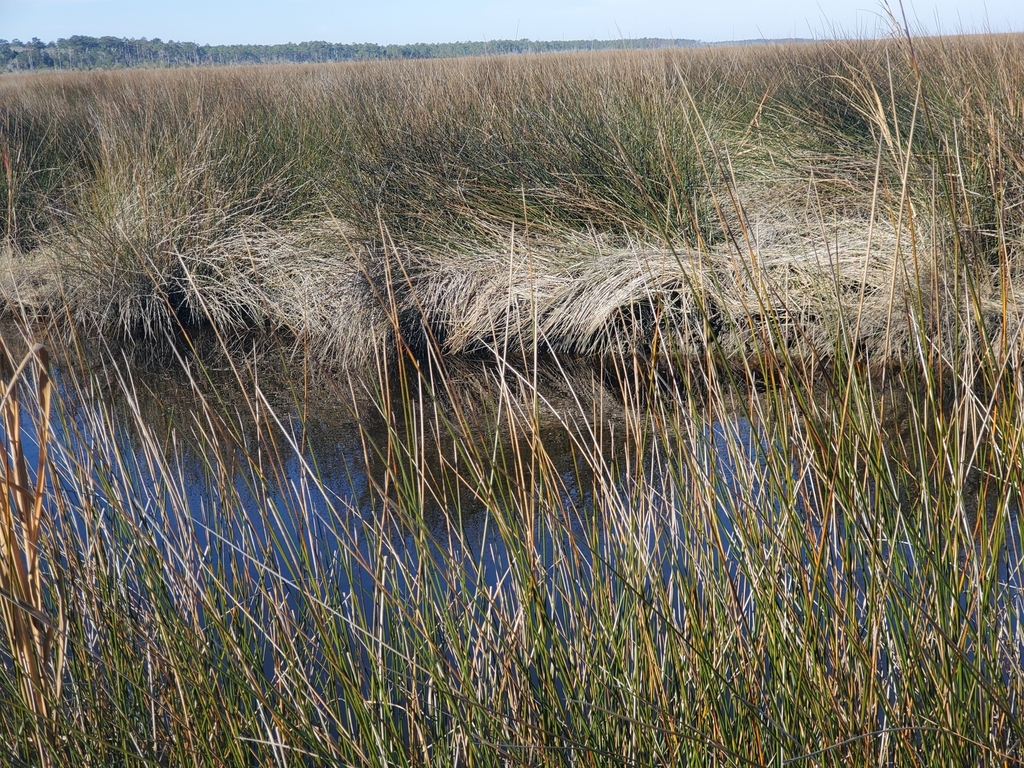
Juncus roemerianus, known as Black Needlerush, needle rush, black rush, or needlegrass rush (the USDA name), is the dominant plant of many brackish and salt marshes along the Atlantic and Gulf coasts of the southeastern United States. It forms dense, uniform stands of stiff, gray-green to nearly black, needle-tipped stems and leaves 3 to 5 feet tall, which give these marshes their dark color when seen from a distance.
Black needlerush is a member of the rush family (Juncaceae). It spreads by tough underground rhizomes and can cover thousands of acres. Along the Gulf Coast of Florida, especially the Big Bend region, and in Mississippi and Alabama, it is the most abundant marsh plant, while on the Atlantic coast it usually grows in the higher, less frequently flooded parts of salt marshes behind smooth cordgrass.
This plant is an important part of coastal ecosystems: it protects shorelines from erosion, filters runoff, and provides habitat for fish, shellfish and birds. It is increasingly used in living shoreline and marsh restoration projects. This guide covers how to identify it, where it grows, and how it is used in coastal landscapes and restoration.
Identification
Black needlerush is easy to recognize in the field. Its dense stands of round, stiff, dark gray-green stems and leaves with extremely sharp points are distinctive among salt marsh plants. Few people forget brushing against it.
Rhizomes & Stems
The plant spreads by thick, creeping rhizomes that form a dense mat in the marsh soil. The stems are round, smooth, and stiff, usually 3 to 5 feet tall, sometimes taller in favorable sites. They grow in dense colonies, each shoot standing upright.
Leaves
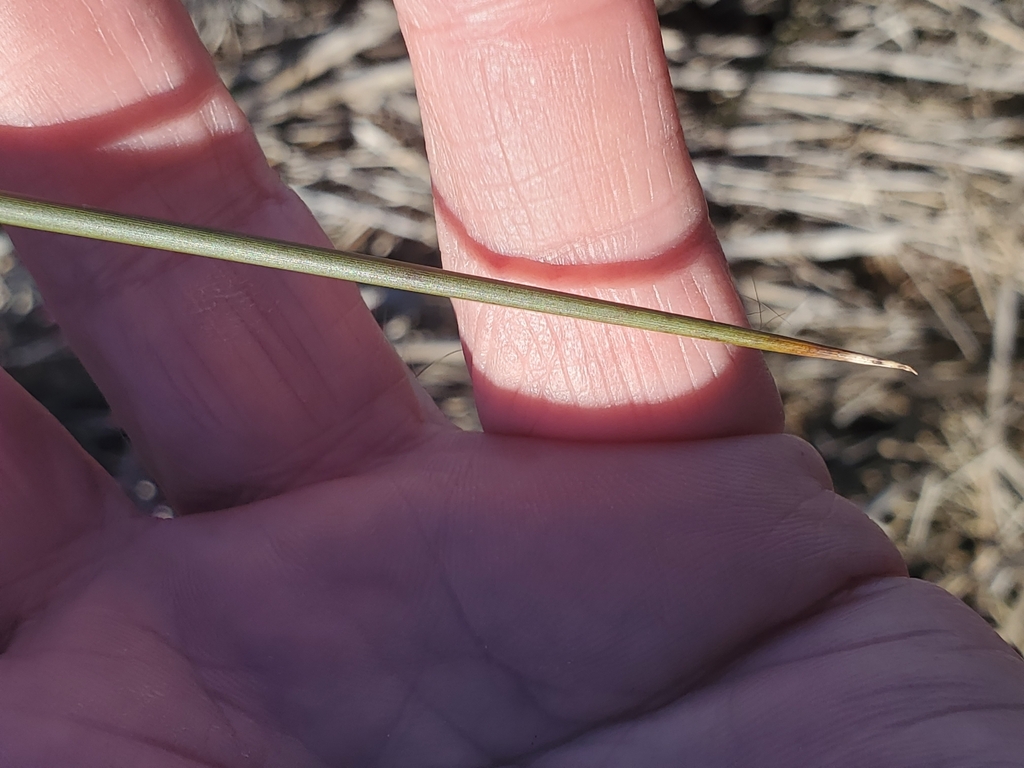
The leaves are round in cross-section, like the stems, and end in a hard, needle-sharp point. They are dark green to gray-green, often turning dark brown to almost black at the tips and in winter, which gives the marsh its dark color. The sharp tips can puncture skin, so walking through a needlerush marsh calls for long pants and care.
Flowers
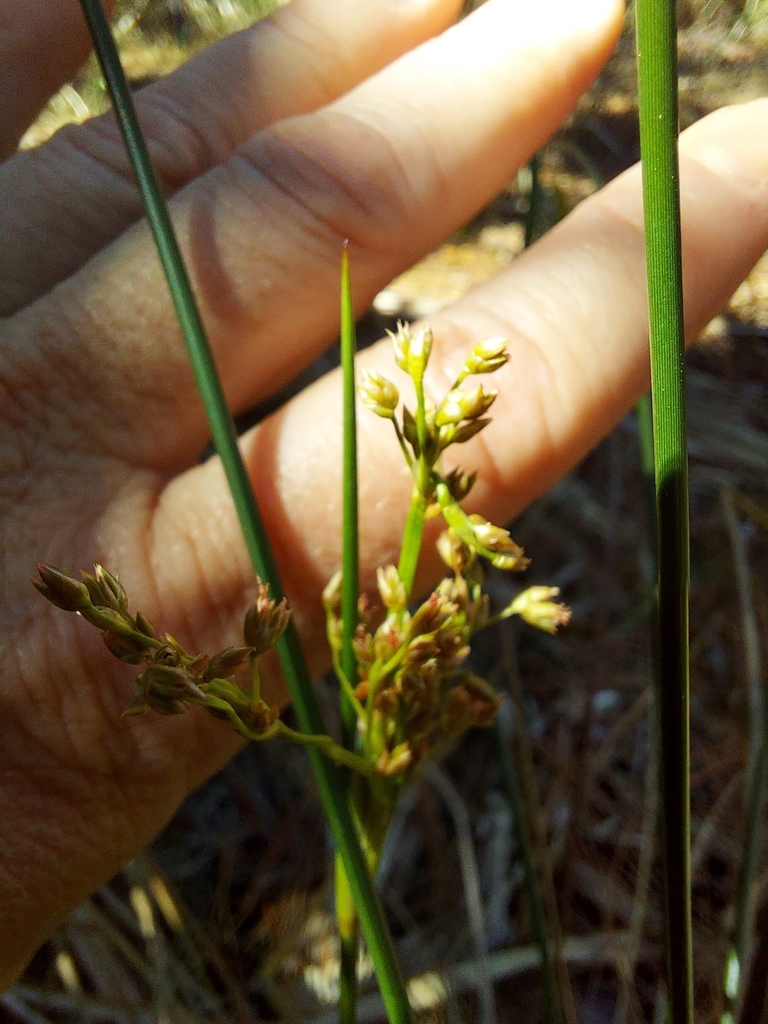
The flowers are small and brownish, borne in a compact, branched cluster near the top of the stem. A stiff bract that looks like a continuation of the stem rises above the cluster, so the flowers appear to grow from the side of the stem. Some plants bear only female flowers and others perfect flowers. Flowering occurs mainly in spring, and fruit develops through summer.
Fruit & Seeds
The fruit is a small, brown, three-sided capsule containing many tiny seeds. Seedling establishment is uncommon in dense marshes; most spread is by rhizomes.
Quick Facts
| Scientific Name | Juncus roemerianus Scheele |
| Family | Juncaceae (rush family) |
| Plant Type | Rhizomatous perennial rush |
| Mature Height | 3–5 ft (occasionally to about 6 ft) |
| Mature Spread | Spreads indefinitely by rhizomes |
| Growth Rate | Slow to moderate |
| Sun Exposure | Full sun |
| Water Needs | High; irregularly flooded, saturated soils |
| Soil Type | Marsh muck, sand or clay; brackish to saline |
| Soil pH | About 5.5–7.5 |
| Bloom Time | Spring to early summer |
| Flower Color | Brownish (inconspicuous) |
| Fall Color | Dark gray-green to brown-black |
| Fruit | Small brown capsule with many seeds |
| Deer Resistant | Yes |
| USDA Hardiness Zones | 7–10 |
Native Range
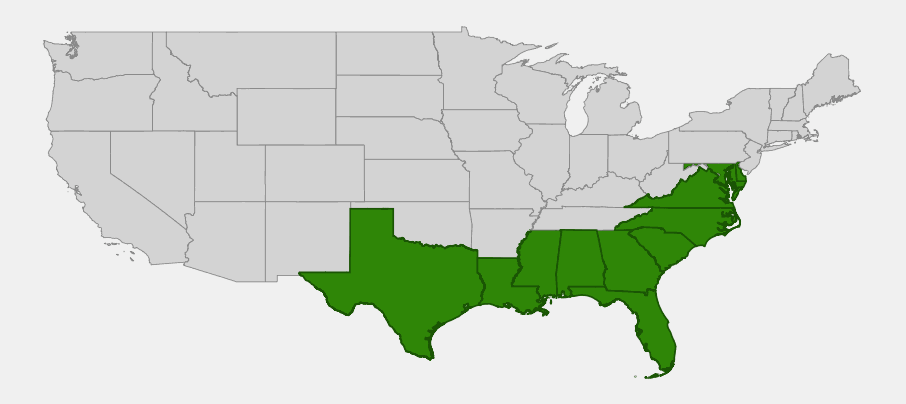
Black needlerush grows along the Atlantic and Gulf coasts of the southeastern United States. USDA PLANTS and the Lady Bird Johnson Wildflower Center record it from eleven states: Delaware, Maryland, Virginia, North Carolina, South Carolina, Georgia, Florida, Alabama, Mississippi, Louisiana and Texas.
It is most extensive on the Gulf Coast, where it forms vast marshes in the Big Bend of Florida, in Mississippi Sound and Mobile Bay, and along the Louisiana coast. On the Atlantic coast it usually occupies the high marsh, inland from smooth cordgrass, from the Chesapeake Bay and Delaware Bay south to Florida. In Florida, the Atlas of Florida Plants maps it in nearly every coastal county, from the Panhandle to the Keys.
Its habitats are brackish and salt marshes flooded irregularly by tides, mainly between mean high water and spring tide levels, as well as tidal river marshes where salt and fresh water mix. It tolerates a broad range of salinity, from nearly fresh to full seawater.
📋 Regional plant lists featuring Black Needlerush: North & South Florida · Alabama, Georgia & Mississippi · North & South Carolina · Maryland, Virginia & West Virginia · Delaware, Southern New Jersey & Long Island · Arkansas, Louisiana, Eastern Oklahoma & Eastern Texas
Growing & Care Guide
Black needlerush is not a typical garden plant, but it is widely used in coastal restoration, living shorelines and waterfront landscapes. Plugs are available from native wetland nurseries in the Southeast. Do not dig plants from wild marshes; coastal wetlands are protected in many states.
Light
Plant in full sun. In shade it grows thin and loses vigor.
Soil & Water
It needs saturated soil that is flooded occasionally by tides or brackish water, such as the upper part of a tidal shoreline. It grows in sand, mud or clay and tolerates salinity from nearly fresh to full seawater. In non-tidal settings it can grow at the edge of brackish ponds or stormwater basins near the coast if the soil stays wet. It is not suited to dry or upland gardens.
Planting Tips
Plant plugs in spring or early summer, 18 to 36 inches apart, at an elevation near mean high water, slightly above the level where smooth cordgrass grows. Plugs establish slowly but spread steadily by rhizomes. For shoreline stabilization, combine with smooth cordgrass at lower elevations and salt-tolerant shrubs such as sea oxeye daisy at higher elevations. Wear gloves and eye protection when handling the plants.
Pruning & Maintenance
Once established, it needs little care. Protect new plantings from waves, boat wakes, foot traffic and grazing until rhizomes spread. Do not fertilize; nutrients encourage competing algae and weeds. Many local regulations require permits for planting or working in tidal wetlands, so check with state and local agencies before starting a shoreline project.
Propagation
Propagate by dividing rhizome clumps into plugs with several stems each. Seeds germinate poorly under ordinary conditions, so nursery propagation is usually by division.
Landscape Uses
- Living shorelines: stabilizing tidal shorelines with smooth cordgrass and oyster reef
- Marsh restoration: re-establishing high marsh on Atlantic and Gulf coasts
- Waterfront landscapes: a native buffer between lawns and tidal water
- Stormwater and erosion control: in brackish, wet areas near the coast
- Wildlife habitat: cover for marsh birds, fish and crustaceans
Wildlife & Ecological Value
Black needlerush marshes are among the most productive ecosystems on the Atlantic and Gulf coasts, supporting fisheries and wildlife far beyond the marsh itself.
For Pollinators
Like other rushes, black needlerush is wind-pollinated and offers little to bees and butterflies.
For Birds
Needlerush marshes provide nesting and feeding habitat for clapper rails, seaside sparrows, marsh wrens, and other marsh birds, and they shelter the secretive black rail in some areas. Herons and egrets hunt along the marsh edges.
For Mammals
Marsh rabbits, marsh rice rats, raccoons and river otters use needlerush marshes for food and cover.
Ecosystem Role
Dead needlerush stems break down slowly and supply detritus that feeds the base of estuarine food webs. The marshes serve as nursery habitat for shrimp, blue crabs and many fish, and their dense rhizome mats bind sediment, reduce erosion, and buffer coastal communities from storm surge.
Cultural & Historical Uses
The German botanist Georg Heinrich Adolf Scheele described Juncus roemerianus in 1849, from specimens collected in Texas. The species name honors Ferdinand Roemer, a German geologist and naturalist who explored Texas in the 1840s and collected plants there.
Unlike softer rushes, black needlerush has little history of use for weaving because of its sharp tips. For coastal communities, its value has long been indirect: the marshes it dominates support fisheries for shrimp, crabs, oysters and fish.
In recent decades, black needlerush has become an important plant in coastal restoration. It is planted in living shoreline projects that use native vegetation and oyster reefs instead of seawalls, and restoration groups and agencies across the Gulf and Atlantic coasts use it to rebuild marshes damaged by storms, development, and oil spills.
Frequently Asked Questions
Why is it called black needlerush?
Its stems and leaves are dark gray-green and turn nearly black at the tips and in winter, and the leaves end in needle-sharp points. From a distance, needlerush marshes look dark compared with marshes of smooth cordgrass.
Is black needlerush dangerous?
Its sharp tips can puncture skin and are a hazard to eyes. Wear long pants, boots and eye protection when working in or walking through needlerush stands.
Can I plant black needlerush on my waterfront?
Yes, in many places it is recommended for living shorelines. Planting in tidal wetlands often requires permits, so check with your state or local environmental agency first.
How is black needlerush different from smooth cordgrass?
Smooth cordgrass (Spartina alterniflora) is a grass with flat leaves that grows in the lower, regularly flooded marsh. Black needlerush is a rush with round, sharp-tipped leaves and usually grows higher in the marsh, where flooding is less frequent.
Does black needlerush grow in fresh water?
It grows best in brackish to salt marshes, but it tolerates low salinity in tidal river marshes. It is rarely found in fully fresh, non-tidal wetlands.

Looking for a nursery that carries Black Needlerush?
Browse our native plant nursery directory: Alabama · Delaware, Florida & Georgia · Louisiana, Maryland & Mississippi · North Carolina · South Carolina, Texas & Virginia