
Copper Iris (Iris fulva)
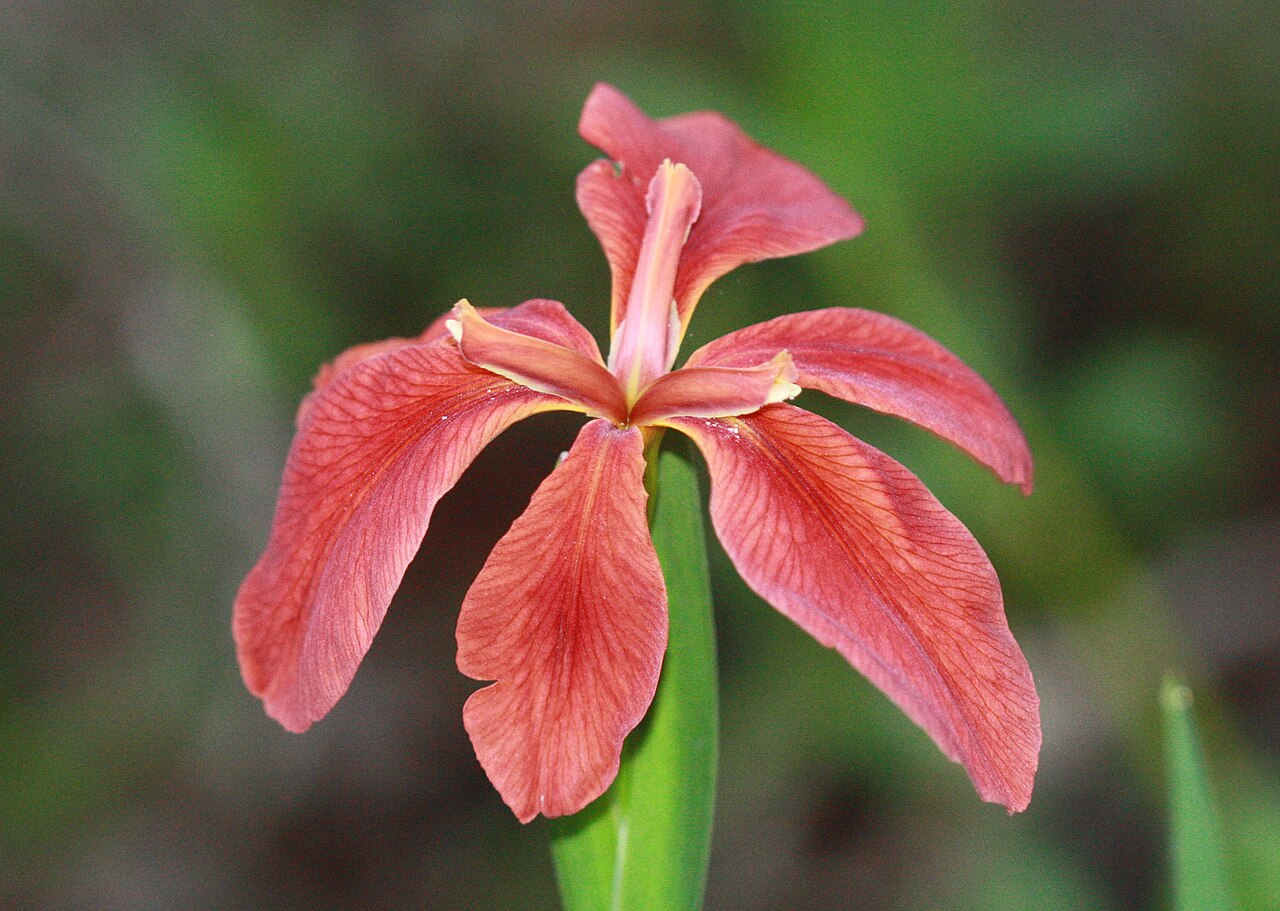
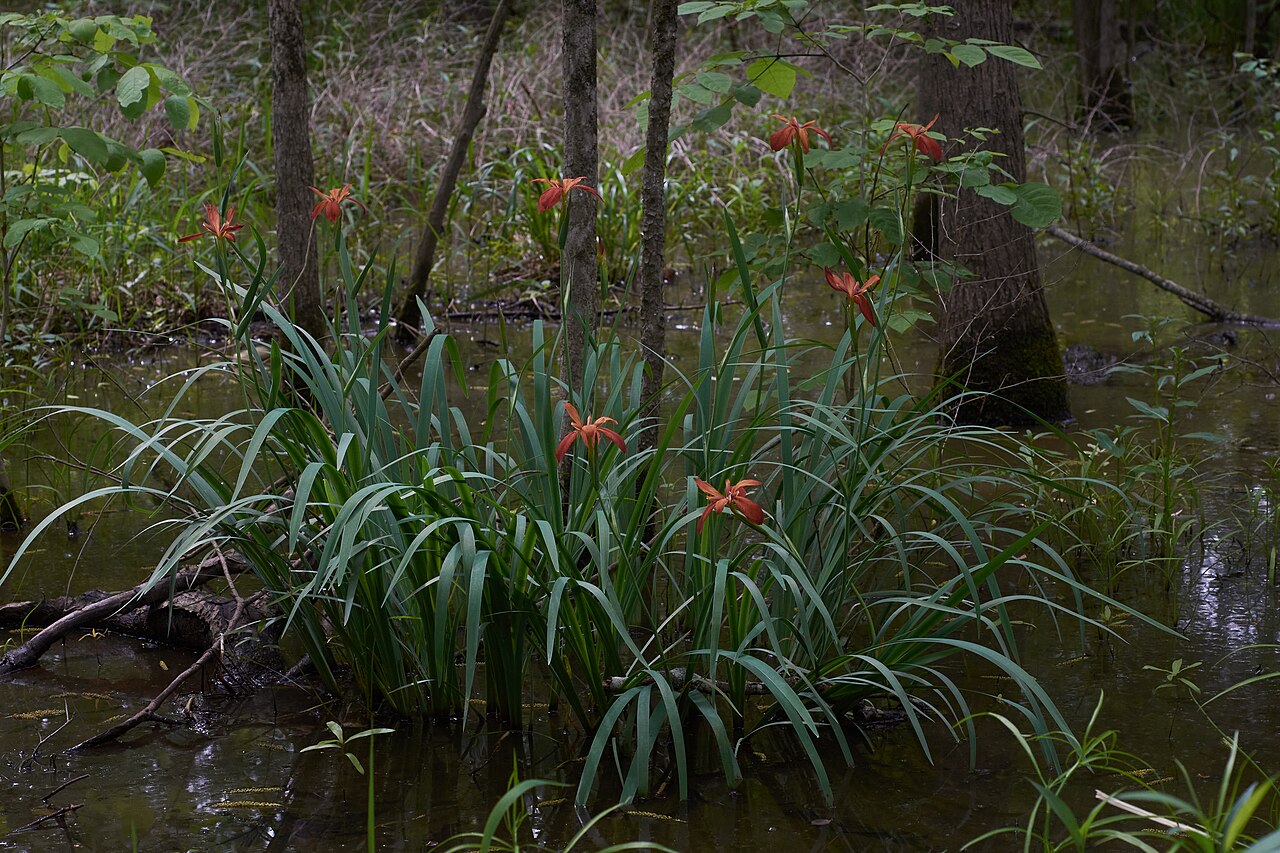
Iris fulva, known as Copper Iris or Red Flag (and sometimes Louisiana Flag or Red Iris), is the only true red iris native to the United States, and one of the most exciting wildflowers of Gulf Coast swamps and bayou edges. In late March through May its flowers open in shades of copper, brick and rust, with a yellow throat, on tall stems held above bright green, sword-shaped leaves. The blooms are unmistakably un-iris-like: instead of the upright standards and falling falls of a bearded garden iris, all six petal-like parts sweep out and droop in a flat, spidery rosette, an arrangement that hummingbirds have been exploiting for a very long time.
This is a plant of the Mississippi Valley and the Gulf Coast plain. In Alabama, Georgia and Mississippi its center of gravity is clearly the west: Mississippi, with its Delta and river-bottom forests, and southwestern Alabama, with its Mobile-Tensaw river country. It reaches Georgia only at the eastern fringe of its range, on the coastal plain. Wherever it grows it wants the same things: standing or seeping fresh water in spring, a rich organic soil that never bakes, and enough open sky to flower. Give it that, and Copper Iris is a reliable, fast-spreading perennial for rain gardens, pond margins, ditches and bog gardens.
Iris fulva also carries an outsized weight in gardening history. It was collected on the banks of the Mississippi near New Orleans in 1811, appears in Audubon’s Birds of America, and became one of the foundation species of the Louisiana iris hybrids that are now grown worldwide. As a native plant it is far more than a parent: it is a hardy, wildlife-friendly, low-input choice for wet ground throughout the Deep South, provided you plant nursery-propagated stock rather than digging it from the wild.
Identification
Copper Iris is an herbaceous, rhizomatous perennial that forms colonies. Flowering stems typically stand 2 to 3 feet tall (Lady Bird Johnson Wildflower Center notes up to 3 feet, rarely to 5), usually with one or two branches and one to three small alternate leaves. Because it spreads by rhizomes, a single planting can grow into a broad stand of stems within a few seasons, and in the wild it is often found in colonies along a bank or ditch.
Rhizomes & Roots
The rhizome is slender, greenish-brown (occasionally reddish), about 1.5 to 2 cm thick, and marked with ring-like scars from old leaf bases. It is shallow-rooted, with fibrous roots underneath, and branches freely. Unlike the fat rhizomes of bearded garden irises, these are set at or just below the soil surface in wet mud and are best left there; burying them deeply invites rot.
Leaves
The leaves are bright green, flat, blade-like and lightly ribbed, 2 to 3 feet long and roughly ½ to 1 inch wide. They rise from the base of the plant and arch outward, and a few smaller leaves clasp the flowering stem. New growth begins early in autumn and the foliage often carries through winter in mild Gulf Coast climates, so the plant is semi-evergreen and is usually leafless (or at its most ragged) only in the heat of late summer. Held up to the light, the leaves show tiny dark dots, a trait shared with other water-loving irises.
Flowers
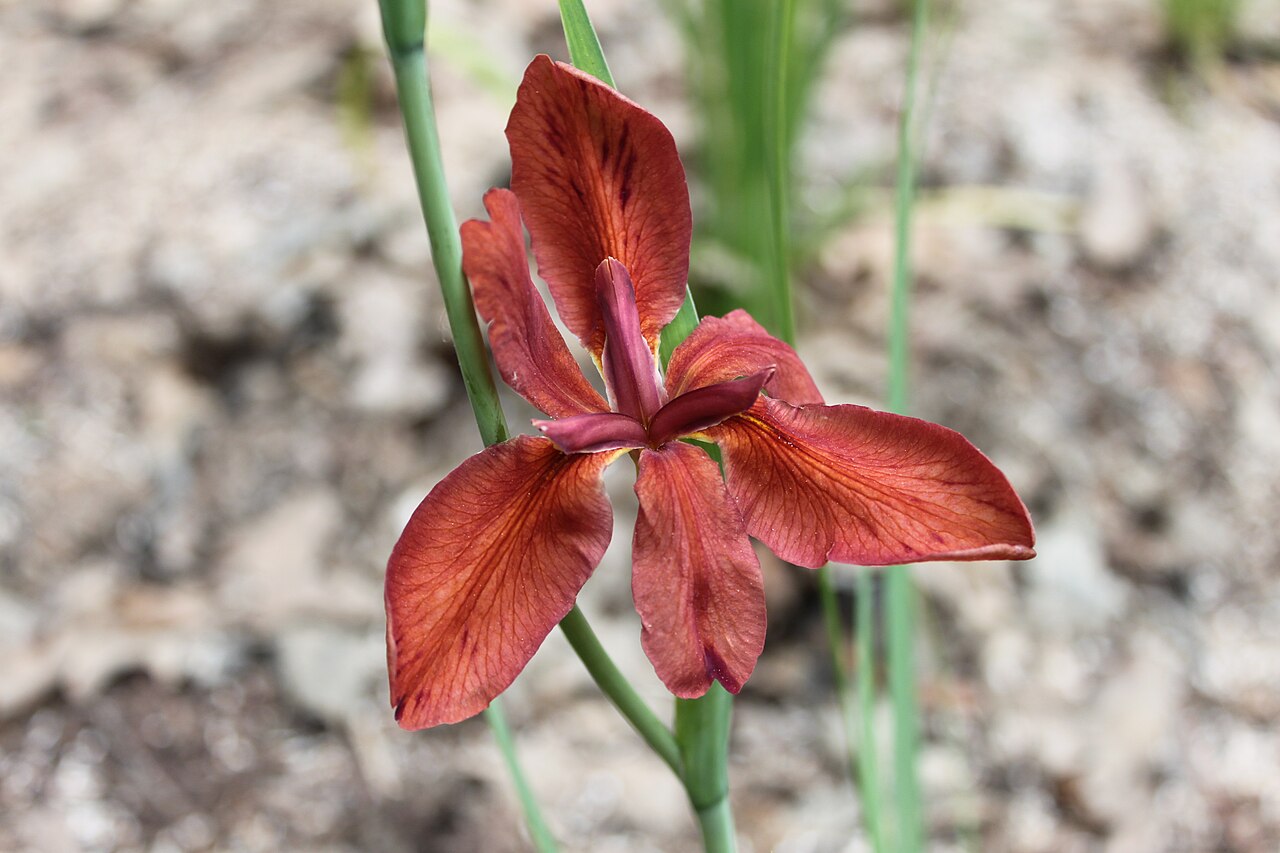
Flowers appear from March into May, one or two per leaf axil, with as many as four to six open on a stem over a period of about three weeks. Each bloom lasts only one to four days, but the succession is steady. Colors run from copper-red and brick-red to rust, bronze and orange-red, with a yellowish tubular center and cream anthers. Yellow-flowered forms turn up occasionally. The perianth is flat and wide-spread: three falls about 2 to 2.5 inches long and three drooping standards, both the same color, which is unusual among irises. The flowers are beardless and crestless, and only faintly fragrant.
If you find a red iris blooming in a Southern ditch, it is almost certainly this species. The other native irises of the region, such as Dwarf Crested Iris (I. cristata), and Virginia Iris (I. virginica), are blue to violet. The blue-purple Louisiana species I. brevicaulis hybridizes with Copper Iris where they meet, producing purple-red and mauve intermediates. Do not confuse the plant with the introduced orange Ditch Lily (Hemerocallis fulva), which has unrelated, lily-like flowers and grows from tuberous roots.
Fruit & Seeds
The fruit is a green, six-angled (hexagonal in cross-section) capsule, oval to elliptical and roughly 1.8 to 3 inches long, that ripens in summer and splits to release flat seeds stacked in two rows in each chamber. The capsule shape is nearly identical to that of I. brevicaulis. Seeds can be carried by water along bayous and ditches to start new colonies downstream.
Quick Facts
| Scientific Name | Iris fulva Ker Gawl. (syn. Iris cupraea, Iris fulvaurea) |
| Family | Iridaceae (Iris) |
| Plant Type | Herbaceous perennial, rhizomatous wetland iris |
| Mature Height | 24–36 in (60–90 cm) in flower; occasionally taller |
| Mature Spread | 12–24 in per clump, spreading steadily by rhizomes |
| Growth Rate | Moderate to fast in moist soil |
| Sun Exposure | Full Sun to Part Sun (6+ hours of sun for best flowering) |
| Water Needs | High. Moist to wet soil, tolerates standing water to about 6 in; poor drought tolerance |
| Soil Type | Saturated, organic-rich mucky loam or clay; also average garden loam kept consistently moist |
| Soil pH | 5.5–7.0 (acidic to neutral; tolerates some lime) |
| Bloom Time | March – May (mid-April to early May in most of Alabama and Mississippi) |
| Flower Color | Copper, brick-red, rust or orange-red with a yellow throat; rare yellow forms |
| Fall Color | None (foliage stays green and semi-evergreen through mild winters) |
| Fruit | Six-angled green capsule, 2–3 in long, splitting to release flat brown seeds |
| Deer Resistant | Yes (iris foliage and rhizomes are toxic and rarely browsed) |
| USDA Hardiness Zones | 6–9 |
Native Range
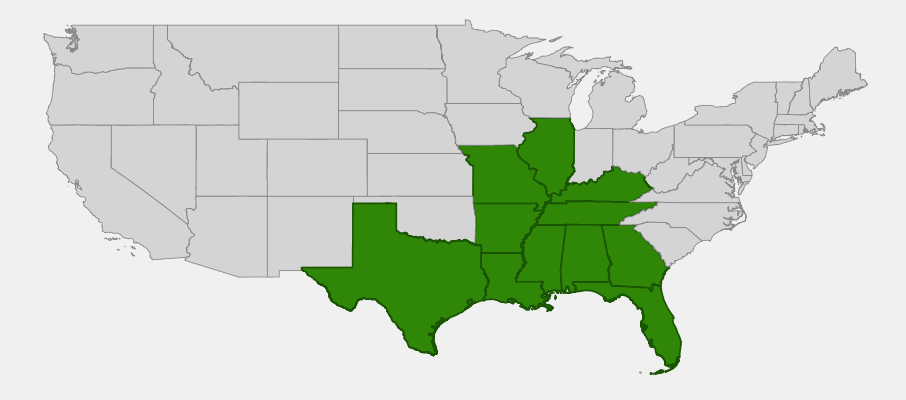
Copper Iris is native to the south-central and southeastern United States, from southern Illinois and Missouri south through the Mississippi Valley to Mississippi and Louisiana, and east along the Gulf Coast to Georgia. It also grows in Arkansas, Kentucky, Tennessee, Texas and Florida, and the Louisiana bayou country is generally considered its heartland. It is a Mississippi-Valley and Gulf-coast species, not an Appalachian or Piedmont one.
Within Alabama, Georgia and Mississippi the distribution is lopsided. It is at home in Mississippi, especially along the river bottoms, the Delta, and the Pearl River and Gulf Coast counties, and in the swamps and stream corridors of southwestern Alabama, including the Mobile-Tensaw delta. It reaches Georgia at the eastern edge of its range, on the coastal plain, where it is scattered and uncommon and not likely to be encountered in the Piedmont or mountains. Georgia gardeners, and those in the northern half of Alabama, can still grow it well as a garden plant, since it is cold-hardy well north of its native range, but they should think of it as an import from the Gulf Coast plain and give it that habitat.
Copper Iris is considered secure across its overall range, but it declines at the northern edge. It is listed as endangered in Kentucky and Tennessee and threatened in Illinois, where it survives in a few southern swamps, and habitat loss is the common cause everywhere: drained swamps, dredged ditches and herbicide runoff. The Illinois and Missouri outposts are why the plant also appears on the Illinois, Iowa and Missouri regional list.
📋 Regional plant lists featuring Copper Iris: Alabama, Georgia & Mississippi · Illinois, Iowa & Missouri
Growing & Care Guide
Copper Iris is easy to grow if you match its habitat and frustrating if you do not. It is a wetland plant first. Treat it like a pond-edge or rain-garden plant, with wet feet in the growing season and sun on its face, and it will spread happily. Put it in a dry perennial border and it will sulk, look scorched by July and slowly disappear.
Light
Full sun to part sun. Louisiana-type irises need about six hours of direct sun in summer to bloom well, and full sun is best for flower production. In the wild the plant often grows in the filtered light of open swamp forest, and it will flower there, but stems get lankier and the display is thinner. In the hot Deep South, a spot with morning sun and light afternoon shade is a good compromise.
Soil & Water
Water is the key. Plant it in soil that is saturated or at least reliably moist from fall through early summer. It grows naturally in water up to about 6 inches deep, so it is well suited to the edge of a pond, a ditch, a rain garden or a bog garden. Soil should be acidic to neutral (pH about 5.5 to 7.0) and rich in organic matter; the plant is more tolerant of lime than many wetland species but performs best in acid muck or loam. Drought tolerance is low. In summer dry spells water deeply and often, and never let the rhizomes bake. The Lady Bird Johnson Wildflower Center notes that leaves are more likely to persist through winter if the site is neither too wet nor too dry, so avoid extremes at either end.
Planting Tips
Set out potted plants or divisions in late summer through fall (August to October), when new growth begins, or in early spring. Plant the rhizome horizontally just beneath the soil surface, about an inch deep, with the leaves above the waterline, and space clumps 1 to 2 feet apart. In a rain garden, place it in the wettest third, where water lingers after storms. For sites that dry out in summer, plant in a sunken container or amend heavily with compost and mulch with pine straw or shredded leaves. Buy nursery-propagated plants; wild-collecting depletes the natural populations, several of which are already rare at the edge of the range.
Pruning & Maintenance
Maintenance is light. Remove spent flower stalks after bloom unless you want seed for wildlife or propagation, and trim tattered foliage back to 6 to 8 inches in late summer when the plant naturally looks its worst, so that fresh fall growth is unobstructed. A light dressing of balanced fertilizer in early fall and again in late winter keeps flowering strong. Thin colonies every few years: this iris spreads by rhizomes and can crowd out slower neighbors. Iris borer (Macronoctua onusta) is the main pest, tunneling into leaves and rhizomes; cutting back and disposing of old foliage in winter removes overwintering eggs. Slugs and snails may nibble fresh fall leaves. All parts of the plant are toxic if eaten and the sap can irritate skin, so wear gloves when dividing.
Propagation
Division is the standard method. Every three to four years, lift the clump in late summer, cut the rhizome into sections with at least one fan of leaves, and replant right away. Seed is also effective: all native irises can be grown from seed. Collect capsules as they turn brown in summer, sow them fresh or after a cold, moist spell, and keep the flat wet. Germination is slow and uneven, and seedlings flower in two to three years. Seedlings from mixed populations vary in color, and the plant hybridizes readily with other Louisiana irises, so seed from a garden that also grows cultivars will not come true.
Landscape Uses
Copper Iris earns its place in many settings:
- Rain gardens and bioswales where water stands for days after storms
- Pond and stream margins, planted in the shallows or on the wet bank
- Bog and water gardens, in mixed plantings with Lizard’s Tail and Cardinal Flower
- Hummingbird gardens, especially in spring before most nectar plants open
- Roadside ditch and drainage swale plantings that would otherwise be mown turf
- Shoreline stabilization and erosion control, thanks to dense rhizome mats
- Restoration of wet meadows and bottomland forest edges
In a mixed planting, pair it with Lizard’s Tail in the shallows, Cardinal Flower at the bank for a red-on-red display that feeds hummingbirds from spring into fall, and Virginia Sweetspire on the drier margin, where its own wet-tolerant, suckering habit will stitch the bank together.
Wildlife & Ecological Value
Copper Iris is a small plant with an outsized role in wetland food webs, especially in spring when few other nectar sources are open in the swamp.
For Pollinators
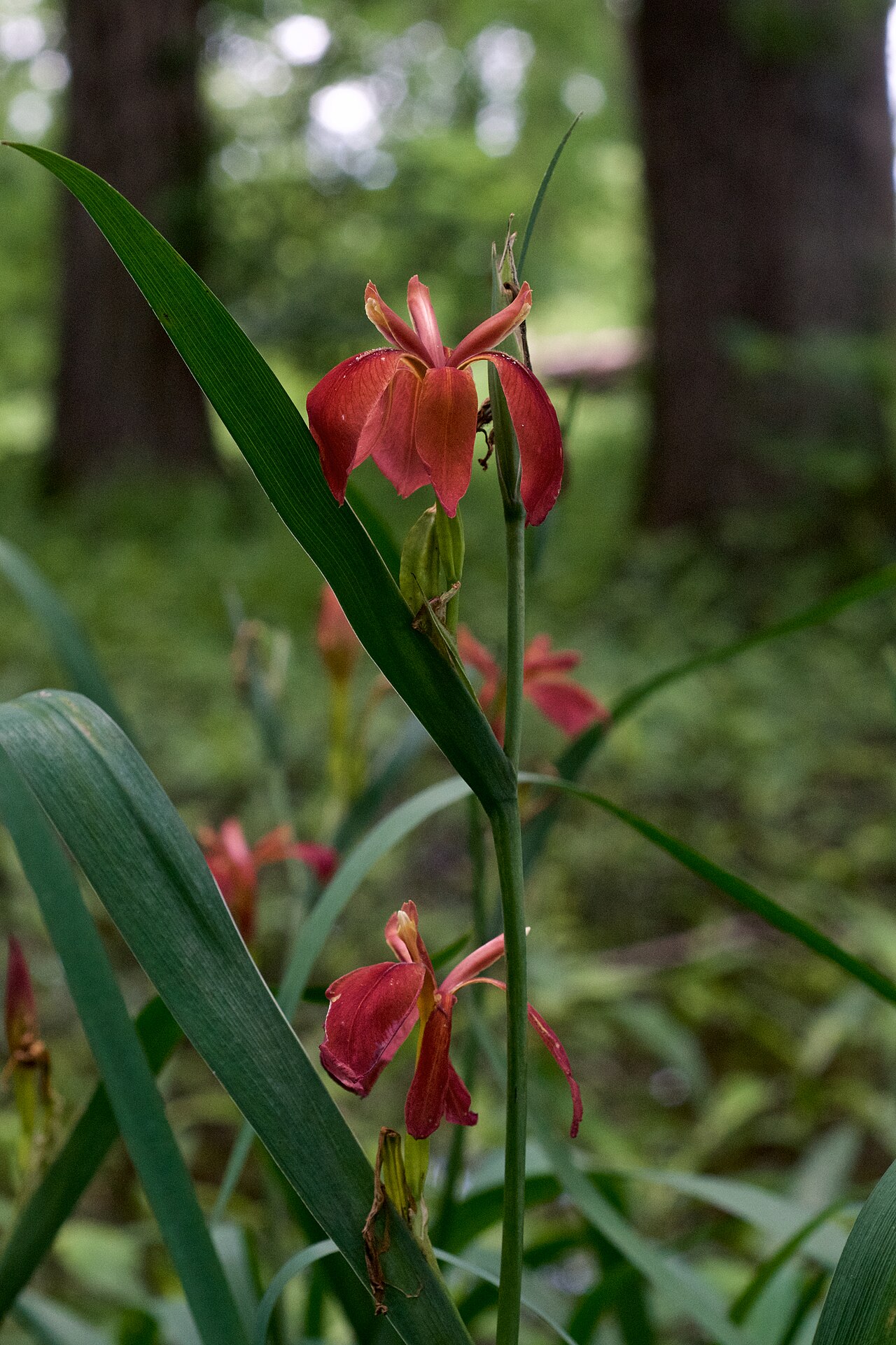
The flat, red, drooping flower is built for hummingbirds. Ruby-throated Hummingbirds, which arrive along the Gulf Coast as the iris begins to bloom in March and April, are its main pollinator, hovering to probe for nectar. Bees also visit for nectar and pollen, and butterflies stop by. Where Copper Iris grows near its blue-flowered relatives, hummingbird preference for red flowers is thought to help keep the species distinct in the wild.
For Birds
Beyond hummingbirds, the dense leaf clumps provide nesting cover and foraging habitat for marsh and swamp songbirds, and the foliage shelters the insects and spiders they feed on. Audubon’s famous plate of a pair of Northern Parulas (a warbler of Southern swamps) perched on a Louisiana Flag, painted by his assistant Joseph Mason, is a reminder of how naturally this plant fits the habitat of southern woodland birds.
For Mammals & Aquatic Life
Iris foliage and rhizomes are toxic, so deer, rabbits and livestock generally leave the plants alone. Muskrats are known to feed on iris rhizomes in some wetlands. In the water, the dense fibrous roots and submerged leaf bases shelter tadpoles, small fish and aquatic invertebrates, and hold soft mud in place.
Ecosystem Role
As a colony-forming emergent, Copper Iris stabilizes soft banks, filters sediment and nutrients from runoff, and adds spring structure and color to shallow water. It is classed as an obligate wetland plant (OBL), meaning it almost always grows in wetlands, and its presence is a reliable indicator of healthy freshwater marsh or swamp forest. The Louisiana iris complex it belongs to, including I. brevicaulis, I. hexagona, I. giganticaerulea and I. nelsonii, is one of the most closely studied cases of natural hybridization in North American plants, and Copper Iris is a key member of that group.
Cultural & Historical Uses
Copper Iris was first collected by botanists on the banks of the Mississippi River near New Orleans in 1811, and formally described by John Bellenden Ker Gawler the following year. The bright red flag (an old English word for iris) then found its way into European gardens, where it was prized as a red-flowered rarity, and it was later awarded the Royal Horticultural Society’s Award of Garden Merit.
In 1821 Joseph Mason painted the flower stalk in Plate 15 of Audubon’s Birds of America, and Audubon added the two parulas. Gardeners and breeders in south Louisiana and across the Gulf South recognized that I. fulva, along with I. brevicaulis, I. giganticaerulea and I. hexagona, would cross to give a spectrum of colors from red to yellow, blue and purple. Today there are hundreds of named Louisiana iris cultivars, and Copper Iris is the red gene pool behind many of them. William Rickatson Dykes raised the first well-known hybrid, Iris × fulvala, from Copper Iris and I. brevicaulis, and it was more free-flowering than either parent.
Louisiana irises are also central to the gardening culture of the Gulf South, from New Orleans backyards to Mississippi pond edges, and to regional garden festivals and society shows. Wild Copper Iris is now a symbol of the wet, fertile places that made that culture possible, and of the need to protect them.
Frequently Asked Questions
Is Copper Iris really native to Alabama, Georgia and Mississippi?
Yes, with a caveat about where. It is a Mississippi-Valley and Gulf-Coast species: firmly native in Mississippi and in southwestern Alabama, and reaching Georgia only on the coastal plain, where it is uncommon. It grows well as a garden plant across all three states.
Can Copper Iris grow in a regular garden bed?
Only if you can keep the soil consistently moist. It has poor drought tolerance, and a plain, well-drained bed will leave it stunted and scorched by midsummer. It does best in a rain garden, at the edge of a pond or in a bog, or in a bed with heavy compost and mulch and regular watering.
Is Copper Iris the same as the orange Ditch Lily (Hemerocallis fulva)?
No. The two share the epithet fulva and a coppery-orange color, and both are commonly seen along Southern roadsides, but they are unrelated. The iris grows from a rhizome with sword-shaped leaves and blooms in spring; Ditch Lily is an introduced daylily that blooms in early summer.
Do hummingbirds visit Copper Iris?
Yes. Its red, flat-faced flowers are adapted to hummingbird pollination, and Ruby-throated Hummingbirds are its principal visitors. The bloom period coincides with their spring arrival on the Gulf Coast.
Is it safe around pets and children?
Treat it as toxic. All parts of irises, especially the rhizomes, can cause vomiting and digestive upset if eaten, and the sap can irritate skin. Plant it where pets are unlikely to chew it, and wear gloves when dividing.

Looking for a nursery that carries Copper Iris?
Browse our native plant nursery directory: Alabama · Georgia · Mississippi