Littleleaf Mockorange (Philadelphus microphyllus)
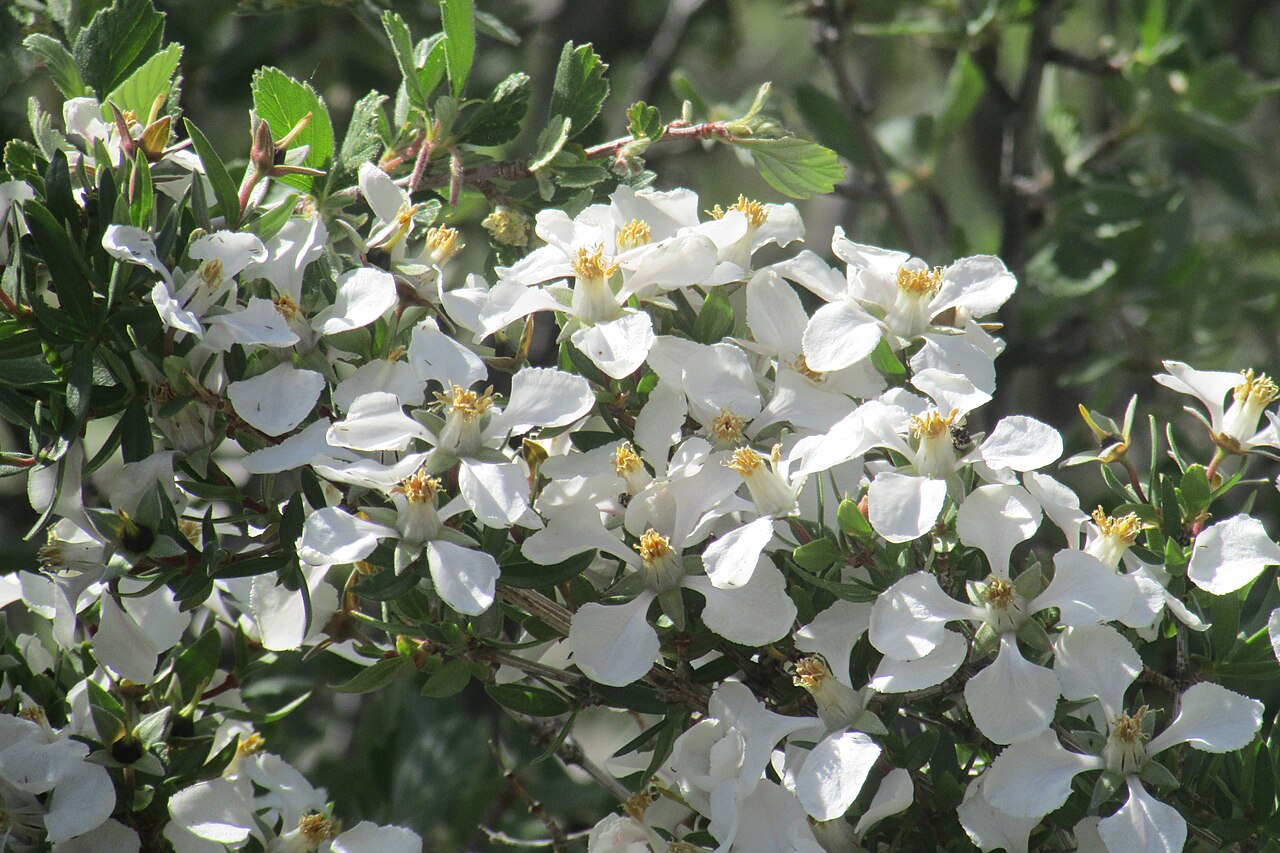
Philadelphus microphyllus, commonly known as Littleleaf Mockorange or Desert Syringa, is the wild mock orange of the canyon country. Where the cultivated mock oranges of eastern gardens are big, floppy shrubs that need regular water, this one is a compact, twiggy native that grows straight out of sandstone cracks and limestone ledges across Utah, western Colorado, and the rest of the Southwest — and for two or three weeks in late spring it covers itself in inch-wide white flowers whose orange-blossom perfume can carry fifty feet down a canyon on a warm evening.
It is a plant that rewards a closer look. The leaves are tiny (the species name means “small-leaved”), gray-green, and neatly paired along wiry stems; the older wood peels in papery reddish-brown strips; and after the flowers fade, hard little four-parted capsules hang on through the winter like miniature acorn cups. Mature plants stay a tidy 3 to 6 feet tall and wide, need no supplemental water once established, and shrug off alkaline soil, reflected heat, and winter cold from Zone 5 to Zone 9. Few native shrubs in the Intermountain West combine that toughness with that much fragrance.
Littleleaf Mockorange is also a plant with a long horticultural pedigree. In 1884 the French breeder Victor Lemoine crossed it with the European Philadelphus coronarius to create Philadelphus × lemoinei, the first of the compact, richly scented hybrid mock oranges that still fill nursery catalogs today. The wild parent, however, remains the better choice for dry Western gardens: smaller, hardier, longer-lived on poor soil, and infinitely more at home on a rocky slope.
Identification
Littleleaf Mockorange is a rounded to spreading deciduous shrub, usually 3 to 5 feet tall in the wild and occasionally reaching 6 to 7 feet in a favorable garden site. It grows as a dense thicket of slender, much-branched stems arising from a woody base, and old plants on cliffs can look more like a tangle of wiry gray twigs than a shrub until they leaf out. The species is highly variable across its wide range, with four recognized varieties that differ mainly in leaf size, hairiness, and the color of the calyx.
Bark & Stems
Young twigs are slender, reddish to tan, and coated with short, stiff, flattened hairs that you can feel by running a stem between your fingers. By the second or third year the bark turns reddish-brown to gray and begins to split and shred in thin papery strips — a classic mock orange trait shared with its relative Lewis’ Mockorange of the Northwest. The pith is white and solid on very young growth, and the branching is strictly opposite, which helps separate the plant from the alternate-branched shrubs (serviceberry, cliffrose, mountain mahogany) it often grows beside.
Leaves
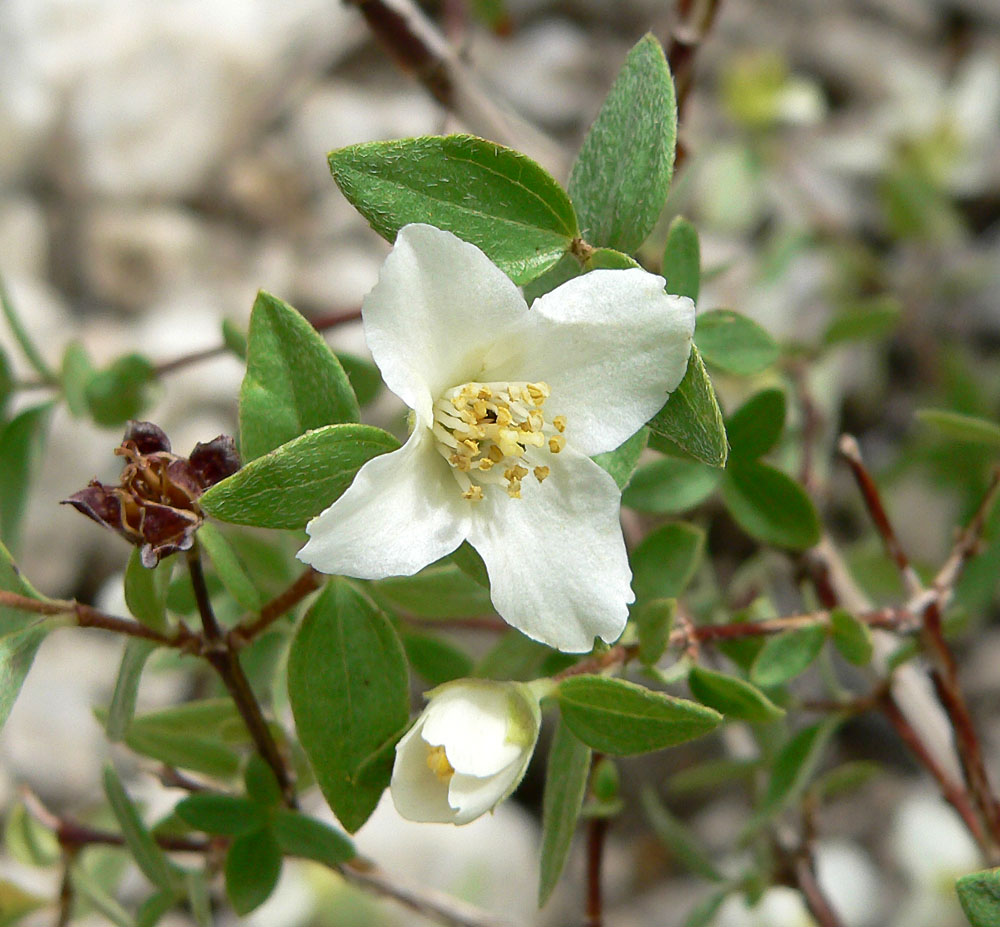
The leaves are small — typically ⅜ to 1 inch (1–2.5 cm) long and only ⅛ to ⅜ inch wide — and arranged in opposite pairs along the stem. Each leaf is lance-shaped to narrowly oval, with a pointed tip, an untapered base, and smooth (entire) margins. Three faint veins run from the base. The upper surface is green to gray-green and may carry a few appressed hairs; the underside is paler and often densely hairy, giving plants in the harshest sites a silvery cast. Leaves emerge in late April or May, hold through the summer with little wilting, and drop after turning a modest yellow in October.
Flowers
The flowers are the reason to grow this plant. They appear singly or in clusters of two or three at the tips of short side shoots from late May into July, depending on elevation. Each is ¾ to 1¼ inches (2–3 cm) across with four (occasionally five) broad, pure white petals arranged in a shallow cross, surrounding a dense central brush of 20 to 40 bright yellow stamens. The calyx beneath is four-lobed and, in var. argyrocalyx of New Mexico, conspicuously silvery-hairy. The fragrance is sweet and citrusy — the “mock orange” of the common name — and is strongest in the evening, when the flowers are working hardest to attract pollinators.
Fruit & Seeds
Pollinated flowers ripen into small, hard, top-shaped capsules about ¼ inch (5–8 mm) long, crowned by the persistent calyx lobes. The capsules turn brown in late summer, split open along four seams to release dozens of tiny, tailed seeds, and then remain on the branches through winter — a useful identification feature when the shrub is bare. An old plant carries a mix of fresh brown capsules and weathered gray ones from previous years.
Quick Facts
| Scientific Name | Philadelphus microphyllus |
| Family | Hydrangeaceae (Hydrangea) |
| Plant Type | Deciduous Shrub |
| Mature Height | 3–6 ft (1–2 m) |
| Mature Spread | 3–6 ft (1–2 m) |
| Growth Rate | Slow to moderate |
| Sun Exposure | Full Sun |
| Water Needs | Low (Drought Tolerant) |
| Soil Type | Rocky, gravelly, or sandy; must drain freely |
| Soil pH | 6.5–8.5 (neutral to alkaline) |
| Bloom Time | Late May – July |
| Flower Color | White with yellow stamens; strongly fragrant |
| Fall Color | Yellow |
| Fruit | Small brown 4-valved capsules, persistent |
| Deer Resistant | Moderate (browsed in winter when other forage is scarce) |
| USDA Hardiness Zones | 5–9 |
Native Range
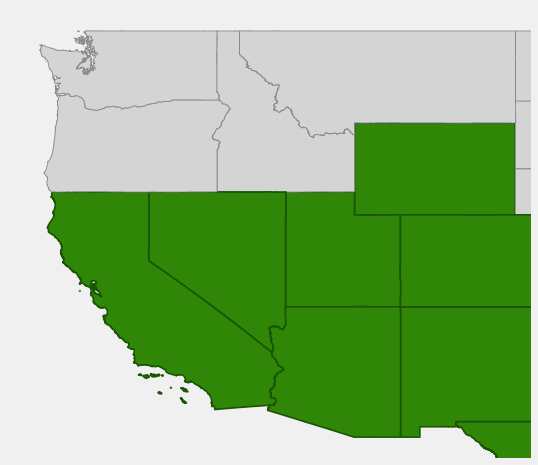
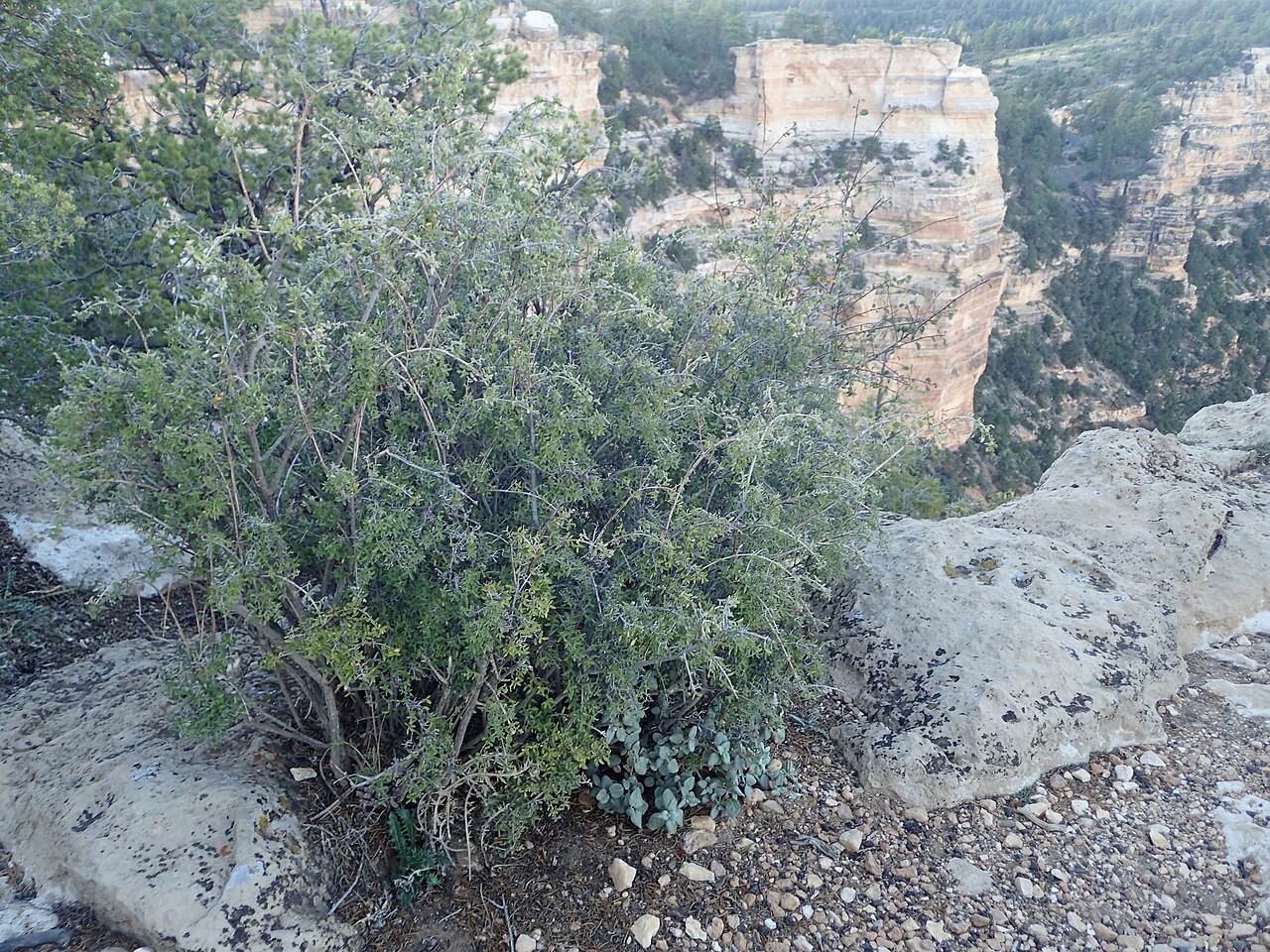
Littleleaf Mockorange is native to the southwestern quarter of the United States and adjacent northern Mexico. Its range runs from the mountains of southern California and Nevada east across Arizona, Utah, and Colorado to New Mexico and the Trans-Pecos of Texas, and north through the Colorado Plateau as far as southern Wyoming. In Utah it is a plant of the canyon country and the foothills of the Wasatch, Uinta, and southern plateaus; in western Colorado it is common in the sandstone and shale canyons of the Colorado, Gunnison, and Dolores drainages, including the cliffs of Black Canyon of the Gunnison where the photograph at the top of this page was taken.
The shrub is a specialist of rocky ground. It grows on cliff faces, talus slopes, canyon walls, and rimrock, frequently with its roots wedged into cracks where a little extra moisture collects, at elevations from roughly 3,000 to 10,000 feet (900–3,000 m). Its usual company is pinyon–juniper woodland and the ponderosa pine and Gambel oak belt above it, though in the Mojave and Sonoran mountains it occurs in oak chaparral and on desert peaks well above the creosote flats. Across that span it tolerates everything from the near-freezing winters of the Uinta foothills to the furnace summers of the Grand Canyon rim.
Four varieties are recognized. Var. microphyllus is the widespread form of Utah, Colorado, and Arizona; var. pumilus is a dwarf of high, dry ridges in Utah, Nevada, and Arizona; var. argyrocalyx, with a silvery-hairy calyx, is centered in New Mexico; and var. madrensis belongs to the Sierra Madre of Mexico. NatureServe ranks the species globally secure (G5), and it is not listed as threatened in any state.
📋 Regional plant lists featuring Littleleaf Mockorange: Utah & Western Colorado
Growing & Care Guide
Littleleaf Mockorange is one of the easiest native shrubs to keep alive in a dry Western garden and one of the easiest to kill with kindness. Everything about it is adapted to rock, sun, and scarcity: give it drainage and light and leave it alone, and it will outlive the gardener. Give it rich soil, shade, and a drip emitter on a timer, and it will grow lank, bloom sparsely, and eventually rot at the crown.
Light
Full sun produces the densest plants and by far the heaviest bloom. The shrub tolerates light afternoon shade — in the wild it often grows on north- and east-facing cliffs that are shaded part of the day — but in more than half-day shade it becomes open and leggy and flowers poorly. Reflected heat from walls, boulders, and gravel mulch does not bother it in the least.
Soil & Water
Drainage matters more than fertility. Sandy, gravelly, or rocky soils are ideal; heavy clay is acceptable only on a slope or in a raised bed where water cannot pool around the crown. The plant is comfortable across a wide pH range and thrives in the alkaline, calcium-rich soils that defeat many garden shrubs. Water new plants deeply every week or two through their first summer to push roots down into the subsoil. From the second year on, a monthly deep soak during prolonged drought is plenty, and established plants in areas receiving 12 or more inches of annual precipitation can be left entirely to the weather. Avoid overhead sprinklers that keep the foliage and crown wet.
Planting Tips
Plant in early spring or in September and October, when cooler nights let roots establish before summer heat. Dig the hole no deeper than the root ball and two to three times as wide, roughen the sides, and backfill with the native soil — no amendments. Set the crown slightly high so that settling never buries it. A 2-inch mulch of crushed rock or pea gravel keeps the crown dry and mimics the plant’s natural setting; avoid deep organic mulches piled against the stems. Space plants 4 to 5 feet apart for an informal hedge or mass, or set a single specimen where its fragrance can be enjoyed near a path, patio, or bedroom window.
Pruning & Maintenance
Littleleaf Mockorange blooms on the previous season’s wood, so any pruning should be done immediately after flowering, never in late winter. Young plants rarely need more than the removal of dead twigs. On older shrubs, cut a few of the oldest, grayest stems to the ground each year right after bloom; this renewal pruning keeps the plant vigorous and flowering from top to bottom without destroying its natural rounded shape. Never shear it into a formal ball — you will remove next year’s flowers and expose the interior twigs. The species has no serious insect or disease problems in the West.
Propagation
Seed is abundant and easy to collect from the brown capsules in late summer. Sow it on the surface of a gritty mix (the seeds need light), give it 30 to 60 days of cold-moist stratification or simply sow outdoors in fall, and expect germination in spring. Softwood cuttings taken in June, after flowering, root readily under mist or in a covered pot with bottom heat, and hardwood cuttings taken in late fall will root in a cold frame. Seed-grown plants may take three or four years to bloom; cuttings flower sooner.
Landscape Uses
The compact size, drought tolerance, and fragrance make this an unusually versatile native shrub:
- Xeriscape and waterwise foundation plantings — a fine-textured 4-foot mound that never needs irrigation once established
- Rock gardens and dry-stone walls — its natural home; plant it at the top of a wall so the branches spill over
- Slopes and erosion control — the fibrous, rock-gripping roots hold loose ground
- Informal hedges and screens — mixed with Apache Plume, Cliffrose, and Fernbush for a sequence of bloom from May through August
- Pollinator and fragrance gardens — site it beside a path or seating area to catch the evening scent
- Restoration of disturbed rocky sites — road cuts, quarry edges, and canyon rims
- Companion planting — pairs naturally with Rocky Mountain Penstemon, Blue Flax, Sulphur Buckwheat, Indian Ricegrass, and Gambel Oak
Wildlife & Ecological Value
On the cliffs and slopes where it grows, Littleleaf Mockorange is often one of only a handful of woody plants, which makes it disproportionately important to the animals that live there. Its value comes less from berries or seed — it produces neither in quantity — than from nectar, pollen, cover, and browse.
For Pollinators
The open, bowl-shaped flowers with their exposed brush of stamens are a classic generalist design, and they draw a wide cast of visitors: bumblebees, mason bees, sweat bees, and other native bees collect the abundant pollen, while honeybees, syrphid flies, and butterflies take nectar. Because the shrub blooms in late spring and early summer — after the serviceberries and before the rabbitbrushes — it bridges a gap in the foothill nectar calendar. The evening-strengthening fragrance suggests that moths visit as well, and the flowers stay open through the night.
For Birds
The dense, wiry crown provides nesting sites and escape cover for canyon-dwelling songbirds such as Bewick’s Wren, Juniper Titmouse, Bushtit, and Spotted Towhee, and the shrub’s insect visitors feed nestlings. Chipping Sparrows and finches glean the tiny seeds from split capsules in late summer, and hummingbirds occasionally work the flowers.
For Mammals
Mule deer, desert bighorn sheep, and elk browse the twigs and foliage, especially in winter when more palatable forage is buried or gone; on some Utah winter ranges it is a significant part of the deer diet. Rock squirrels and chipmunks shelter in the branch tangle and take seed. Because the plant grows on cliffs, much of its browse is out of reach, which is one reason old specimens persist on heavily used ranges.
Ecosystem Role
As a rock-crevice pioneer, Littleleaf Mockorange helps stabilize talus and canyon walls, traps windblown soil and leaf litter around its base, and creates small pockets of shade and organic matter where penstemons, buckwheats, and grasses can establish. Its deep, spreading roots draw moisture from fractures that shallower-rooted plants cannot reach, and it resprouts from the root crown after fire, helping rocky slopes recover.
Cultural & Historical Uses
The straight, hard, pithy-centered stems of mock oranges were prized throughout the West by Indigenous peoples for arrow shafts, and the genus is still called “arrowwood” in parts of its range. Where Littleleaf Mockorange was the local species — among the Diné (Navajo), Hopi, Havasupai, and Southern Paiute — its slender shoots served the same purpose, and the tough wood was worked into small tools, pipe stems, and cradleboard parts. The flowers and leaves contain saponins and were crushed in water to make a mild lather for washing hair and skin, a use recorded for several mock orange species across the West.
The plant entered Western botany in 1853, when the Harvard botanist Asa Gray described it from specimens collected on the Mexican Boundary Survey. Within a few decades seed had reached Europe, and in 1884 Victor Lemoine of Nancy, France, used it as the pollen parent of Philadelphus × lemoinei. That cross — the small, hardy, intensely fragrant American species on one side and the large-flowered European sweet mock orange on the other — produced the compact “Lemoine hybrids” that revolutionized the genus in gardens. Nearly every modern mock orange cultivar with a neat habit and a strong scent, from ‘Belle Etoile’ to ‘Manteau d’Hermine’, carries some Littleleaf Mockorange in its ancestry.
Today the species is grown by native plant nurseries across the Southwest and Intermountain region, and it is increasingly used by highway departments, parks, and utilities for revegetating rocky cuts and canyon-edge developments. For home gardeners it is one of the best answers to the perennial Western question of what will bloom, smell wonderful, and survive on a hot, dry slope without a hose.
Frequently Asked Questions
Is Littleleaf Mockorange the same as the mock orange sold at garden centers?
No. Most garden-center mock oranges are Philadelphus coronarius from Europe or hybrids descended from it. They grow 8 to 12 feet tall, need regular water, and often lose their fragrance in breeding. Littleleaf Mockorange is the compact, drought-tolerant native of the Southwest — half the size, hardier on poor soil, and reliably fragrant. It is, however, one of the parents of the popular Lemoine hybrids.
How much water does it need?
Very little once established. Water deeply every week or two through the first summer, then taper off. Mature plants in most of Utah and western Colorado survive on natural precipitation, with a deep soak once a month during severe drought producing more flowers.
When should I prune it?
Right after it finishes flowering in early summer. It blooms on last year’s wood, so pruning in winter or early spring removes the coming season’s flowers. Remove a few of the oldest stems at ground level each year rather than shearing the whole plant.
Will it grow in clay soil?
Only if the site drains — on a slope, in a raised or bermed bed, or with the crown set high and mulched with gravel. Standing water around the roots in winter is the surest way to lose it. On flat clay ground, choose Golden Currant or Chokecherry instead.
Is it deer resistant?
Moderately. Deer generally ignore it during the growing season when better forage is available, but they will browse the twigs in winter, particularly in heavy snow years. Young plants in areas with high deer pressure benefit from a wire cage for the first two or three winters.