
Bluebead Lily (Clintonia borealis)
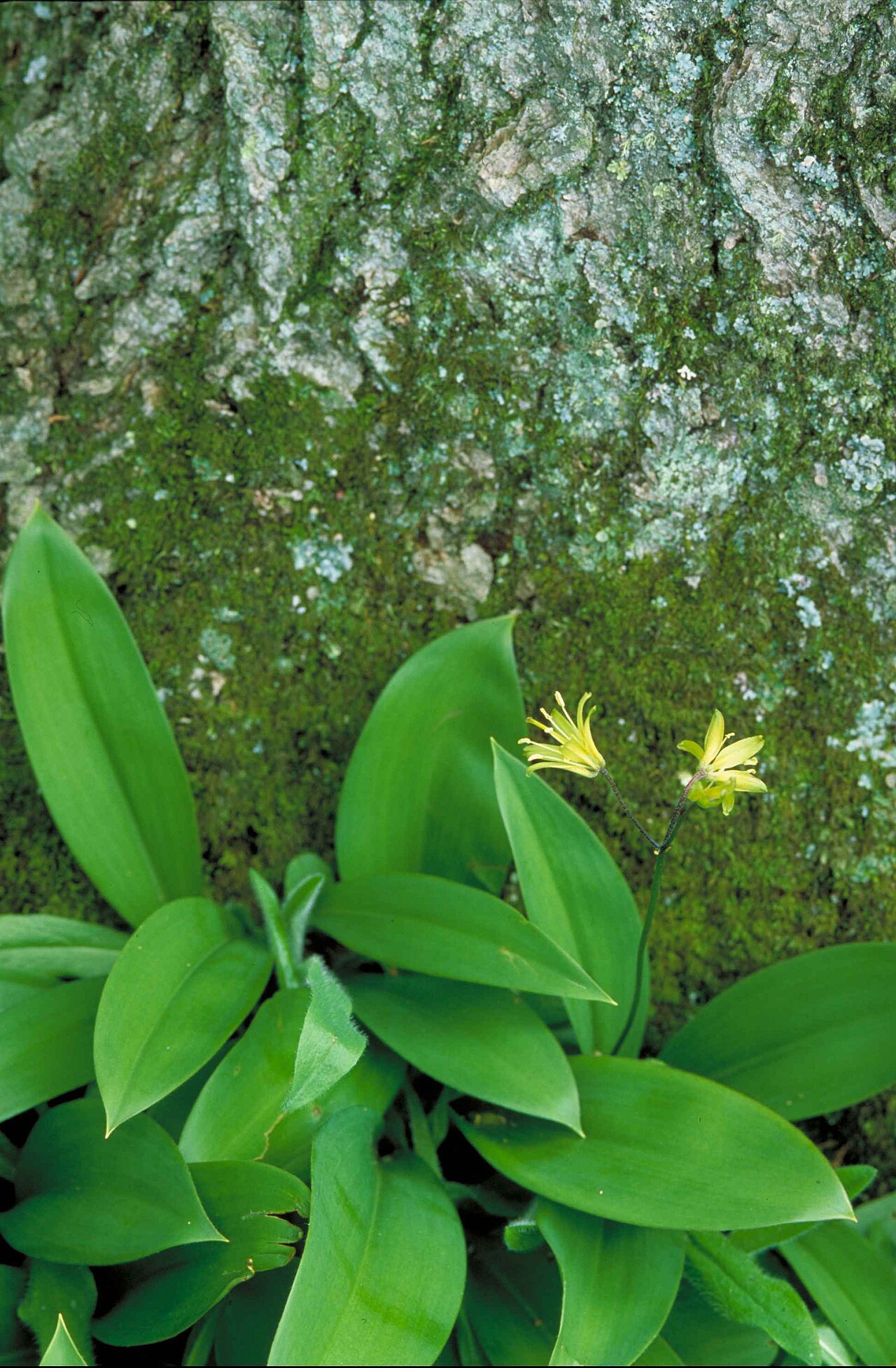
Bluebead lily (Clintonia borealis) is a small native perennial of cool eastern woodlands. Several broad, glossy leaves gather at the base of each shoot, and a slender stalk lifts a few yellow to greenish-yellow flowers above them. Later, the same stalk carries the conspicuous blue fruits that give the plant its name. The sequence from quiet foliage to nodding flowers to bright berries makes it valuable in a woodland garden seen at close range.
This is a plant for the right woodland conditions, not simply any place that is shaded. It needs a cool, moisture-retentive root environment, and a hot bed beneath a building overhang may fail even though it receives little direct sun. In New England, an existing moist woodland edge or a sheltered garden with rich leaf-derived soil is a more natural fit. The regional table gives a typical height of twelve inches; flowering stalks can be taller, reaching roughly twenty inches in botanical descriptions.
Use nursery-propagated plants and allow time for the shallow rhizomes to build a colony. Bluebead lily is slow-growing, and a small group can be overwhelmed by vigorous groundcovers or damaged by casual digging before it has a chance to establish. Its fruit is ornamental and useful to wildlife, but it should not be treated as a garden snack. This guide focuses on recognizing and growing the plant, not on foraging.
Identification
Stems & Rhizomes
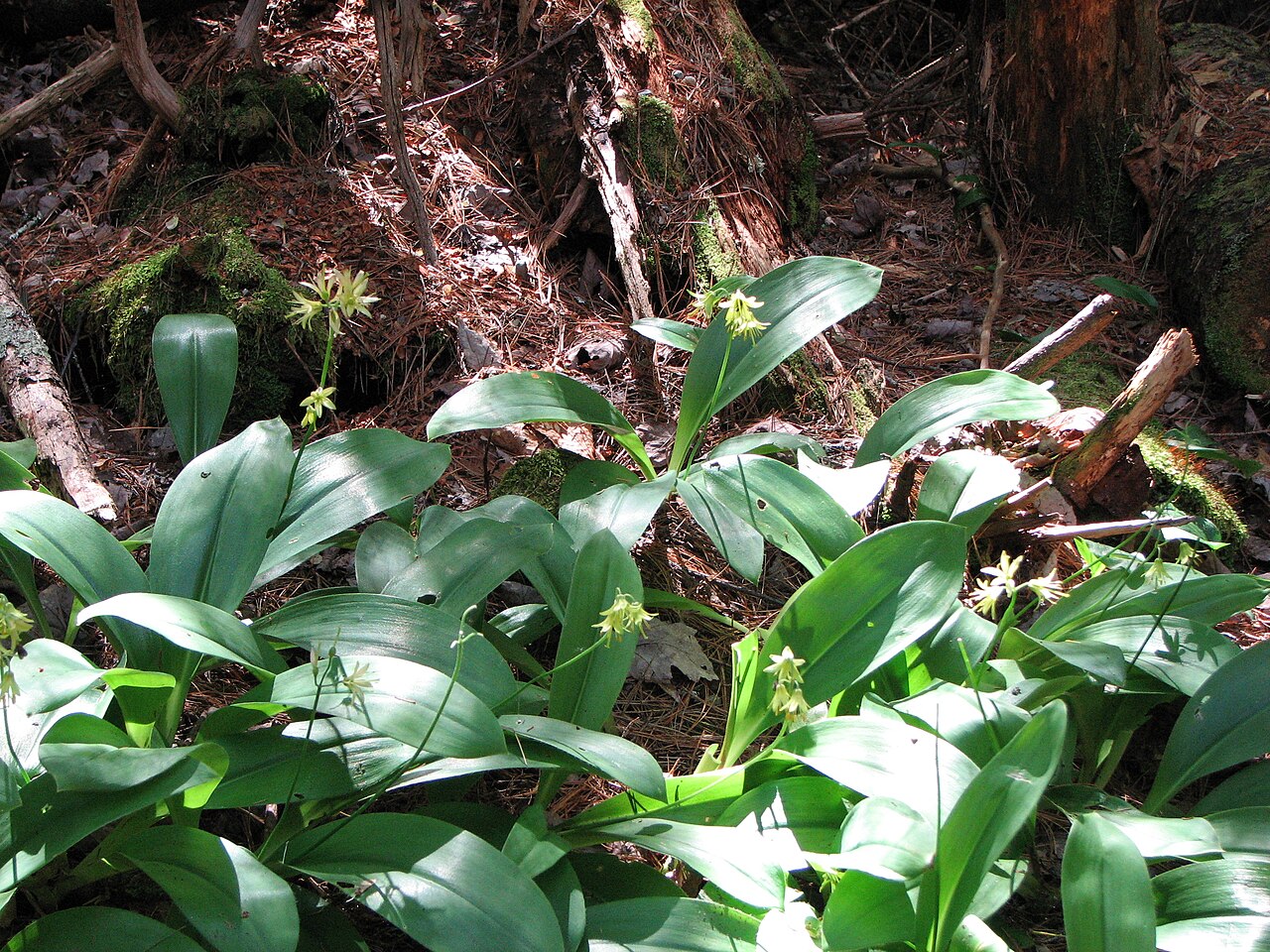
The perennial framework is an underground spreading rhizome. Above it, a short leafy shoot supports a separate, mostly leafless flower stalk. There is no woody bark or permanent upright stem to prune. Colonies become visible as groups of similar leaf clusters rising through the litter. When the plant is not flowering, take care not to assume that every broad-leaved woodland shoot nearby is the same species; several unrelated plants share that general silhouette.
Leaves
Usually two to four broad, glossy leaves curve outward near the base. They are oblong to elliptic, with a strong lengthwise orientation to the veins and a substantial, smooth-looking surface. Fine hairs may be visible along the margins. The leaves are much broader than those of a grass and are not carried in the paired arrangement of a Solomon’s seal stem. Leave the leaves attached when checking identification; tearing away a leaf to compare it can remove a large part of a small shoot’s working surface.
Flowers
A short cluster of nodding, bell-like flowers ends the slender stalk. Each flower has six yellow to yellow-green tepals rather than a round ball of petals. Flora of North America describes clusters usually containing three to eight flowers, sometimes more, and flowering from May into early July across the range. Timing in an individual garden depends on latitude, elevation, and spring weather. The flowers distinguish this species from eastern Clintonia umbellulata, which has smaller white flowers in a more crowded cluster.
Fruit & Seeds
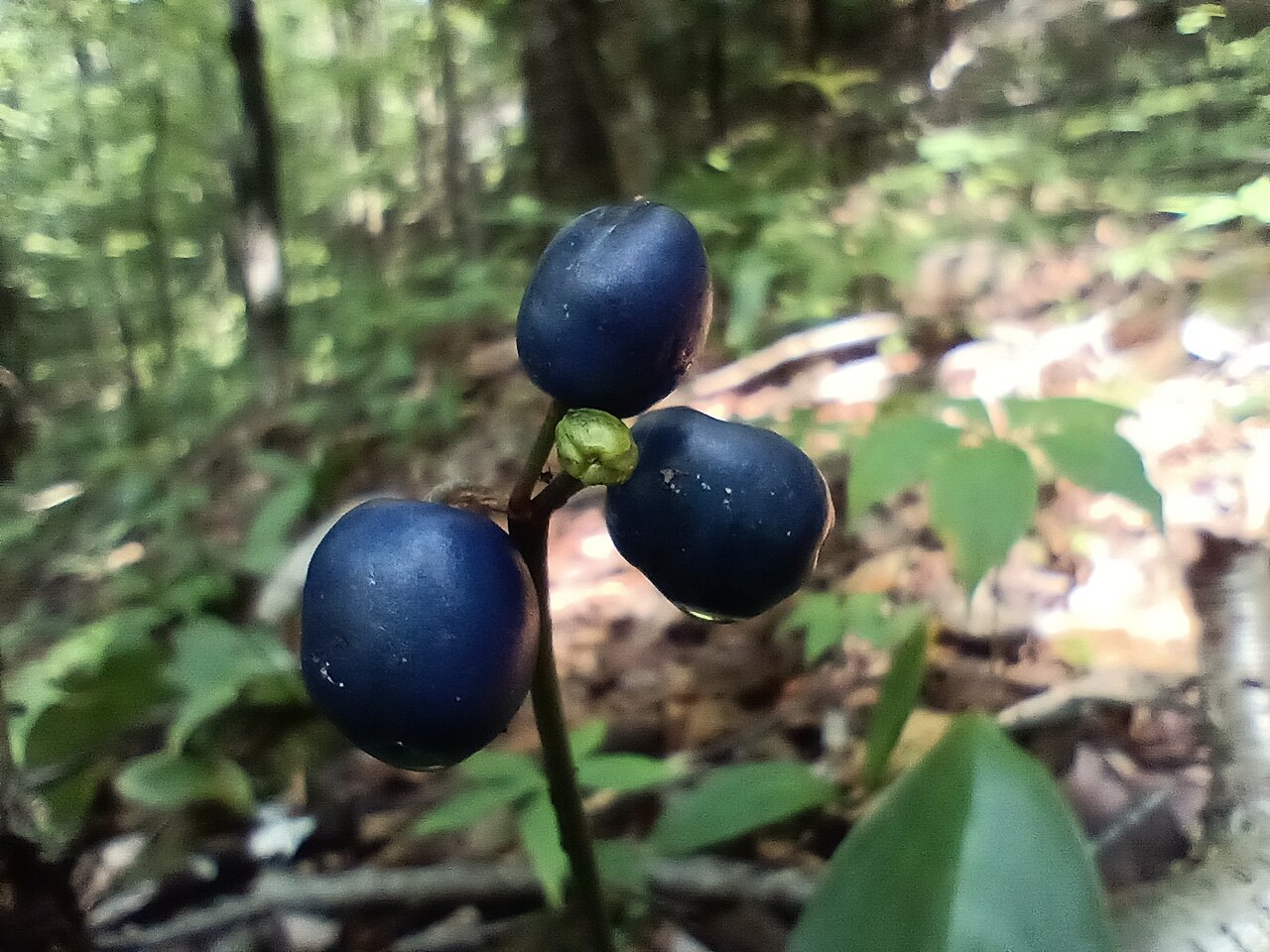
The fruits ripen to a striking deep or ultramarine blue and stand above the leaf cluster. Their strong color can make the plant easier to spot in fruit than in flower. They are not blueberries: this species belongs to the lily family, not the heath family, and fruit color is not an edibility test. NC State treats the berries as potentially poisonous and unsuitable for eating. Leave them for observation and wildlife rather than encouraging tasting, particularly in gardens used by children.
Quick Facts
| Scientific Name | Clintonia borealis (Aiton) Raf. |
| Family | Liliaceae (lily family) |
| Plant Type | Native rhizomatous woodland perennial |
| Mature Height | About 6–12 inches in the garden; flowering stalks may reach about 20 inches |
| Mature Spread | About 6–12 inches per small clump; colonies broaden slowly |
| Growth Rate | Slow |
| Sun Exposure | Part shade to shade; cool dappled light |
| Water Needs | Average to moist, with consistent moisture; avoid prolonged drying |
| Soil Type | Humus-rich, cool woodland soil |
| Soil pH | Acidic conditions preferred |
| Bloom Time | Late spring to early summer; approximately May–early July across the range |
| Flower Color | Yellow to greenish yellow |
| Fall Color | Deciduous; foliage yellows and dies back |
| Fruit | Showy blue berries; not for human consumption |
| Deer Resistant | Do not assume resistance; protect vulnerable new growth where browsing occurs |
| USDA Hardiness Zones | 2–8 in horticultural references; cool summer conditions are critical |
Native Range
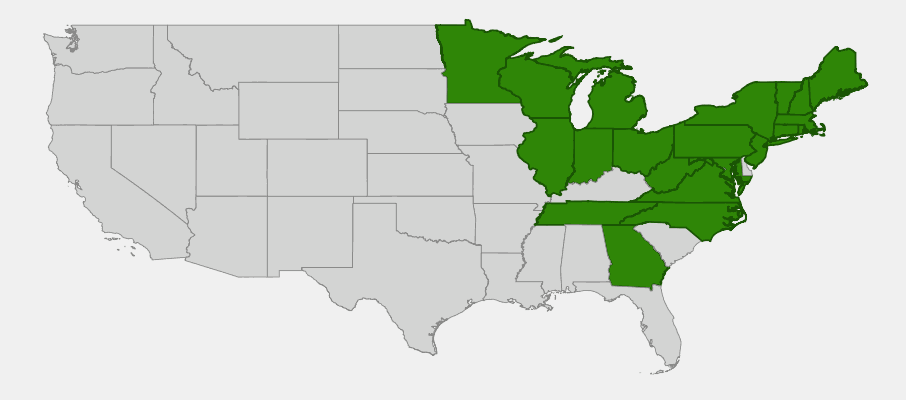
Bluebead lily is native to eastern North America, from the Canadian boreal and Great Lakes region through New England and south in the Appalachian Mountains. Its southern occurrence does not imply that it will thrive in every lowland garden at the same latitude. The combination of canopy shelter, moisture, and cool conditions is central to understanding where it grows naturally.
Flora of North America records it in rich coniferous, mixed, and deciduous woods from near sea level to about 1,600 metres. Native Plant Trust includes it among the shade-loving plants of New England and emphasizes its difficulty with inconsistent moisture. In a woodland garden, the practical parallel is a stable root environment with organic matter and protection from summer heat, not a constantly flooded basin.
The map follows the state distribution in Flora of North America. It shows broad native occurrence rather than county occupancy or a promise of landscape suitability. Western North American bluebead lilies may belong to other Clintonia species, so do not extend this map by using photographs or records of a blue-fruited western plant. Obtain stock labeled with the full scientific name and ask about its source region.
📋 Regional plant list: New England
Growing & Care Guide
Light
Provide part shade to shade, preferably the diffuse light of a woodland canopy. Avoid a site where the plant receives intense afternoon sun even if the morning is shaded. A cool northern garden may offer more latitude than a warm urban bed, but shade alone cannot solve a heat problem. If existing trees are removed, monitor the planting because the new exposure may change soil temperature and water loss immediately. A sheltered trial patch is a sensible first step before planning a large colony.
Soil & Water
Keep the root zone moist and cool without turning the planting hole into a sump. Leaf-derived organic matter helps the surface hold moisture, but water still has to reach the roots during a dry spell. Check the actual soil rather than judging by damp mulch. A site that repeatedly alternates between drought and heavy irrigation is a poor match for a plant noted for struggling with inconsistent moisture. Avoid compacting the bed while working around it, and do not bury the crowns under thick layers of fresh mulch.
Planting Tips
Plant nursery stock in a cool season, preserving the root ball and setting it at the original soil level. Prepare only as much space as can be maintained gently; repeated deep digging around established trees damages both tree roots and woodland perennials. Water after planting and keep neighboring plants from leaning over the new shoots. Mark the location so the dormant planting is not mistaken for an empty space in autumn or early spring. Expect establishment to be a gradual process rather than a display that fills in immediately.
Pruning & Maintenance
There is no need for routine pruning beyond removing damaged material when useful. Let green leaves continue working after bloom, and allow fruit to remain if wildlife and seasonal interest are goals. Once foliage has naturally died back, tidy only as much as needed to avoid smothering the crown. Slugs and snails can damage leaves; inspect the plant and the surrounding litter before choosing a response. A few feeding marks do not mean the colony has failed, and broad pesticide use can damage the other woodland organisms the planting is meant to support.
Propagation
Division of established cultivated rhizomes and propagation from seed are possible, but neither is a shortcut around the species’ slow pace. Keep divisions substantial, handle roots carefully, and replant into prepared moist soil without letting them dry. Seed work is best approached with a species-specific nursery protocol and patience through dormancy. Do not remove colonies from wild woods. If a supplier cannot explain whether plants were propagated or collected, choose a nursery with a clearer production history.
Choosing Companions
Place bluebead lily among restrained woodland plants rather than beneath a fast-spreading groundcover. Its broad leaves make a good contrast with finer fern foliage, but the fern must leave enough space and light for the lily to function. Keep aggressive grasses and dense roots out of the immediate patch. In a garden where every available plant quickly overruns it, the design needs adjustment; adding more bluebead lilies without changing the competition will not solve the underlying problem.
Landscape Uses
- A small colony in a cool, moist native woodland garden.
- A close-view planting beside a shaded path, where the blue fruit can be seen without stepping into the bed.
- A broad-leaved contrast among compatible, nonaggressive ferns and woodland perennials.
- A seasonal accent in a garden managed for natural leaf litter rather than bare, repeatedly cultivated soil.
- A teaching plant for comparing flowering and fruiting stages, with clear guidance that berries are not for eating.
Wildlife & Ecological Value
For Pollinators
Bees visit the flowers for nectar or pollen; other insects may use floral resources without being equally effective pollinators. Keep that distinction in mind when observing visitors. Avoid spraying a flowering patch and include other native species that bloom before and after it. A bluebead lily colony contributes to a woodland sequence rather than providing a full season of food on its own.
For Birds
Songbirds use the berries, making the fruit more than an ornamental detail. Leave some fruit in place and maintain nearby vegetation that provides shelter. Wildlife use does not establish human edibility, and this is a useful distinction to explain when the intensely blue fruits attract attention. Do not harvest all of the fruit for indoor arrangements if supporting the garden’s food web is a priority.
For Mammals
Chipmunks are among the animals reported to eat the fruits. Small mammals may also move through the cover provided by the surrounding woodland planting. A newly installed garden is still vulnerable to disturbance, so assess damage directly rather than assuming every missing berry or leaf is a problem requiring control. The goal is a functioning planting with room for some wildlife use, not an untouched display isolated from the rest of the garden.
Ecosystem Role
Bluebead lily belongs to the herb layer of cool forests. Its rhizomes allow local persistence and expansion, while its leaves, flowers, and fruit connect it with the seasonal rhythms of that habitat. Protecting established woodland soil and canopy conditions is more important than manipulating the plant for maximum height or bloom. Where it already grows naturally, keep trails and storage areas away from the colony and resist “improving” the forest floor by stripping its litter.
Cultural & Historical Uses
The genus Clintonia honors DeWitt Clinton, the New York naturalist and statesman. The species epithet borealis points to the northern character of the plant’s range. Both parts of the name fit a species most closely associated with cool eastern forests, even though its distribution extends south along mountain systems.
Common names such as bluebead lily and yellow clintonia emphasize different seasons: one refers to fruit, the other to flowers. Older references may place it under Dracaena borealis, a documented botanical synonym rather than a different houseplant to substitute. Use the current full name when checking a nursery label and compare descriptions carefully if researching through older floras.
In a contemporary native garden, the plant is best valued for its whole life cycle and its fit with an intact woodland setting. Nursery propagation allows gardeners to enjoy that cycle without removing wild colonies. A modest planting that survives, fruits, and gradually expands is a more meaningful success than a short-lived mass planting in a hot site chosen only for a photograph.
Frequently Asked Questions
Are bluebead lily fruits blueberries?
No. They are fruits of a lily-family plant, not a Vaccinium shrub. Do not eat them; NC State treats the berries as potentially poisonous. Color alone never establishes edibility.
Why does a plant listed as hardy still struggle in my garden?
Hardiness ratings mainly describe winter cold. Bluebead lily also needs cool conditions and consistent moisture in the growing season. A hot, dry shaded bed can be unsuitable even inside a listed hardiness zone.
Should its flowers look like yellow balls?
No. The flowers are nodding and bell-like, with six yellow or greenish-yellow tepals. A round blue structure later in the season is a fruit, not a flower.
Will it make a groundcover quickly?
No. It spreads slowly by rhizomes and needs time to form a colony. Start with a manageable patch, protect it from competition, and judge progress over several seasons.
Can I divide a wild patch for my garden?
Use nursery-propagated plants instead. Wild colonies are part of their existing woodland habitat, and digging them disrupts both the plant and the surrounding soil. Ask a reputable native nursery about propagation and regional provenance.
Sources & Further Reading
- Flora of North America: Clintonia borealis
- NC State Extension: Clintonia borealis
- Native Plant Trust: yellow blue-bead lily
- Native Plant Trust Go Botany: Clintonia borealis
- USDA PLANTS: Clintonia borealis
Find Native Plants
Ask growers about nursery propagation and regional provenance. Browse our Maine native plant nurseries, New Hampshire native plant nurseries, Vermont native plant nurseries, Connecticut native plant nurseries directory for suppliers.