
Ebony Spleenwort (Asplenium platyneuron)
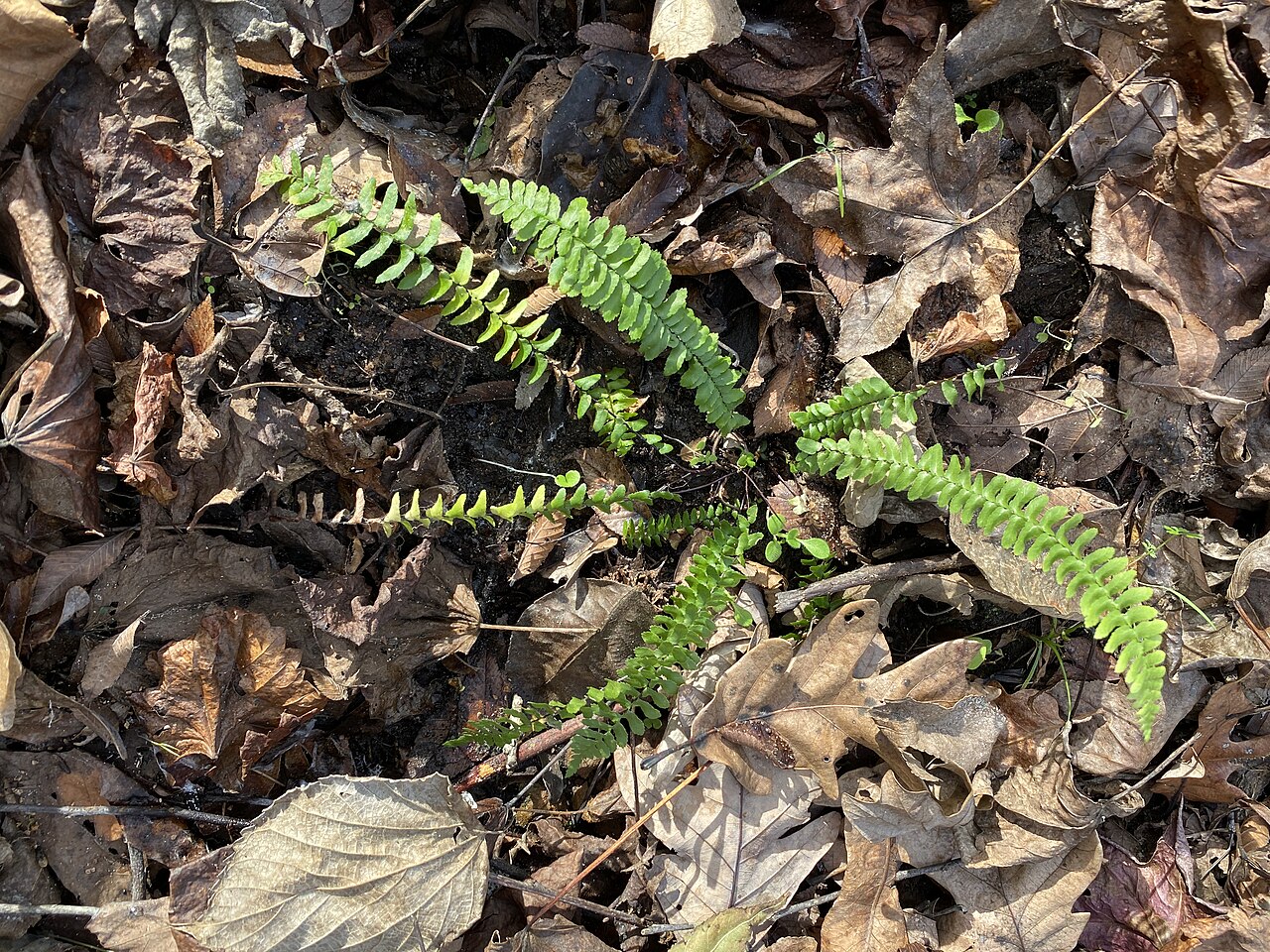
Ebony spleenwort (Asplenium platyneuron) is a small fern with an unusually strong outline: narrow green fronds arranged along polished, dark brown stems. It suits the close-up scale of a shaded rock garden, a woodland path edge or a lightly sheltered bank. Unlike moisture-loving ferns that need a broad wet bed, it often grows in relatively lean, well-drained pockets where its fine root system can establish without standing water.
The name “ebony” points to the dark stipe and rachis, not to the color of the leaflets. A colony is easiest to appreciate at eye level on a low bank or beside a path, where those details are visible. It is a modest accent rather than a fast carpet for a large open area. Allow it room among stones and leaf litter instead of surrounding it with spreading plants that will cover its small fronds.
Ebony spleenwort is native in Alabama, Georgia and Mississippi and across a much wider part of North America. Native does not mean indestructible: constant saturation, thick mulch over the crown or a sudden move into hot afternoon sun can still cause failure. Start with nursery-propagated stock, match the soil drainage to the species, and use the natural rock-and-woodland setting as a guide rather than treating all ferns alike.
Identification
Crown and stems
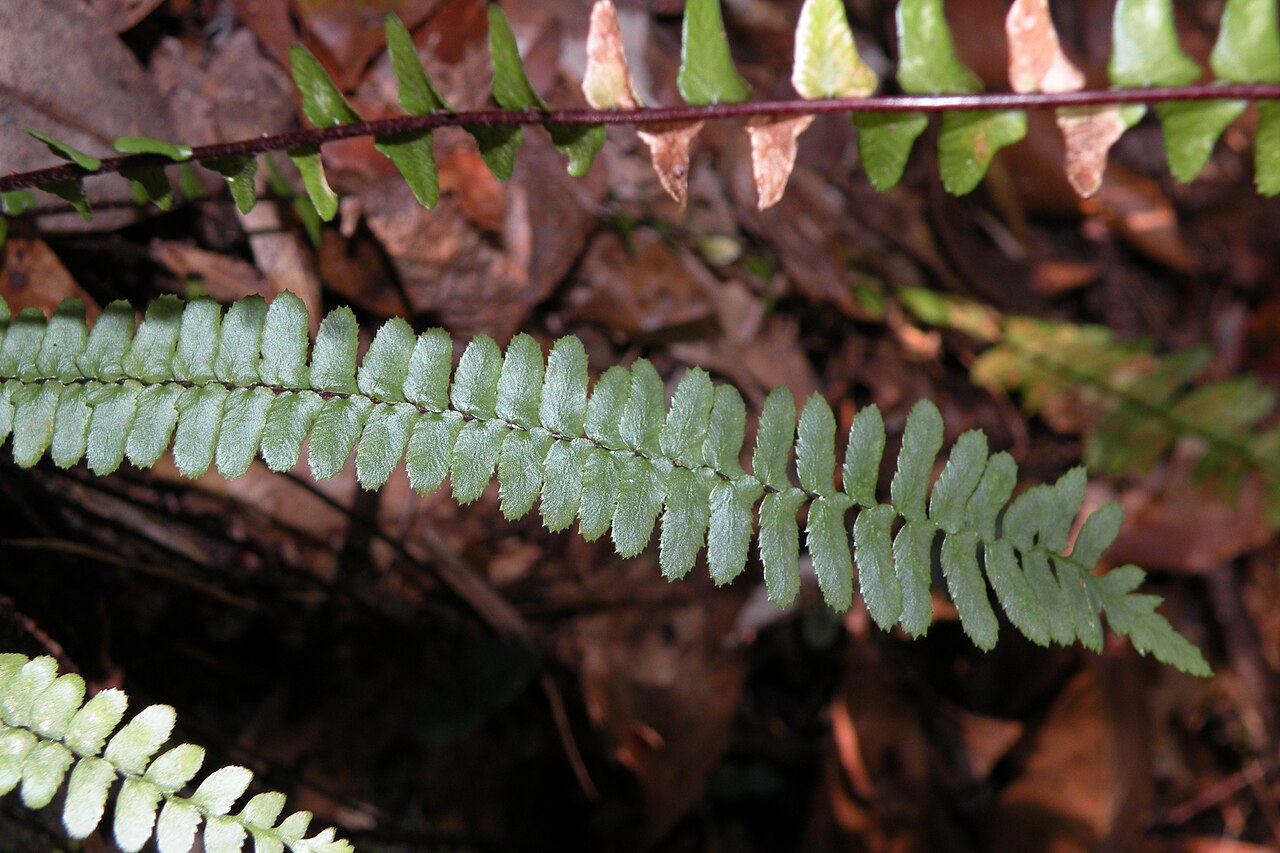
The plant grows from a short crown or rhizome rather than the long-running underground network of a large colony-forming fern. The visible leaf stalk and central axis are glossy reddish-brown to nearly black. This dark line is one of the quickest field marks, especially on older fronds. A dark stem by itself is not conclusive, because other spleenworts also share that character.
Sterile and fertile fronds
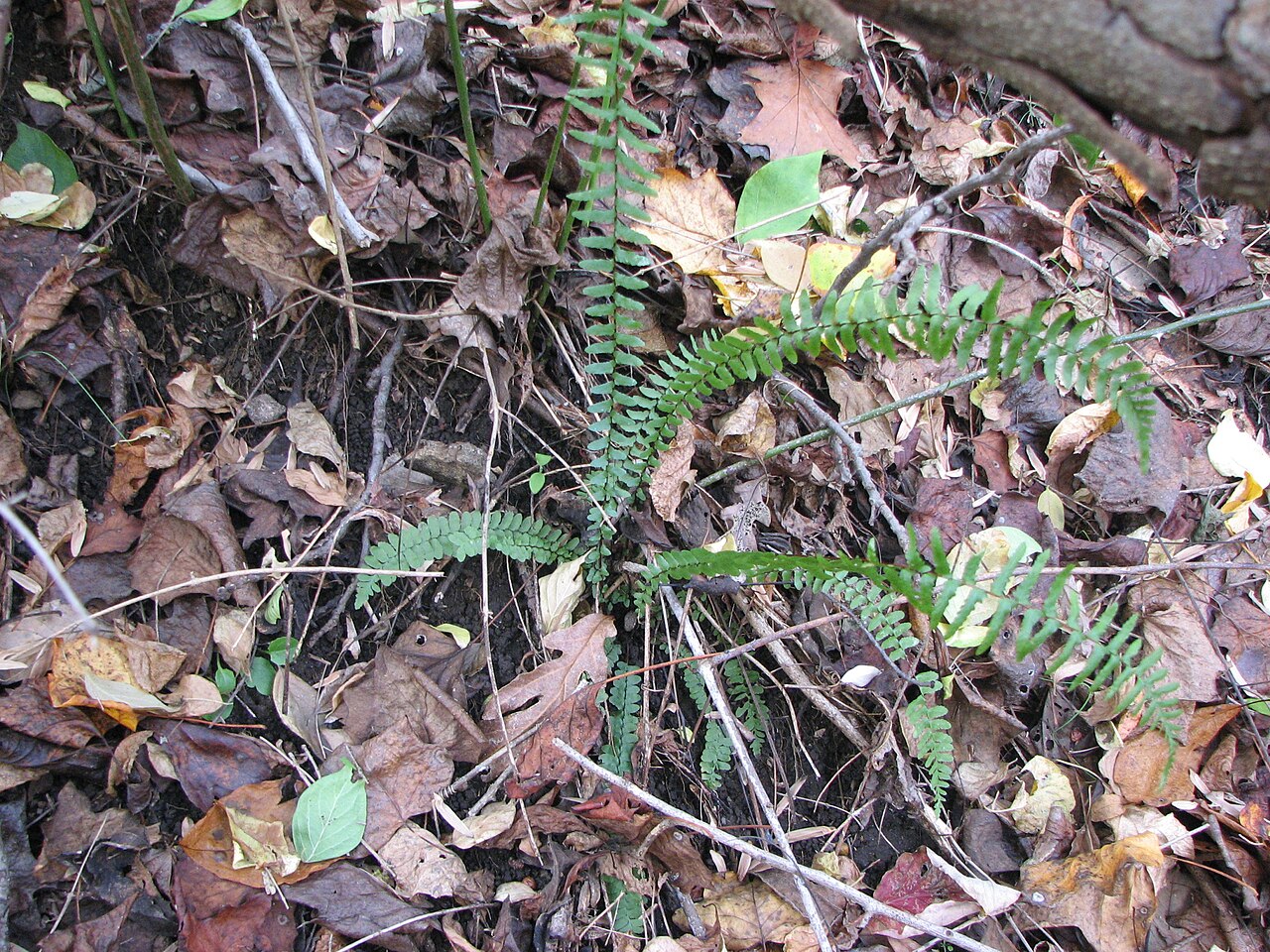
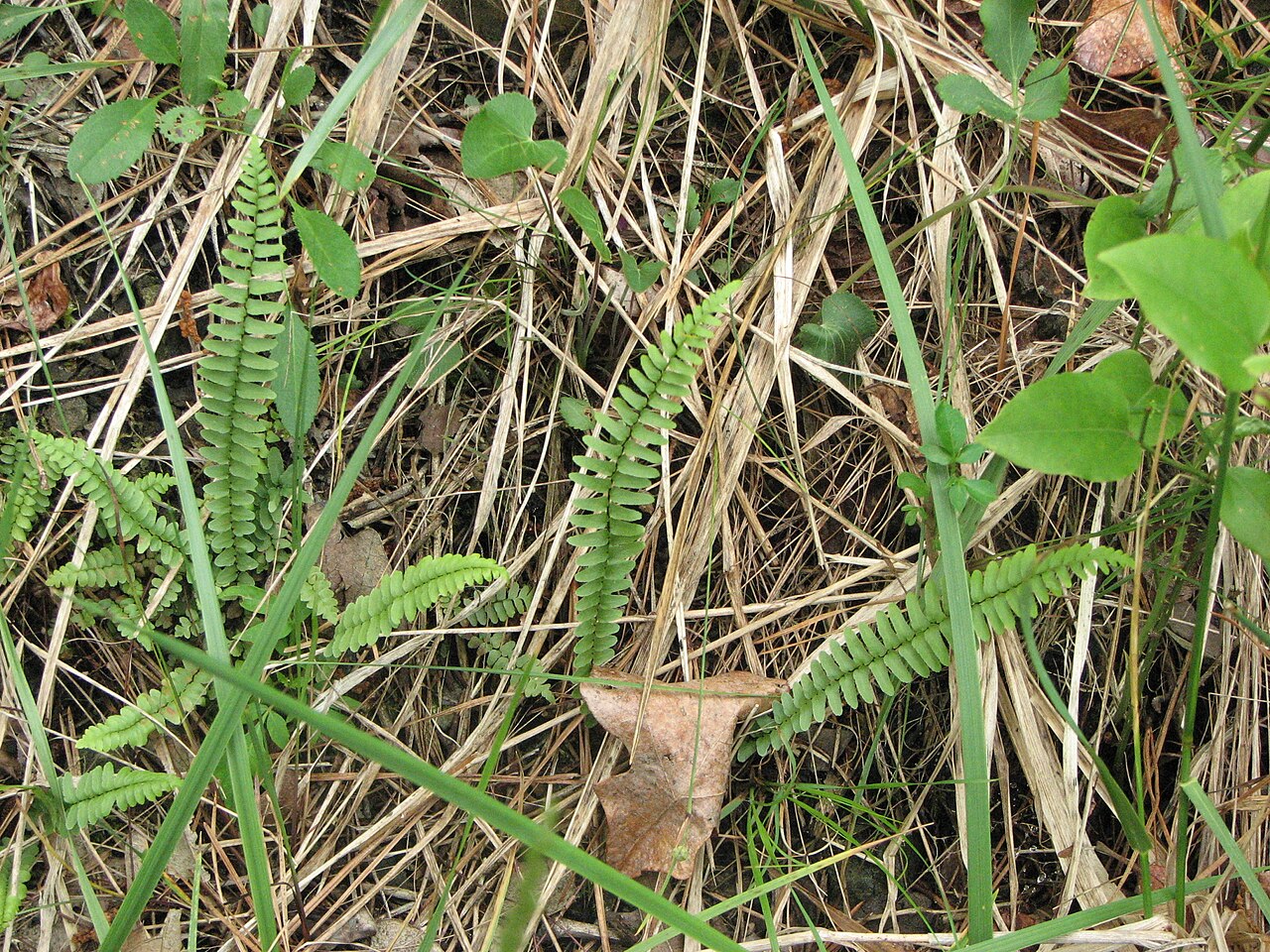
Ebony spleenwort produces two noticeably different frond forms. Shorter, often evergreen sterile fronds tend to arch outward or lie closer to the ground; taller fertile fronds stand more upright and are seasonally deciduous. A plant photographed in winter can therefore look much flatter and smaller than the same plant during active growth. Do not judge its mature structure from only one low frond.
The regional table gives a compact 6–12-inch range. Botanical garden and extension descriptions also record taller fertile growth, around 8–20 inches. That variation is meaningful rather than a contradiction to be hidden: small plants in lean rock pockets can stay short while favorable woodland conditions produce longer fronds. Leave vertical space above a planting instead of placing it immediately under the overhanging leaves of a larger perennial.
Leaflets and dark rachis
Many pairs of relatively small, oblong leaflets are arranged along the narrow frond. Their edges are gently toothed or scalloped, and the base of a leaflet can have an ear-like projection near its attachment. The blade is usually wider above the middle and narrows toward the lower end. Use a close view of the leaflet bases together with the glossy stem when comparing it with another small fern.
Spores rather than flowers
There are no flowers, fruits or seeds. On fertile fronds, elongated spore-bearing sori occur on the lower surface of the leaflets, arranged along the veins. Their orderly placement distinguishes them from randomly scattered discoloration. A gardener unfamiliar with ferns can easily mistake normal reproductive structures for disease; turn the frond gently and compare several mature leaflets before treating anything.
Quick Facts
| Scientific Name | Asplenium platyneuron |
| Family | Aspleniaceae |
| Plant Type | Small perennial fern; evergreen sterile and deciduous fertile fronds |
| Mature Height | 6–12 in in the regional list; fertile fronds commonly 8–20 in |
| Mature Spread | About 8–20 in; compact crown rather than a large running colony |
| Growth Rate | Modest clump development; pace varies with site |
| Sun Exposure | Partial shade to shade; dappled woodland light |
| Water Needs | Average to occasionally dry; keep young plants moist but well drained |
| Soil Type | Well-drained rocky or humus-influenced loam |
| Soil pH | Adaptable; acidic conditions generally preferred |
| Bloom Time | Non-flowering; reproduces by spores and sometimes plantlets |
| Flower Color | None; green fronds and glossy dark stems |
| Fall Color | Low sterile fronds can remain green; taller fertile fronds die back |
| Fruit | None; sori beneath fertile leaflets |
| Deer Resistant | Generally resistant, but not guaranteed untouched |
| USDA Hardiness Zones | 3–9 |
Native Range
Ebony spleenwort has a broad native distribution in eastern and central North America, with western outliers reaching parts of the Southwest. The Kew account used for the map includes Arizona, Colorado and New Mexico as well as the eastern states. Those scattered records should not be interpreted as a continuous belt of equally suitable garden habitat. Local exposure, rock structure and available moisture remain decisive.
Its natural habitat includes rocky woods, banks, slopes, openings and disturbed ground. That flexibility helps explain why it can occur in a forested setting as well as a more open rocky site. It does not mean that the fern tolerates any combination of heat, water and soil. A crevice that drains promptly but stays somewhat sheltered is quite different from a shallow container baking beside pavement.
Ontario and Québec form part of the Canadian range, and the species also has a separate native presence in southern Africa. The accompanying map shows only U.S. state-level native occurrence; it does not portray those overseas or Canadian populations. For southeastern garden planting, obtain North American, preferably regionally sourced nursery material rather than assuming that provenance from any part of the global range is equivalent.
Native Range at a Glance
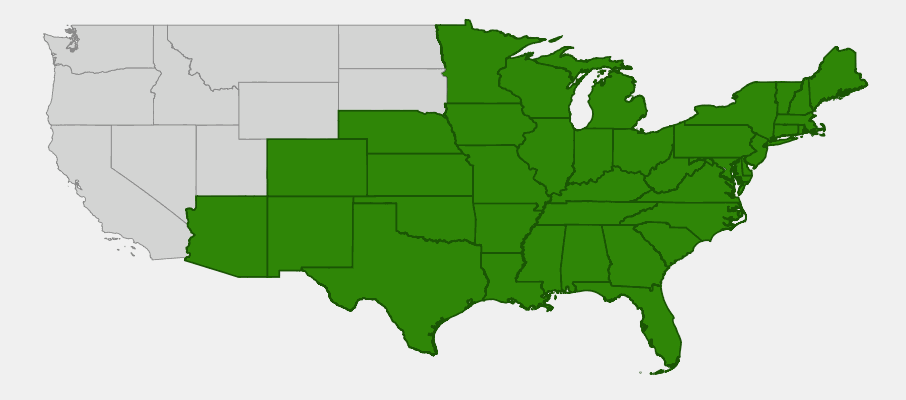
| U.S. States | Alabama, Arkansas, Arizona, Colorado, Connecticut, Delaware, Florida, Georgia, Iowa, Illinois, Indiana, Kansas, Kentucky, Louisiana, Massachusetts, Maryland, Maine, Michigan, Minnesota, Missouri, Mississippi, North Carolina, Nebraska, New Hampshire, New Jersey, New Mexico, New York, Ohio, Oklahoma, Pennsylvania, Rhode Island, South Carolina, Tennessee, Texas, Virginia, Vermont, Wisconsin, West Virginia |
| Canada / Other Native Regions | Ontario and Québec; also native in southern Africa, outside this U.S. map |
| Ecoregion | Eastern and central woodland and rocky-slope habitats, with western outliers |
| Elevation Range | Varies across the range; no single numeric interval established by the sources used here |
| Habitat | Rocky banks, crevices, wooded slopes, openings and some disturbed ground |
| Common Associates | Small woodland herbs, rock-site plants and leaf-litter communities |
| Distribution Sources | Kew Plants of the World Online; USDA (County-Level Data) |
Map: U.S. state-level native occurrence based on Kew, not county coverage or a guarantee of garden suitability. Canadian and other native regions are described in the text.
📋 See the Alabama, Georgia & Mississippi native plant list for regional context.
Growing & Care Guide
Light
Partial shade or dappled woodland light is an excellent starting point. Ebony spleenwort can grow in substantial shade, yet its ability to inhabit openings does not justify putting a newly purchased shade-grown pot into intense southern afternoon sun. Acclimate plants gradually if moving them to a brighter position. A rock on the west side of a small planting can provide useful shelter without covering the fronds.
Watch the plant and the soil together. A wilted or browned fern in bright light may be suffering from a dry root zone, heat reflected from masonry or recent transplant disturbance. Adding more water without checking drainage can simply replace one stress with another. When possible, correct exposure and soil conditions instead of relying on frequent emergency watering.
Soil and water
Use a well-drained, humus-influenced soil with mineral structure. Shallow rocky ground, loam and crevices are suitable settings when roots can obtain moisture but excess water escapes. The species is adaptable in pH, with acidic conditions often recommended for garden culture. Do not add lime just because the plant is a fern associated with rocks; rocks and fern species differ greatly in their chemistry.
The local table’s moisture code A refers to average moisture, not drought tolerance. Established plants can tolerate occasional dryness, but a tiny new root system should not be left to desiccate. Water carefully during establishment and allow the soil to drain. A constantly wet saucer beneath a pot, a buried crown or a compacted depression is a greater risk than a short period of moderately dry soil around an established fern.
Planting tips
Choose a firm, healthy crown with green fronds and no evidence of a rotting base. Place the crown near the same level it occupied in the nursery pot, with roots settled into surrounding soil. Do not bury the plant deeply to make it look anchored. If planting among stones, make sure the root pocket connects with actual soil rather than ending in an isolated cavity that alternates between a puddle and complete dryness.
Use fine leaf litter sparingly around the plant and keep coarse mulch off the crown. Because this fern is small, ordinary landscape mulch can cover it surprisingly easily. Plant where foot traffic and leaf-blower cleanup are unlikely to dislodge the crown. A few well-sited plants that remain visible are more successful than a large number tucked into unsuitable cracks.
Pruning and maintenance
Retain healthy sterile fronds through winter where they remain green. Remove damaged or fully dead fronds gently, taking care not to pull the crown loose. There is no reason to cut the entire plant back on a routine shrub-pruning schedule. The tall fertile fronds and low sterile fronds have different seasonal roles, so tidy individual leaves rather than assuming that all fronds should behave alike.
Keep competing seedlings and invasive vines away from the planting. Slugs or aphids can occasionally affect ferns, but not every chewed tip warrants intervention. Inspect the actual pest before acting, and begin with simple physical measures where feasible. Poor drainage and crown damage should be considered when a whole plant declines; they cannot be corrected with an insect treatment.
Propagation
Spores are the normal route to many new plants, but fern propagation has a small, easily overlooked gametophyte stage before recognizable fronds develop. A consistently clean and appropriately moist propagation setup matters more than treating spores like ordinary flower seed. Use a specialist fern propagation reference or nursery guidance if undertaking this process for the first time.
Ebony spleenwort may also form small vegetative buds near the bases of fronds. If such buds naturally develop into plantlets, they provide a way to observe the species’ reproductive flexibility without collecting from the wild. Do not repeatedly split a tiny single crown in an effort to multiply stock quickly. A small, stable garden population can be increased gradually and with much less damage.
Landscape uses
- A small fern accent beside a shaded path where the dark rachis can be seen clearly.
- A rock-garden pocket with reliable drainage and protection from reflected afternoon heat.
- A naturalistic woodland bank with light leaf litter and limited competition from larger groundcovers.
- A close-observation planting for learning fertile versus sterile fronds and the arrangement of fern sori.
Wildlife & Ecological Value
Pollinators
Ebony spleenwort does not flower, so it supplies neither floral nectar nor pollen to bees. Its contribution to a native planting is structural and ecological rather than a bloom-based food source. Include suitable native flowering plants elsewhere in the same garden if attracting pollinating insects is a primary aim. Avoid attaching a generic “great nectar plant” claim to a fern merely because it is native.
Birds and small animals
A small fern contributes to the low layer of vegetation used by invertebrates and other animals, particularly when combined with undisturbed leaf litter and stones. It is not a major berry source or a substitute for woody cover. Think of it as one part of a layered habitat: small plants can support a useful ground-level mosaic even when their individual contribution is subtle.
Deer and disturbance
Extension sources describe useful resistance to deer damage, but resistance is not an absolute guarantee. More often, the practical vulnerability of a garden plant is its small size: trampling, aggressive raking or burial under fresh mulch can remove it before browsing does. Mark new plantings and leave the root zone undisturbed while they establish.
Diversity in small spaces
Rock pockets and woodland banks can support specialized plants that would disappear beneath a uniform planting of vigorous groundcover. Keeping some of these small niches open preserves variety. Ebony spleenwort is particularly valuable in that design role because it remains compact and offers a distinctive shape rather than attempting to dominate the bed.
Cultural & Historical Uses
The common name spleenwort belongs to a long botanical tradition of naming plants in relation to presumed medicinal roles. A historical name is not evidence that the plant safely treats a disorder, and this profile does not recommend harvesting or consuming it. Its modern value here is as a native fern with a clear, observable structure and a place in a well-designed woodland garden.
The botanical name Asplenium platyneuron also helps gardeners avoid confusion with much larger plants called “silvery spleenwort.” Those names can refer to different genera, habits and moisture requirements. Nursery labels should include the full scientific name; a common-name match alone is not enough to choose the right plant or to connect a plant-list entry to a profile.
Looking closely at the dark rachis, the small lobed leaflet bases and the contrast between fertile and sterile fronds turns this otherwise easily missed species into an excellent teaching plant. It rewards careful observation rather than mass display. Protecting a few naturally occurring plants on a wooded property can be as worthwhile as adding new plants, provided their identity is confirmed and their habitat is not disturbed.
Frequently Asked Questions
Is ebony spleenwort evergreen?
The shorter sterile fronds can remain evergreen, while taller fertile fronds are deciduous. Seasonal appearance therefore varies with the frond type and local climate. Do not expect every upright frond to stay green through winter.
Why is the central stem dark?
A glossy dark brown or reddish-black stipe and rachis are normal identification characters. Dark color by itself is not rot. Evaluate the firmness of the crown and the health of the leaflets rather than treating the species’ characteristic stem color as a disease symptom.
Can it grow in a wet rain-garden basin?
A continuously saturated basin is not a good default site. Ebony spleenwort prefers much better drainage than sensitive or netted chain fern. A sheltered, higher edge might work if soil conditions suit it, but choose a genuinely moisture-loving fern for the wettest portion.
Are the brown marks beneath a frond a problem?
Regularly arranged sori on fertile fronds are normal. Irregular lesions, webbing, active insects or a collapsing crown require a different assessment. Compare the underside of several fronds before deciding whether intervention is needed.
Can I move it from a rock ledge in the woods?
Use nursery-propagated stock for a new garden. Small rock-grown plants may have roots extending into fragile crevices, and removal can damage both the fern and its habitat. If it already occurs on your property, protecting the existing location is usually the better option.
Sources & Further Reading
- NC State Extension — Ebony Spleenwort
- Kew Plants of the World Online — native distribution and taxonomy
- USDA PLANTS — ASPL
Find Native Plants Near You
Ask for nursery-propagated, accurately identified plants and a seed or stock source suited to your region. Browse native plant nurseries in Alabama, Georgia, and Mississippi. Confirm local nativity and site suitability before ordering.