
Wild-oats (Uvularia sessilifolia)
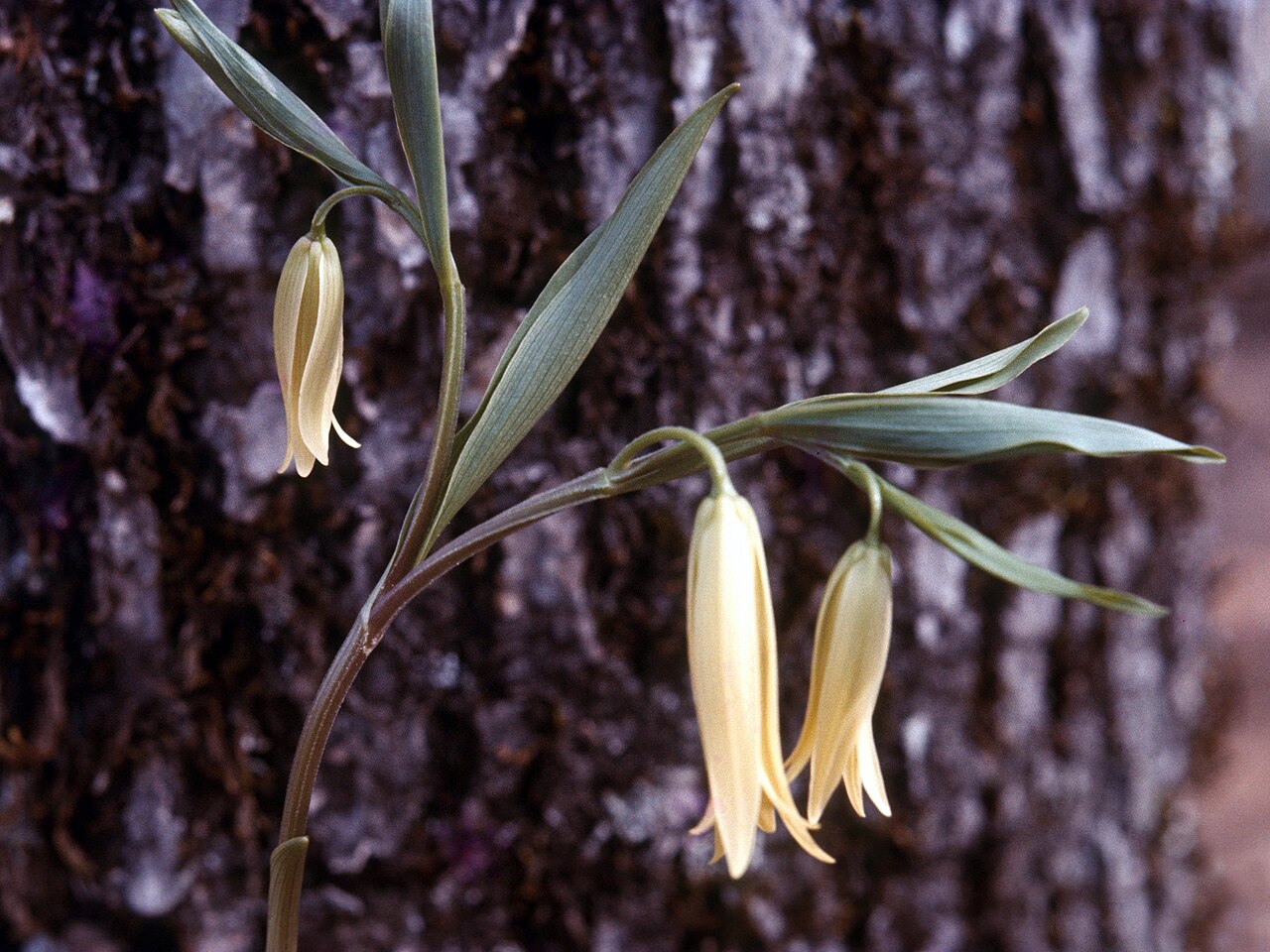
Wild-oats (Uvularia sessilifolia), also known as sessile-leaved bellwort, is a woodland wildflower rather than an oat grass. Its slender stems carry pointed, stalkless leaves and pale hanging bells in spring. The quiet cream-to-yellow flowers suit a close-view shade garden, where their shape can be appreciated without competing against a mass of brighter border plants.
The plant gradually spreads through slender underground stems and can become a loose groundcover in suitable woods. Give it a stable home in humus-rich, well-drained soil with part shade or woodland shade. A typical garden shoot may be modest, but the species is not limited to the six-inch height formerly shown in the regional table: Flora of North America records stems up to about eighteen inches. The revised table range of six to eighteen inches is a more useful landscape expectation.
For a New England garden, use it beside a shaded path or among restrained woodland companions. Choose nursery-propagated stock, protect the underground network from repeated digging, and let the planting develop at its own pace. Its common name can lead to confusion with grasses, so order by Uvularia sessilifolia and check the botanical label before introducing a replacement.
Identification
Stems & Underground Growth
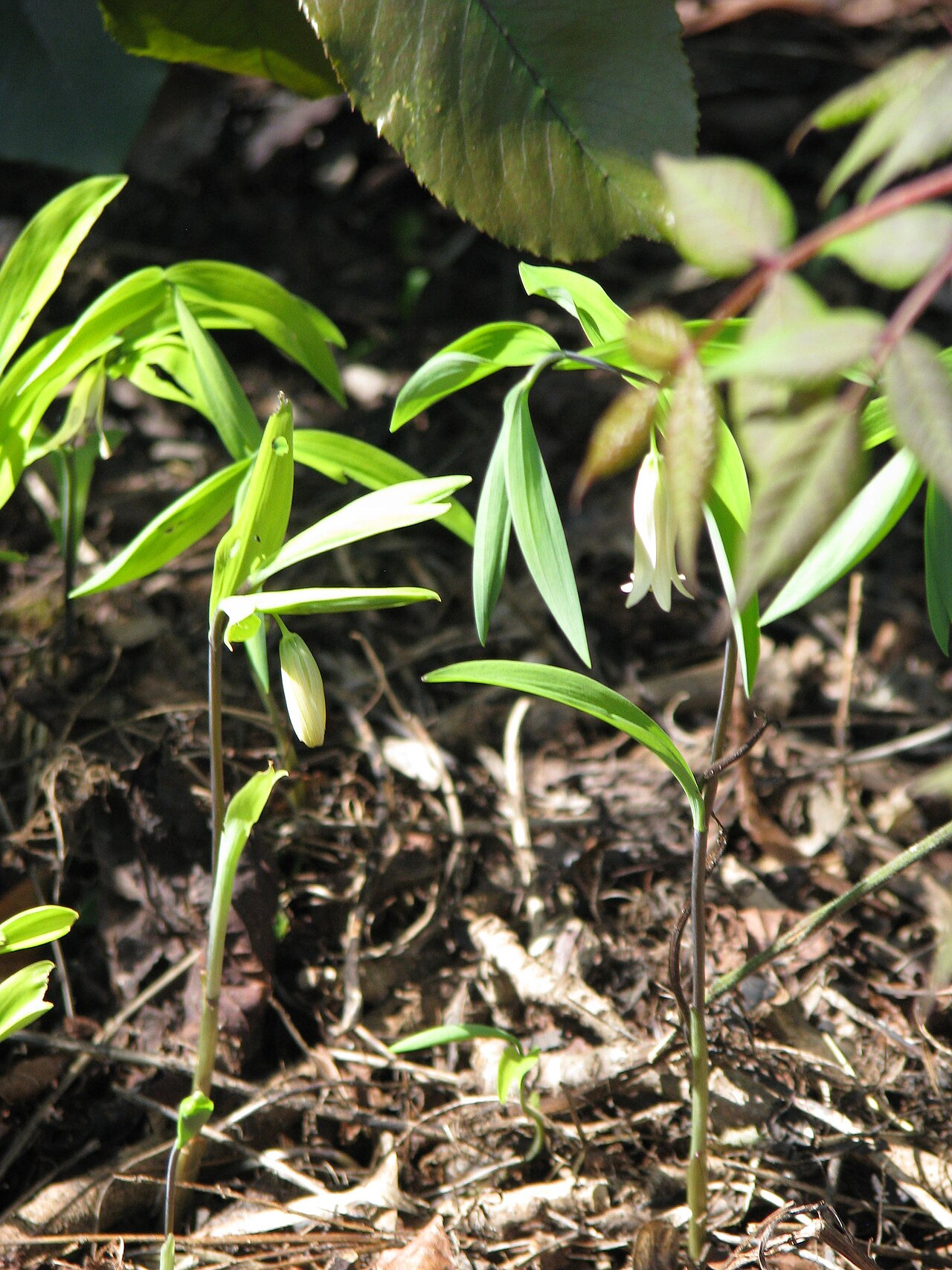
Slender upright stems branch toward the upper portion and can bend in a loose zigzag between the leaves. The perennial plant persists below ground on elongated rhizomes, with stolons helping a patch spread. It has no woody trunk or ornamental bark. A colony should be treated as a connected planting rather than as a collection of completely independent stems; rough digging between the shoots can sever the parts that allow it to grow.
Leaves
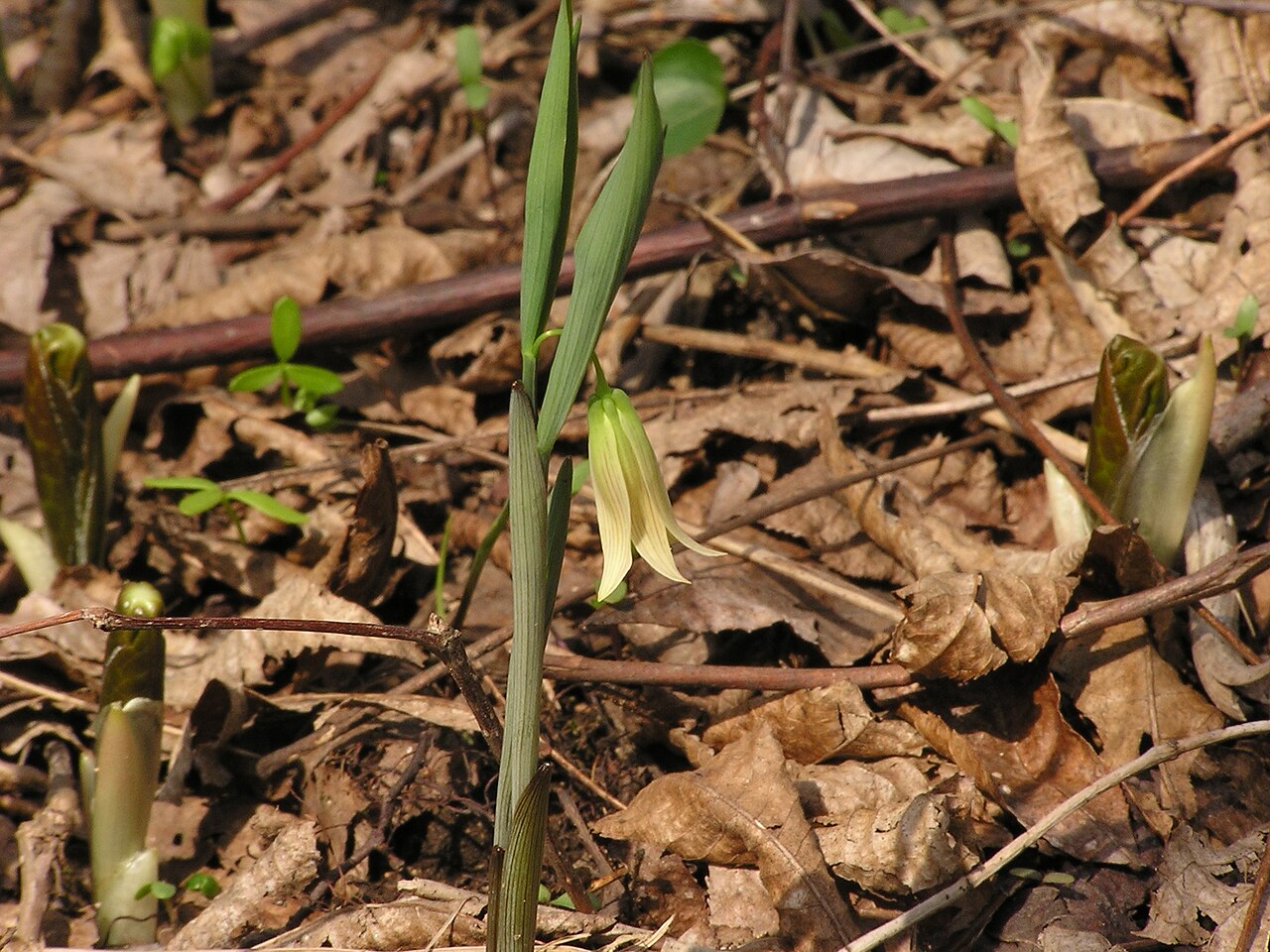
The simple leaves are narrow to broadly elliptic and attach directly to the stem without a distinct stalk. That stalkless attachment is the meaning of sessilifolia. Unlike the leaves of some other bellworts, they are not pierced by the stem. Look at the actual leaf base rather than identifying a plant from its drooping flower alone. Emerging leaves can appear folded or narrow, then spread as they mature, so spring photographs may not show the final shape.
Flowers
The pale straw-yellow or cream flowers hang downward, usually one on a stem. Six elongated tepals form the bell, and the outside may show fine lengthwise veins. Flowering occurs in spring to early summer across the native range. The effect is graceful rather than densely showy; place a patch where you can see beneath the leaves from the side. A plant with much larger, strongly twisted bright-yellow flowers and stem-pierced leaves may be another Uvularia species.
Fruit & Seeds
After flowering, the plant can produce a distinct three-winged capsule. The dry capsule is a better late-season identification clue than expecting berries, because bellwort is not a bluebead lily or a Solomon’s seal. Seed formation varies, and a patch can expand vegetatively even when obvious capsules are scarce. Leave some stems undisturbed through the reproductive season if you want to observe the progression from flower to capsule or encourage natural recruitment.
Quick Facts
| Scientific Name | Uvularia sessilifolia L. |
| Family | Colchicaceae; included in Liliaceae in some older floras |
| Plant Type | Native rhizomatous woodland perennial |
| Mature Height | Typically about 6–18 inches; size varies with site and stage |
| Mature Spread | A small patch broadens gradually by underground stems |
| Growth Rate | Moderate once established; allow time for a colony |
| Sun Exposure | Part shade to woodland shade |
| Water Needs | Average to moist, well-drained soil |
| Soil Type | Humus-rich loam; adaptable where the root environment is suitable |
| Soil pH | Acidic to near-neutral |
| Bloom Time | Spring to early summer |
| Flower Color | Pale yellow to cream |
| Fall Color | Deciduous foliage eventually yellows and dies back |
| Fruit | Dry three-winged capsule |
| Deer Resistant | Not guaranteed; monitor young shoots where browsing pressure is high |
| USDA Hardiness Zones | 4–8 in NC State horticultural guidance |
Native Range
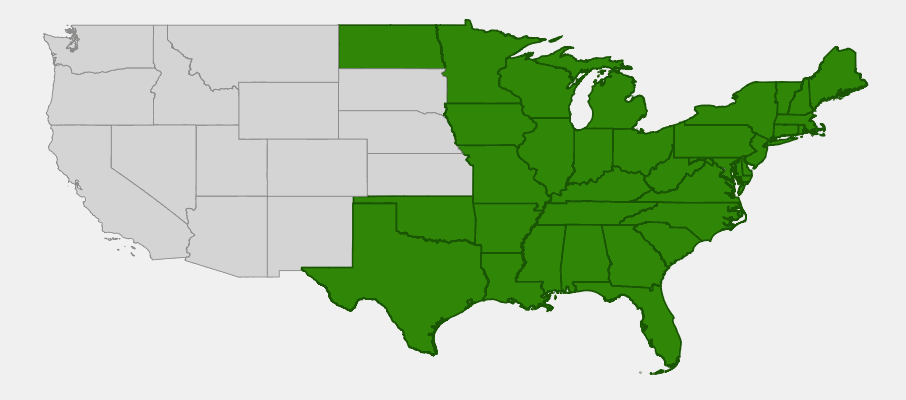
Wild-oats is native to eastern and central North America, including the New England states and adjoining Canadian regions. Flora of North America records it from the northern interior and eastern Canada south through much of the eastern United States. The map follows that flora’s state list, rather than treating every cultivated observation as a native occurrence.
Its habitats include moist hardwood coves, alluvial woods, thickets, and, particularly farther north, somewhat drier woodland. That range of settings explains why it can be adaptable after establishment without making it a universal choice for dry shade. In a garden, rich soil, a protected surface, and moderate moisture are a sensible starting combination.
The flora gives an elevation range from near sea level to about 1,000 metres. A shaded state is only a broad distribution cue; it does not describe every county, soil, or exposure. For a restoration planting, confirm local occurrence and obtain an appropriate source. For a home garden, pay equal attention to drainage, competition, and whether the site can remain undisturbed.
📋 Regional plant list: New England
Growing & Care Guide
Light
Start with part shade or woodland shade, the conditions reflected in the regional table. A deciduous canopy provides a seasonal pattern of brighter spring light and summer shelter. Some references allow more sun under favorable moisture conditions, but that is not a reason to put newly purchased plants in a hot exposed bed. Watch the site at different times of day and choose a position where the small spring flowers will be visible without sacrificing a cool root environment.
Soil & Water
Use moisture-retentive, well-drained soil with leaf-derived organic matter. The plant should not sit in a compacted, water-filled planting hole, and it should not repeatedly dry out while establishing. Keep a loose natural litter layer, allowing it to break down rather than stripping the bed clean each spring. Check beneath the litter during dry periods. Water slowly enough to reach the roots, not just the top of the mulch. Avoid piling heavy bark over emerging stems, which need room to rise through the surface.
Planting Tips
Plant propagated nursery stock during a cool period and keep the root ball intact as much as practical. Set it at its original level, water it in, and mark the location so later garden work does not cut through the long underground stems. Choose the final site before planting rather than planning to move it repeatedly. An initial small group lets you assess the site’s moisture and competition before expanding the planting. Leave enough room for the stems to develop their natural open habit.
Pruning & Maintenance
Do not cut back green foliage immediately after flowering. It supports the underground perennial system even when the flowers are gone. Remove dead or damaged material only when useful, and weed carefully rather than hoeing through the colony. Young growth can suffer slug damage; inspect at the time damage appears and distinguish feeding marks from drought or mechanical injury. Keep vigorous groundcovers from overrunning the patch. A woodland plant does not become low-maintenance simply because it is native if its neighbors are inappropriate.
Propagation
NC State recommends root cuttings or seed, and advises sowing fresh seed promptly rather than letting it dry out. Follow a species-specific nursery protocol and keep records of the seed source and sowing date. If an established cultivated patch is divided, retain enough roots and underground stem to support recovery and replant promptly. Do not use wild collection as a propagation shortcut. Allowing some capsules to mature can support gradual natural spread within a suitable garden bed.
Keeping the Colony Legible
The flowers are easiest to appreciate when the planting has a clear edge and compatible neighbors. Place taller plants behind it and avoid putting a dense mat-forming species directly over its rhizome zone. A discreet marker is useful after foliage dies back. In a mixed woodland bed, compare growth at the same season each year rather than assuming the disappearance of spring flowers means the plant has vanished. Patient observation is a better guide than repeatedly disturbing the roots to check them.
Landscape Uses
- A loose native groundcover in a shaded woodland bed with room for gradual spread.
- A path-edge planting where hanging flowers can be viewed from the side.
- A pale-flowered companion to restrained ferns and other native spring perennials.
- A naturalistic planting beneath deciduous trees where leaf litter is retained.
- An identification garden demonstrating stalkless leaves and dry three-winged capsules.
Wildlife & Ecological Value
For Pollinators
NC State identifies wild-oats as a host resource for the specialist bee Andrena uvulariae. That is a specific ecological connection worth protecting: avoid insecticide use during flowering and preserve suitable nearby ground for native bees. The plant should still be part of a varied native planting that supplies flowers at other times of year. A brief spring bloom cannot provide an entire season’s resources on its own.
For Birds
This is not a fleshy-fruited bird shrub. Its contribution is as one part of a diverse woodland understory, rather than a promise of a large berry crop. Keep surrounding native plants with complementary food and cover functions. Accurate expectations help avoid replacing a useful small wildflower merely because it does not attract the same conspicuous visitors as a fruiting tree.
For Mammals
Tender shoots can be vulnerable in a garden with heavy browsing pressure. Check actual damage before choosing a response, and use physical protection for a small establishing patch when necessary. Avoid unsupported claims that every bellwort is deer-proof. The plant’s low height also makes accidental trampling important; keeping people and pets on the path may prevent more damage than any pest treatment.
Ecosystem Role
Wild-oats adds a spreading perennial layer beneath the tree and shrub canopy. Its underground stems allow a patch to occupy suitable space over time, while seasonal foliage participates in the woodland’s cycle of growth and litter. Maintain that soil surface and avoid repeated cultivation. It is a garden groundcover at a gentle scale, not a substitute for engineered erosion control or a heavily trafficked lawn.
Cultural & Historical Uses
The common name wild-oats is misleading if read literally: the plant is not a cereal and does not belong to the grass family. Sessile-leaved bellwort is a more descriptive name because it points to the leaf attachment and hanging flower shape. Use the scientific name on plant lists and nursery orders to keep this woodland perennial separate from true wild oat grasses.
Older botanical works may place the species in Oakesia or Oakesiella, and older family treatments include it with the lilies. Modern horticultural references commonly place Uvularia in Colchicaceae. These changes in classification do not justify creating multiple garden entries for the same species. Compare the name and its synonyms when researching a plant through older books.
In a modern native garden, the most useful tradition to carry forward is close observation of woodland plants in their proper setting. Buy propagated material, let the natural form develop, and resist the urge to clean the bed so thoroughly that the soil loses its protective litter. A modest colony can then provide spring detail for many seasons without requiring a showy or intensive management style.
Frequently Asked Questions
Is wild-oats a grass?
No. Uvularia sessilifolia is a broad-leaved woodland perennial in Colchicaceae, not a cereal or a lawn grass. The full scientific name prevents confusion.
How do I distinguish it from other bellworts?
Look for stalkless leaves that are not pierced by the stem, pale hanging flowers, and later the three-winged capsule. Use a regional key if the leaf attachment or flower details are unclear.
Is six inches its maximum height?
No. Small plants may be about six inches, but the species can approach eighteen inches. The revised table uses a range rather than presenting the low end as a fixed mature size.
Should I rake away every leaf in spring?
No. Keep a loose, natural litter layer while clearing only thick piles that obstruct emerging shoots. Raking hard through the bed can damage the plants and their shallow connections.
Can I sow stored dry seed?
Fresh seed is preferable; NC State advises sowing promptly after ripening and not allowing it to dry out. Use a species-specific propagation method and do not assume an old dry packet will behave like fresh seed.
Sources & Further Reading
- NC State Extension: Uvularia sessilifolia
- Flora of North America: Uvularia sessilifolia
- USDA PLANTS: Uvularia sessilifolia
Find Native Plants
Ask growers about nursery propagation and regional provenance. Browse our Maine native plant nurseries, New Hampshire native plant nurseries, Vermont native plant nurseries, Connecticut native plant nurseries directory for suppliers.