
Black Grama (Bouteloua eriopoda)
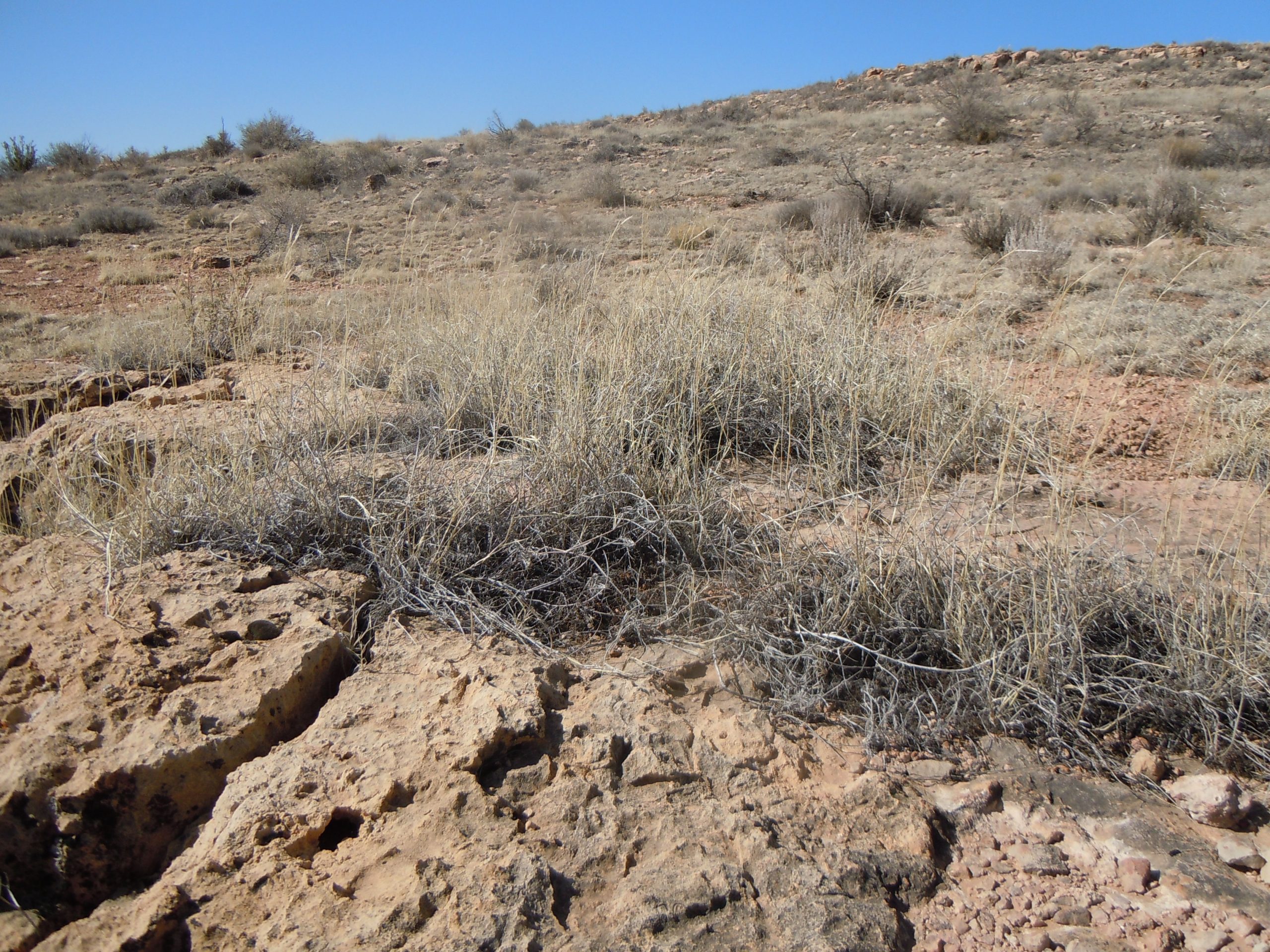
Bouteloua eriopoda, commonly known as Black Grama, is a warm-season perennial bunchgrass that defines the look and feel of the Chihuahuan and Sonoran Desert grasslands of the American Southwest. A member of the Poaceae (grass family), it gets its common name from the blackish, almost charcoal cast its seed heads take on as they mature and dry — a sharp contrast to the plant’s otherwise silvery, blue-green foliage. Black grama is widely regarded by rangeland ecologists as one of the most important and most drought-resilient forage grasses in the arid Southwest, and its decline in heavily grazed country has long been used as an indicator of rangeland health.
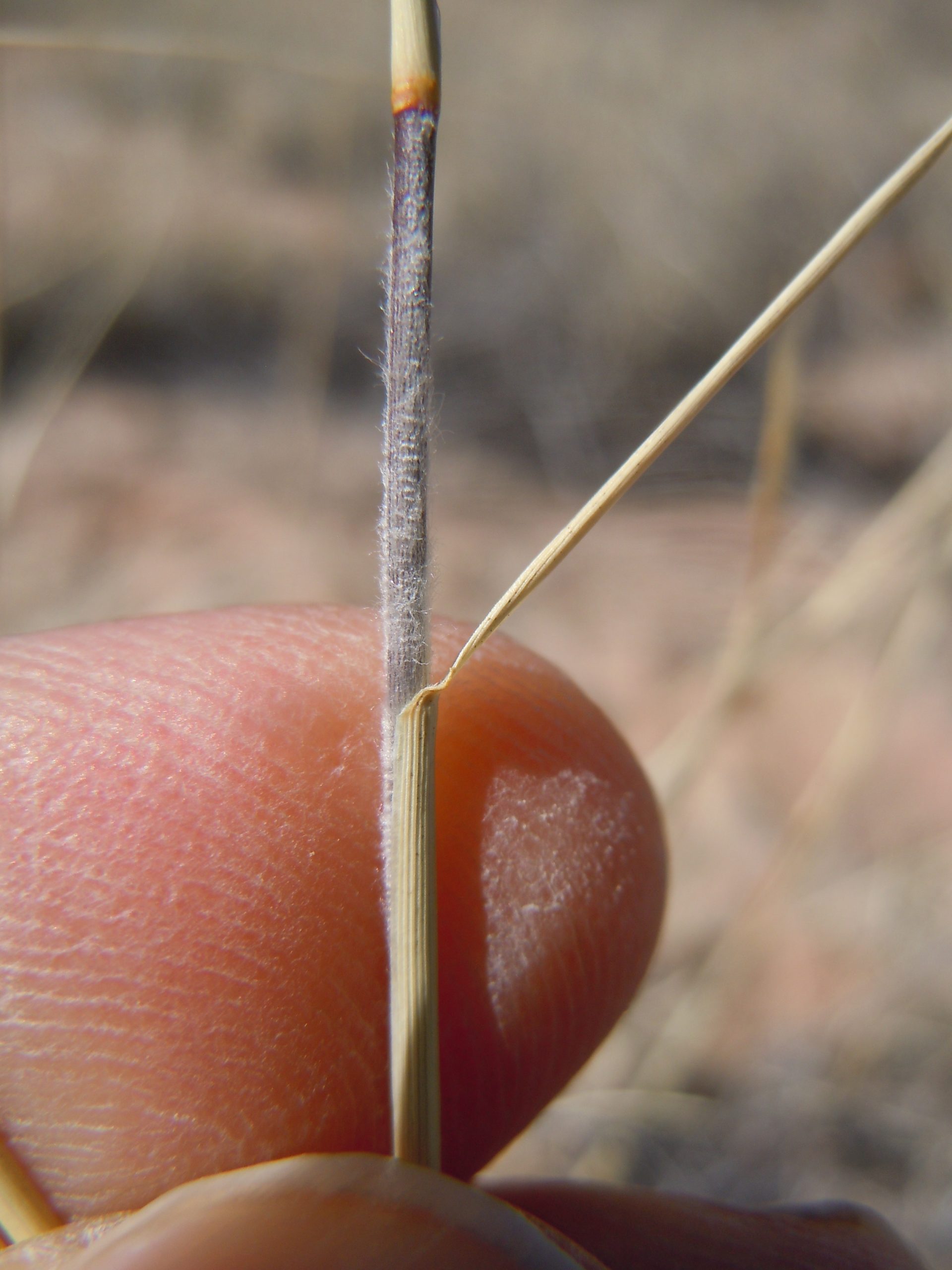
Black grama is a low, sprawling grass, typically 4 to 12 inches tall at the foliage, with wiry stolons (above-ground runners) that creep outward and root at the nodes, slowly knitting together into loose mats or rings. The stolons are covered in fine, woolly white hairs, especially at the rooting nodes, giving the plant a soft, cottony look up close even though the overall clump reads as wiry and gray from a distance. In summer, after good rain, slender flowering stalks rise 8 to 20 inches above the foliage, each tipped with one to three curved, one-sided spikelets that resemble tiny combs or eyelashes.
Unlike many Southwestern natives that are chosen mainly for ornamental value, black grama earns its place in the garden through authenticity and function: it is the grass that actually built the desert grasslands of New Mexico, west Texas, and southeastern Arizona, and it remains one of the best low-water, low-maintenance groundcovers for xeric gardens, erosion control, and habitat restoration within its native range. It largely disappears from heavily overgrazed land and is slow to recolonize, so established stands are worth protecting rather than disturbing.
Identification
Black grama is most easily recognized by its sprawling, mat-forming habit and fine, wiry texture — it looks less like a typical bunchgrass and more like a loose tangle of gray-green wire spreading across bare, rocky ground. Established plants often form rings several feet across as old growth dies out in the center and new stolons continue rooting at the perimeter.
Stems & Stolons
The defining identification feature of black grama is its stolons: slender, wiry, above-ground stems that trail along the soil surface and root wherever a node touches moist ground. These stolons and especially the rooting nodes are densely covered in short, woolly white hairs year-round, visible even on dead, straw-colored material in winter. This persistent woolliness at the nodes distinguishes black grama from similar desert grasses even outside the growing season.
Leaves
Leaves are narrow, flat to slightly rolled, 2 to 6 inches long and rarely more than 1/16 inch wide, blue-green to gray-green when fresh and curling as they cure to a pale straw color. The foliage is fine-textured and low-growing, rarely exceeding a foot in height even at its peak.
Flowers & Seed Heads
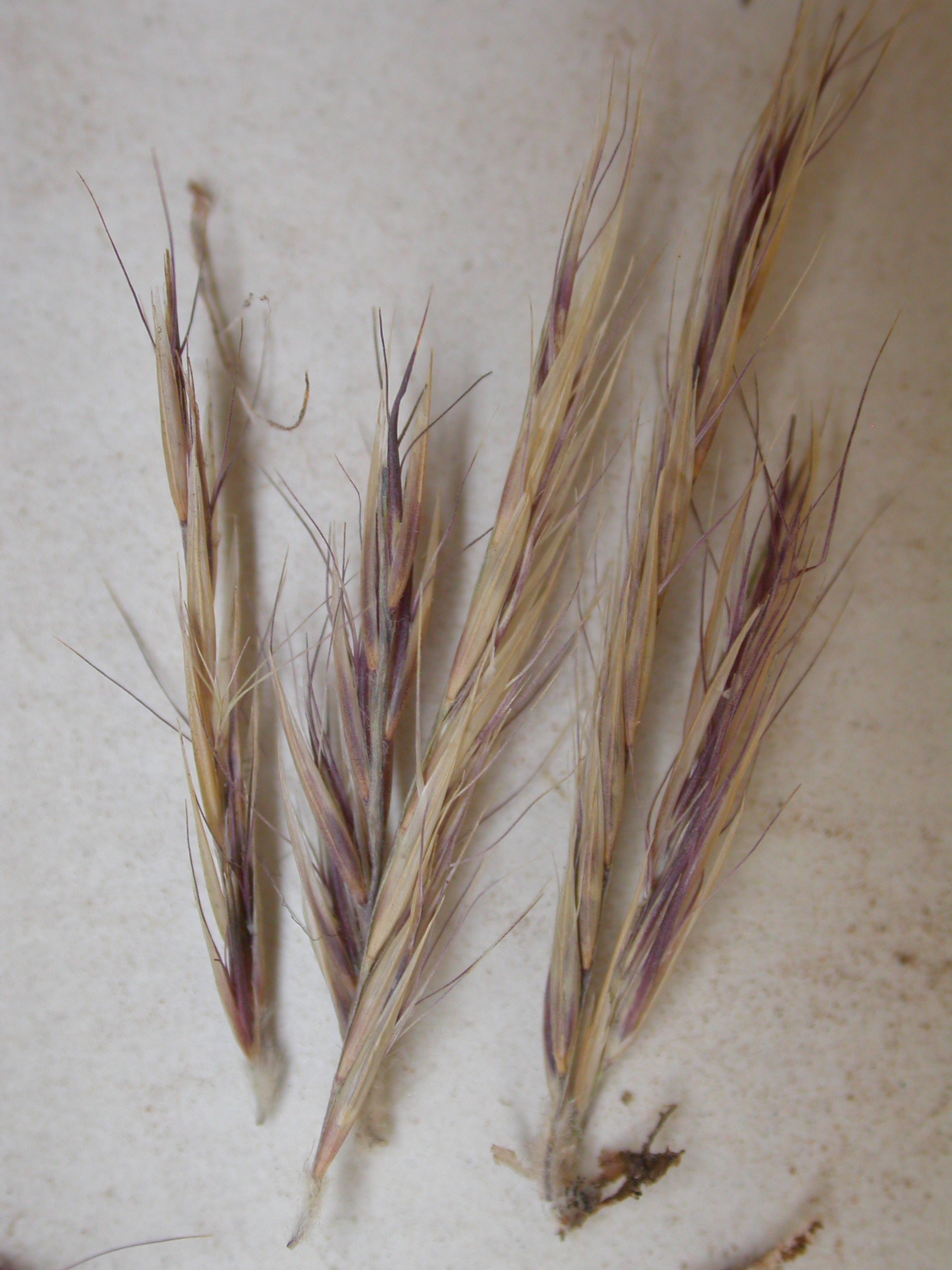
Flowering culms rise well above the foliage from mid to late summer, usually after the first good monsoon rains. Each culm bears one to three short, curved spikes (rarely more) arranged along one side of the stem, each spike 3/4 to 1 1/2 inches long. The purplish-black to dark brown spikelets, each tipped with a hairy, bristle-like awn, give the seed heads their distinctive sooty color and the plant its common name. Flowering is erratic and tightly tied to summer precipitation — in dry years, black grama may produce few or no seed heads at all, relying instead on stolon growth to spread.
Fruit & Seeds
Seed is produced in the curved spikelets described above. Black grama is notoriously low in viable seed production compared with many grasses; most natural spread and recovery happens vegetatively, through rooting stolons, rather than from seed. This trait makes black grama slow to recolonize after severe disturbance or overgrazing, since it cannot easily reseed bare ground the way annual or more seed-prolific perennial grasses can.
Quick Facts
| Scientific Name | Bouteloua eriopoda |
| Family | Poaceae (Grass) |
| Plant Type | Warm-Season Perennial Grass (stoloniferous) |
| Mature Height | 4–12 in foliage; flowering culms to 20 in |
| Mature Spread | 1–4 ft, spreading by stolons |
| Growth Rate | Slow |
| Sun Exposure | Full Sun |
| Water Needs | Low |
| Soil Type | Well-drained; sandy, gravelly, or rocky caliche soils |
| Soil pH | 7.0–8.5 (neutral to alkaline) |
| Bloom Time | July – September (after summer rain) |
| Flower Color | Purplish-black to dark brown |
| Fall Color | Straw-tan |
| Fruit | Grain within hairy, dark spikelets |
| Deer Resistant | Yes (though grazed by livestock and wildlife as forage) |
| USDA Hardiness Zones | 5–9 |
Native Range
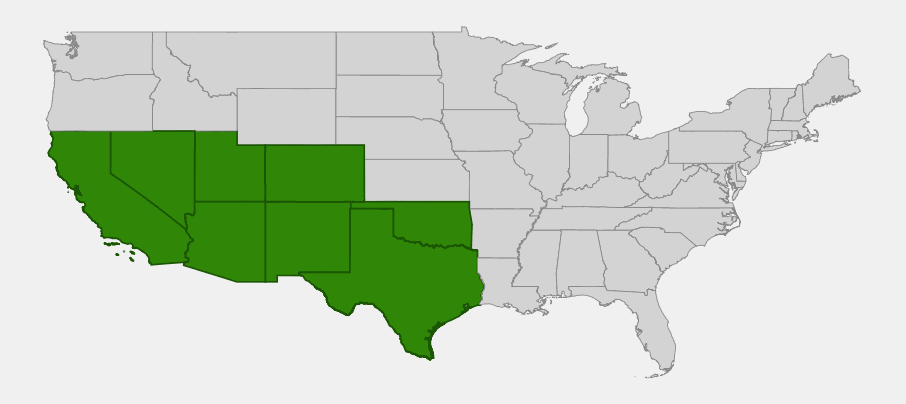
Black grama is native to the warm desert grasslands of the American Southwest, with its core range running from southeastern Arizona and southern Nevada and Utah through New Mexico, the Trans-Pecos and High Plains of Texas, western Oklahoma, and southeastern Colorado, with scattered populations in southern California. It is one of the dominant grasses of the Chihuahuan Desert grasslands of New Mexico and far west Texas, where it has historically covered enormous areas of bajadas and plains between about 3,500 and 6,000 feet elevation.
Within this range, black grama is most abundant on gravelly or sandy upland sites with good drainage — rocky hillsides, bajadas, and mesa tops — rather than heavy clay soils or low-lying areas that collect runoff. It is commonly found growing alongside blue grama (Bouteloua gracilis), tobosagrass (Pleuraphis mutica), and threeawns (Aristida spp.) in grama-galleta grasslands, and under or near creosotebush (Larrea tridentata) and honey mesquite (Prosopis glandulosa) in desert shrub-grassland transition zones.
Black grama populations have declined sharply across much of their historical range due to over a century of heavy livestock grazing; because the species reproduces mainly by stolons rather than seed, it recovers very slowly once grazed out, and in many areas has been permanently replaced by shrubs such as creosotebush and mesquite. Where it persists in good condition, black grama stands are often a sign of well-managed or lightly grazed rangeland.
📋 Regional plant lists featuring Black Grama: Arizona & New Mexico · Utah & Western Colorado · Nebraska, Kansas & Eastern Colorado
Growing & Care Guide
Black grama rewards patience rather than fuss. It is not a fast-establishing lawn substitute, but once rooted in, it is one of the toughest, longest-lived, most authentically regional groundcovers available for hot, dry Southwestern gardens.
Light
Black grama needs full sun. It is a plant of open desert grassland and bajadas and will not perform well, or persist, in shade or even significant part-day shade from buildings or trees.
Soil & Water
Give black grama sharply drained, gravelly, sandy, or rocky soil — the kind typical of desert uplands — and avoid heavy clay or any spot where water stands after rain. It tolerates alkaline soils well and needs no soil amendment in most desert gardens. Once established, black grama is extremely drought tolerant and needs no supplemental irrigation beyond what falls naturally in its native range; young plants benefit from occasional deep watering during their first one to two summers to help stolons root in.
Planting Tips
Black grama establishes slowly from seed because so little of its seed is viable, so container-grown plugs or divisions from local native plant nurseries are the more reliable way to start a planting. Set plants out in spring, after the danger of hard frost has passed, and space them 12 to 24 inches apart to allow stolons room to fill in over several seasons. Avoid disturbing an established wild patch of black grama if you find one on your property — it is slow to recover and better left in place than transplanted.
Pruning & Maintenance
Little maintenance is needed. Cutting or mowing old growth back to 2 to 3 inches in late winter, before new growth starts, keeps stands looking tidy, though it is not required for plant health. Avoid mowing or grazing too closely or too frequently, since repeated close defoliation is exactly what has eliminated black grama from so much of its former range.
Landscape Uses
Black grama fits a narrow but valuable niche in native landscaping:
- Xeric groundcover for rocky, sunny slopes and desert gardens
- Erosion control on bajadas and upland desert sites
- Rangeland and habitat restoration in its historical Chihuahuan and Sonoran Desert range
- Authentic desert-grassland plantings paired with creosotebush, mesquite, and cacti
- Low-water alternative to turf in arid Southwestern yards
Wildlife & Ecological Value
Black grama is a foundational species of Southwestern desert grasslands, and its ecological value lies as much in habitat structure and soil stabilization as in any single wildlife interaction.
For Birds
Ground-nesting and grassland bird species, including various sparrows and quail, use black grama sod for cover and forage among the seed heads for grain in good rain years. Its low, dense mats provide shelter from both sun and predators in otherwise sparse desert grassland.
For Mammals
Black grama is one of the most valuable native forage grasses in the Southwest for both livestock and wild grazers, including pronghorn, mule deer, and a variety of small mammals. Historically it was considered premier cattle forage because it cures well on the stem and retains nutritional value through winter, which is also exactly why overgrazing has hit it so hard.
For Pollinators
As a wind-pollinated grass, black grama does not provide floral resources for pollinators, but its structure supports the grassland insect communities — grasshoppers, beetles, and other invertebrates — that in turn feed birds, lizards, and small mammals throughout the desert food web.
Ecosystem Role
Black grama’s spreading stolons bind loose desert soils in place, reducing wind and water erosion on bajadas and upland sites that would otherwise be prone to blowing or washing out. As a long-lived, slow-to-recover perennial, its presence or absence is widely used by range ecologists as an indicator of grassland health, and its loss from a site is often followed by shrub encroachment from creosotebush or mesquite.
Cultural & Historical Uses
Black grama does not carry the extensive ethnobotanical record of many Southwestern plants, but it played an outsized role in the region’s ranching history. Beginning in the late 1800s, vast stands of black grama across New Mexico, west Texas, and southeastern Arizona supported the open-range cattle industry, prized for curing on the stem into a nutritious standing hay that cattle could graze through the winter without supplemental feed.
That same quality made black grama grasslands extremely vulnerable to overstocking. Range scientists studying the Jornada Experimental Range in New Mexico, established in 1912 partly to study black grama decline, documented how decades of heavy grazing converted vast grama grasslands into creosotebush and mesquite shrubland, a transformation now considered one of the classic case studies in North American rangeland degradation.
Today black grama is studied and actively managed as a key species in Chihuahuan Desert grassland restoration, and its recovery on protected or lightly grazed land is often used as a benchmark for successful range management.
Frequently Asked Questions
Is black grama a good lawn substitute?
Not for a traditional lawn — it is too slow-growing, too low in viable seed, and too easily damaged by foot traffic or close, frequent mowing. It works far better as a xeric groundcover or accent in a desert-style garden than as a walkable turf replacement.
Why does black grama spread so slowly?
Black grama produces relatively little viable seed and relies mainly on rooting stolons to spread, which is a much slower process than seed dispersal. This is also why overgrazed black grama stands are so slow to recover on their own.
Does black grama need regular watering once established?
No. Established plants are highly drought tolerant and are adapted to the natural rainfall of their native desert grassland range. Supplemental water is mainly useful during the first one to two growing seasons to help new plantings root in.
Can black grama be mowed or grazed?
It tolerates occasional, light mowing or grazing, which mimics its natural role as rangeland forage, but repeated close defoliation is what caused its widespread decline across the Southwest. In the garden, infrequent, high cutting is safer than regular close mowing.
Where does black grama grow best in a garden?
It performs best in full sun on well-drained, gravelly or sandy soil, mimicking the rocky bajadas and upland plains of its native range. Avoid low spots that collect water or heavy clay soils, where it tends to struggle.

Looking for a nursery that carries Black Grama?
Browse our native plant nursery directory: Arizona · California · Colorado · Nevada, New Mexico & Oklahoma · Texas & Utah