
Green and Gold (Chrysogonum virginianum)
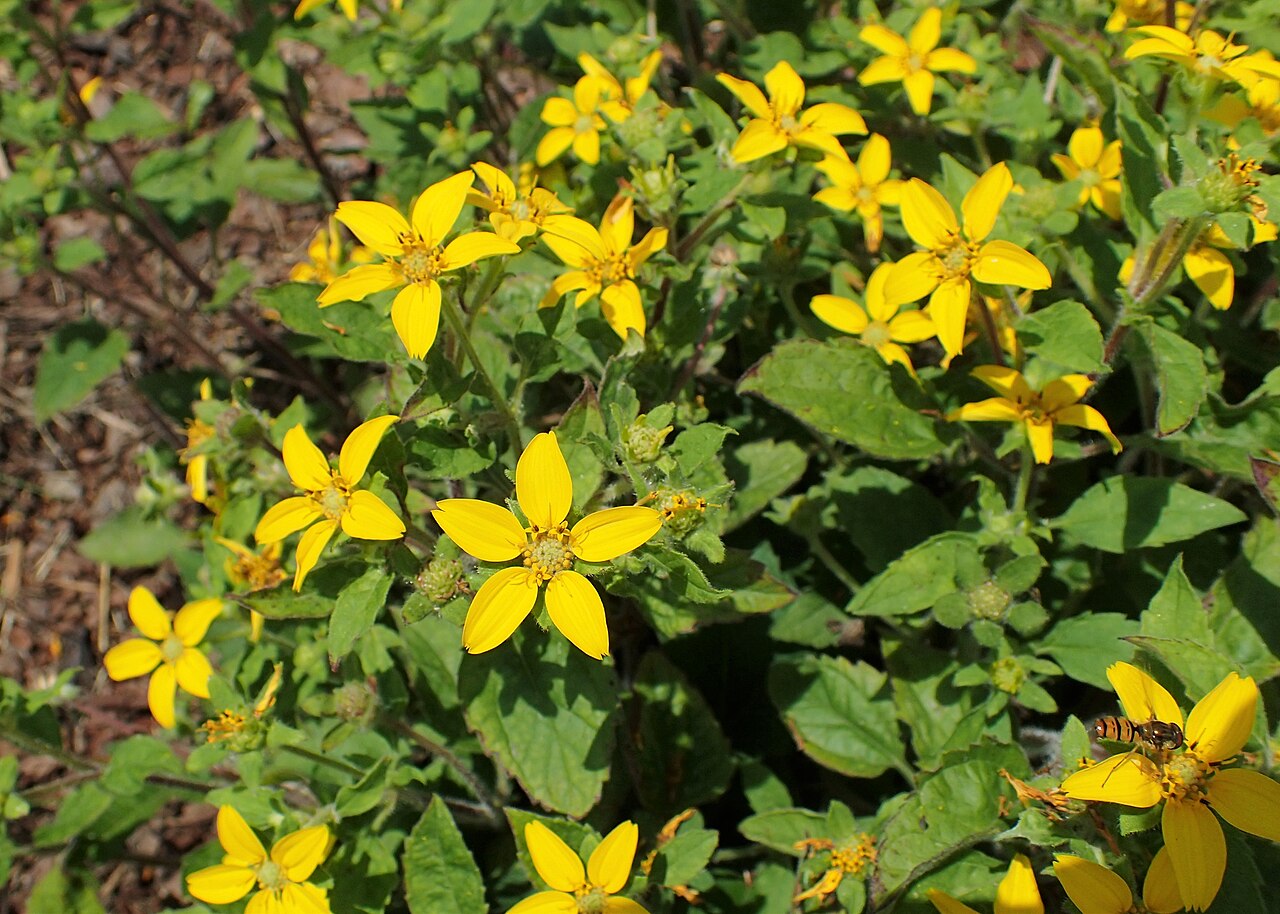
Chrysogonum virginianum, commonly called Green and Gold (also golden-knee or goldenstar), is a low, mat-forming perennial wildflower native to woodlands of the eastern and southeastern United States. It belongs to the aster family, Asteraceae, though its flowers don’t look much like a typical daisy — each one is a simple, five-rayed yellow star held just above a tight clump of fuzzy, dark green leaves. It is the only species in its genus, which makes it a true regional original rather than one of many look-alikes.
In the wild, green and gold spreads by short rhizomes and leafy runners across the floor of oak-hickory and mixed hardwood forests, often forming loose patches at the edges of trails, rock outcrops, and streambanks where a bit more light reaches the ground. It blooms over an unusually long season, often starting in April and continuing in flushes into early fall, which has made it one of the most popular southeastern native groundcovers for home gardens.
For gardeners from Pennsylvania to the Gulf Coast, green and gold fills a role few other natives do as well: a tidy, low evergreen-to-semievergreen groundcover for part shade that flowers for months, asks for almost nothing once established, and knits itself into a weed-smothering mat without becoming aggressive. It pairs naturally with other shade-garden standards like foamflower and creeping phlox.
Identification
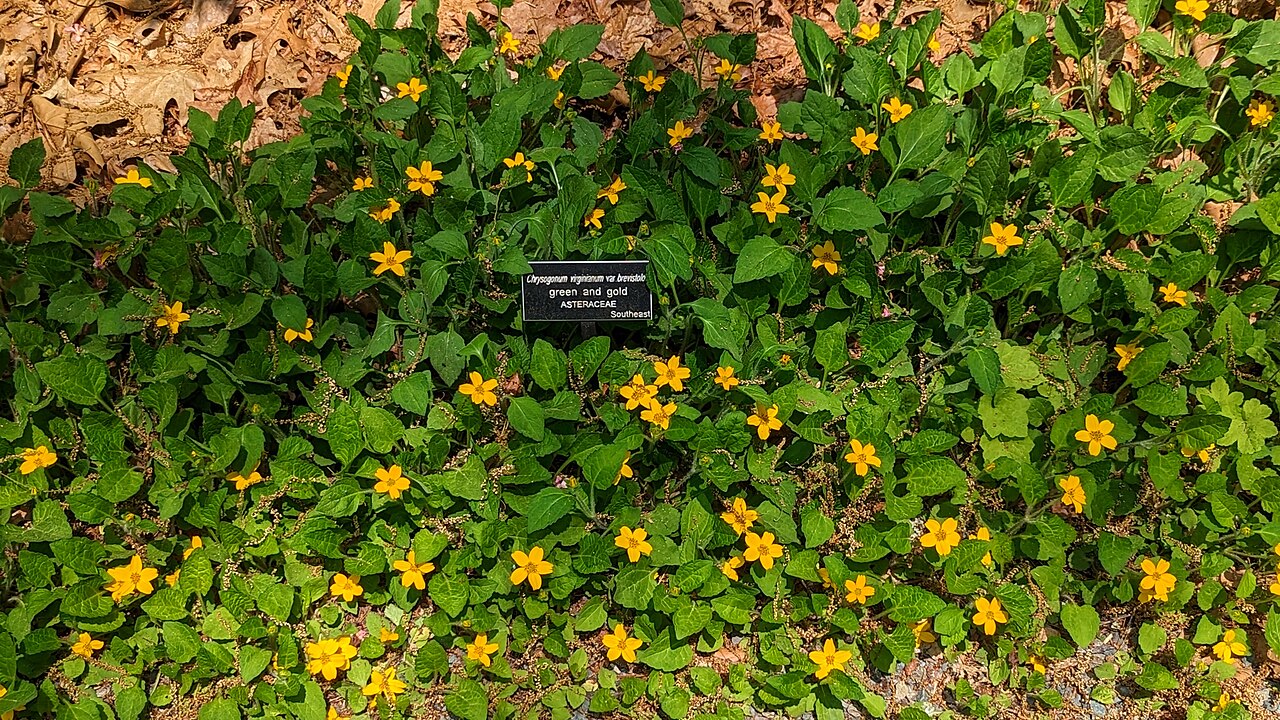
Green and gold grows as a low, spreading mat rarely more than 6 to 10 inches tall, though the flowering stems can reach a bit higher. Two growth forms occur across its range: a more upright, clump-forming type in the northern part of the range (var. virginianum), and a lower, stoloniferous, more rapidly spreading type farther south (var. australe and var. brevistolon), which is the form most often sold for groundcover use.
Leaves
The leaves are opposite, oval to heart-shaped, 1 to 3 inches long, with shallow, rounded teeth along the margin. Both leaf surfaces are covered in soft, spreading hairs, giving the whole plant a slightly fuzzy, matte texture rather than the smooth gloss of many woodland groundcovers. In mild winters the foliage stays green or takes on a bronzy-maroon tint; in colder parts of the range it dies back to the rhizome.
Flowers
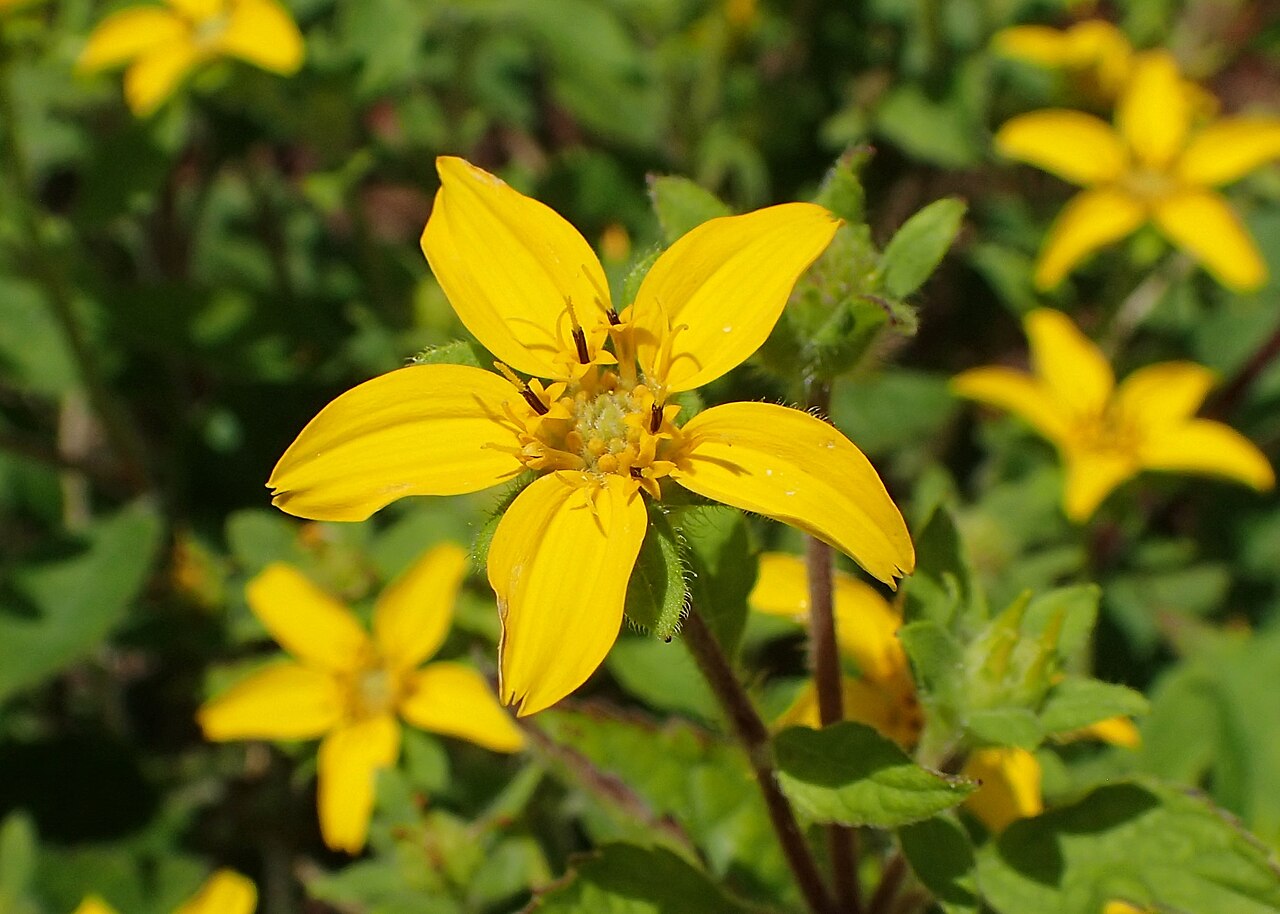
Each flower head looks like a simple yellow star, usually with five broad, slightly notched ray florets surrounding a small cluster of golden disc florets, about 1 to 1.5 inches across. Flowers are borne singly or in pairs on short stalks that stand just above the foliage, and the plant’s own glandular hairs give the flowering stems a faintly sticky feel. Bloom is heaviest in spring but continues sporadically through summer and often rebounds with a second flush in fall, especially after rain.
Fruit & Spread
After flowering, each head forms a cluster of small, dry, single-seeded fruits (cypselae, often loosely called achenes) that drop close to the parent plant. More important for garden purposes is vegetative spread: the plant extends by short rhizomes and, in the southern varieties, by leafy stolons that root at the nodes, which is how a single plant gradually becomes a solid patch.
Quick Facts
| Scientific Name | Chrysogonum virginianum |
| Family | Asteraceae (Aster) |
| Plant Type | Herbaceous to semi-evergreen groundcover perennial |
| Mature Height | 4–10 in |
| Mature Spread | 12–24 in, slowly forming larger patches by rhizomes and stolons |
| Growth Rate | Moderate |
| Sun Exposure | Part Shade (tolerates more sun with consistent moisture) |
| Water Needs | Average to moist; not drought tolerant in full sun |
| Soil Type | Moist, well-drained woodland loam, humus-rich |
| Soil pH | Acidic, roughly 5.0–6.5 |
| Bloom Time | April – October, heaviest in spring with a fall rebloom |
| Flower Color | Bright yellow |
| Fall Color | Foliage may bronze or stay green; semi-evergreen in mild winters |
| Fruit | Small dry single-seeded cypselae, not ornamentally significant |
| Deer Resistant | Mostly yes; the hairy, bitter foliage is seldom browsed heavily |
| USDA Hardiness Zones | 5–9 |
Native Range
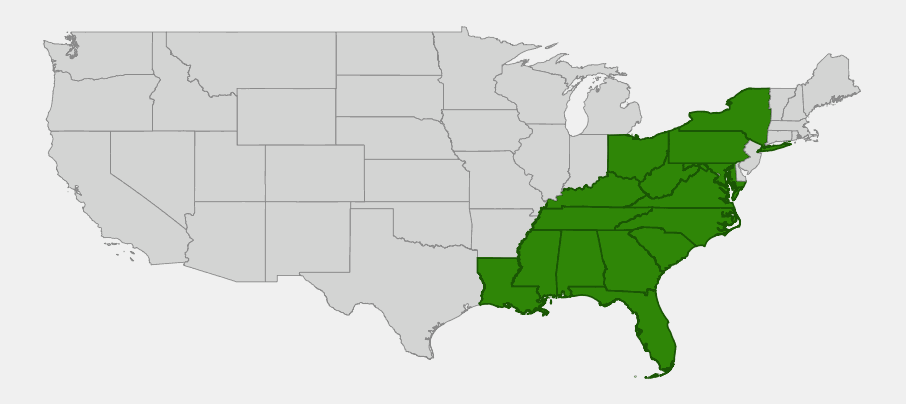
Green and gold is native to the eastern and southeastern United States, with a range centered on the Appalachian and Piedmont woodlands. It occurs from southern New York and Pennsylvania south through Maryland, Virginia, West Virginia, Kentucky, Tennessee, and the Carolinas, continuing into Georgia, Alabama, Mississippi, Louisiana, and the Florida Panhandle, with Ohio marking its western edge. Populations are notably sparser and more scattered toward the western and northern limits of this range, including Ohio and Louisiana.
Three recognized varieties divide up this range: the more upright var. virginianum from New York and Pennsylvania south to the Carolinas, Kentucky and Ohio; var. brevistolon through Georgia, Alabama, the Carolinas, Tennessee and Kentucky; and the low, fast-spreading var. australe from Florida, Georgia and Alabama west to Mississippi and Louisiana. Most of the plants sold in nurseries trace back to the spreading southern varieties, which is why cultivated green and gold often looks lower and more stoloniferous than wild northern populations.
Typical habitat is the floor and edges of dry to moist deciduous and mixed hardwood forests — oak-hickory woods, slopes above streams, and the margins of rock outcrops — usually in the dappled light under a broken canopy rather than deep, unbroken shade. It is not listed as rare or protected anywhere in its range, but like many woodland wildflowers it depends on intact forest understory and can decline where land is cleared or heavily shaded by closed-canopy pine plantations.
📋 Regional plant lists featuring Green and Gold: New York, Pennsylvania & Northern New Jersey · Maryland, Virginia & West Virginia · North Carolina & South Carolina · Georgia, Alabama & Mississippi · Arkansas, Louisiana, Eastern Oklahoma & Eastern Texas · Kentucky & Tennessee · Ohio & Indiana
Growing & Care Guide
Green and gold has earned its popularity by being one of the easiest native groundcovers to grow well. It wants the conditions of a woodland edge — some shade, steady moisture, and rich soil — but it is forgiving of ordinary garden conditions once it has a season or two to establish.
Light
Part shade is ideal: a few hours of morning sun with afternoon shade, or the dappled light under high deciduous trees, produces the densest flowering and the neatest foliage. Plants tolerate fairly deep shade but bloom more sparsely there, and they can take more sun — even nearly full sun in the cooler parts of the range — if the soil stays consistently moist. In hot, humid summers, too much direct afternoon sun combined with dry soil will scorch the leaves.
Soil & Water
This species wants humus-rich, well-drained, slightly acidic soil that mimics a forest floor — think leaf litter over loam. It is not a plant for heavy clay that stays wet, nor for deep sand that dries out quickly; both extremes shorten its life. Keep the soil evenly moist, especially through its first growing season, after which an established patch handles short dry spells but still performs best with regular rainfall or occasional supplemental water during summer droughts.
Planting Tips
Set out container plants in spring or fall, spacing them 12 to 18 inches apart if you want a solid groundcover mat within two to three years; closer spacing fills in faster. A 2-inch layer of shredded leaf mulch helps retain moisture, suppresses weeds while the planting establishes, and slowly enriches the soil as it breaks down, just as leaf litter would in the wild. Green and gold is an excellent front-of-border or pathway-edge plant because its low habit won’t hide what’s behind it.
Propagation
The easiest method by far is division: dig and separate rooted sections of an established clump in spring or early fall and replant them immediately. Stoloniferous forms often root themselves at the nodes, so a rooted runner can simply be severed from the mother plant and moved. Seed is possible but slower and less reliable, since cypselae germinate unevenly and seedlings take longer to reach flowering size than divisions.
Pruning & Maintenance
Maintenance is minimal. Shear or pinch back leggy growth in late winter to tidy the patch and encourage denser new growth before spring bloom. Deadheading isn’t necessary for repeat flowering, but removing spent flower stalks after the main spring flush can tidy the planting and may encourage the fall rebloom. Divide congested clumps every three to four years to keep them vigorous and to generate new plants for other parts of the garden.
Landscape Uses
Green and gold’s low, spreading habit and long bloom season make it one of the most versatile native groundcovers for shaded and part-shade gardens:
- Woodland groundcover under high-canopy trees, where it forms a flowering mat in place of turf
- Shade garden edging along paths, patios, and the front of mixed perennial borders
- Erosion control on gentle shaded slopes, thanks to its spreading rhizomes and stolons
- Rock garden and outcrop plantings in part shade, especially the compact southern varieties
- Pollinator and native plant gardens, paired with other spring-blooming woodland perennials such as alumroot
- Container and small-space gardens, where its tidy, low mound suits a shaded pot
Wildlife & Ecological Value
Though modest in size, green and gold pulls real weight in a native garden’s ecological web, especially during the early part of the growing season when few other woodland flowers are blooming.
For Pollinators
The simple, open yellow flowers are easy for small bees to work, and they attract a range of native bees, syrphid (hover) flies, and small butterflies and skippers, particularly during the heavy spring bloom when the plant can be covered in flowers for weeks. Because bloom often continues sporadically through summer and into fall, a green and gold patch provides a small but dependable nectar source across most of the growing season.
For Birds & Other Wildlife
Green and gold is not a major food source for birds or mammals, but its dense, low foliage mat offers useful ground-level cover for insects and small creatures, and the tiny dry fruits are occasionally taken by seed-eating songbirds. Its chief wildlife contribution is indirect: as a weed-suppressing groundcover it reduces bare soil and non-native groundcover, helping maintain healthier conditions for the native insect and plant communities a woodland garden depends on.
Ecosystem Role
In the wild, green and gold’s role is as a forest-floor stabilizer and early-to-late-season nectar source, knitting together bare soil between larger herbaceous plants and ferns. Its dense mat helps retain moisture in the leaf litter layer and limits erosion on the gentle slopes where it is common. In a garden setting, it performs the same function, serving as a living mulch that reduces weed pressure between larger shrubs and perennials.
Cultural & Historical Uses
Green and gold does not carry a significant documented history of medicinal or utilitarian use among Indigenous peoples or early settlers, unlike many showier or more abundant woodland plants. Its historical significance is mainly horticultural: Southeastern botanists and native plant enthusiasts recognized its garden merit early in the 20th century, and it became one of the first southeastern wildflowers to be deliberately selected and propagated for the nursery trade, with named cultivars such as ‘Allen Bush’ and ‘Pierre’ selected for compact habit and heavy bloom.
The genus name Chrysogonum comes from the Greek chrysos (gold) and gony (knee), a reference to the golden flowers that appear at the joints, or “knees,” of the stem — the origin of the alternate common name golden-knee. The species name virginianum simply reflects that the plant was first formally described from specimens collected in Virginia.
Today green and gold’s main cultural role is as a staple of native plant landscaping across the Southeast, where it is widely sold by native plant nurseries and promoted by extension services and native plant societies as a low-maintenance, ecologically sound alternative to non-native groundcovers like periwinkle or English ivy.
Frequently Asked Questions
Is Green and Gold the same as Golden Star?
Yes. “Golden star,” “goldenstar” and “golden-knee” are all common names used for the same plant, Chrysogonum virginianum. “Green and gold” is simply the most widely used name today.
Will Green and Gold take over my garden?
No. It spreads steadily by rhizomes and stolons to form a dense patch, but it is not aggressive or weedy; it stays within a reasonable area and is easy to edge or divide if it needs containing.
Does Green and Gold bloom all summer?
It blooms heaviest in spring, then flowers more sporadically through summer, often with a second flush in fall, especially after rain or in cooler weather. It is not a continuous nonstop bloomer, but few native groundcovers flower over such a long window.
Can Green and Gold grow in full sun?
It can, especially in the cooler, more northern parts of its range, but it needs consistently moist soil to do so. In hot summer climates, part shade with some protection from intense afternoon sun gives the best results and avoids leaf scorch.
Is Green and Gold deer resistant?
Mostly. Its hairy, somewhat bitter foliage is not a preferred browse for deer, though no plant is completely deer-proof, and hungry deer in a drought year may still sample it.

Looking for a nursery that carries Green and Gold?
Browse our native plant nursery directory: New York, Ohio & nearby states · Pennsylvania, Virginia & nearby states · Kentucky, Louisiana & nearby states · Georgia, Florida & nearby states · Alabama & nearby states