Atlantic Pigeonwings (Clitoria mariana)
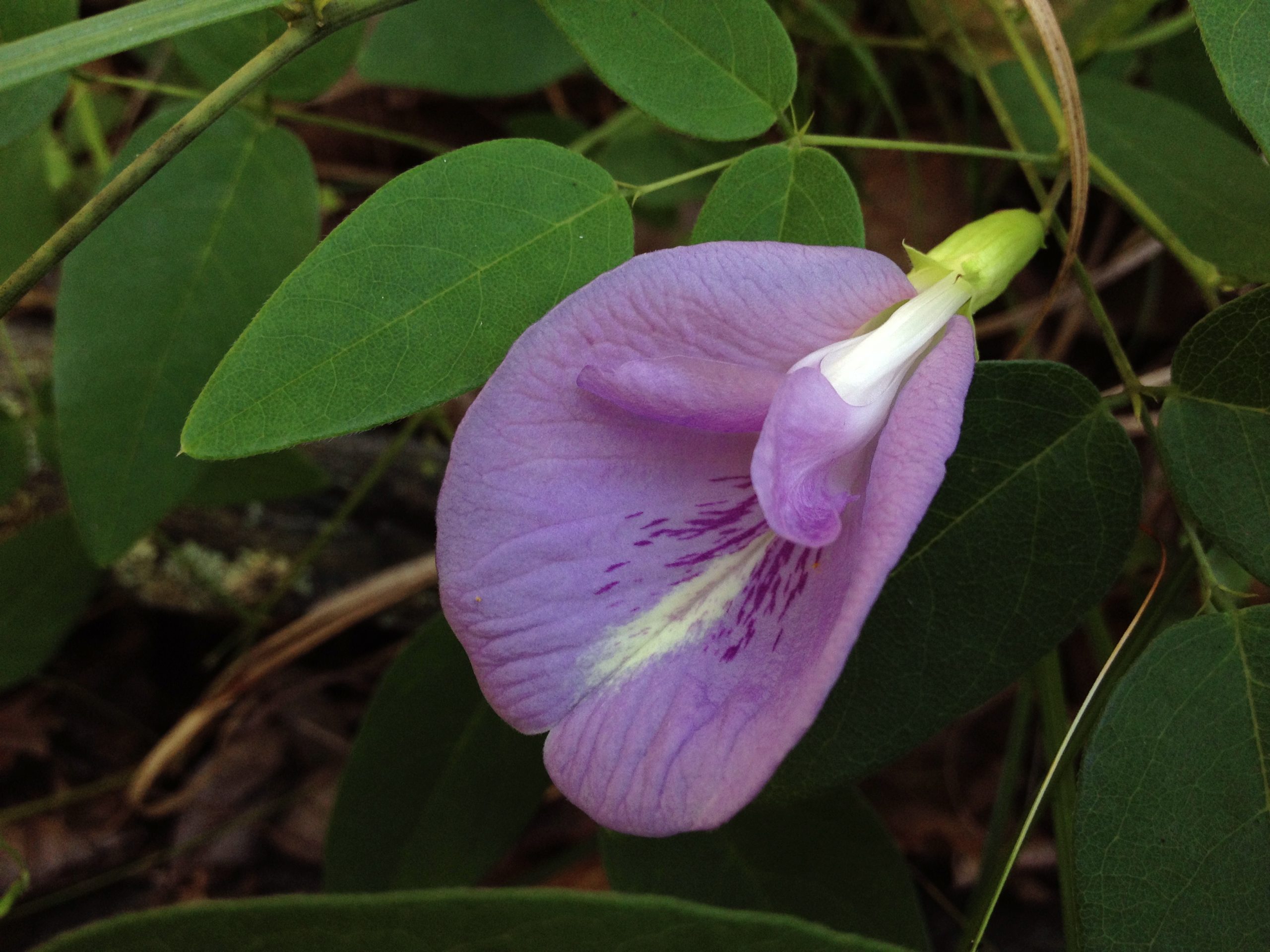
Clitoria mariana, commonly called Atlantic Pigeonwings or Butterfly Pea, is a slender, twining perennial vine native to open woods and dry thickets across much of the eastern, southern, and central United States. It belongs to the pea family, Fabaceae, and produces some of the showiest wildflowers of any native vine: large, erect, lavender-pink blooms up to 2 inches across that look almost too big for the thin, wiry stems that carry them.
Unlike many twining vines that scramble aggressively over everything in reach, Atlantic Pigeonwings is a modest, well-mannered plant, often rising just 1 to 2 feet by leaning on surrounding grasses and shrubs rather than climbing high. It favors dry, sandy or rocky soil in open woodland, woodland edges, and clearings, where it gets good light but isn’t crowded out by taller, lusher vegetation.
For gardeners in its native range, Atlantic Pigeonwings is a low-key, high-reward addition to a sunny native bed, rock garden, or open woodland edge. It asks for lean, well-drained soil and a bit of patience, since plants are not aggressive spreaders, but it rewards that patience with a long summer bloom season and flowers unlike almost anything else in a native plant garden.
Identification
Atlantic Pigeonwings is a herbaceous perennial vine, usually twining or sprawling, occasionally growing almost erect when unsupported, with slender stems 1.5 to 2 feet long that are smooth to lightly hairy.
Leaves
The leaves are pinnately trifoliate (divided into three leaflets) and borne on short petioles with small stipules at the base. Leaflets are thin-textured, oval, 1 to 4 inches long and ½ to 2 inches wide, smooth or only slightly hairy, with a lighter green, somewhat duller underside than the glossy upper surface.
Flowers
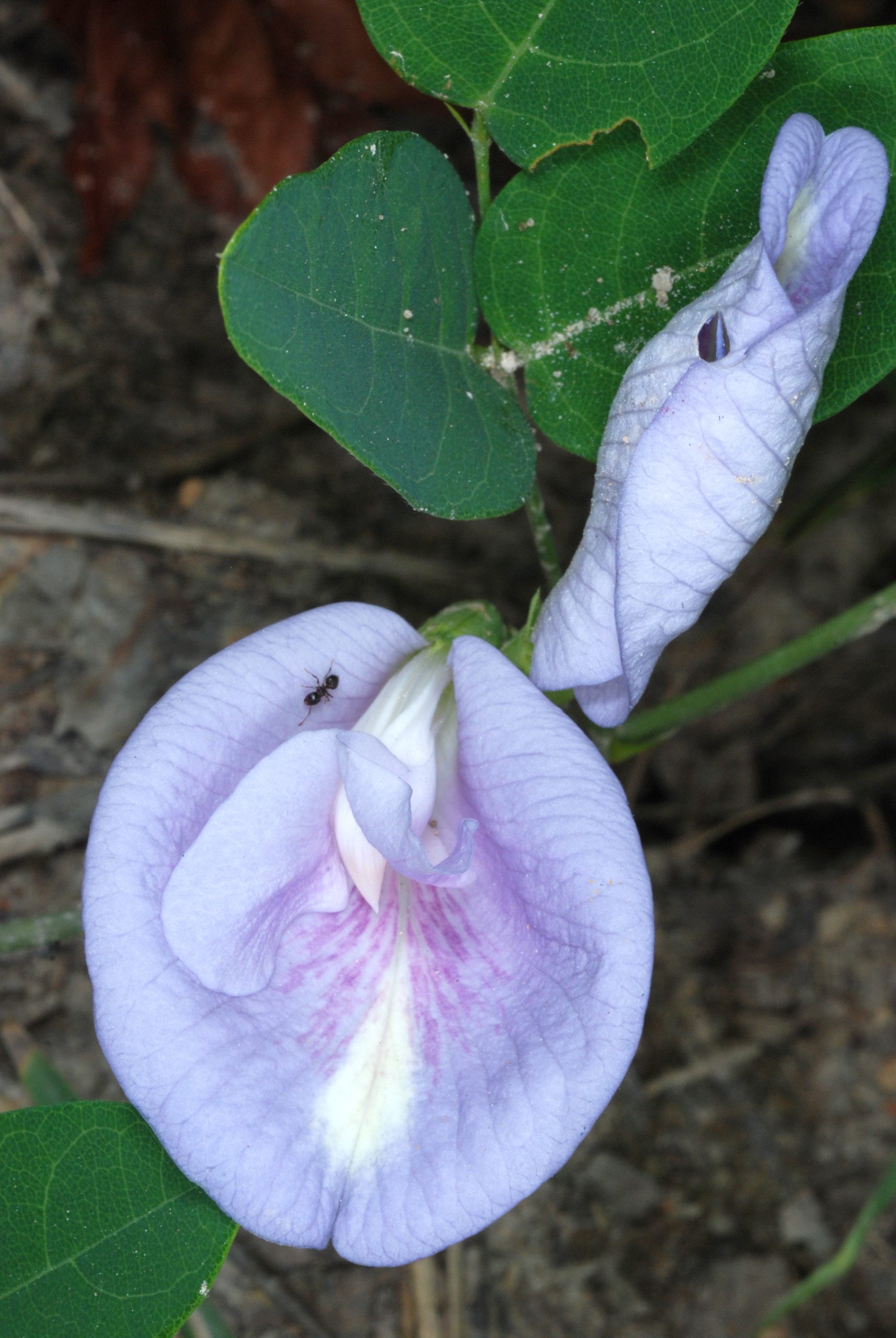
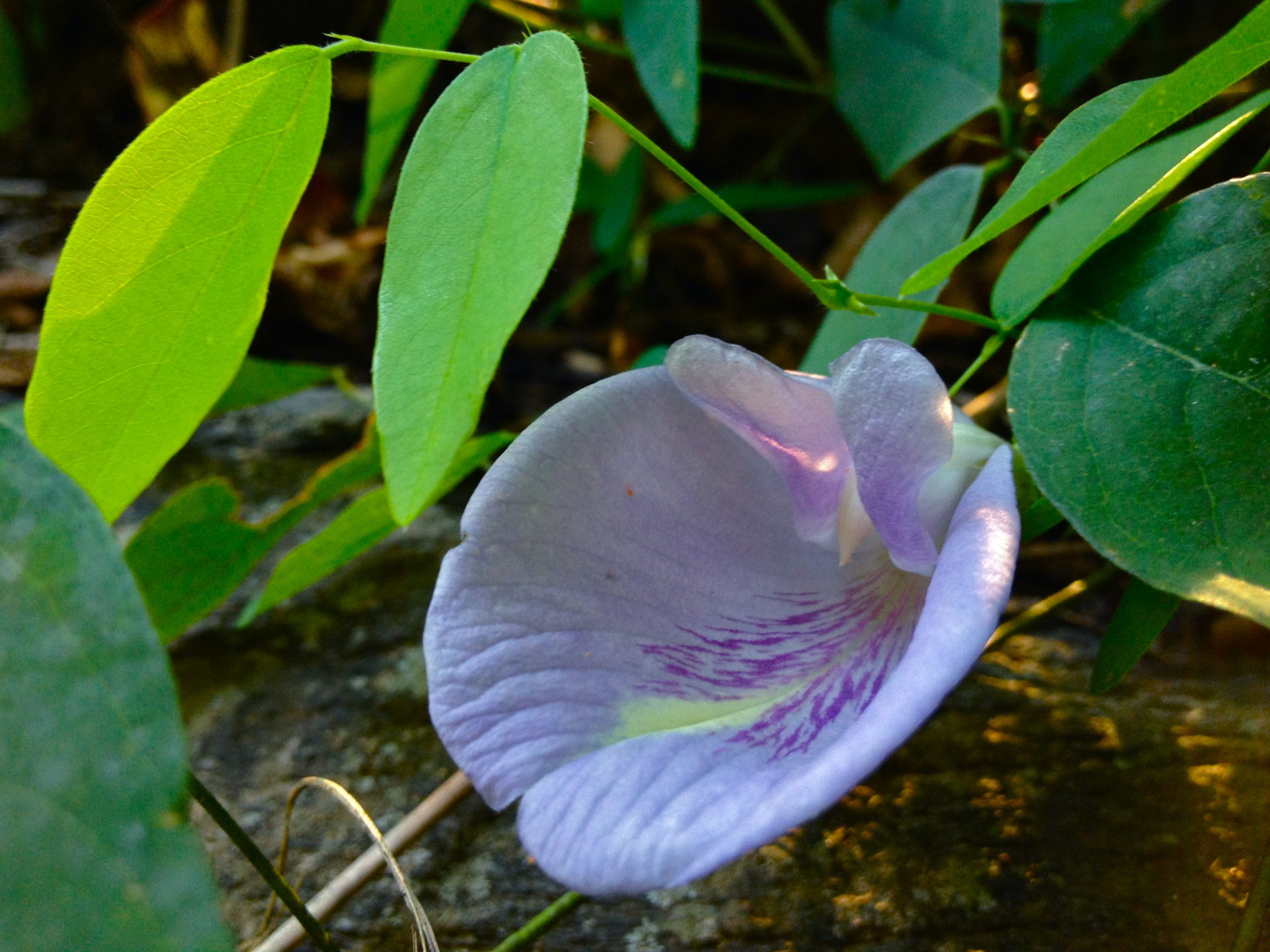
Flowers are axillary, usually borne singly or occasionally in twos or threes, and stand out immediately for their size and orientation: the broad, showy banner petal is held upright and forward, not drooping, which is the easiest way to tell this species apart from the similar spurred butterfly pea (Centrosema virginianum), whose banner points downward. The corolla is lavender-pink to pale violet, about 1.5 to 2 inches long, with a tubular calyx at its base and much smaller wing and keel petals tucked beneath the banner. Blooms open mainly in the morning and typically last only a day or two each, but a healthy plant produces a steady succession of new flowers through the summer.
Fruit & Seeds
After pollination, each flower produces a slender, flattened, linear seed pod roughly an inch long, which dries and splits open to release several small hard seeds. The pods are easy to overlook among the foliage and are not an ornamental feature, but they are the easiest way to collect seed for propagation.
Quick Facts
| Scientific Name | Clitoria mariana |
| Family | Fabaceae (Pea) |
| Plant Type | Herbaceous twining perennial vine |
| Mature Height | 1–2 ft (trailing or twining, not a tall climber) |
| Mature Spread | 1–3 ft, lax and sprawling over neighboring plants |
| Growth Rate | Slow to moderate |
| Sun Exposure | Full Sun to Part Shade |
| Water Needs | Low; prefers dry, well-drained sites |
| Soil Type | Dry, sandy or rocky, well-drained soil |
| Soil pH | Tolerant of acidic to neutral soils |
| Bloom Time | June – August |
| Flower Color | Lavender-pink to pale violet |
| Fall Color | None notable; foliage dies back to the rootstock |
| Fruit | Slender flattened seed pod about 1 in, not ornamental |
| Deer Resistant | Moderate; as a legume it can be browsed where deer pressure is high |
| USDA Hardiness Zones | 6–9 |
Native Range
Atlantic Pigeonwings has one of the broadest native ranges of any eastern wildflower vine, stretching from New York and Pennsylvania south through the Mid-Atlantic and Southeast to Florida, and west across the Ohio Valley and Mississippi Valley to Missouri, Iowa, Kansas, Oklahoma, and Texas. A notable, more isolated native population also occurs in the mountains of southeastern Arizona, far outside the main eastern range.
Across this wide range the species is consistently a plant of dry, open habitats rather than rich, moist woods: dry upland forests, open pine woods, woodland edges and clearings, rocky slopes, shale barrens, and old fields on sandy or rocky soil. It typically needs at least partial sun, and populations thin out or disappear where forest canopy closes in and shades the ground too heavily.
Atlantic Pigeonwings is not globally rare, but because it depends on open, sunny microhabitats within otherwise wooded landscapes, it can be locally uncommon and is sensitive to habitat loss from development, fire suppression, and the spread of invasive groundcover. It is listed as an endangered species in New Jersey and Pennsylvania, at the northeastern edge of its range, so gardeners there should plant only nursery-propagated stock and never dig plants from the wild.
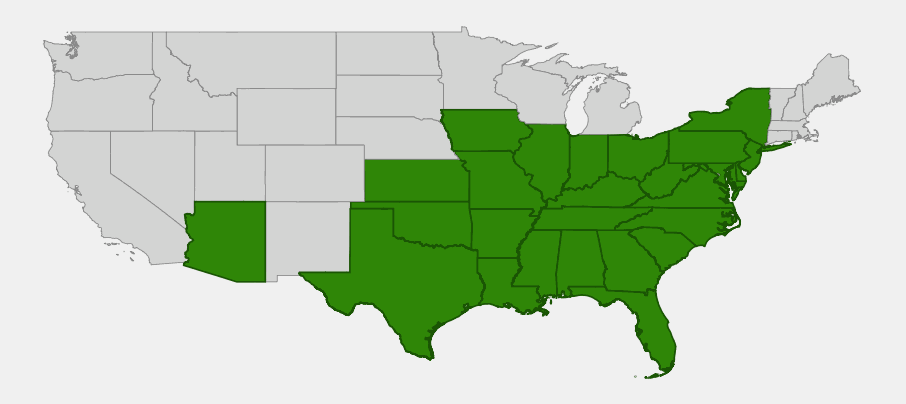
📋 Regional plant lists featuring Atlantic Pigeonwings: New York, Pennsylvania & Northern New Jersey · Delaware, Southern New Jersey & Long Island · Maryland, Virginia & West Virginia · North Carolina & South Carolina · Georgia, Alabama & Mississippi · Arkansas, Louisiana, Eastern Oklahoma & Eastern Texas · Kentucky & Tennessee · Ohio & Indiana · Illinois, Iowa & Missouri · Arizona & New Mexico · Nebraska, Kansas & Eastern Colorado
Growing & Care Guide
Atlantic Pigeonwings is easy to please as long as you resist the urge to coddle it. This is a plant of lean, dry soils in the wild, and it performs best when grown the same way in a garden.
Light
Full sun to light part shade gives the strongest flowering. Plants in deeper shade survive but bloom sparsely and grow leggy as they stretch for light, which fits the species’ natural preference for woodland edges and clearings rather than closed-canopy forest.
Soil & Water
Good drainage matters more than fertility. Dry, sandy or rocky soils that would stress many garden perennials suit this vine well, and heavy, wet, or rich soils tend to encourage floppy growth and can shorten its life. Established plants are drought tolerant and need no supplemental watering beyond normal rainfall in most of their range; water only during extended dry spells in the first year after planting.
Planting Tips
Give Atlantic Pigeonwings something low to lean on — ornamental grasses, low shrubs, or a small trellis — since it doesn’t climb vigorously enough to need (or want) a large structure. Plant in spring after the soil has warmed, and avoid rich, amended planting holes that hold too much moisture; if anything, mix in sand or fine gravel on heavier soils. Give it room among lower-growing, sun-loving companions rather than crowding it with lush, moisture-loving perennials, though it can also be tucked near sturdier native vines like crossvine or coral honeysuckle without being overwhelmed, since its light habit won’t compete for the same climbing space.
Propagation
Seed is the most practical method for home gardeners: collect the slender pods once they dry and split, and scarify the hard seed coat (a light nick or an overnight soak in warm water) to improve germination. Division is difficult because the plant lacks the spreading rhizomes of many perennials, so seed-grown or nursery-propagated plants are the standard way to establish new stock.
Landscape Uses
Its small scale and striking flowers make Atlantic Pigeonwings a specialty plant for specific garden situations rather than a general-purpose groundcover or climber:
- Dry, sunny native beds alongside little bluestem and other lean-soil wildflowers
- Rock gardens and gravelly slopes where drainage is excellent
- Open woodland edges, scrambling over low shrubs at the sunny margin of a wooded lot
- Pollinator gardens, for its long bloom season and bee-pollinated flowers
- Restoration plantings in open pine woods, savannas, and dry upland forest understory
Wildlife & Ecological Value
Atlantic Pigeonwings contributes real ecological value for its small size, chiefly through its relationships with pollinators and one well-documented butterfly.
For Pollinators
The large, structurally specialized flowers are built for bee pollination: a visiting bee must push down into the keel to reach the reproductive parts, which deposits pollen on the bee’s body as it forces its way in and out. Large native bees are the most effective visitors, and the long summer bloom window gives them a reliable nectar source through the hottest part of the season.
For Butterflies
Atlantic Pigeonwings is a documented larval host plant for the long-tailed skipper (Urbanus proteus), whose caterpillars feed on the foliage. This makes the species a useful inclusion in a butterfly garden built around native larval host plants rather than only nectar sources.
Ecosystem Role
As a legume, Atlantic Pigeonwings fixes atmospheric nitrogen through root-associated bacteria, modestly enriching the lean, sandy soils it typically grows in. Its presence is also something of an indicator species: because it depends on open, sunny conditions within a wooded landscape, a healthy population often signals that fire, grazing, or other natural disturbance is keeping the understory appropriately open for a wider community of dry-site wildflowers.
Cultural & Historical Uses
Atlantic Pigeonwings does not have a well-documented history of medicinal or utilitarian use among Indigenous peoples or early settlers in North America, unlike its more famous Old World relative, the butterfly pea (Clitoria ternatea), which has long been used in Southeast Asia as a food dye and in traditional preparations. The American species appears to have been valued primarily for its ornamental appeal.
The genus name Clitoria references the shape of the flower’s keel, a naming convention from 18th-century botanical Latin. The species name mariana refers to the Province of Maryland, where early botanical specimens were collected and described.
Today, Atlantic Pigeonwings is primarily grown and appreciated by native plant enthusiasts and specialty nurseries rather than mainstream horticulture, valued for its unusual flower form and its role as a conservation-minded choice for dry, sunny native plantings.
Frequently Asked Questions
Is Atlantic Pigeonwings the same as butterfly pea tea?
No. The blue tea sold as “butterfly pea flower tea” comes from Clitoria ternatea, a related but different species native to tropical Asia. Atlantic Pigeonwings (Clitoria mariana) is the North American native species and is not used this way.
How can I tell Atlantic Pigeonwings apart from spurred butterfly pea?
Look at how the large petal is oriented. In Atlantic Pigeonwings (Clitoria mariana) the banner petal faces up and forward; in spurred butterfly pea (Centrosema virginianum) the flower is essentially upside down, with the banner pointing downward.
Will Atlantic Pigeonwings climb a trellis?
It can twine lightly on a small support, but it is not a vigorous climber like many vines. It’s better suited to leaning on low shrubs, grasses, or a modest trellis than to covering a large structure.
Is Atlantic Pigeonwings endangered?
It is not endangered across its full range, but it is listed as an endangered species in New Jersey and Pennsylvania, at the northern edge of its distribution. Always buy nursery-propagated plants rather than wild-collected stock, especially in those states.
Does Atlantic Pigeonwings need rich garden soil?
No — it actually performs worse in rich, moisture-retentive soil. Lean, dry, well-drained sandy or rocky soil that mimics its native open-woods habitat produces the sturdiest plants and the best flowering.

Looking for a nursery that carries Atlantic Pigeonwings?
Browse our native plant nursery directory: New York, Ohio & nearby states · Pennsylvania, Virginia, Texas & nearby states · Kentucky, Louisiana & nearby states · Georgia, Florida & nearby states · Alabama, Arizona & nearby states · Illinois, Iowa, Kansas & nearby states