
Trailing Arbutus (Epigaea repens)
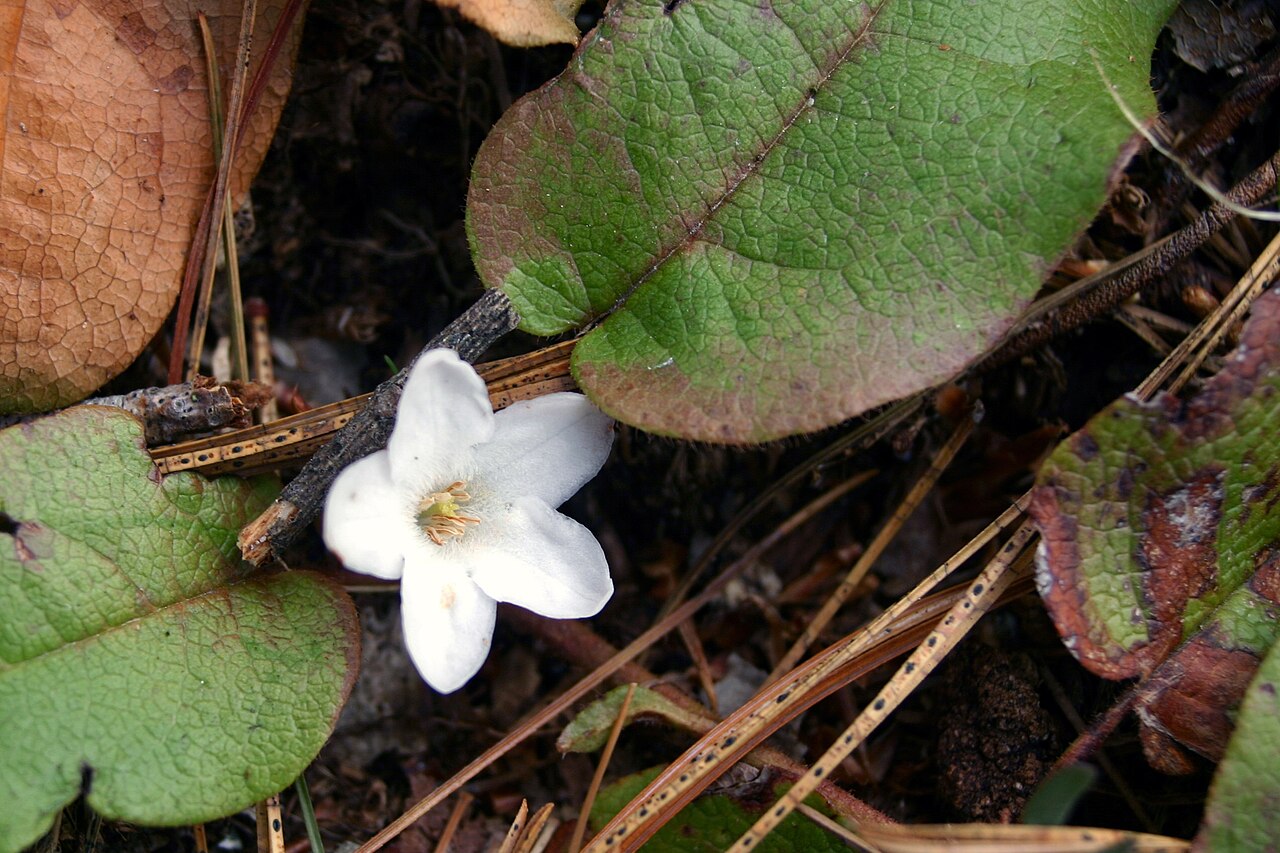
Epigaea repens, commonly known as Trailing Arbutus, Mayflower, or Ground Laurel, is a low, evergreen, woody shrub that hugs the forest floor across much of eastern North America. Few native plants have inspired as much affection — its intensely fragrant spring flowers, often blooming while patches of snow still linger, made it one of the most cherished wildflowers of early American settlers, who called it the Plymouth Mayflower after the first flower reportedly seen by the Pilgrims following their first brutal winter.
True to its name, trailing arbutus grows prostrate to sprawling, its woody stems creeping along the ground for up to 20 inches, covered in rusty-brown hairs, with leathery oval leaves that stay green through winter. The clustered, pale pink to white flowers are small — about half an inch across — but their sweet, spicy fragrance is disproportionate to their size, and a single patch in bloom can scent an entire stretch of trail.
Trailing arbutus has a well-earned reputation for being difficult to cultivate, and it is not a plant for typical garden beds. It needs specific, acidic, humus-rich woodland conditions and is sensitive to disturbance — qualities that have made it increasingly scarce in parts of its range due to overcollection and habitat loss. For gardeners with the right shaded, acidic woodland setting, though, it remains one of the most rewarding native groundcovers to establish.
Identification
Trailing arbutus is most easily recognized by its combination of a creeping, woody growth habit, leathery evergreen leaves, and small, intensely fragrant flowers that appear very early in spring.
Growth Habit & Stems
This is a slow-growing, prostrate to sprawling subshrub, typically 4 to 6 inches tall but spreading up to 20 inches along the ground. The woody stems and young leafy twigs are covered in distinctive rust-colored hairs, a helpful identification feature year-round, even when the plant isn’t in flower.
Leaves
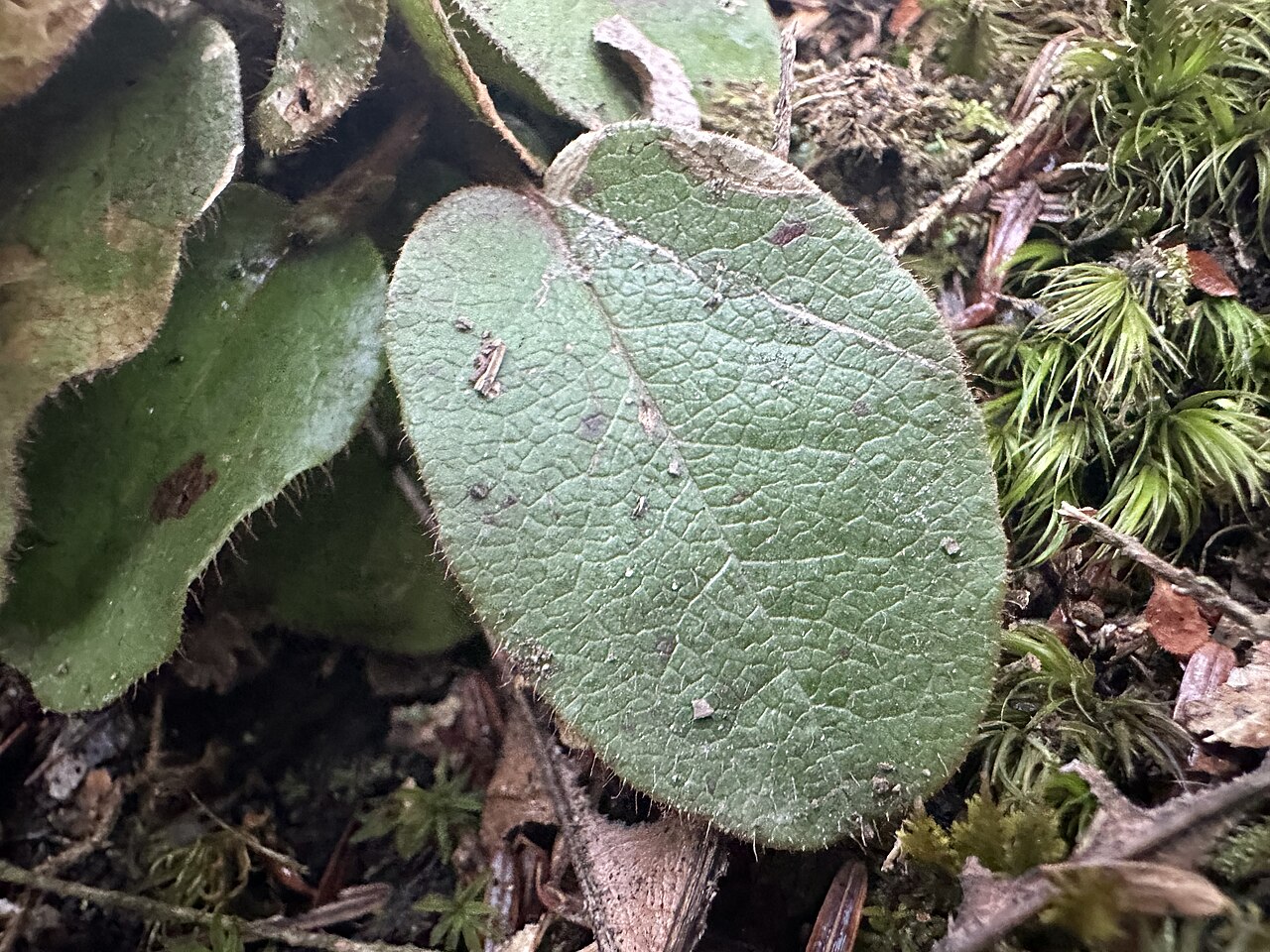
Leaves are alternate, evergreen, oval with a rounded base, and rough to the touch. The upper surface is smooth (glabrous) while the underside is more or less hairy, and leaves are borne on short, rusty-hairy petioles. The tough, leathery texture lets the foliage persist through winter, often looking a bit weathered and purple-bronze by the time flowers appear.
Flowers
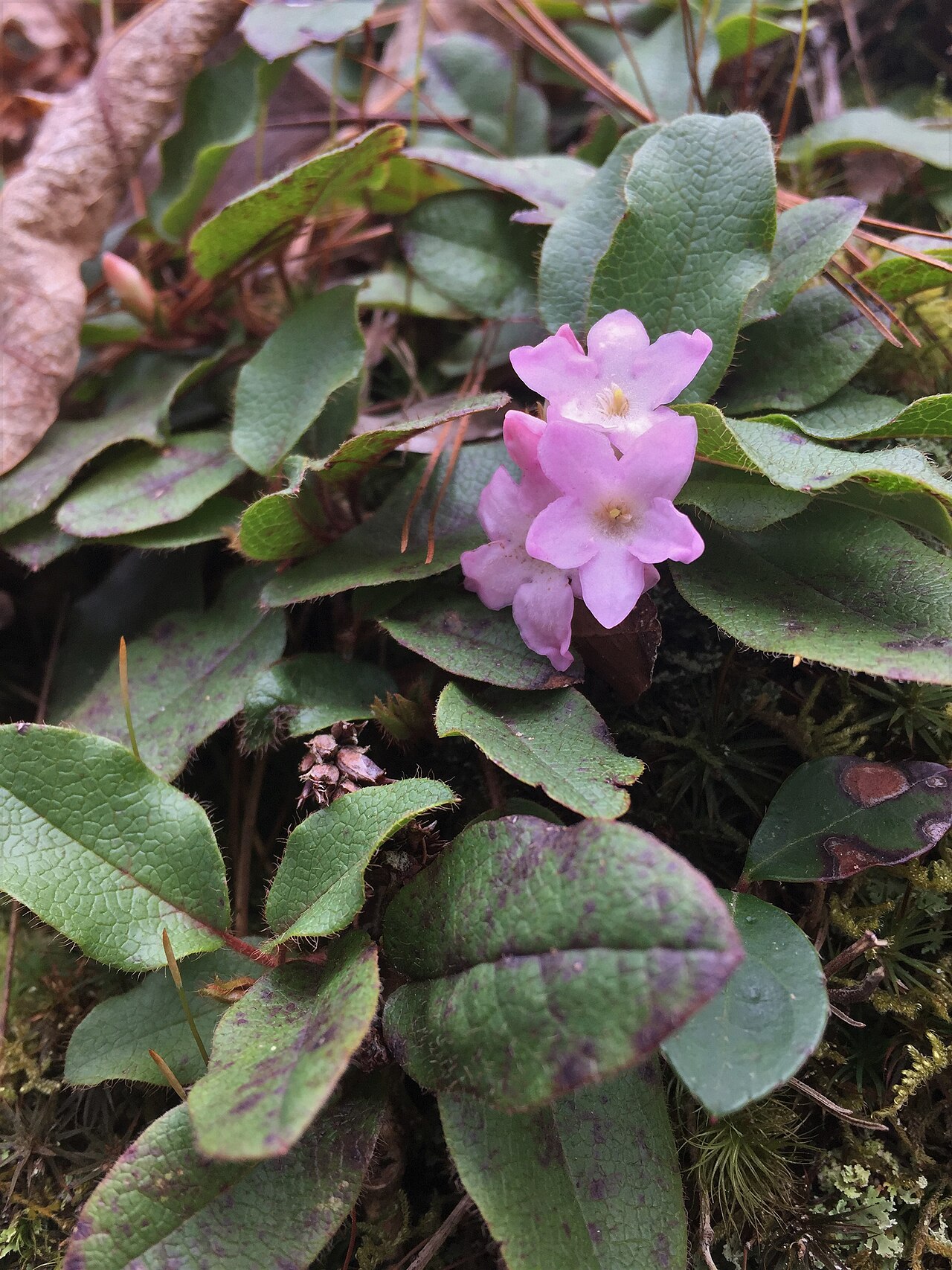
Flowers are five-lobed, salverform (a slender tube flaring into five flat lobes), pale pink to nearly white, and intensely fragrant, blooming in dense clusters at the branch tips from March into May depending on latitude and elevation. Each flower is small, roughly half an inch across when fully open, with a hairy corolla tube and five stamens. The combination of early bloom time, strong fragrance, and ground-hugging habit makes trailing arbutus unmistakable once you’ve encountered it.
Quick Facts
| Scientific Name | Epigaea repens |
| Family | Ericaceae (Heath) |
| Plant Type | Evergreen Prostrate Subshrub / Groundcover |
| Mature Height | 4–6 in |
| Mature Spread | Up to 20 in, slowly creeping |
| Growth Rate | Slow |
| Sun Exposure | Part Shade to Full Shade |
| Water Needs | Moderate; consistent moisture, good drainage |
| Soil Type | Sandy to peaty, humus-rich, acidic |
| Soil pH | Strongly acidic |
| Bloom Time | March – May |
| Flower Color | Pale pink to white |
| Fall Color | Evergreen; leaves may bronze in winter |
| Fruit | Small capsule, inconspicuous |
| Deer Resistant | Yes |
| USDA Hardiness Zones | 3–9 |
Native Range
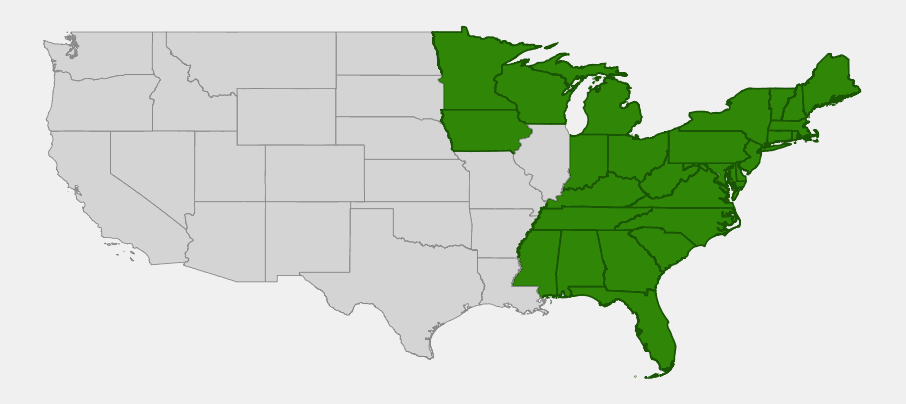
Trailing arbutus has one of the broadest ranges of any plant on this site, native across the eastern half of the continent from the Canadian Maritimes and New England west to Minnesota and Iowa, and south through the Appalachians to the Florida Panhandle and the Gulf Coast of Mississippi. Within the United States it is documented across New England, the Mid-Atlantic, the Great Lakes states, and the Appalachian South, with its southern limit reaching the Florida Panhandle and coastal Mississippi.
Throughout this range, trailing arbutus favors acidic, well-drained forest soils — sandy, rocky, or loamy — in a wide variety of woodland types, from pine barrens to oak-heath forests to mixed hardwood slopes. It is frequently part of the “heath complex” understory alongside other Ericaceae shrubs, rooting in thin, humus-rich duff over acidic parent material, often on slopes or in open woodland rather than deep shade.
Trailing arbutus is thought to be sensitive to disturbance such as logging and grazing, which likely explains its scarcity in many areas today despite its broad historic range. It is also notoriously difficult to transplant from the wild — a trait combined with decades of enthusiastic over-picking for its fragrant flowers that has led several states to protect it by law. Always obtain nursery-propagated plants rather than digging wild trailing arbutus, which rarely survives transplanting in any case.
📋 Regional plant lists featuring Trailing Arbutus: New Hampshire, Maine & Vermont · Connecticut, Massachusetts & Rhode Island · New York, Pennsylvania & Northern New Jersey · Delaware, Southern New Jersey & Long Island · Maryland, Virginia & West Virginia · North Carolina & South Carolina · Georgia, Alabama & Mississippi · Kentucky & Tennessee · Ohio & Indiana · Illinois, Iowa & Missouri · Michigan, Wisconsin & Eastern Minnesota
Growing & Care Guide
Trailing arbutus has a well-earned reputation for being difficult, but success comes down to replicating its narrow set of natural requirements closely and then leaving it alone.
Light
Give it part to full shade, as found beneath an open woodland canopy. It is naturally found in dappled light on wooded slopes rather than deep, dense shade or full sun — too much direct sun dries out the shallow root zone it depends on.
Soil & Water
This is a plant for strongly acidic, humus-rich, well-drained soil — sandy or peaty woodland duff rather than garden loam or clay. It needs consistent moisture without ever sitting wet; a mulch of pine needles or leaf litter helps maintain both the moisture and the acidity it requires. Never add lime or plant it near concrete foundations or walkways, which can raise soil pH enough to doom it.
Planting Tips
Always start with nursery-propagated plants — never wild-collected material, which both damages wild populations and rarely survives transplanting due to the plant’s sensitive root system and its reliance on mycorrhizal fungi present in undisturbed forest soil. Plant in fall or early spring, disturb the root ball as little as possible, and site it where it can establish undisturbed for years; this is not a plant that responds well to being moved once settled.
Pruning & Maintenance
Trailing arbutus needs essentially no pruning. Avoid walking on or disturbing the planting area, keep leaf litter mulch replenished, and resist the urge to “clean up” fallen leaves around it — that litter layer is part of what keeps the soil acidic and moist the way this plant needs.
Propagation
Propagation is slow and best left to specialty native plant nurseries, who typically use softwood cuttings or careful division of established, nursery-grown stock. Home propagation from seed is difficult and rarely successful; buying nursery-propagated plants is by far the more reliable path.
Landscape Uses
Trailing arbutus fits a narrow but treasured role in the right setting:
- Acidic woodland gardens beneath oaks, pines, or other acid-soil trees
- Native groundcover for shaded, undisturbed forest-floor plantings
- Fragrance gardens sited along a path where the spring bloom can be appreciated up close
- Heath-complex companion plantings with mountain laurel, rhododendron, and blueberries
- Conservation and restoration plantings in areas where wild populations have declined
Wildlife & Ecological Value
Trailing arbutus contributes meaningfully to the early-spring woodland ecosystem, offering resources that are scarce elsewhere at that time of year.
For Pollinators
The fragrant, early-blooming flowers are an important nectar source for queen bumblebees and other early-emerging native bees at a time when few other flowers are available. Trailing arbutus is also the larval host plant for the Hoary Elfin butterfly (Callophrys polios), whose caterpillars feed specifically on this and related heath-family plants.
For Birds
While not a major direct food source for birds, the low, evergreen groundcover trailing arbutus forms contributes to the structural diversity of the forest floor, providing cover for ground-foraging species and contributing to the broader insect populations that woodland birds depend on.
For Mammals
Small mammals use the dense, low evergreen mats as cover, and the plant is generally left alone by deer, making it a reliable, persistent component of a woodland groundcover layer even under browsing pressure.
Ecosystem Role
As an evergreen, mat-forming subshrub, trailing arbutus helps stabilize the thin, acidic duff layer of oak-heath and pine-oak woodlands, and its early flowering fills an important seasonal gap for pollinators emerging before most other woodland wildflowers bloom. Because it depends on specific mycorrhizal fungal relationships in undisturbed forest soil, its presence is often considered an indicator of relatively intact, long-undisturbed woodland habitat.
Cultural & Historical Uses
Trailing arbutus holds an outsized place in American folklore relative to its humble size. Known as the “Plymouth Mayflower,” it is traditionally said to have been the first flower the Pilgrims saw after surviving their devastating first winter in Massachusetts, and it was later adopted as the floral emblem of both Massachusetts and Nova Scotia. Massachusetts law still fines the digging up of a wild trailing arbutus plant $50 — a rule rooted in genuine historical concern over the species’ decline from overcollection.
Several Indigenous nations used trailing arbutus medicinally. The Cherokee prepared a decoction of the plant to treat abdominal pain and gave infusions to children for diarrhea, as well as using it for kidney and chest ailments. The Haudenosaunee (Iroquois) used compounds of the plant for labor pains, rheumatism, indigestion, and kidney complaints, while the Algonquin used a leaf infusion for kidney disorders. The Forest Potawatomi regarded trailing arbutus as their tribal flower, believing it had come directly from their divinity. These are documented historical and ethnobotanical uses, not medical advice, and the plant has no established modern medicinal use.
By the late 19th and early 20th centuries, trailing arbutus had become so popular for its fragrant spring flowers that wild picking and digging seriously depleted populations across the Northeast, prompting the protective laws that remain on the books in some states today. That history is part of why nursery-propagated stock, rather than wild-collected plants, matters so much for this species.
Frequently Asked Questions
Why is trailing arbutus so hard to grow?
It requires a narrow combination of strongly acidic soil, consistent but not excessive moisture, partial shade, and an intact mycorrhizal fungal community in undisturbed forest soil. Garden conditions rarely replicate all of these at once, and the plant resents root disturbance, which is why even nursery-grown specimens need a stable, undisturbed site to thrive.
Can I dig up trailing arbutus from the wild?
You shouldn’t. Wild trailing arbutus rarely survives transplanting because of its sensitive root system and dependence on undisturbed soil fungi, and digging it up further depletes already-declining wild populations. In Massachusetts, doing so is even subject to a legal fine. Always buy nursery-propagated plants instead.
Is trailing arbutus the same as mayflower?
Yes, in the eastern United States. “Mayflower” and “Plymouth Mayflower” are both common names for trailing arbutus (Epigaea repens), referencing its early spring bloom and its association with the Pilgrims. Note that “mayflower” is also used for unrelated plants in other regions, so the scientific name is the most reliable identifier.
Does trailing arbutus spread aggressively?
No — quite the opposite. It is a slow-growing, low-spreading plant that can take years to form a noticeable mat, and it is not considered aggressive or weedy anywhere in its native range.
Is trailing arbutus endangered?
It is not federally listed, but it has declined significantly in parts of its range due to habitat disturbance, logging, and decades of overcollection for its fragrant flowers, and several states regulate or protect it. Local status varies, so check your state’s native plant or natural heritage program for specifics before collecting or transplanting.

Looking for a nursery that carries Trailing Arbutus?
Browse our native plant nursery directory: New Hampshire, New Jersey, New York, North Carolina & Ohio · Pennsylvania, Rhode Island, South Carolina, Tennessee, Vermont & Virginia · Kentucky, Maine, Maryland, Massachusetts, Michigan, Minnesota & Mississippi · Connecticut, Delaware, Florida & Georgia · Alabama · Indiana & Iowa · West Virginia & Wisconsin