
Western Blue Virgin’s Bower (Clematis occidentalis)
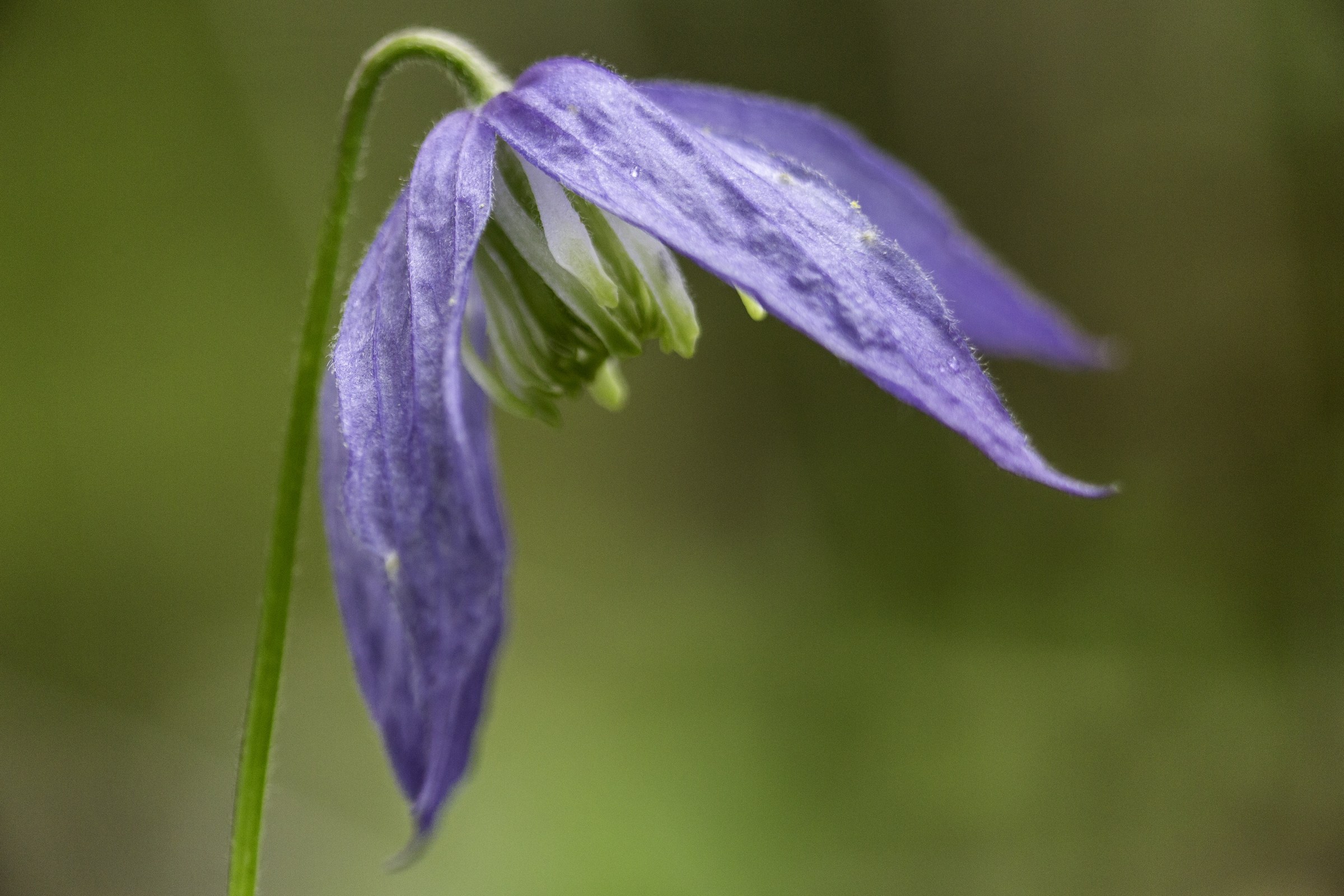
Clematis occidentalis, commonly known as Western Blue Virgin’s Bower, Purple Clematis, or Blue Virginsbower, is a slender, wiry vine in the buttercup family (Ranunculaceae) with an unusually split native range: it is a familiar sight scrambling over rocky slopes and talus in the Rocky Mountains and Pacific Northwest, and it also turns up as a rare, scattered relict in cool, rocky woods across the Upper Midwest and Northeast. Wherever it grows, its large, solitary, nodding flowers in shades of violet-blue to reddish-purple are unmistakable in late spring.
Unlike many of its showier garden-bred cousins, Western Blue Virgin’s Bower is a modest, restrained climber, rarely smothering its supports the way some clematis vines can. It twines by its leafstalks rather than true tendrils, draping loosely over shrubs, rock outcrops, and talus piles. In its western strongholds it is a familiar component of open coniferous forest and rocky canyon walls; in the East and Upper Midwest it is uncommon to rare, usually found on calcium-rich ledges, river bluffs, and talus slopes, and several states near the edge of its range track it as a plant of conservation concern.
For gardeners within its native range, this clematis is a well-behaved choice for a rock garden, dry stone wall, or the base of a trellis in part shade, especially where soil stays cool at the root zone. It is far less common in cultivation than large-flowered hybrid clematis, but native plant nurseries in its range increasingly offer it, and it is a good choice for anyone wanting an authentic, regionally appropriate climbing vine rather than an ornamental cultivar.
Identification
Western Blue Virgin’s Bower is a slender, woody-based perennial vine, typically climbing or trailing 1 to 10 feet depending on available support, though the Washington-endemic variety dissecta grows as a low, scarcely viny tuft rather than a true climber.
Stems
Stems are thin, round to slightly angled, mostly hairless to sparsely hairy, and often tinged purplish, with the lower portions becoming woody with age. The plant has no tendrils; instead, the long leaf stalks (petioles) twist and coil around twigs, branches, and rock edges for support, which is the usual way to tell a true clematis vine from other climbers at a glance.
Leaves
Leaves are opposite and compound, almost always divided into three leaflets (the low, tufted variety sometimes has undivided or shallowly lobed leaflets instead). Leaflets are egg- to heart-shaped or lance-shaped, 1.5 to 3.5 inches long, with pointed tips and margins that are either smooth or have a few shallow teeth. The leaf surfaces are hairless to sparsely hairy and somewhat firm in texture, attached to noticeably hairy leaf stalks.
Flowers
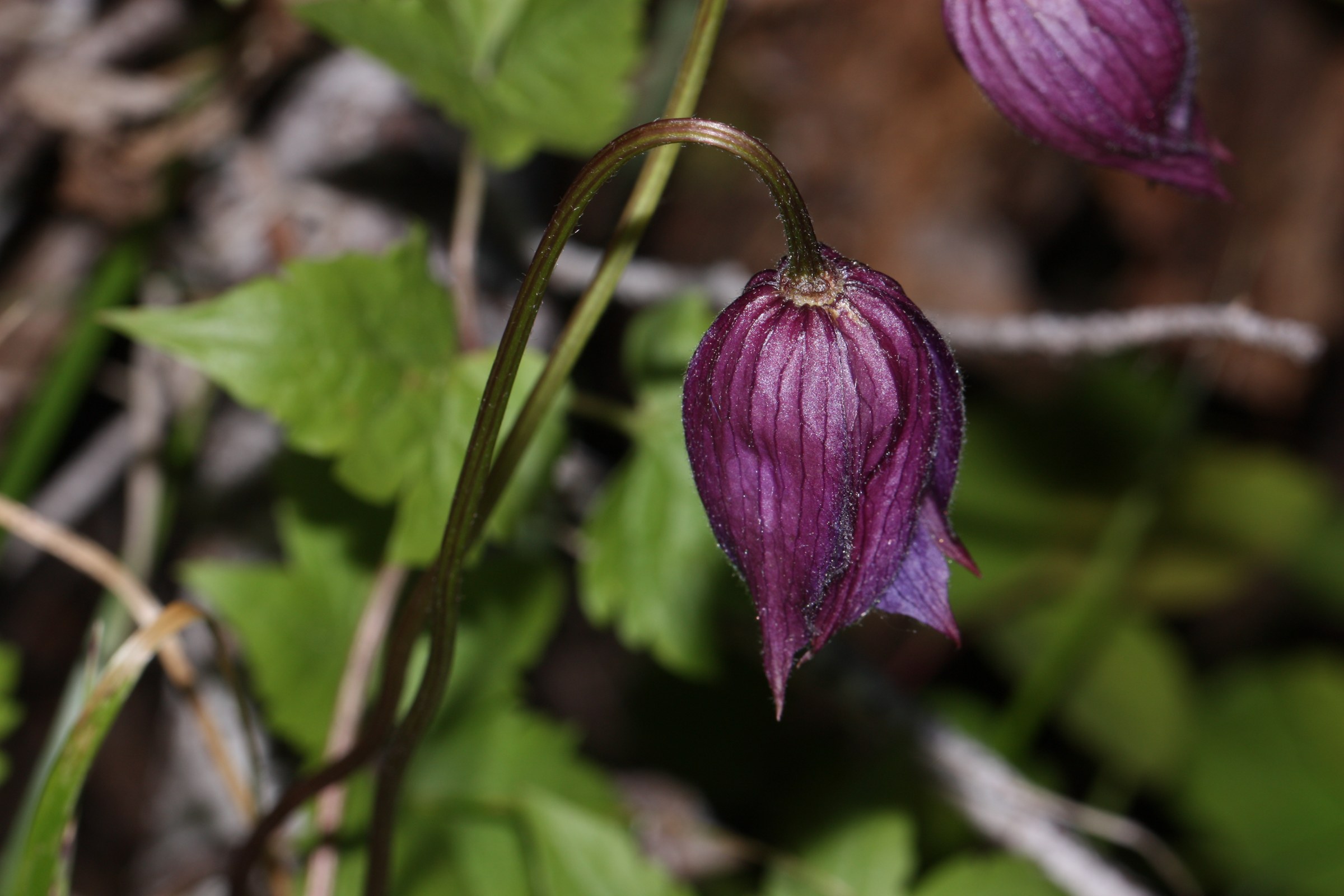
The flowers are large for the genus, 1.5 to 2.5 inches long, and appear singly from the leaf axils on slender, hairy stalks in late spring to early summer. Each flower nods or droops and has four petal-like sepals (true petals are absent) that range from violet-blue to reddish-purple, rarely white, with a hairy outer surface and a prominent, conspicuous network of veins. At the center is a dense cluster of stamens surrounded by flattened, petal-like staminodes that are often white with pink-tinged veins, giving the flower’s throat a frilly, two-toned look.
Fruit & Seeds
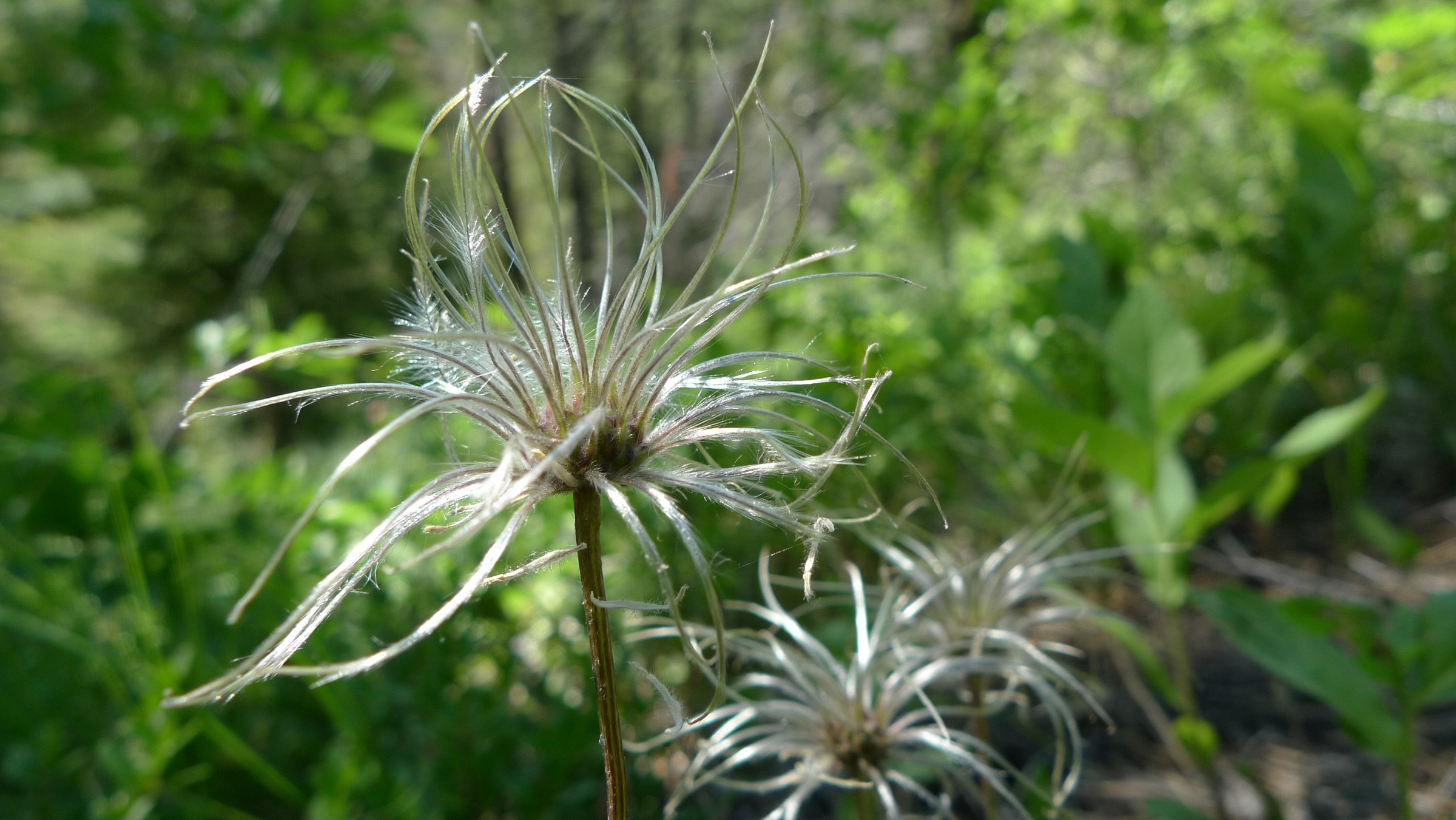
Like other clematis, the flowers give way to a cluster of plume-tailed achenes. Each small seed carries a long, feathery, silvery-gray tail up to about 2 inches long, and the whole seed head forms an airy, spinning-top-shaped cluster that is almost as ornamental as the flower. Seeds ripen from green to rusty brown by late summer and are dispersed on the wind.
Quick Facts
| Scientific Name | Clematis occidentalis (Hornem.) DC. |
| Family | Ranunculaceae (Buttercup) |
| Plant Type | Deciduous climbing vine (woody-based perennial) |
| Mature Height | 1–10 ft climbing length |
| Mature Spread | 2–4 ft at the base |
| Growth Rate | Slow to moderate |
| Sun Exposure | Part Shade to Full Sun (roots kept cool) |
| Water Needs | Low to moderate; good drainage essential |
| Soil Type | Rocky, well-drained; often calcareous |
| Soil pH | Neutral to alkaline |
| Bloom Time | May – June |
| Flower Color | Violet-blue to reddish-purple, rarely white |
| Fall Color | Yellow-green foliage; showy silvery seed plumes |
| Fruit | Feathery-tailed achene clusters, late summer |
| Deer Resistant | Yes, generally avoided by deer |
| USDA Hardiness Zones | 3–7 |
Native Range
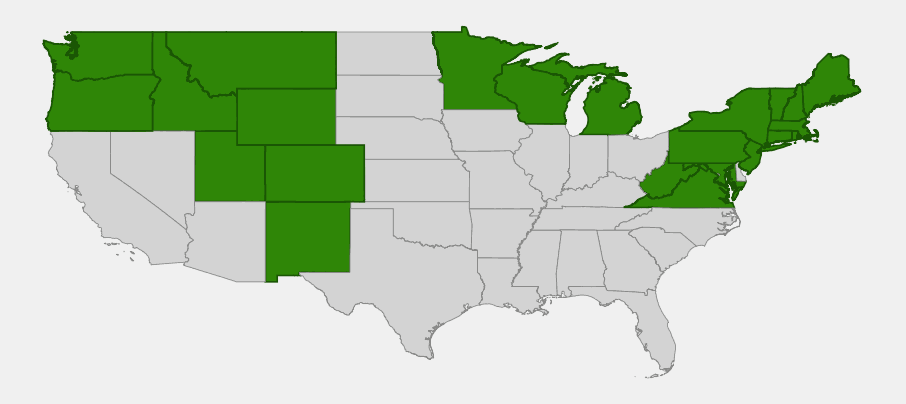
Western Blue Virgin’s Bower has a striking disjunct native range split between two regions. Its main stronghold is the northern Rocky Mountains and Pacific Northwest, where it is reasonably common from Washington and Oregon east through Idaho into Montana, Wyoming, Utah and Colorado, with scattered populations south into New Mexico. A second, much sparser population occurs roughly 1,000 miles away, across the Upper Midwest and Northeast — Minnesota, Wisconsin, Michigan, New York, Pennsylvania, New Jersey, and the New England states, plus Maryland, Virginia and West Virginia — where it survives as a local relict on cool, rocky sites and is considered rare or of conservation concern in several of those states.
In the West, typical habitat is open coniferous or mixed forest, rocky canyon slopes, and talus, often climbing over shrubs or scrambling across broken rock from low valleys up into subalpine elevations. In the East and Upper Midwest, it favors calcium-rich settings — limestone or dolomite cliffs, talus slopes, river bluffs, and rocky, open woods — conditions that mirror the well-drained, mineral-rich sites it prefers out West.
Because eastern and midwestern populations are small, scattered, and slow to spread (the heavy, plumed seeds don’t travel far), those states generally regard it as uncommon to rare, and it is not a plant to collect from the wild anywhere in its range. Nursery-propagated plants, where available, are the appropriate way to add it to a native garden.
📋 Regional plant lists featuring Western Blue Virgin’s Bower: Idaho, Eastern Oregon & Eastern Washington · Western Oregon & Western Washington · Montana & Wyoming · Utah & Western Colorado · Arizona & New Mexico · Michigan, Wisconsin & Eastern Minnesota · New York, Pennsylvania & Northern New Jersey · Maryland, Virginia & West Virginia · New Hampshire, Maine & Vermont · Connecticut, Massachusetts & Rhode Island
Growing & Care Guide
Western Blue Virgin’s Bower is a good match for gardeners who want an authentic native alternative to ornamental clematis cultivars, as long as its preference for rocky, well-drained soil is respected.
Light
This clematis tolerates a wide range of light, from fairly open sun to part shade, but it does best when its flowers and foliage get some sun while its roots stay shaded and cool — the classic clematis rule of “head in the sun, feet in the shade.” In its native rocky habitats this usually happens naturally, as roots run deep into cool crevices while the vine climbs up into brighter light.
Soil & Water
Good drainage is essential; this is a plant of rocky slopes and talus, not rich garden loam. A lean, gritty, neutral-to-alkaline soil suits it well, and established plants need only modest supplemental water, tolerating short dry spells once their root system is established. Soggy or heavy clay soil is the fastest way to lose this plant.
Planting Tips
Site it at the base of a low wall, rock garden slope, or open shrub where its leaf stalks can grab hold of something to climb. Mulch lightly with gravel or stone rather than heavy organic mulch to keep the crown dry and mimic its rocky native habitat. Because the species is uncommon to rare through much of its eastern range, buy only nursery-propagated stock and never collect wild plants or seed.
Pruning & Maintenance
This is a light, restrained vine that needs very little pruning. Remove dead or winter-damaged stems in early spring, and trim lightly after flowering if you want to control its spread. Unlike many large hybrid clematis, it does not need hard annual cutback and generally looks best left to find its own way over its support.
Landscape Uses
Good placements include:
- Rock gardens and dry stone walls where roots can run into cool crevices
- Base of a low trellis or shrub for light, informal climbing
- Native plant and xeric gardens within its home range
- Slope and talus plantings that mimic its natural rocky habitat
- Pollinator gardens, where its early-summer flowers draw bees
Wildlife & Ecological Value
Though not a dominant food plant for wildlife, Western Blue Virgin’s Bower makes a useful, if modest, contribution to the plant communities it grows in.
For Pollinators
The large, nodding flowers are visited by bumblebees and other native bees, which push past the hairy sepals to reach the pollen-rich cluster of stamens at the center. Because it blooms in late spring to early summer, it offers a nectar and pollen source at a time when many rocky-slope habitats have relatively few other flowers open.
For Birds
Small songbirds occasionally use the wiry stems for nesting material, and the tangled growth at the base of rock outcrops can offer modest cover. The species is not a significant food source for birds, which mainly benefit indirectly from the insects the flowers attract.
For Mammals
Deer and other large herbivores generally leave this vine alone, which is one reason it persists well on exposed, grazed rocky slopes where more palatable plants are quickly browsed down.
Ecosystem Role
On loose talus and rocky slopes, the wiry stems and root system of Western Blue Virgin’s Bower help stabilize small pockets of soil among the rocks, and its presence is often a sign of a stable, undisturbed rock-outcrop plant community. In its disjunct eastern and midwestern populations, it is part of the specialized flora of calcareous cliffs and ledges, habitats that support a distinct community of plants adapted to thin, mineral-rich soils.
Cultural & Historical Uses
Western Blue Virgin’s Bower has a much smaller historical footprint than many showier native wildflowers, in part because it grows scattered across rocky, often hard-to-reach terrain rather than in accessible meadows or open ground. Some Indigenous peoples in its western range used various native clematis species for utilitarian purposes such as light cordage made from the tough, fibrous stems, though detailed, species-specific records for Clematis occidentalis itself are sparse compared with better-documented relatives.
The plant’s clearest historical role has been botanical and horticultural rather than practical. Nineteenth-century botanists such as Hornemann and de Candolle formally described the species from specimens collected in the Rocky Mountain West, and later field botanists, including Hitchcock and Cronquist in their influential Pacific Northwest flora, documented its range and the distinctive low, tufted Washington variety now known as dissecta.
In more recent decades, Western Blue Virgin’s Bower has drawn interest from rock gardeners and native plant enthusiasts specifically because it behaves so differently from large hybrid clematis vines — modest, slow, and well suited to a true rock garden setting rather than a trellis full of bloom. Its conservation status in several eastern and midwestern states has also made it a plant of interest to botanists tracking rare calcareous-habitat species.
Frequently Asked Questions
Is Western Blue Virgin’s Bower the same as common garden clematis?
No. Most garden clematis sold in nurseries are large-flowered hybrids bred mainly from Asian species. Western Blue Virgin’s Bower is a distinct North American native with smaller, more delicate nodding flowers and a much more restrained growth habit.
Why does it grow in such scattered, disconnected places?
Its range is a classic example of a disjunct distribution: a large, continuous western population in the Rockies and Pacific Northwest, and a second, much smaller population a thousand miles away in the Northeast and Upper Midwest. Botanists think both populations are remnants of a once more continuous range that contracted as climate shifted after the last ice age, leaving isolated pockets on the cool, rocky, calcium-rich sites the plant still prefers today.
Is it rare, and can I collect it from the wild?
In its Rocky Mountain and Pacific Northwest stronghold it is not considered rare, but in several states at the eastern and midwestern edge of its range it is tracked as uncommon or rare by state natural heritage programs. Never dig or collect it from the wild; look for nursery-propagated plants instead.
Does it need a trellis like other clematis?
It benefits from something to climb — a low shrub, rock wall, or small trellis — but it is a much lighter, less vigorous climber than large hybrid clematis and will not need heavy structural support.
What does the seed head look like?
After flowering, each cluster of seeds develops long, silvery, feathery tails that curl outward in a loose, spinning-top shape. These plumed seed heads are showy in their own right and persist into late summer, adding a second season of visual interest after the flowers fade.

Looking for a nursery that carries Western Blue Virgin’s Bower?
Browse our native plant nursery directory: Washington · Oregon · Idaho · Montana, Minnesota, Michigan, Maine, Massachusetts & Maryland · Wyoming, Wisconsin & West Virginia · Utah, Pennsylvania, Vermont, Rhode Island & Virginia · Colorado & Connecticut · New Mexico, New York, New Hampshire & New Jersey