
Stiff Dogwood (Cornus foemina)
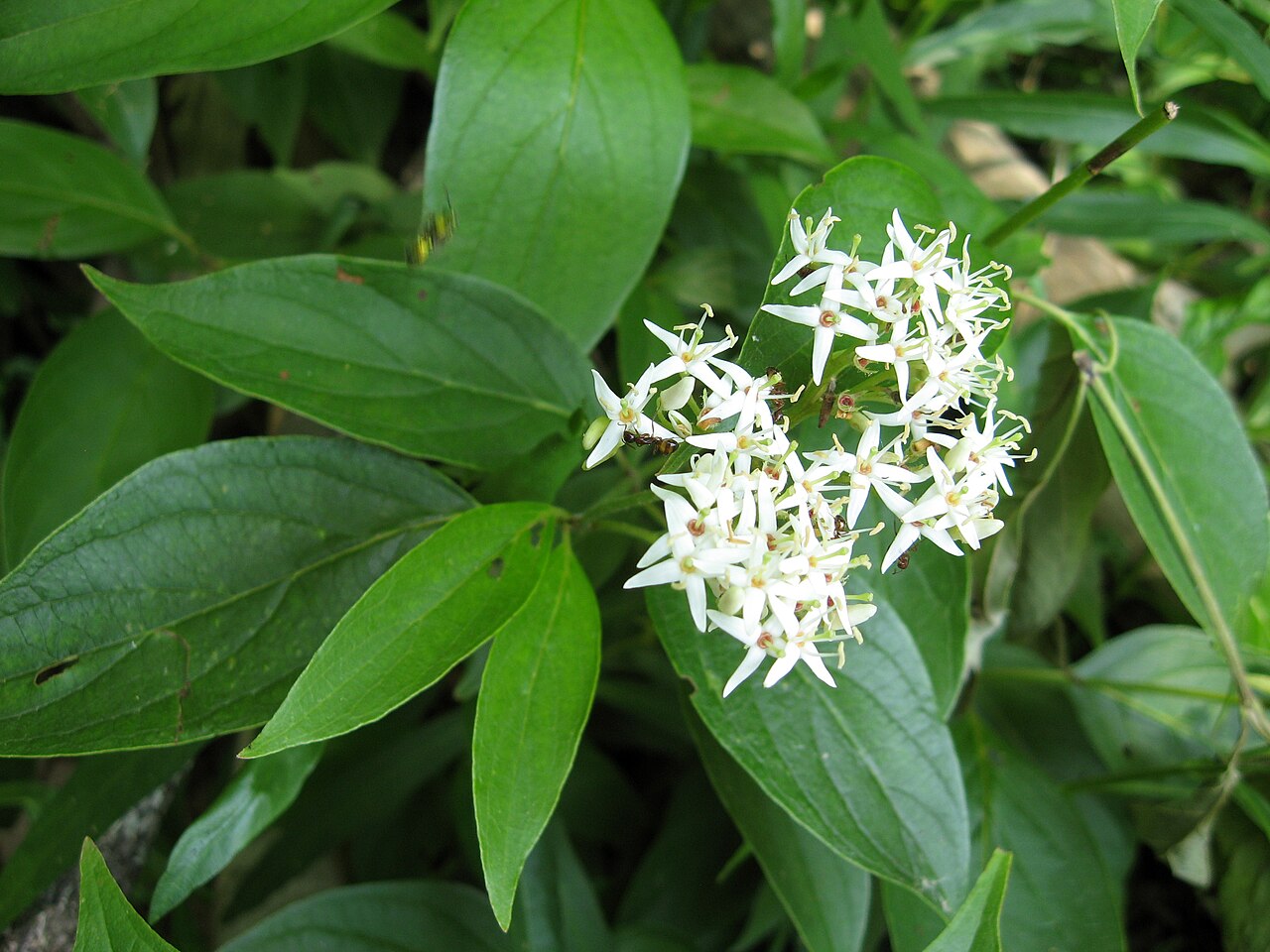
Cornus foemina, commonly called Stiff Dogwood (also Swamp Dogwood, Stiffcornel Dogwood, or Bluefruit Dogwood), is a deciduous, multi-trunked shrub or small tree of wet ground across the east-central and southeastern United States. It belongs to the dogwood family and, like its relatives, offers a full season of interest: red young twigs in winter, flat clusters of white flowers in spring, and blue to blue-violet fruit that draws songbirds in fall.
Stiff dogwood is less showy than the familiar flowering dogwood (Cornus florida) — its blooms are small and clustered rather than large and petal-like — but it more than makes up for that with toughness. Few native shrubs handle consistently wet, poorly drained soil as well, which makes it a natural choice for pond edges, stream banks, rain gardens, and other soggy sites where many other woody plants struggle.
The species is sometimes still sold or listed under the older name Cornus stricta, which botanists now treat as the same plant as Cornus foemina. If you see “Cornus stricta” on an older plant list or nursery tag in this region, it refers to the same stiff dogwood described here.
Identification
Stiff dogwood typically grows 10 to 25 feet tall as a large, multi-trunked shrub or small tree, with several stems clustered from the base rather than a single central trunk.
Bark & Twigs
Young twigs are a distinctive deep red, smooth, and hairless, with a white pith inside — a useful identification mark, since the similar gray dogwood (Cornus racemosa) has tan pith instead. Older bark turns gray and furrowed, often with a braided or checkered look as it splits with age.
Leaves
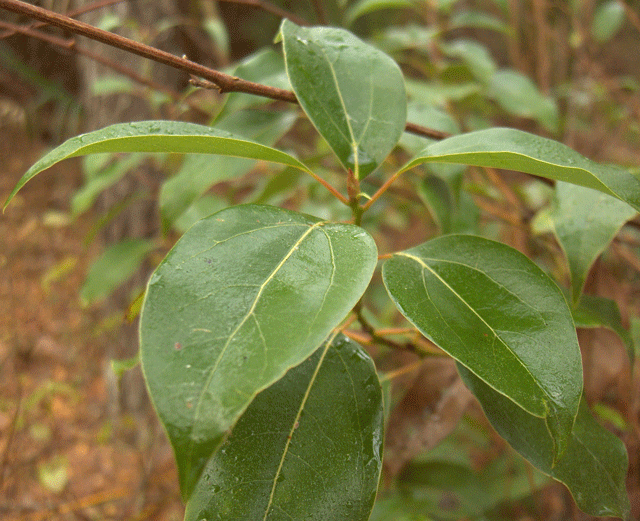
Leaves are arranged oppositely along the stem, lanceolate to elliptic in shape, 1.5 to 4 inches long, with 3 to 4 pairs of curved side veins typical of dogwoods. The upper surface is smooth and dark green; the lower surface is pale gray-green with sparse fine hairs. Fall color can turn a reddish-purple before the leaves drop.
Flowers & Fruit
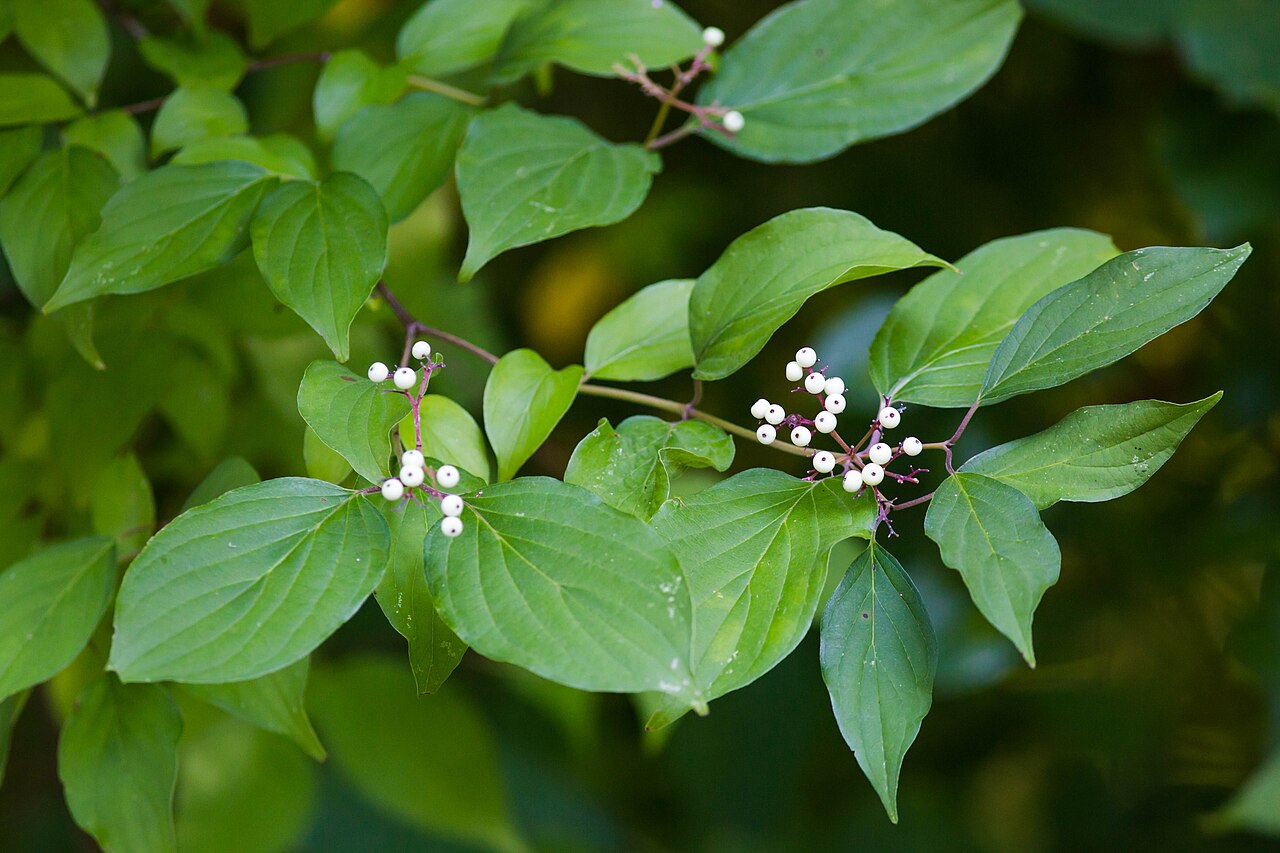
Small, creamy-white flowers open in flat-topped clusters at the branch tips from March into June. They are visited readily by bees, wasps, flies and butterflies, though the scent is more functional than pleasant to people. Flowers give way in late summer and fall to clusters of pale blue to blue-violet drupes about a quarter inch across — sometimes aging to a whitish blue — that are a favorite of fall-migrating and resident songbirds.
Quick Facts
| Scientific Name | Cornus foemina (syn. Cornus stricta) |
| Family | Cornaceae (Dogwood) |
| Plant Type | Deciduous, multi-trunked shrub / small tree |
| Mature Height | 10–25 ft |
| Growth Rate | Moderate |
| Sun Exposure | Full sun to partial shade |
| Water Needs | Moderate to high; very tolerant of wet, poorly drained soil |
| Soil Type | Sand to loam; tolerates seasonally flooded ground |
| Soil pH | Wide range, acidic to slightly alkaline |
| Bloom Time | March – June |
| Flower Color | Creamy white |
| Fall Color | Reddish-purple |
| Fruit | Pale blue to blue-violet drupes, late summer–fall |
| Deer Resistant | No (deer and rabbits browse foliage and twigs) |
| USDA Hardiness Zones | 6–9 |
Native Range
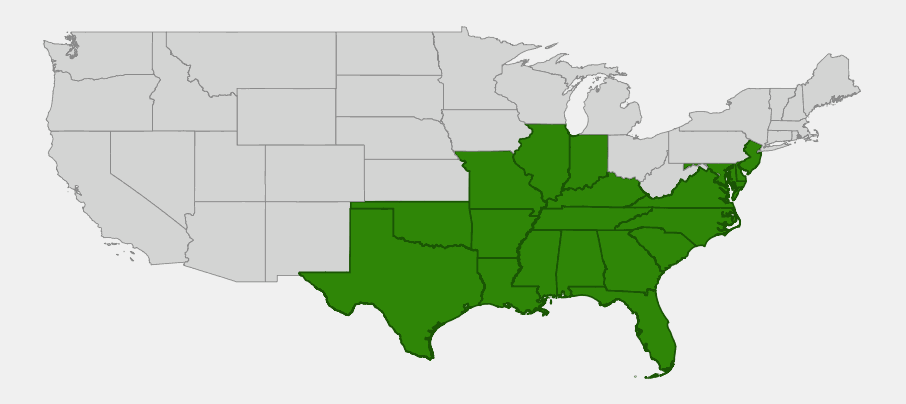
Stiff dogwood is native to the east-central and southeastern United States, found mainly along the Atlantic and Gulf coastal plains from Virginia south to Florida, west through the Gulf states to eastern Texas and Oklahoma, and north through the Mississippi Valley into southeastern Missouri, southern Illinois and Indiana, Kentucky, and Tennessee, with outlying native populations in Delaware, Maryland, and southern New Jersey.
Throughout this range it is a wetland species, growing in marshes, swamps, river and stream banks, pond margins, floodplain forests, pocosin edges, interdune swales, and even wet roadside ditches, from sea level up to about 1,500 feet.
📋 Regional plant lists featuring Stiff Dogwood: Georgia, Alabama & Mississippi · Arkansas, Louisiana, Eastern Oklahoma & Eastern Texas · Kentucky & Tennessee · North Carolina & South Carolina · Maryland, Virginia & West Virginia · Illinois, Iowa & Missouri · Ohio & Indiana · Delaware, Southern New Jersey & Long Island
Growing & Care Guide
Stiff dogwood is an easygoing native for exactly the kind of difficult, wet site that frustrates many other shrubs. Give it consistent moisture and it asks for very little else.
Light
Plant in full sun to partial shade. Flowering and fruiting are heaviest with more sun, but the shrub performs well as an understory or edge planting in partial shade too.
Soil & Water
Stiff dogwood tolerates sandy or loamy soil across a wide pH range and is exceptionally tolerant of poor drainage and seasonal flooding. It is an excellent choice for naturally wet spots — pond edges, rain gardens, low areas that stay soggy after storms — where it will outperform most other landscape shrubs. It also handles average garden moisture once established, though it will not thrive in dry, well-drained sites.
Planting Tips
Set out container-grown plants in fall or early spring. Because the shrub naturally forms a multi-trunked clump, give it 8 to 10 feet of space to spread, or plant in groups for a naturalized thicket along a pond or stream edge. It establishes readily from seed as well as from nursery stock.
Pruning & Maintenance
Little pruning is needed beyond removing dead or crossing stems in late winter. Stiff dogwood has no serious insect or disease problems, making it a reliably low-maintenance choice once sited correctly.
Landscape Uses
- Rain gardens and bioswales, where its flood tolerance is a real asset
- Pond and stream bank plantings for naturalizing and erosion control
- Wildlife and pollinator gardens, thanks to its spring flowers and fall fruit
- Naturalized borders and thickets in low, moist ground
- Floodplain and wetland restoration plantings
Wildlife & Ecological Value
Stiff dogwood supports wildlife across the whole growing season, from spring bloom through fall fruiting.
For Pollinators
The spring flower clusters draw bees, wasps, flies, and butterflies for nectar and pollen. The foliage also serves as a larval host plant for the spring azure butterfly, adding caterpillar-stage value beyond the flowers themselves.
For Birds & Mammals
The blue to blue-violet fall fruits are eaten by many species of songbirds, as well as raccoons, black bears, squirrels, and chipmunks. Deer and rabbits browse the foliage and twigs, which makes young plants worth protecting from heavy grazing pressure until established.
Ecosystem Role
As a common understory shrub of swamps, floodplains, and pond margins, stiff dogwood helps stabilize wet soils with its clustered, multi-stemmed root crowns and adds structural diversity to wetland edges that might otherwise be dominated by a few flood-tolerant trees.
Cultural & Historical Uses
Stiff dogwood has a much lower profile in historical records than showier relatives like flowering dogwood, and specific traditional uses of this particular species are not well documented. Like other dogwoods, it has mainly been valued as part of the native plant community of southeastern wetlands rather than for a direct human use, and more recently has gained attention from gardeners looking for a tough native shrub for wet, difficult sites.
Frequently Asked Questions
Is stiff dogwood the same plant as Cornus stricta?
Yes. Cornus stricta is an older scientific name that is now treated as a synonym of Cornus foemina. Older nursery tags or plant lists using “Cornus stricta” refer to the same species described here.
How is stiff dogwood different from gray dogwood?
The easiest way to tell them apart is the pith inside young twigs: stiff dogwood has white pith, while gray dogwood (Cornus racemosa) has tan pith. Stiff dogwood’s fruit is also blue to blue-violet rather than the white fruit typical of gray dogwood.
Can stiff dogwood grow in standing water?
It tolerates seasonally wet and poorly drained soil very well and is a good choice for sites that flood periodically, though it is not a true aquatic plant and prefers soil that is wet rather than permanently submerged.
Are the berries edible?
The fruit is an important food source for birds and mammals, but it is not a plant grown or recommended for human food use.
Does stiff dogwood need full sun?
No. It flowers and fruits best in full sun but tolerates partial shade well, making it versatile for both open wetland edges and the dappled light of a floodplain forest understory.

Looking for a nursery that carries Stiff Dogwood?
Browse our native plant nursery directory: Alabama & Arkansas · Delaware, Florida & Georgia · Illinois & Indiana · Kentucky, Louisiana, Maryland, Mississippi & Missouri · New Jersey, North Carolina & Oklahoma · South Carolina, Tennessee, Texas & Virginia