
Mexican Plum (Prunus mexicana)
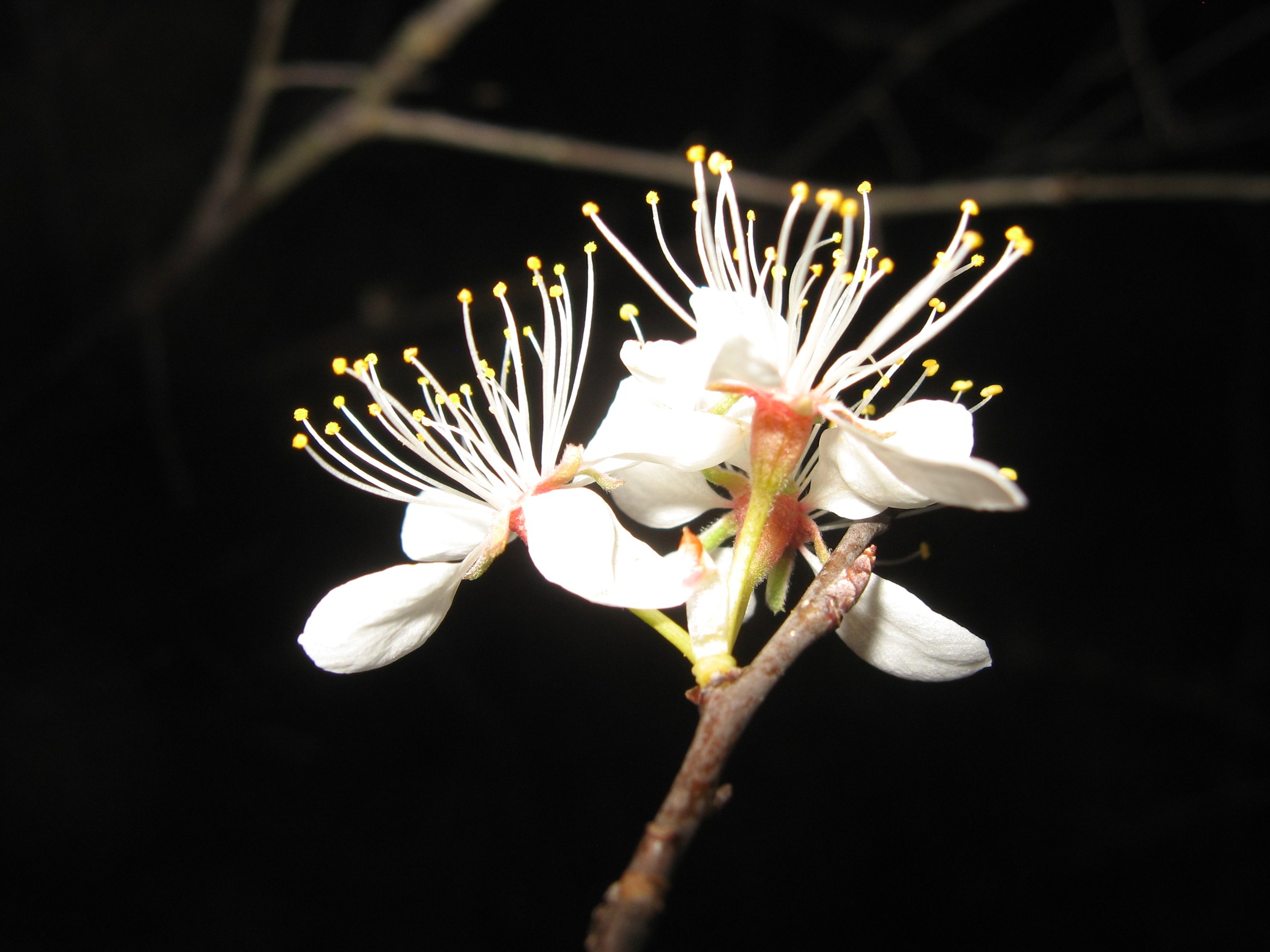
Prunus mexicana, the Mexican Plum, is one of the most garden-worthy small native trees of the central and eastern United States, prized for its fragrant white spring flowers, smooth gray-pink exfoliating bark, and sweet, edible purple fruit. Despite the name, it is not actually restricted to Mexico — it is native across a wide swath of the south-central and eastern United States, from Texas and the southern Plains east through the Mississippi Valley and into the lower Great Lakes and Southeast.
In late winter or early spring, often before most other trees have leafed out, Mexican plum covers itself in clouds of white, five-petaled blossoms with a sweet fragrance that can be detected from a distance. Flowering is followed by rounded, plum-like fruit that ripens to a deep reddish-purple by late summer, prized by wildlife and, when fully ripe, pleasant eating for people as well.
For home gardeners and restoration plantings alike, Mexican plum offers four-season interest: striking spring bloom, attractive summer foliage, good fall color in many areas, and smooth, flaking bark that adds winter appeal. It tolerates a wide range of soils, handles both sun and partial shade, and asks for very little care once established, making it one of the best small flowering trees for naturalistic native landscapes across its broad range.
Identification
Mexican plum typically grows as a small, rounded tree 15 to 25 feet tall with an equal or greater spread, occasionally reaching 35 feet on the best sites. It often develops multiple trunks or a short single trunk topped by a broad, spreading crown.
Bark & Twigs
Young bark is smooth and gray to reddish-brown; as the tree matures, the bark develops an attractive, papery, exfoliating texture, peeling in thin curls to reveal lighter inner bark — a standout winter feature that distinguishes Mexican plum from many other small native trees. Twigs are slender, reddish-brown, and largely thornless, unlike many wild plums.
Leaves
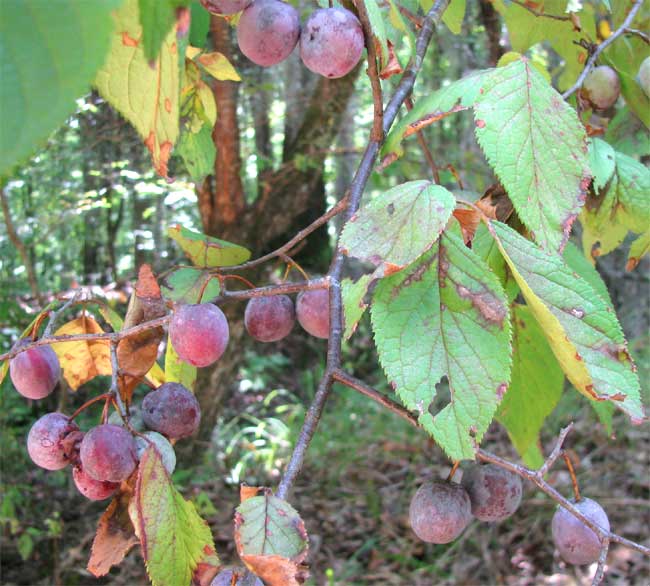
Leaves are simple, alternate, elliptical to oval, 2 to 4 inches long, with finely toothed margins and a somewhat leathery texture. The upper surface is dark green and often slightly wrinkled or quilted in appearance from sunken veins; the underside is paler and may be softly hairy. Fall color ranges from yellow to a soft reddish-purple depending on the individual tree and the season.
Flowers & Fruit
Flowers open in early spring, typically February through April depending on latitude, before or just as the leaves emerge. Each blossom has five white petals and a prominent cluster of yellow-tipped stamens, carried singly or in small clusters along bare branches, and the bloom is reliably fragrant. The fruit is a rounded drupe about an inch across, ripening from green to yellow-red to a deep purple-red by late summer and early fall, with a thin, dusty bloom on the skin typical of wild plums. The flesh is yellow, juicy, and sweet-tart when fully ripe, surrounding a single hard pit.
Quick Facts
| Scientific Name | Prunus mexicana |
| Family | Rosaceae (Rose) |
| Plant Type | Deciduous small tree / large shrub |
| Mature Height | 15–25 ft (to 35 ft on good sites) |
| Mature Spread | 15–25 ft, rounded crown |
| Growth Rate | Moderate |
| Sun Exposure | Full Sun to Part Shade |
| Water Needs | Moderate; drought tolerant once established |
| Soil Type | Adaptable; loam, clay or limestone-influenced soils |
| Soil pH | 6.0–8.0 (tolerates alkaline soil) |
| Bloom Time | February – April, before or with new leaves |
| Flower Color | White |
| Fall Color | Yellow to reddish-purple |
| Fruit | Reddish-purple plums, about 1 in, late summer–fall |
| Deer Resistant | No (browsed by deer) |
| USDA Hardiness Zones | 5–9 |
Native Range
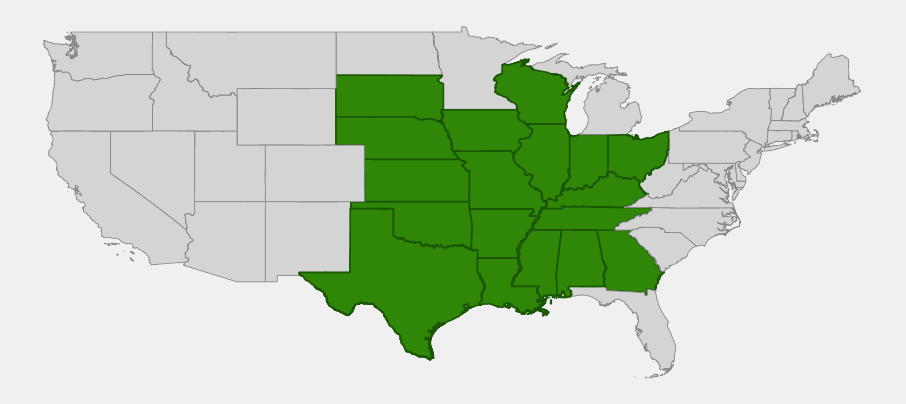
Mexican plum has one of the broadest native ranges of any American wild plum, centered on the south-central United States and extending into the Mississippi Valley, lower Midwest, and parts of the Southeast. Its core range runs through Texas, Oklahoma, Kansas, and Nebraska, east through Arkansas, Louisiana, and Missouri, and on into Illinois, Indiana, Ohio, Kentucky, Tennessee, Mississippi, Alabama, and the western edge of Georgia, with outlying populations reaching into Iowa, Wisconsin and South Dakota. It is not native to Michigan or Minnesota. It is not native to the Atlantic Coastal Plain, Florida, New England, or the Rocky Mountain and Pacific states.
Typical habitat includes the margins of woods and fields, fencerows, limestone glades and bluffs, stream terraces, and open upland woods, usually on well-drained soils that are often influenced by limestone. It tends to grow as a scattered understory or edge tree rather than forming pure stands, often appearing as a single, well-formed small tree at a woodland margin, as seen in the Kentucky specimen pictured on this page.
Because it tolerates a wide range of soils, including heavier clay and limestone-derived ground, Mexican plum has proven adaptable in cultivation well beyond the exact edges of its wild range, but gardeners outside the native states listed above should treat it as an introduced, not local-native, planting.
📋 Regional plant lists featuring Mexican Plum: Arkansas, Louisiana & Eastern Oklahoma/Texas · Georgia, Alabama & Mississippi · Kentucky & Tennessee · Ohio & Indiana · Illinois, Iowa & Missouri · Michigan, Wisconsin & Eastern Minnesota · North & South Dakota, Western Minnesota · Nebraska, Kansas & Eastern Colorado
Growing & Care Guide
Mexican plum is easygoing and adaptable, making it a reliable choice for gardeners across a very wide climate range, from the humid Southeast to the drier southern Plains.
Light
It flowers and fruits best in full sun but tolerates light shade, especially as an understory tree at a woodland edge, where it naturally occurs. More shade generally means fewer flowers and a more open, reaching form.
Soil & Water
Mexican plum is remarkably adaptable to soil type, growing well in loam, clay, and limestone-influenced alkaline soils alike, as long as drainage is reasonable. Give young trees regular water through their first one to two growing seasons; established trees are moderately drought tolerant and generally need supplemental water only during extended dry spells.
Planting Tips
Plant in fall or late winter while the tree is dormant. Because trees are often multi-trunked in the wild, decide early whether you want a single-trunk tree form or a more naturalistic multi-stemmed shrub, and prune accordingly while the plant is young. Give it room for its mature spread — 15 to 25 feet — away from foundations and overhead wires.
Pruning & Maintenance
Prune in late winter while dormant to remove crossing or crowded branches and to maintain the desired form; avoid heavy summer pruning, which can stress the tree and reduce next year’s bloom. Mexican plum can be susceptible to the same pests and diseases as other stone fruits, including borers and black knot fungus, but is generally healthier and lower-maintenance than cultivated plum varieties when grown in appropriate native conditions.
Propagation
Mexican plum is grown from seed, which should be cleaned of fruit pulp and cold-stratified for three to four months to break dormancy before spring sowing. Root suckers from established trees can sometimes be dug and transplanted, though seed-grown stock generally establishes with a better root system.
Landscape Uses
- Specimen flowering tree for early spring bloom and winter bark interest
- Woodland edge and naturalistic plantings alongside oaks, hackberry and eastern redcedar
- Wildlife gardens, since the fruit and flowers draw abundant wildlife
- Hedgerows and windbreaks in rural and agricultural settings
- Pollinator gardens, as an early and reliable spring nectar source
- Restoration plantings on limestone glades, fencerows and woodland margins
Wildlife & Ecological Value
Mexican plum is valuable to wildlife through nearly every season, from its early nectar-rich bloom to its late-summer fruit crop.
For Pollinators
The early, abundant white flowers are an important nectar and pollen source for native bees and honeybees at a time of year when few other woody plants are blooming, making it valuable for queen bumblebees and other early-emerging pollinators.
For Birds
Many birds, including cedar waxwings, American robins, and various woodpeckers, eat the ripe fruit, and the dense branching provides good nesting cover. Game birds such as wild turkey and bobwhite quail also use the fruit and cover.
For Mammals
White-tailed deer readily browse the foliage and twigs, which can make establishing young trees a challenge without some protection in areas with high deer pressure. Raccoons, foxes, opossums, and squirrels eat the ripe fruit and help disperse the seeds.
Ecosystem Role
As an early, reliable bloomer at woodland edges and fencerows, Mexican plum helps anchor the pollinator food web in early spring before most other native plants have begun flowering. Its fruit production supports a wide range of wildlife through late summer, and its tolerance of disturbed, edge, and limestone habitats lets it colonize fencerows and old fields that can otherwise be low in woody plant diversity.
Cultural & Historical Uses
Mexican plum’s sweet, tangy fruit has long been gathered by people across its native range. Indigenous peoples throughout the southern Plains and Mississippi Valley historically ate the ripe fruit fresh and dried it for storage, and the tree’s fruit continued to be a popular wild foraging find for settlers and rural communities well into the twentieth century, often used for jams, jellies, and preserves.
The tree was also valued ornamentally once its garden qualities were recognized, particularly for its early, fragrant bloom and attractive exfoliating bark, and it has long been planted as a dooryard and farmstead tree across the southern Plains and mid-South for both its fruit and its beauty.
As with other members of the genus Prunus, the leaves, twigs, and seed pits of Mexican plum contain cyanogenic compounds and are not edible; only the ripe fruit flesh has a history of being eaten, with the pit discarded. This is a matter of historical and regional foraging practice, not a general recommendation to eat any part of the plant without proper identification.
Frequently Asked Questions
Is Mexican plum fruit edible?
The ripe fruit flesh has a long history of being eaten fresh or made into jams and preserves once it turns deep reddish-purple and softens. As with all Prunus species, the pit, seeds, leaves, and twigs contain cyanogenic compounds and should never be eaten; discard the pit and never crack it open to eat the kernel inside.
Is Mexican plum actually from Mexico?
Not primarily. Despite the common name, its native range is centered on the south-central and eastern United States — Texas, Oklahoma, the Mississippi Valley, and the lower Midwest and Southeast — rather than Mexico itself, though its range does approach the Mexican border region in Texas.
How fast does Mexican plum grow, and how big does it get?
It grows at a moderate pace and typically reaches 15 to 25 feet tall and wide at maturity, occasionally larger on excellent sites. It is well suited to smaller yards where a full-size shade tree would be too large.
Will deer eat Mexican plum?
Yes, deer readily browse the foliage and tender young growth, and young trees may need protection such as fencing or tree tubes in areas with heavy deer pressure until they grow tall enough to be out of easy reach.
Does Mexican plum need another tree nearby to fruit?
Like many wild plums, Mexican plum benefits from cross-pollination with a genetically different individual to set a good fruit crop; a single isolated tree may flower well but fruit sparsely. Planting more than one, or relying on other wild plums growing nearby, improves fruit set.

Looking for a nursery that carries Mexican Plum?
Browse our native plant nursery directory: Texas · Kansas · Nebraska & Oklahoma · Kentucky, Tennessee, Louisiana & Mississippi