
Heartleaf Peppervine (Ampelopsis cordata)
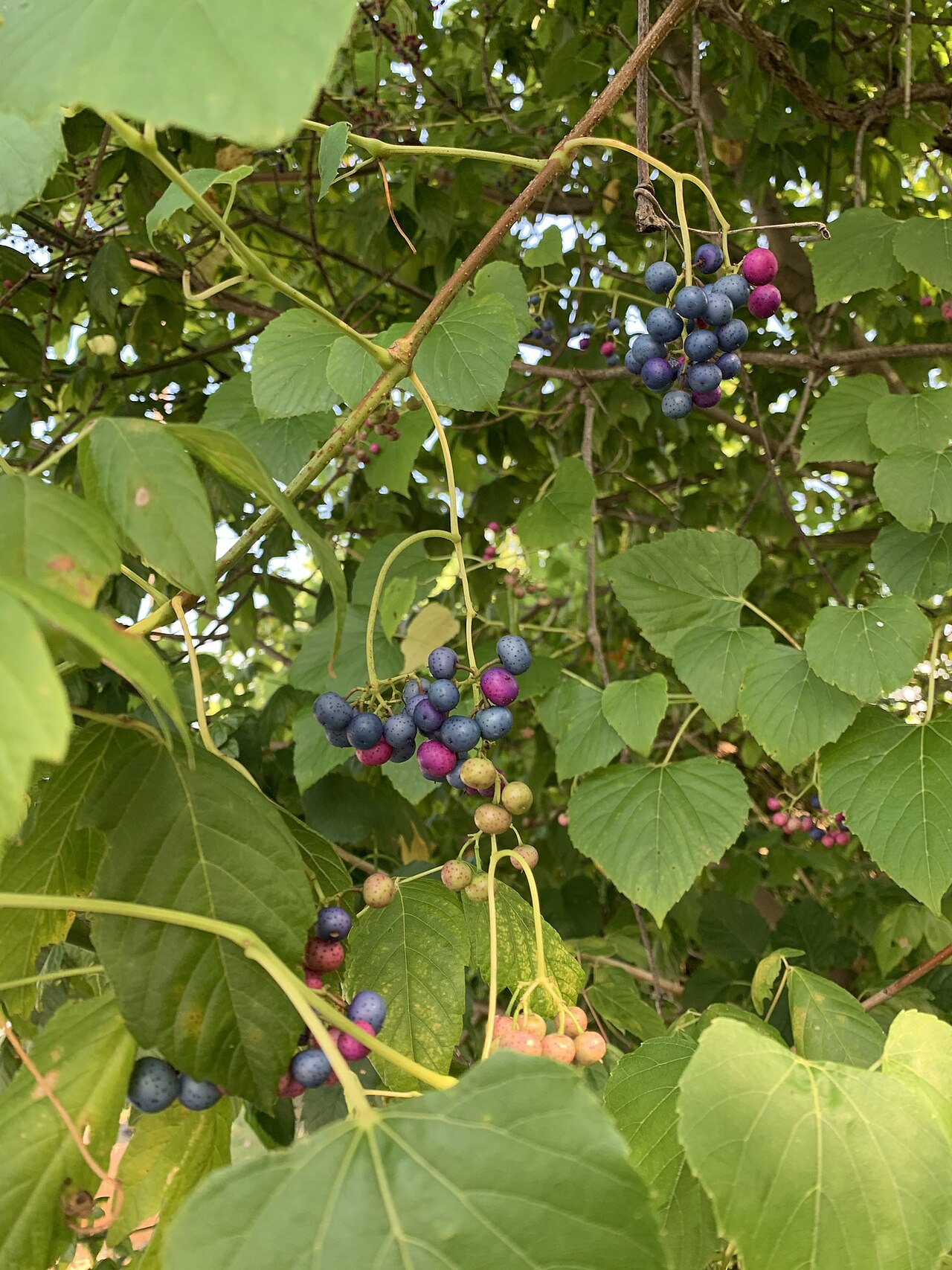
Ampelopsis cordata, commonly called Heartleaf Peppervine (also written heart-leaf peppervine or heartleaf ampelopsis), is a fast-growing, woody, tendril-climbing vine native to the eastern and south-central United States. It belongs to the grape family (Vitaceae) and is a close cousin of wild grapes and Virginia creeper, though it lacks their familiar palmately compound leaves. Instead, heartleaf peppervine carries simple, broad, heart-shaped leaves that give the plant its common name and make it easy to pick out along creek banks, fencerows, and forest edges.
This vine thrives in the bottomland woods, stream margins, and moist thickets of the South and lower Midwest, where it climbs into shrubs and small trees using forked tendrils rather than twining stems. It is an unassuming plant through spring and early summer — its small greenish flowers go almost unnoticed — but by late summer it becomes a standout as its berries ripen unevenly within the same cluster, passing through shades of pale green, yellow, pink, purple, and finally a deep speckled blue, often all at once.
Heartleaf peppervine is sometimes confused with its weedy, nonnative relative porcelain berry (Ampelopsis glandulosa var. brevipedunculata), an East Asian vine that has become seriously invasive in parts of the Northeast and Midwest. The native heartleaf peppervine is far better behaved in the landscape and plays a genuine ecological role in its home range, but gardeners should always confirm which species they are buying, since nurseries and online sellers sometimes mislabel the two.
Identification
Heartleaf peppervine is a deciduous, woody vine that climbs by means of branched tendrils produced opposite the leaves, reaching 15 to 25 feet or more into the canopy of streamside trees and shrubs. Unlike wild grape, its bark does not shred into long strips, and unlike Virginia creeper, its tendrils lack the small adhesive discs that let that species climb smooth surfaces. Heartleaf peppervine needs something to grab onto — a branch, a wire fence, a trellis — because its tendrils can only coil around a support.
Stems
Young stems are green to reddish and somewhat angled in cross-section, becoming woody and brown with age. The pith inside the stem is white and continuous (not diaphragmed), a detail that separates Ampelopsis from true grapevines (Vitis), which have brown pith interrupted at the nodes.
Leaves
The leaves are simple (not compound), alternate, and broadly ovate to heart-shaped at the base, 2 to 5 inches long, with a pointed tip and shallow, rounded teeth along the margin. Occasionally a leaf shows one or two shallow lobes, but the leaves never divide into three or five leaflets the way Virginia creeper’s do. The upper surface is glossy dark green; the underside is paler and smooth to slightly hairy along the veins. Leaves turn a muted yellow in autumn before dropping.
Flowers
Small, inconspicuous, greenish-white flowers appear in loose, flat-topped to umbel-like clusters opposite the leaves from late spring into summer. Each flower has five tiny petals and is easily overlooked, though it draws a steady traffic of small native bees, flies, and wasps while in bloom.
Fruit & Seeds
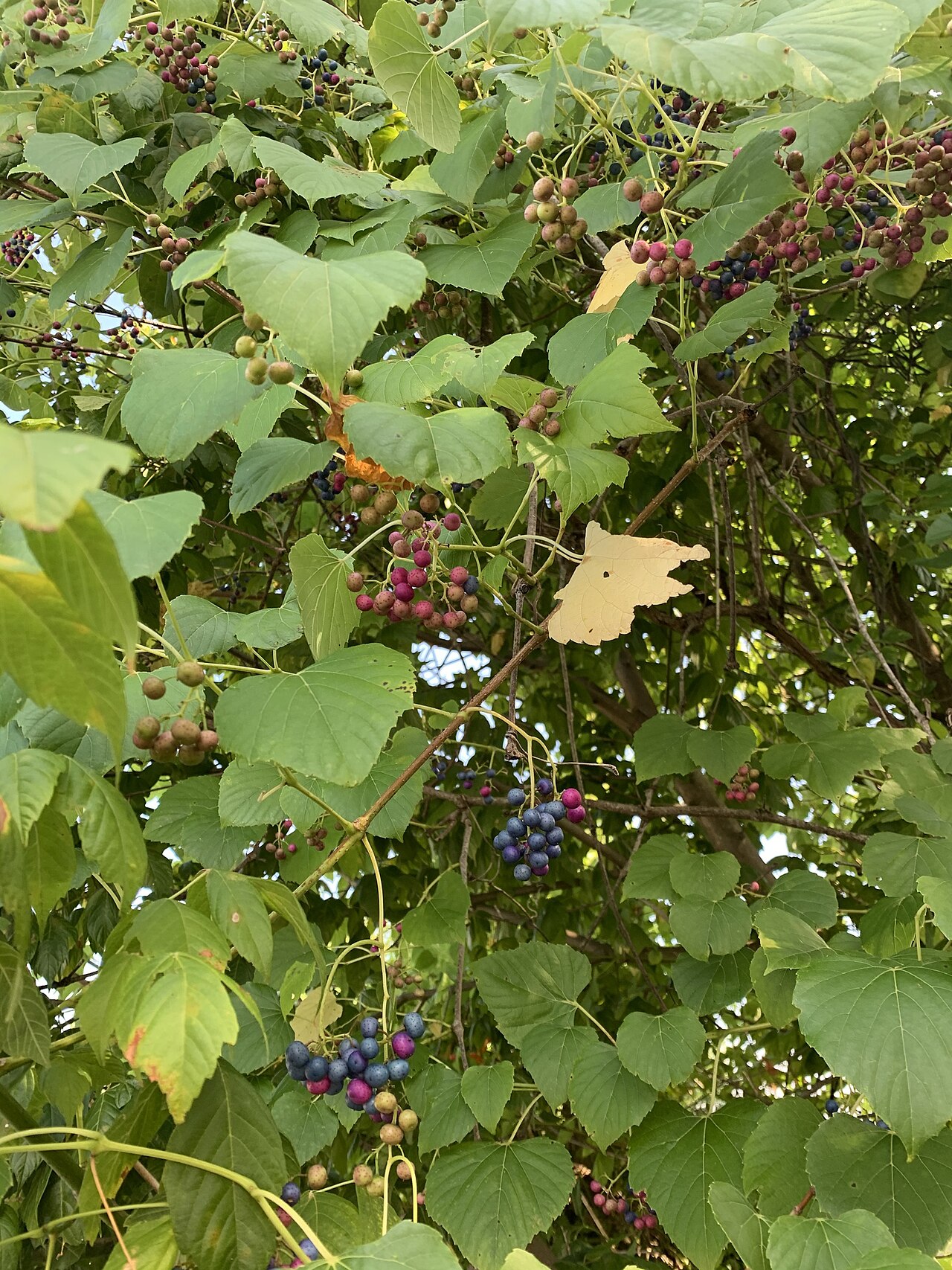
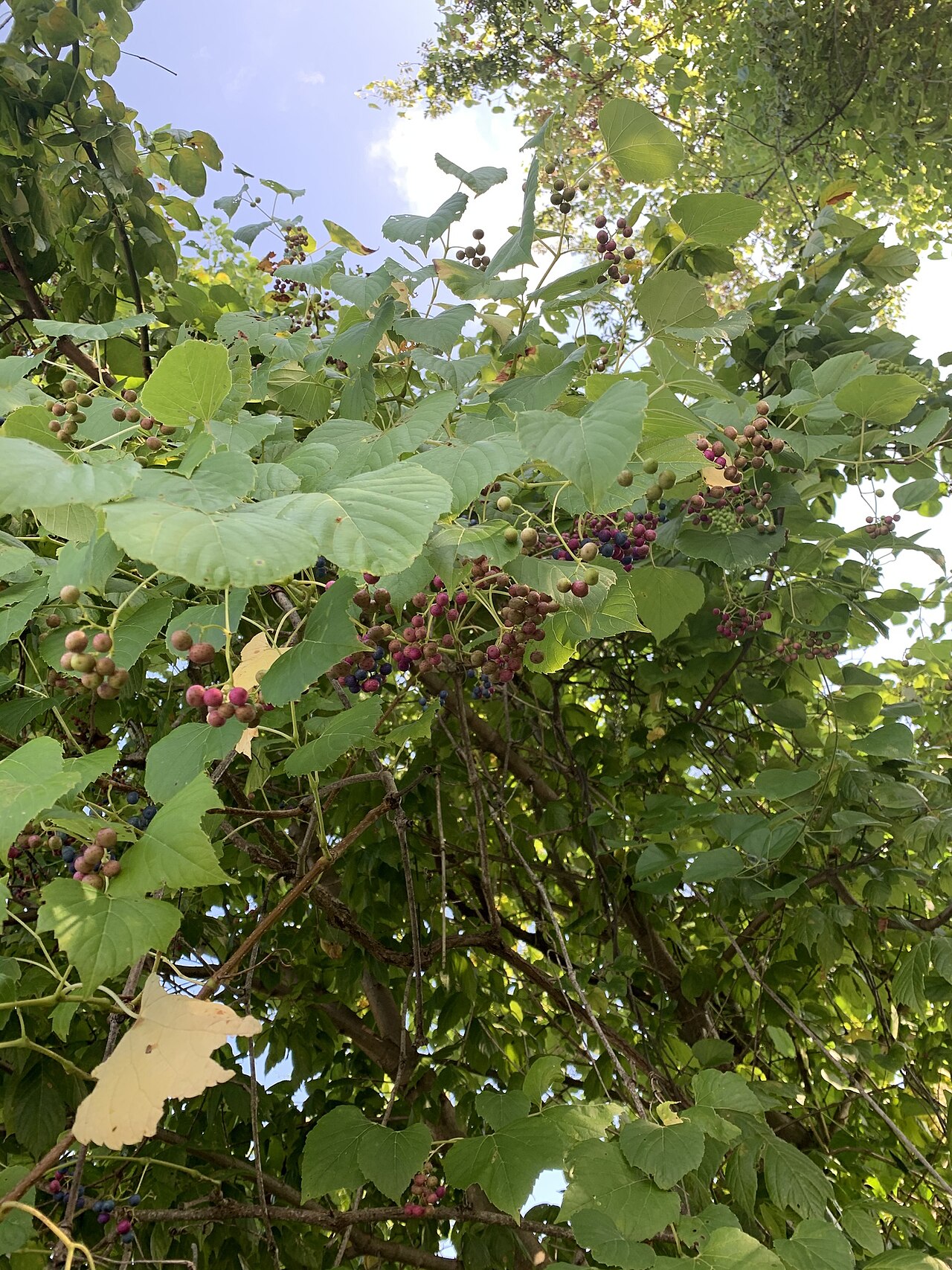
The fruit is the vine’s most memorable feature: round berries about ¼ to ⅓ inch across, borne in loose, branching clusters. As they mature from late summer through fall, berries on the same cluster ripen unevenly, moving through pale green, straw-yellow, pink, lavender, and deep speckled blue or purple at full ripeness. The berries are not palatable to people — they are bitter, sparsely fleshed, and generally considered inedible for human use — but birds and small mammals eat them readily once fully ripe.
Quick Facts
| Scientific Name | Ampelopsis cordata |
| Family | Vitaceae (Grape) |
| Plant Type | Deciduous woody vine |
| Mature Height | 15–25 ft of climb (or trailing over the ground) |
| Mature Spread | 10–20 ft, as wide as its support allows |
| Growth Rate | Fast |
| Sun Exposure | Full Sun to Part Shade |
| Water Needs | Average to Wet; tolerates seasonal flooding |
| Soil Type | Moist, fertile bottomland soils; adaptable |
| Soil pH | 6.0–7.5 |
| Bloom Time | May – July |
| Flower Color | Greenish-white |
| Fall Color | Muted yellow |
| Fruit | Round berries ripening green to pink to blue-purple; not edible for people |
| Deer Resistant | Moderate (deer occasionally browse foliage) |
| USDA Hardiness Zones | 6–9 |
Native Range
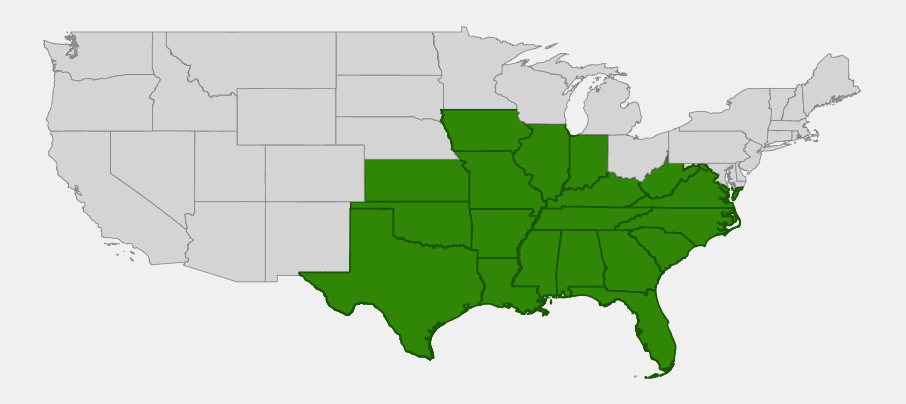
Heartleaf peppervine is native to the southeastern and south-central United States, from the Gulf Coast north through the Mississippi and Ohio valleys and west onto the eastern edge of the Great Plains. It is most abundant in Arkansas, Louisiana, Mississippi, Alabama, and Georgia, and extends north through Tennessee, Kentucky, Missouri, Illinois, Indiana, and Iowa, and west through Oklahoma, Kansas, and Texas. At the western and northern edges of its range it becomes scarce and is confined to the better-watered sites along creeks and rivers.
Within this range, heartleaf peppervine is a plant of bottomland hardwood forests, stream banks, floodplain thickets, and disturbed moist ground at the margins of woods. It tolerates occasional flooding and heavy soils that would stress many other woody vines, which is part of why it is so characteristic of Southern creek bottoms. In the drier country at the western fringe of its range — in Oklahoma and north-central Texas — it is confined almost entirely to the immediate vicinity of permanent water.
Heartleaf peppervine has occasionally shown up outside this core range as a garden escape or waif, including isolated, non-native occurrences reported in Connecticut; it is not considered native to New England, the Mid-Atlantic coastal plain, or anywhere outside the range described above, and gardeners north and east of this range should not expect it to behave as a true native there.
📋 Regional plant lists featuring Heartleaf Peppervine: Maryland, Virginia & West Virginia · North Carolina & South Carolina · Georgia, Alabama & Mississippi · Arkansas, Louisiana, Eastern Oklahoma & Eastern Texas · Kentucky & Tennessee · Ohio & Indiana · Illinois, Iowa & Missouri · Nebraska, Kansas & Eastern Colorado
Growing & Care Guide
Heartleaf peppervine is easy to grow but needs a clear job in the landscape, since it climbs vigorously and is not a tidy, restrained vine for a small trellis by the front door. It earns its keep in naturalistic settings — streambank restoration, wildlife hedgerows, and screening along a back fence — where its fast growth and tolerance of wet soil are assets rather than problems.
Light
This vine grows best in full sun to light shade. In full sun it flowers and fruits most heavily; in partial shade, typical of its native streamside thickets, it grows a bit more loosely but remains healthy. Deep, continuous shade will thin it out and reduce fruiting.
Soil & Water
Heartleaf peppervine is at its best in moist, fertile soils and tolerates occasional flooding or standing water better than most woody vines, reflecting its natural home along creeks and in bottomland woods. It is not a plant for dry, sandy upland sites — in the drier parts of its range it is restricted to streamside ground for exactly this reason. Once established, it shows good tolerance of the wide range of soil textures found in river bottoms, from silt to heavy clay.
Planting Tips
Give heartleaf peppervine a sturdy support from the start — a fence, arbor, or the lower limbs of an established tree — since its tendrils need something to grip rather than a flat wall. Plant in fall or early spring and keep the root zone consistently moist through the first growing season. Because it spreads readily by seed in wet, open ground, site it where volunteer seedlings along a streambank are welcome rather than a maintenance headache.
Pruning & Maintenance
Prune in late winter to control size and remove tangled growth, cutting back to a framework of main stems if the vine has outgrown its space. It tolerates hard pruning well and will resprout vigorously. Because of its vigor, keep it away from small shrubs or young trees it could overtop in a single growing season, and monitor it in cultivated beds where it is not wanted.
Propagation
Heartleaf peppervine is most easily propagated from softwood cuttings taken in early summer, which root readily under mist or in a humid propagation box. Seed requires cold, moist stratification over winter and germinates unevenly the following spring; cuttings are the more reliable method for gardeners who want plants true to a known wild source.
Landscape Uses
- Streambank and wetland-edge restoration, where its flood tolerance is a real advantage
- Wildlife hedgerows that combine fruit, cover, and nectar across the growing season
- Screening along fences and utility structures in moist ground
- Naturalized plantings at the edge of woods or along ditches and low spots
- Erosion control on moist slopes where a fast-rooting vine is useful
Wildlife & Ecological Value
Heartleaf peppervine pulls its weight in a Southern wildlife garden across three seasons, from its early-summer flowers to its late-season fruit crop and its value as cover.
For Pollinators
The small greenish flowers, though easy to miss, produce abundant nectar and draw a steady stream of small native bees, syrphid flies, and wasps through the heat of early summer, a season when many showier native flowers have already finished blooming.
For Birds
Many songbirds, including mockingbirds, catbirds, robins, and various thrushes, eat the ripening berries from late summer into fall, and the dense tangled growth the vine forms over shrubs provides good nesting cover and protection from predators and weather.
For Mammals
Raccoons, opossums, and squirrels take advantage of the berry crop, and the vine’s tangled growth along creek corridors adds structural cover that small mammals use for travel between denser patches of woods.
Ecosystem Role
As a native component of bottomland forest understory and streamside thickets, heartleaf peppervine helps stabilize moist soils with its spreading root system and contributes to the structural layering that distinguishes a healthy floodplain forest edge from a bare one. Unlike the invasive porcelain berry it is sometimes mistaken for, it does not form smothering monocultures and coexists with the shrubs and young trees it climbs.
Cultural & Historical Uses
Heartleaf peppervine has no significant history of food or medicinal use among Indigenous peoples or early settlers; its small, sparse, bitter berries were never a food source, and the plant is not documented in historical ethnobotanical accounts as being cultivated or harvested for any practical purpose. It has instead mostly lived in the background of Southern bottomland woods, noticed chiefly by botanists and, more recently, by native-plant gardeners.
In the mid-twentieth century, agricultural researchers in the southern Great Plains evaluated heartleaf peppervine, under its older name “heartleaf ampelopsis,” as a candidate ornamental vine for shelterbelt and windbreak plantings in Texas and Oklahoma, noting its native presence along creek courses at the eastern edge of the Plains. That interest was modest and the vine never became a major nursery crop, but it reflects an early recognition of the plant’s toughness and adaptability outside its wettest bottomland sites.
Today its main cultural role is ecological rather than historical: native-plant gardeners and restoration practitioners in the South increasingly plant heartleaf peppervine specifically because it fills the same structural niche as porcelain berry and other introduced tangle-forming vines, without their invasive tendencies.
Frequently Asked Questions
Can you eat heartleaf peppervine berries?
No. The berries are not a food plant for people — they are sparsely fleshed, bitter, and not cultivated or harvested for human consumption. Leave them for the birds and other wildlife that rely on them in late summer and fall.
Is heartleaf peppervine invasive?
Within its native range in the South and lower Midwest, no — it is a well-behaved native vine. It is sometimes confused with porcelain berry (Ampelopsis glandulosa var. brevipedunculata), a nonnative Asian vine that is genuinely invasive in parts of the Northeast and Midwest; always confirm the species before buying.
How do I tell heartleaf peppervine apart from wild grape or Virginia creeper?
Heartleaf peppervine has simple, heart-shaped leaves, unlike Virginia creeper’s five leaflets or wild grape’s lobed, palmate leaves. Its pith is white and continuous through the stem, while true grapevines have brown pith interrupted at each node.
Does heartleaf peppervine need support to climb?
Yes. Its forked tendrils can only grip onto something to coil around, such as a branch, wire, or trellis; it cannot climb a flat wall the way Virginia creeper does with its adhesive tendril discs.
Will heartleaf peppervine tolerate a wet, low spot in my yard?
Very well. It is one of the more flood-tolerant native woody vines and is a strong choice for the kind of seasonally soggy ground along a ditch, pond edge, or low corner of a property where many other vines struggle.

Looking for a nursery that carries Heartleaf Peppervine?
Browse our native plant nursery directory: Alabama & Arkansas · Florida & Georgia · Illinois, Indiana, Iowa & Kansas · Kentucky, Louisiana, Mississippi & Missouri · North Carolina & Oklahoma · South Carolina, Tennessee, Texas & Virginia · West Virginia