
Agarita (Mahonia trifoliolata)
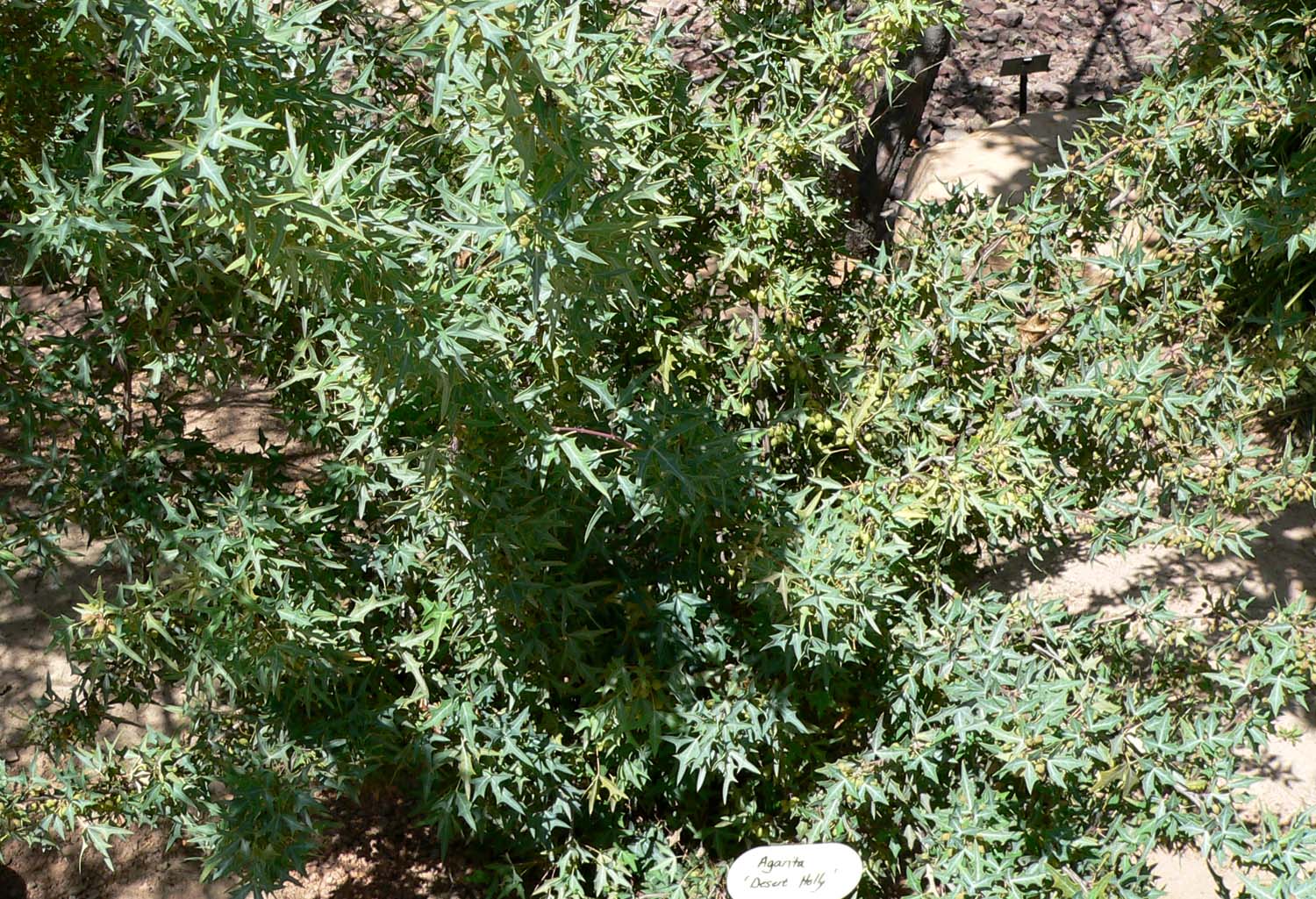
Mahonia trifoliolata (syn. Berberis trifoliolata), known throughout its range as Agarita (also spelled Agarito or Algerita), is one of the toughest and most recognizable evergreen shrubs of the Texas Hill Country, the South Texas Plains, and the Chihuahuan Desert borderlands of New Mexico and Arizona. A member of the barberry family (Berberidaceae), Agarita is instantly identifiable by its gray-green to blue-gray, holly-like leaves, each tipped with needle-sharp spines, and by the bright yellow wood just beneath the bark — a trait shared with other barberries. Ranchers and gardeners alike have long valued it for exactly the qualities that make it difficult to ignore: it is spiny, drought-proof, and reliably good-looking in every season.
Agarita is usually the first shrub to bloom on the Edwards Plateau, often flowering as early as February, weeks before most other natives wake up. Its small, fragrant yellow flowers cluster along the branches and can perfume an entire hillside on a warm late-winter day, making it one of the most important early nectar sources for native bees and honeybees coming out of winter dormancy. By late spring the flowers give way to shiny, tart red berries that ripen from May into July, feeding songbirds, raccoons, foxes, and other wildlife while also providing the makings of a traditional Hill Country jelly.
Because of its dense, spine-armored branching, Agarita also does double duty as a living hedge and wildlife refuge: bobwhite quail, cactus wrens, and other ground- and shrub-nesting birds tuck their nests deep inside its thorny tangle, safe from most predators. For a low-water native landscape anywhere from the Rio Grande Plains to the Trans-Pecos, Agarita offers year-round structure, late-winter flowers, early-summer fruit, and almost no maintenance once it is established.
Identification
Agarita typically grows as a rounded, many-stemmed evergreen shrub 3 to 6 feet tall and wide, occasionally reaching 8 to 10 feet in favorable, undisturbed sites. Its rigid, spreading branches often form dense, impenetrable thickets. If you nick a stem or root, the wood underneath is a distinctive bright yellow — a quick field check that confirms you are looking at a barberry relative rather than a true holly, which it superficially resembles.
Leaves
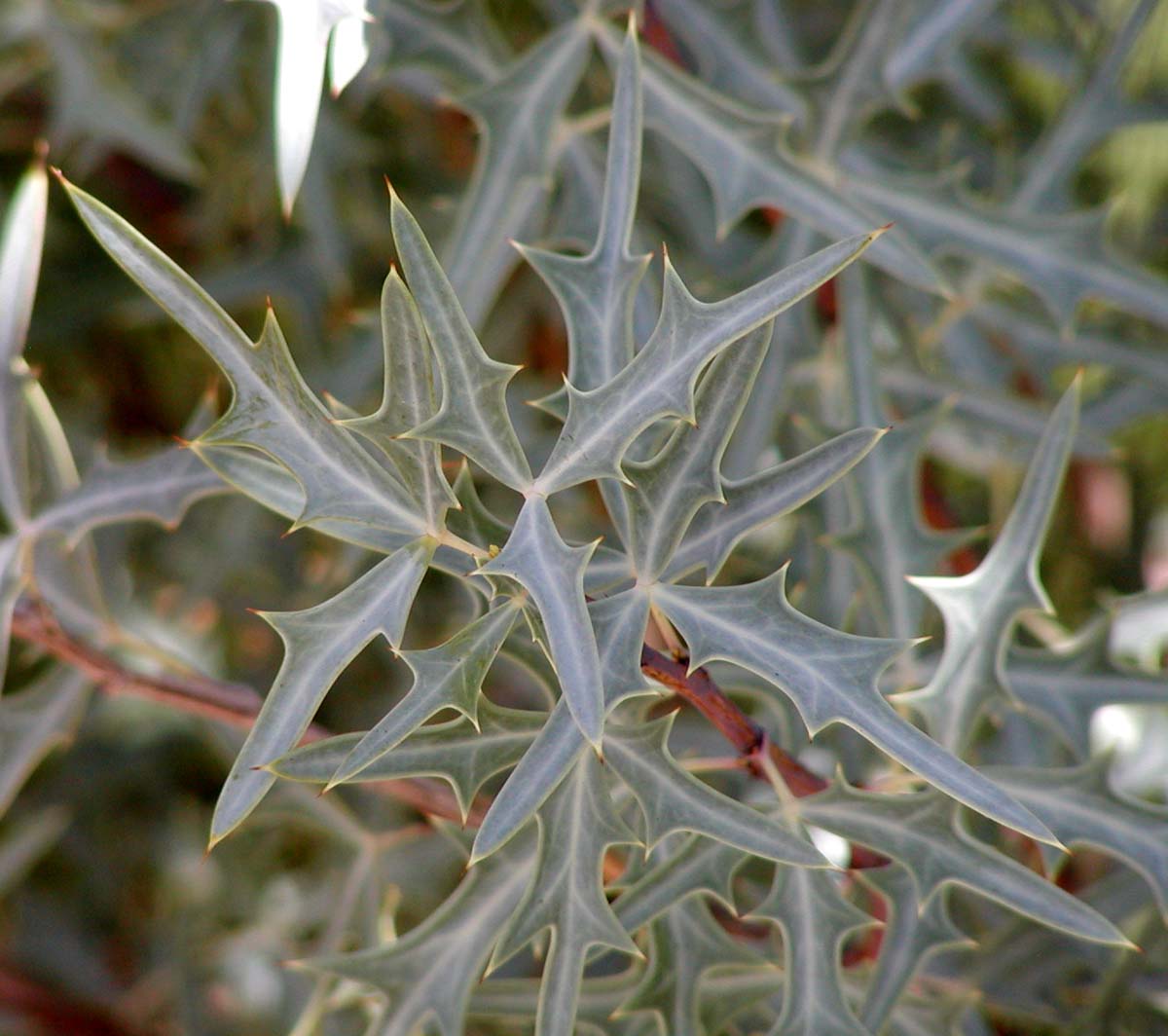
The evergreen leaves are compound, divided into three stiff, holly-like leaflets 2 to 4 inches long, colored gray-green to silvery blue-gray. Each leaflet carries 3 to 7 lobes, every one ending in a sharp spine, which is why Agarita is sometimes called “desert holly” even though it is unrelated to true hollies. The spiny foliage persists year-round, giving the plant structure and defensive cover through every season, including winter when many other shrubs are bare.
Flowers
Small, fragrant yellow flowers appear in dense clusters along the stems from February into April — often the earliest native shrub to bloom in its range. Each flower is up to ½ inch wide, with six petals and six similar sepals forming a shallow cup around the central stamens and pistil. In a good bloom year, a mature shrub can be heard before it is seen, humming with native bees and honeybees drawn to its early nectar.
Fruit & Seeds
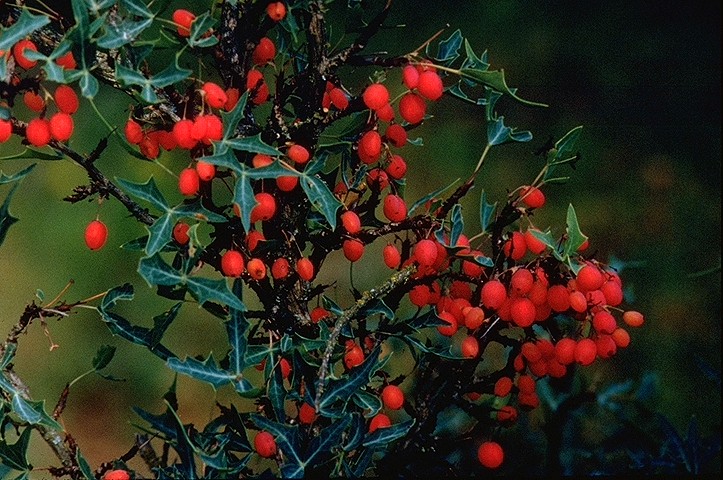
The flowers ripen into shiny, pea-sized red berries from May through July. The berries are tart and juicy, edible fresh or cooked into jelly and wine, and are eagerly eaten by mockingbirds, cardinals, and other songbirds, as well as raccoons, gray foxes, and other small mammals. Each berry contains a few small, hard seeds.
Quick Facts
| Scientific Name | Mahonia trifoliolata (syn. Berberis trifoliolata) |
| Family | Berberidaceae (Barberry) |
| Plant Type | Evergreen Shrub |
| Mature Height | 3–6 ft (occasionally to 8–10 ft) |
| Mature Spread | 3–6 ft |
| Growth Rate | Slow to moderate |
| Sun Exposure | Full Sun to Part Shade |
| Water Needs | Low (very drought tolerant once established) |
| Soil Type | Rocky, well-drained; limestone, caliche, loam or clay |
| Soil pH | Alkaline (7.0–8.5) |
| Bloom Time | February – April |
| Flower Color | Yellow, fragrant |
| Fall Color | Evergreen (no fall color change) |
| Fruit | Red berries, edible, ripen May–July |
| Deer Resistant | High (spiny foliage deters browsing) |
| USDA Hardiness Zones | 7–10 |
Native Range
Agarita is native to a comparatively narrow but well-defined region of the American Southwest: coastal South Texas, the Texas Hill Country and Edwards Plateau, the Rio Grande Plains, and the Trans-Pecos, continuing west into the bootheel of New Mexico and the southeastern corner of Arizona, plus adjacent northern Mexico. Within Texas it is one of the defining shrubs of the limestone hill country, often growing alongside Texas Persimmon, Texas Mountain Laurel, and Cenizo on thin, rocky soils that few other woody plants tolerate.
It is important not to confuse Agarita’s true native range with simple garden availability: the species is widely planted well outside this area because of its toughness and low water needs, but it is not native to East Texas, the Texas Panhandle, Oklahoma, or anywhere outside the belt described above. Gardeners in those regions can still grow it successfully, but should think of it as a well-adapted regional native brought in from a neighboring ecoregion rather than a local wild plant.
Across its true range, Agarita grows on hills, rocky slopes, canyon rims, and in open woods and thickets, almost always on well-drained, calcareous soils over limestone or caliche. It tolerates both dry and seasonally moist sites as long as drainage is sharp, and it is a defining shrub of the Edwards Plateau savanna and Chihuahuan Desert grassland-woodland transition zones.
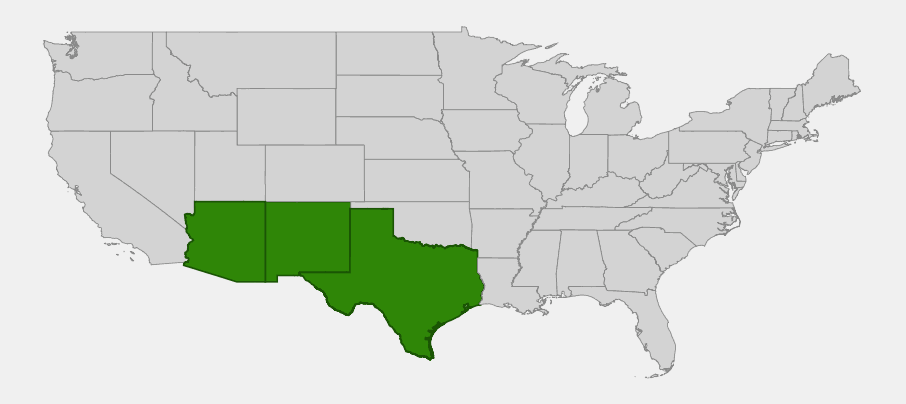
📋 Regional plant lists featuring Agarita: Arizona & New Mexico
Growing & Care Guide
Agarita is about as low-maintenance as native shrubs get, provided it has the sharp drainage and bright sun it evolved with. Gardeners in hot, dry, alkaline-soil regions of the Southwest will find it nearly bulletproof once established; it is far less forgiving of heavy, wet clay or regular overhead irrigation.
Light
Full sun produces the densest, most compact, most floriferous plants. Agarita also tolerates part shade, particularly in the hottest parts of its range, but will grow looser and bloom somewhat less in heavier shade.
Soil & Water
Give Agarita rocky, well-drained soil — limestone, caliche, gravelly loam, or clay, as long as water does not stand. It is highly drought tolerant once established and needs no supplemental irrigation in most of its native range after the first one to two years. Overwatering or poor drainage is the most common way to lose a planted Agarita; this is a shrub built for lean, alkaline soils, not rich garden beds.
Planting Tips
Plant container-grown Agarita in fall or early spring so roots can establish before summer heat arrives. Because of its spines, site it away from walkways, patios, and areas where people or pets brush past regularly — but that same armor makes it an excellent barrier planting along property lines or beneath windows. Space plants 4 to 6 feet apart for a informal hedge or screen.
Pruning & Maintenance
Agarita needs very little pruning. Remove dead wood any time of year, and shape lightly after flowering if a more formal look is wanted, wearing heavy gloves for the job. Avoid shearing into a tight hedge shape, which sacrifices the flowers and berries that make the plant valuable to wildlife. Established plants are essentially pest- and disease-free.
Landscape Uses
Agarita earns its keep in several garden roles:
- Xeriscaping and low-water native plant beds
- Wildlife hedgerows that double as nesting cover for quail and songbirds
- Barrier or security plantings beneath windows or along property lines
- Winter and early-spring interest — evergreen structure with some of the earliest native flowers of the year
- Pollinator gardens, as an early-season nectar source for native bees
- Erosion control on dry, rocky slopes
Wildlife & Ecological Value
Few Southwestern native shrubs pull as much ecological weight across the calendar year as Agarita, which offers nectar in late winter, cover year-round, and fruit in early summer.
For Pollinators
Agarita’s February-to-April bloom makes it one of the most important early-season nectar sources on the Edwards Plateau and in the Trans-Pecos, flowering before most competing natives have woken up. Native bees and honeybees work the fragrant yellow flowers heavily, and beekeepers consider Agarita a reliable early honey source.
For Birds
The ripe red berries are eaten by mockingbirds, cardinals, and other songbirds through late spring and early summer. Just as valuable is the plant’s dense, spine-armored structure: bobwhite quail and other ground- and shrub-nesting birds use Agarita thickets as predator-resistant cover and nest sites.
For Mammals
Raccoons, gray foxes, and other small mammals feed on the berries, while the thorny branches offer protective cover for rabbits and other small wildlife moving through open rangeland and scrub.
Ecosystem Role
As one of the structurally dominant shrubs of the Edwards Plateau and South Texas Plains, Agarita stabilizes thin, rocky soils, provides the thorny understory structure that many prey species depend on for safety, and bridges the gap between late-winter dormancy and the first flush of spring growth for the region’s pollinators.
Cultural & Historical Uses
Agarita has long been part of life in the Texas Hill Country and South Texas Plains. Its tart, juicy berries were gathered by Indigenous peoples and later by Anglo and Mexican American settlers alike, most often cooked down into a distinctive, slightly tangy jelly — still a point of local pride at Hill Country farmers markets and county fairs today — and occasionally fermented into wine.
Early settlers also dug the shrub’s roots, which, like the stems, carry the bright yellow pigment characteristic of barberries, and used them to produce a yellow dye. The same spiny structure that makes Agarita useful to wildlife made it a practical living fence for keeping livestock and intruders out of garden plots on rural homesteads, long before barbed wire was common.
Ranchers in the region have also long watched Agarita’s bloom as an informal seasonal marker: its early flush of yellow flowers, often the first substantial bloom of the year on the Edwards Plateau, has traditionally been read as one of the first visible signs that winter is loosening its grip.
Frequently Asked Questions
Are Agarita berries actually safe to eat?
Yes. The ripe red berries are edible and have a long history of use for jelly and wine in Texas. They are tart, with fairly large seeds, so most people cook and strain them rather than eating them straight off the bush.
Why does Agarita bloom so early?
Agarita is adapted to the Edwards Plateau’s mild winters and typically flowers from February into April, well ahead of most other native shrubs. This early bloom gives it first access to pollinators emerging in late winter and lets its berries ripen before the peak summer heat.
Is Agarita the same plant as holly?
No. Despite the spiny, holly-like leaves and the occasional nickname “desert holly,” Agarita is a barberry (Berberidaceae), not a true holly (Ilex, Aquifoliaceae). A reliable tell is the bright yellow wood just under the bark, a barberry family trait that true hollies do not share.
Will Agarita grow outside Texas, New Mexico, and Arizona?
It is only native to those three states, but its extreme drought tolerance and adaptability to alkaline soils mean it is sometimes grown as a xeriscape shrub elsewhere in the Southwest. Outside its native range it should be treated as a regional introduction, not a local native.
How do I handle pruning without getting hurt?
Wear thick leather gloves and long sleeves — the spine tips at the end of every leaf lobe are sharp enough to puncture skin easily. Prune minimally and only to remove dead wood or control size, since heavy shearing removes the flowers and berries that give Agarita its wildlife value.

Looking for a nursery that carries Agarita?
Browse our native plant nursery directory: Arizona · New Mexico · Texas