
Moonseed (Menispermum canadense)
Menispermum canadense, commonly known as Moonseed, Canadian Moonseed, or Yellow Parilla, is a native woody, climbing vine of eastern North American woodlands, thickets, and streambanks. It belongs to the small Menispermaceae (moonseed) family and is named for its most distinctive feature: a flattened, crescent-moon-shaped seed hidden inside each berry, visible when the fruit is cut open or the pulp removed.
Moonseed twines its way up fences, shrubs, and tree trunks using twisting stems rather than tendrils, producing broad, lobed leaves that can look remarkably like wild grape foliage. In late summer and fall it bears loose clusters of round, purple-black berries that likewise closely resemble wild grapes in size, color, and arrangement — a resemblance that matters a great deal, because Moonseed fruit is poisonous and must never be eaten.
Despite this important caution, Moonseed is an ecologically valuable native vine within its range, offering early-summer flowers for small pollinators and structurally diverse cover for wildlife. It is best appreciated as a woodland-edge and naturalizing vine for wild or restoration-style gardens, planted and enjoyed with a clear understanding that its lookalike fruit is strictly for viewing, not eating.
Identification
Moonseed is a deciduous, woody, twining vine that can climb 15 to 20 feet or more into shrubs and trees, or sprawl along the ground and over low structures where nothing taller is available to climb. It spreads by both seed and rhizome, often forming colonies of genetically identical stems from a single parent plant.
Bark & Stems
Young stems are slender, green, and twining, climbing by wrapping directly around supports rather than using tendrils or adhesive holdfasts — a key difference from grapevines, which climb by tendrils. With age, the base of the vine develops thin, grayish-brown, somewhat ridged bark, though most of the plant’s visible growth each year is on new, flexible green stems.
Leaves
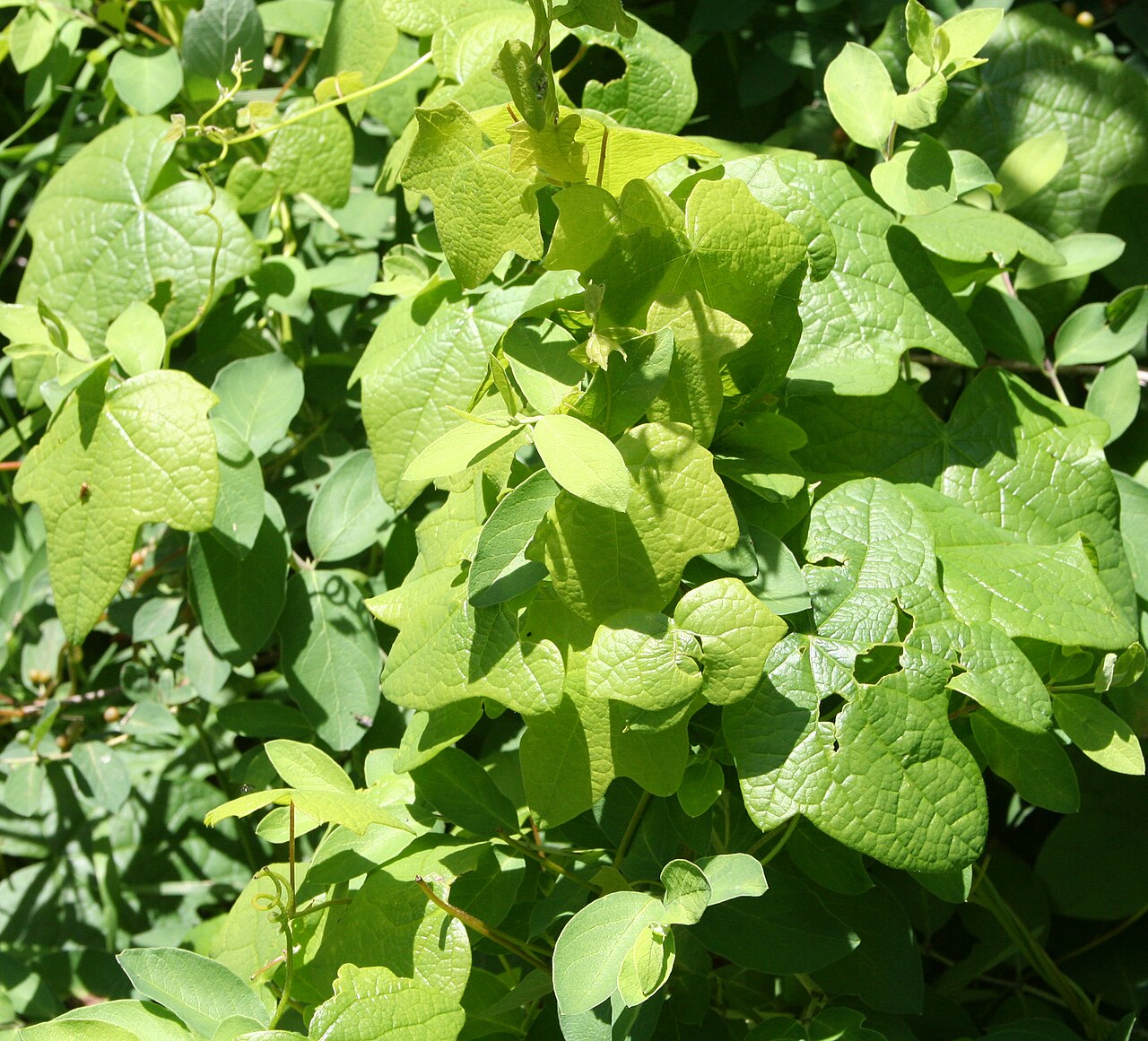
The leaves are alternate, simple, and broadly rounded to shield-shaped, 4 to 8 inches across, with 3 to 7 shallow, rounded lobes — though some leaves are unlobed and nearly circular. The leaf stalk (petiole) attaches slightly inside the leaf margin rather than at the very edge, a peltate-like attachment that is one of the more reliable ways to distinguish Moonseed from true grape leaves, which attach right at the leaf base. Leaves are medium green above, paler and often finely hairy beneath.
Flowers
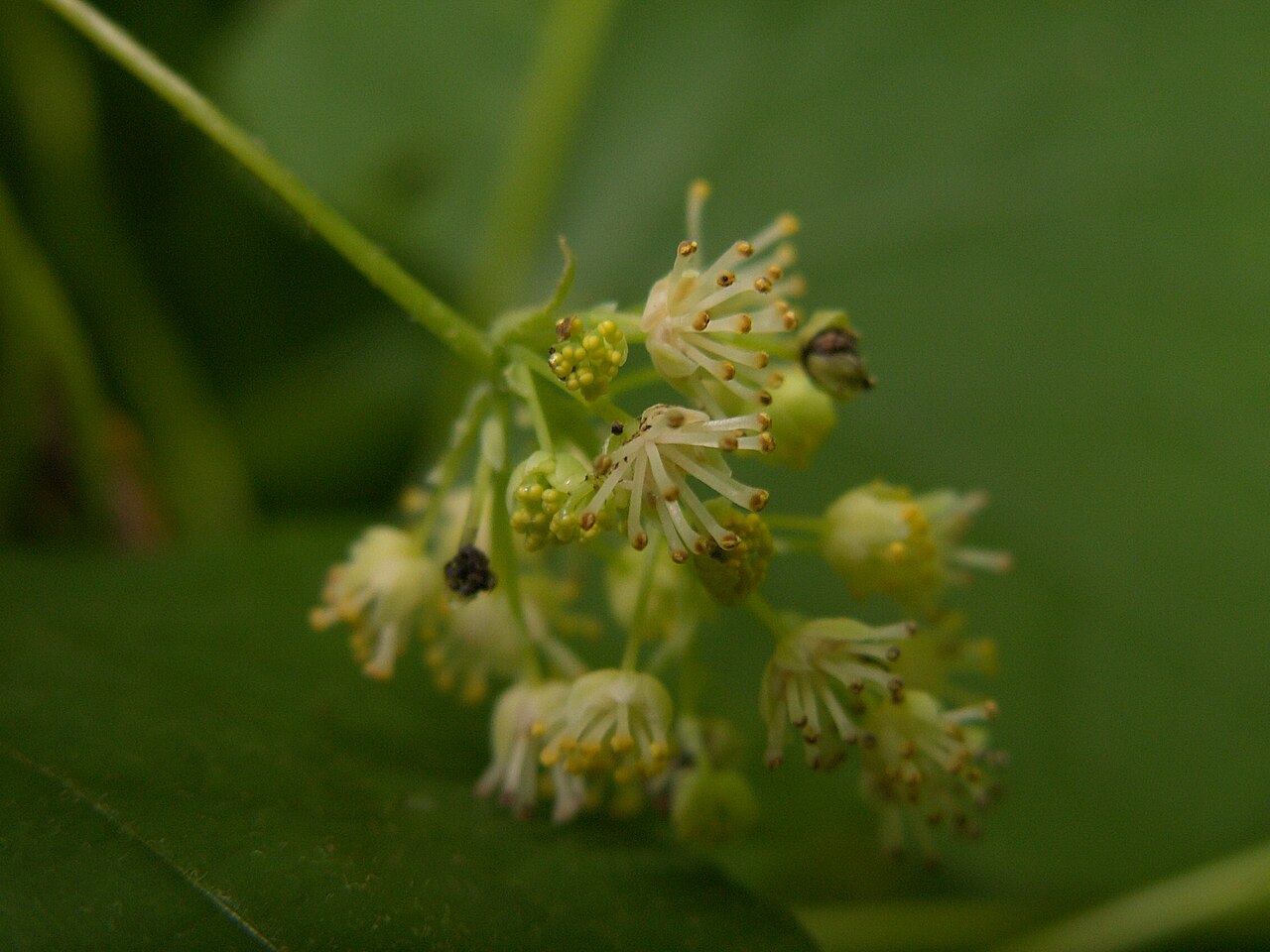
Small, greenish-white to yellowish flowers appear in loose, branched clusters at the leaf axils from late spring into early summer. Moonseed is dioecious, meaning individual plants are either male or female; only female plants, once pollinated by a nearby male, will go on to produce the characteristic berries. The flowers are easy to overlook, lacking showy petals, but they provide a modest nectar source for small native bees and flies.
Fruit & Seeds
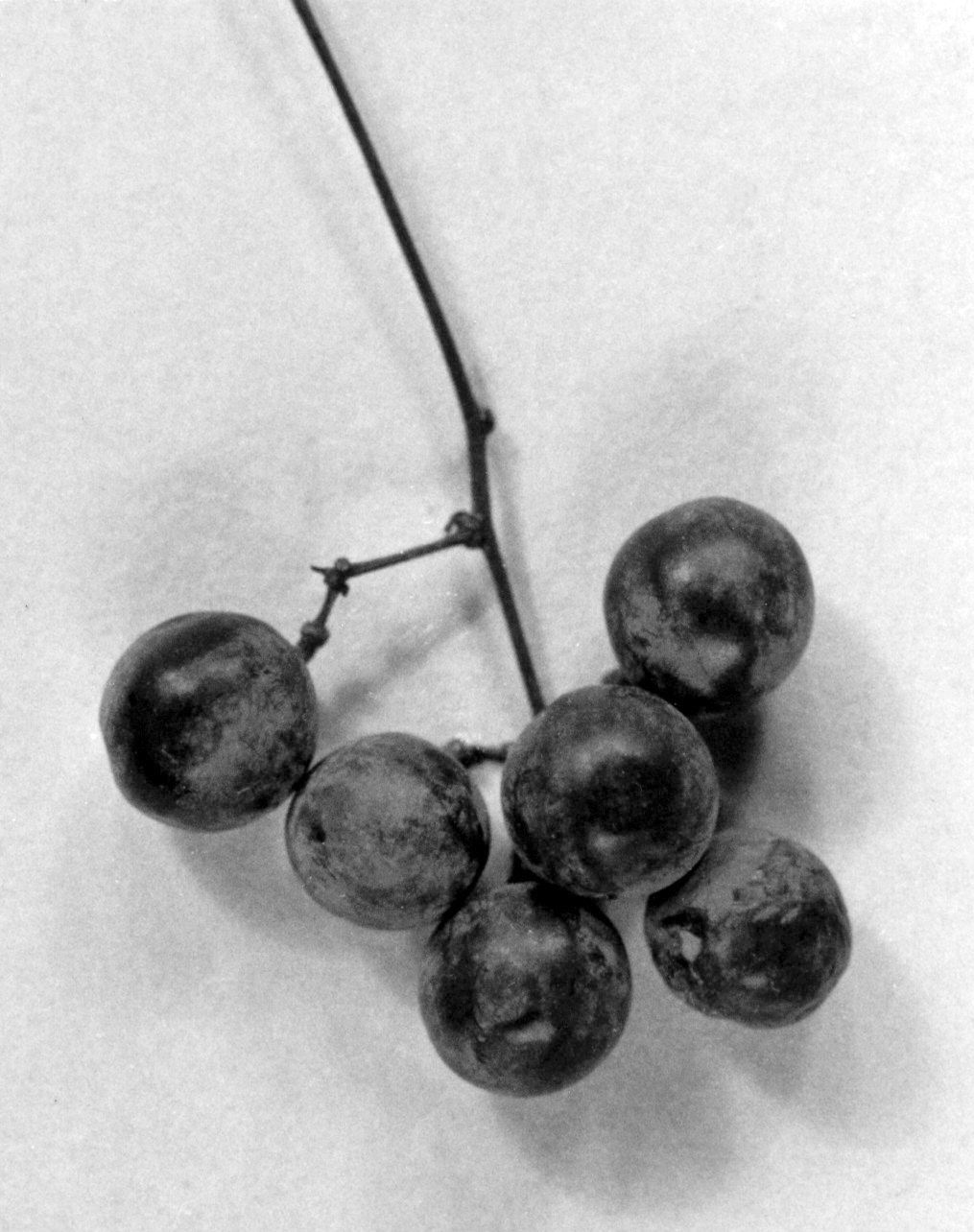
Warning: Moonseed fruit and seeds are poisonous and can easily be mistaken for wild grapes — never eat them. The fruit is a round, fleshy, purple-black drupe about ⅓ to ½ inch across, ripening in loose, grape-like clusters from September into October — the very same season that true wild grapes ripen nearby, which is exactly when confusion is most dangerous. The giveaway is inside: slice a berry open, or remove the pulp, and Moonseed reveals a single flattened, crescent- or ring-shaped seed, unlike the small teardrop-shaped seeds found in true grapes. If you cannot positively confirm which plant you are looking at, treat any wild, grape-like berry in Moonseed’s range with caution and do not eat it.
Quick Facts
| Scientific Name | Menispermum canadense |
| Family | Menispermaceae (Moonseed) |
| Plant Type | Deciduous Woody Vine |
| Mature Height | Climbing to 15–20 ft |
| Mature Spread | Spreads by rhizome; colonies can cover a wide area |
| Growth Rate | Fast |
| Sun Exposure | Part Shade to Full Sun |
| Water Needs | Moderate |
| Soil Type | Moist, rich soil; tolerates a range of textures |
| Soil pH | 6.0–7.5 (neutral to slightly acidic) |
| Bloom Time | Late Spring – Early Summer |
| Flower Color | Greenish-white to yellowish |
| Fall Color | Yellow-green, not showy |
| Fruit | Purple-black grape-like drupes; poisonous, do not eat |
| Deer Resistant | Moderate |
| USDA Hardiness Zones | 4–8 |
Native Range
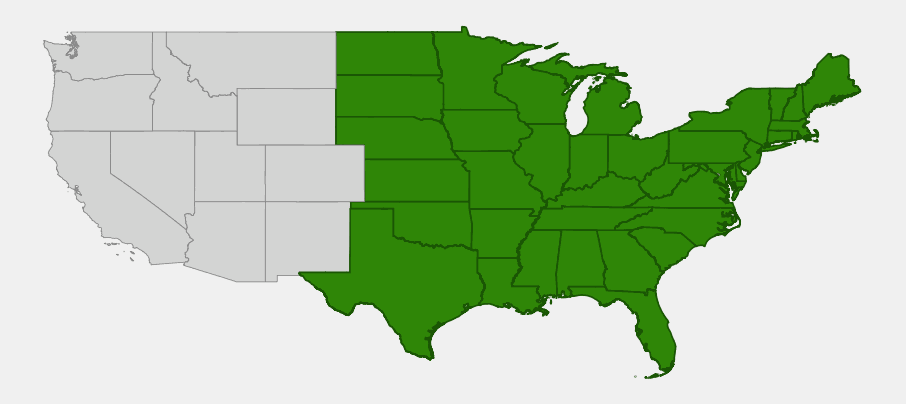
Moonseed is native to eastern North America, ranging from the southern edge of Canada — including Ontario, Quebec, and Manitoba — south through the eastern and central United States to northern Florida, and from the Atlantic Coast west to the eastern Great Plains of the Dakotas, Nebraska, Kansas, Oklahoma, and Texas. Within this broad eastern range it is a widespread, if often overlooked, component of streamside and woodland-edge plant communities.
The species favors moist, rich soils in partial shade to full sun, and is most often encountered along riverbanks and stream corridors, in floodplain thickets, at the edges of moist deciduous woods, and in fencerows and hedgerows where birds have deposited its seed. It generally avoids deep forest interiors, instead favoring the brighter light available at woodland margins, clearings, and disturbed edges.
Moonseed is absent as a native species from the western United States, including the Rocky Mountain states and the Pacific Coast, where its range simply does not extend; gardeners west of its native range should not plant it as a “native” selection, though it is not generally considered invasive outside its home range either.
📋 Regional plant lists featuring Moonseed: New Hampshire, Maine & Vermont, Connecticut, Massachusetts & Rhode Island, New York, Pennsylvania & Northern New Jersey, Delaware, Southern New Jersey & Long Island, Maryland, Virginia & West Virginia, North & South Carolina, Georgia, Alabama & Mississippi, Arkansas, Louisiana, Eastern Oklahoma & Eastern Texas, Kentucky & Tennessee, Ohio & Indiana, Illinois, Iowa & Missouri, Michigan, Wisconsin & Eastern Minnesota, North Dakota, South Dakota & Western Minnesota, Nebraska, Kansas & Eastern Colorado
Growing & Care Guide
Moonseed is an easy, vigorous native vine for the right setting — one where its twining habit and spreading tendency are welcome rather than a maintenance headache.
Light
Moonseed grows well from part shade into full sun. In more shaded woodland-edge settings it climbs eagerly toward the light; in sunnier spots it produces denser foliage and a fuller flower and fruit display on female plants.
Soil & Water
This species prefers moist, rich soil reminiscent of its native streamside and floodplain habitats, but it adapts well to average garden soil once established, and tolerates occasional flooding better than many garden vines. Moderate, consistent moisture produces the best growth, though established plants tolerate brief dry spells.
Planting Tips
Give Moonseed a sturdy support — a fence, arbor, or mature shrub — since it climbs by twining its stems rather than using tendrils or adhesive holdfasts, and it needs something it can physically wrap around. Because the species spreads by rhizome as well as by seed, site it where naturalizing is acceptable, or plan on root-pruning or installing a root barrier if you want to keep a colony contained. Note that only female plants bear the ornamental (if poisonous) fruit, so if fruit display matters to you, confirm you are getting a female plant or allow room for both sexes.
Pruning & Maintenance
Moonseed tolerates hard pruning well and can be cut back in late winter to control size or renew growth. Because it spreads by rhizome, gardeners who want to limit its footprint should be prepared to periodically remove unwanted shoots at the margins of the planting. Wear gloves when handling and disposing of ripe fruit clusters, and keep cut vines with fruit away from children and pets.
Landscape Uses
Within its native range, Moonseed fills several practical roles in wilder garden styles:
- Naturalistic screening on fences, arbors, and rustic structures
- Streambank and floodplain restoration plantings, where it tolerates periodic wet soil
- Wildlife and pollinator gardens — early-summer flowers and fall fruit for birds
- Woodland-edge and hedgerow plantings that embrace a looser, naturalized look
Wildlife & Ecological Value
Moonseed offers real habitat value within its native range, even though its fruit is off-limits to people.
For Pollinators
The small, unshowy flowers of late spring and early summer provide nectar and pollen for small native bees, flies, and other short-tongued insects at a time when they are actively foraging in woodland-edge habitats.
For Birds
Unlike people, many birds can safely eat Moonseed’s fruit, and several songbird species consume the ripe berries in fall, helping disperse seed along fencerows, woodland edges, and streambanks where new vines then establish.
For Mammals
The dense, twining growth of mature Moonseed vines provides cover and structural complexity for small mammals moving through woodland-edge and streamside habitat, and some mammals are documented browsing the foliage without apparent harm, though the fruit remains a hazard for humans and some other animals.
Ecosystem Role
As a rhizome-spreading vine of streambanks and woodland margins, Moonseed helps stabilize disturbed soil along waterways and contributes structural diversity to the shrub and vine layer of eastern forest-edge ecosystems, filling a niche alongside other native climbers like wild grape and Virginia creeper.
Cultural & Historical Uses
Historically, the root of Moonseed — sometimes called “yellow parilla” in older herbal literature — was used in 19th-century American folk and eclectic medicine, often as a substitute for or adulterant of true sarsaparilla preparations. These uses are documented as a matter of historical record rather than as guidance for today: the plant’s fruit is confirmed toxic, and unsupervised use of any part of Moonseed is not advised.
The common name “moonseed” itself comes directly from the seed’s distinctive crescent or ring shape, clearly visible when a berry is cut in half — a detail naturalists and foragers have long used as the definitive way to separate this vine from true wild grapes, whose seeds are small and teardrop-shaped rather than crescent-shaped.
In modern native plant gardening, Moonseed’s main cultural role is as an attractive, fast-growing native alternative to non-native ornamental vines, valued for its grape-like foliage and ease of care — provided gardeners pass along the critical knowledge that its berries, however tempting they may look in September, are not food.
Frequently Asked Questions
Can you eat Moonseed berries?
No. Moonseed fruit is poisonous and must never be eaten. It closely resembles wild grapes in size, color, and ripening season, which makes misidentification genuinely dangerous — always check for the telltale crescent-shaped seed before assuming any wild, grape-like berry is safe, and when in doubt, don’t eat it.
How do I tell Moonseed apart from wild grape?
Two reliable differences: Moonseed’s leaf stalk attaches slightly inside the leaf margin rather than right at the edge, and its climbing stems twine around supports rather than using the coiling tendrils that grapevines use. Most definitively, Moonseed’s seed is flattened and crescent- or ring-shaped, while grape seeds are small and teardrop-shaped.
Is Moonseed invasive?
Within its native eastern range, Moonseed is a normal, non-aggressive component of woodland-edge and streamside plant communities, though it does spread by rhizome and can form colonies in a garden setting if left unchecked. It is not generally listed as an invasive species.
Will Moonseed grow in shade?
Yes, it tolerates part shade well and is often found at the brighter edges of woodlands in the wild, though it flowers and fruits most heavily with more sun.
Do I need a male and female plant to get berries?
Yes. Moonseed is dioecious, so only female plants produce fruit, and they need a nearby male plant for pollination. If you specifically want the (ornamental, inedible) fruit display, confirm you have plants of both sexes.

Looking for a nursery that carries Moonseed?
Browse our native plant nursery directory: ME, MA, MD, MI, MN, MS, MO, KY & LA · NH, NY, NJ, NC, OH, OK, NE & ND · VT, RI, PA, VA, SC, TN & TX · IN, IL, IA & KS · AL & AR · CT, DE, GA & FL · WV & WI