
Mountain Muhly (Muhlenbergia montana)
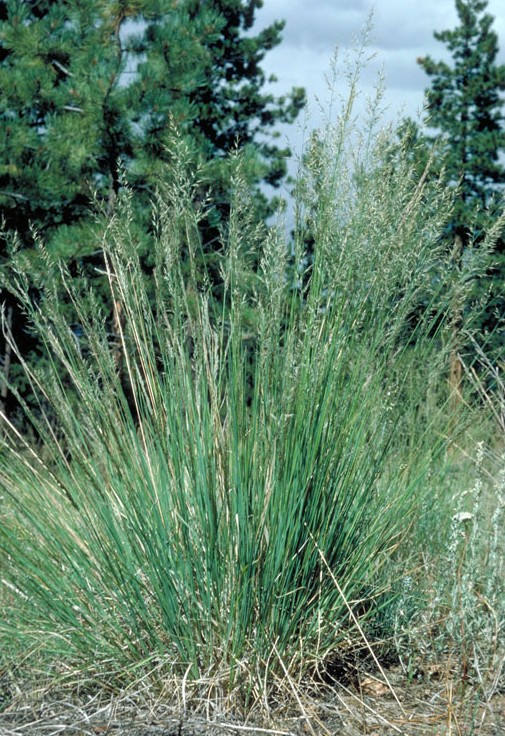
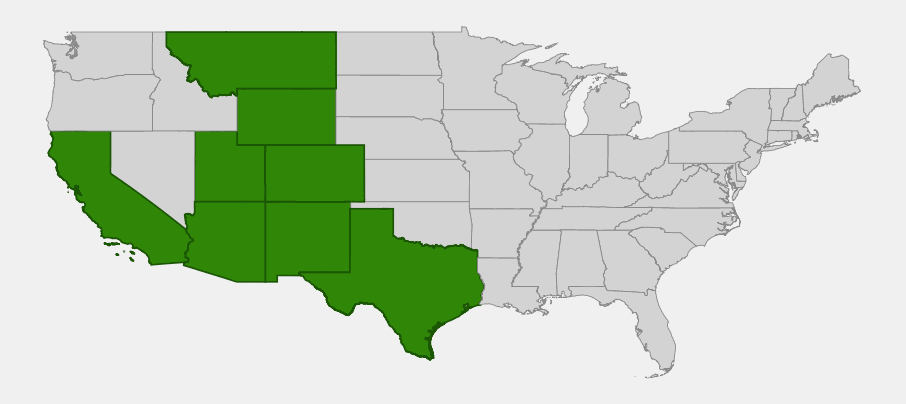
Muhlenbergia montana, commonly known as Mountain Muhly, is a tough, densely tufted native bunchgrass of the mountain West, found from Montana and Wyoming south through the Rockies and Southwest to western Texas, and west through the Great Basin ranges into California’s Sierra Nevada, continuing south through Mexico to Guatemala. It is one of the signature grasses of the ponderosa pine belt, where it carpets the open, parklike stands between the trees and forms some of the most extensive native bunchgrass cover in the Southwest’s montane forests.
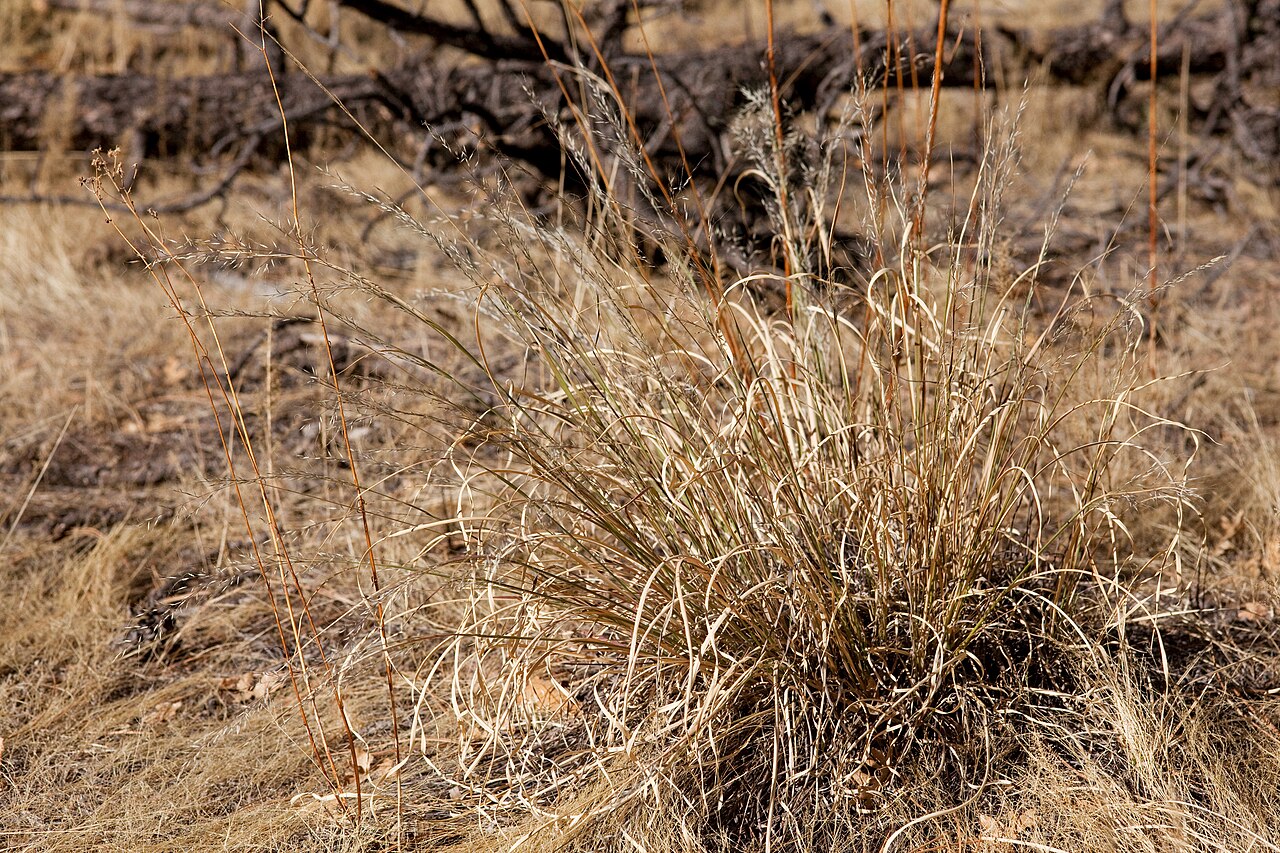
Mountain muhly forms neat, fine-textured clumps 4 to 32 inches tall, with most of the leafy growth low and basal and slender flowering stems rising above it in late summer. Its narrow, wiry leaves and understated, straw-colored seed heads give it a quiet, almost architectural presence rather than a showy one — this is a grass valued more for what it does in the landscape than for how it looks in bloom. It is genuinely important: it is one of the most heavily used forage grasses on Southwestern cattle and elk range, and its dense tufts and persistent old sheaths help it survive fire and drought that would wipe out less resilient grasses.
For native plant gardeners at mid to high elevation in the Rocky Mountain and Southwestern states, mountain muhly is an honest, low-maintenance choice for a dry, sunny, well-drained site that wants to look like the floor of an open pine forest rather than a manicured lawn. It asks for very little once it’s established and rewards you with the same tough persistence that has kept it dominant on Southwestern rangeland for generations of grazing, drought, and fire.
Identification
Mountain muhly is a native, perennial, warm-season bunchgrass. Its culms are branched at the base and densely tufted, usually erect, 4 to 32 inches (10–80 cm) tall. Leaves are mostly basal and densely clustered, with a few additional leaves along the culm; leaf blades run 2 to 10 inches (5–25 cm) long. The leaf sheaths become papery and loose with age, often flattened, and persist on the plant rather than falling away — a detail that matters ecologically, since those old sheath bases help protect the plant’s basal buds from fire.
Flowers & Seed Heads
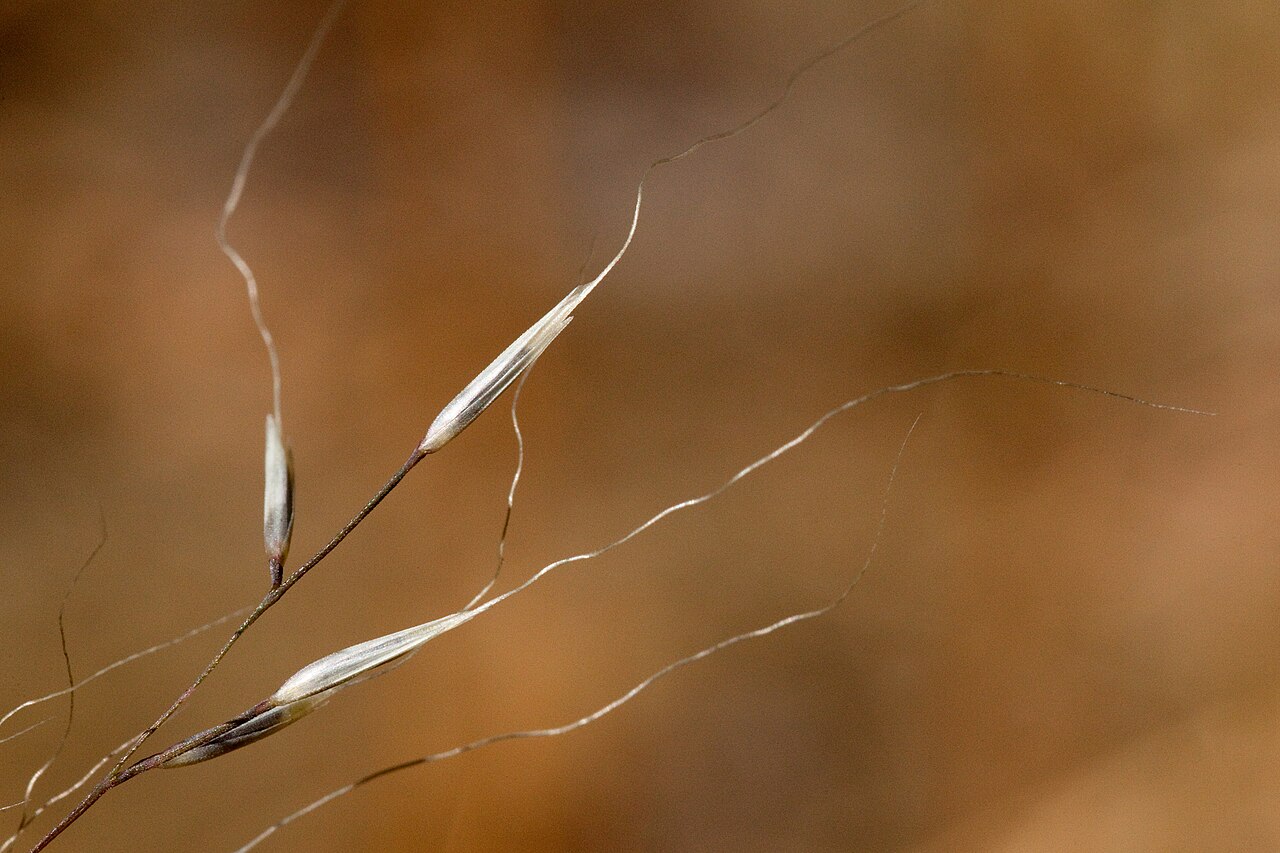
The inflorescence is a narrow, oblong panicle, erect to somewhat nodding, 2 to 6 inches (5–15 cm) long, with branches 0.4 to 3.5 inches (1–9 cm) long that are erect to moderately spreading. Each one-flowered spikelet carries a lemma with an awn 0.24 to 0.79 inch (6–20 mm) long — shorter and less hair-fine than the awns of some related muhlys, giving the seed head a softer, more bristled look rather than a wispy one. Flowering generally runs from July through September across most of the plant’s range, later (August–September) at higher, colder sites in Arizona, and plants sometimes hold their seed into winter in central Arizona.
Roots
Mountain muhly has a deep, fibrous root system well suited to drought: in sampled soils, roughly 15 percent of its roots were in the top 3 feet of soil and 58 percent in the top 6 feet, with the deepest roots reaching as far as 9 feet down. That root depth lets it compete successfully for soil moisture even against establishing conifer seedlings.
Quick Facts
| Scientific Name | Muhlenbergia montana |
| Family | Poaceae (Grass) |
| Plant Type | Warm-season perennial bunchgrass |
| Mature Height | 4 in – 32 in (10–80 cm) |
| Mature Spread | Dense tufts, 1–1.5 ft wide |
| Growth Rate | Slow to moderate |
| Sun Exposure | Full Sun (tolerates light pine shade) |
| Water Needs | Low to average; excellent drainage required |
| Soil Type | Coarse to loamy, gravelly or stony; sheds water well |
| Soil pH | Neutral to slightly alkaline (grows poorly on acidic or saline soil) |
| Bloom Time | July – September (Aug–Sept in Arizona) |
| Flower Color | Straw to tan, narrow panicles |
| Fall Color | Tan/buff as the clump cures for winter |
| Fruit | Small caryopsis (grain), sometimes held into winter |
| Deer Resistant | No — a preferred winter forage for elk and mule deer |
| USDA Hardiness Zones | 4–9 |
Native Range
Mountain muhly has one of the broadest ranges of any Southwestern muhly grass. It occurs from Montana and Wyoming south through the Rocky Mountains, Colorado Plateau, and Southwest to western Texas (chiefly the Trans-Pecos mountains, such as the Guadalupe and Davis Mountains, rather than the state as a whole), continuing south through Mexico to Guatemala. It extends west through Utah and Arizona and reaches into California, where it grows in the northern mountains and the Sierra Nevada, typically on granitic rock outcrops.
Elevation is the common thread across this wide range: mountain muhly is a montane and subalpine species nearly everywhere it grows, from around 2,650 feet in Montana up to over 11,000 feet in California, Colorado, and New Mexico. It favors dry to moist sites with excellent drainage — grassy parklands, slopes and foothills, rocky hillsides, canyons, and mesas — and is especially characteristic of the open understory of ponderosa pine forest, where it is often the dominant grass between the trees. It grows on a wide range of coarse to loamy soils (gravelly loam, sandy loam, stony loam, disintegrating sandstone and limestone-derived soils) but performs poorly on acidic or saline ground.
Because it is adapted to a summer-growing-season climate with winter and late-summer precipitation peaks, mountain muhly is well matched to the Southwest’s monsoon pattern as well as to the more evenly distributed rainfall of the central and northern Rockies. It is both a seral and a climax species, meaning it holds its ground in mature forest as well as colonizing more open, disturbed, or early-succession sites — a flexibility that has helped make it one of the most widely distributed bunchgrasses in western mountain rangeland.
📋 Regional plant lists featuring Mountain Muhly: Arizona & New Mexico · Utah & Western Colorado · Montana & Wyoming
Growing & Care Guide
Mountain muhly is an easy, forgiving grass for the right site: dry, sunny, and sharply drained, ideally at some elevation. It is not a grass for rich garden soil or regular irrigation — those conditions favor weedier competitors and don’t match what this species actually wants.
Light
Plant mountain muhly in full sun. It grows best in the open and declines measurably as shade increases, whether from encroaching trees or shrubs; in its native ponderosa pine openings it thins out as the canopy closes in.
Soil & Water
Give it coarse, well-drained soil — gravelly, sandy, or stony loam rather than heavy clay — and avoid acidic or saline ground, where it performs poorly. Once established its deep, fibrous root system (reaching as deep as 9 feet in favorable soil) makes it genuinely drought tolerant; water new plantings regularly through the first year, then taper off to rely on natural precipitation, supplementing only during extended dry spells.
Planting Tips
Set out container plants or sow seed in spring once the soil has warmed, matching the natural start of growth that mountain muhly shows in the wild (roughly when daytime highs reach 50°F). Space plants about 12 to 18 inches apart to let each tuft develop its full, dense form without early crowding. It performs best at higher elevations or in regions with cool nights; at low, hot elevations outside its natural range it may struggle.
Pruning & Maintenance
Cut back old growth in late winter before new shoots emerge. Mountain muhly tolerates grazing and mowing reasonably well when it is actively growing, but repeated heavy cutting or trampling during the growing season will weaken and eventually eliminate it, just as heavy livestock grazing does on Southwestern rangeland — let it rest and regrow through its summer growing season rather than cutting it hard and often.
Landscape Uses
Mountain muhly’s toughness and fine, neutral texture make it useful in several settings:
- Dry, sunny slopes and rock gardens at mid to high elevation
- Open “pine parkland” plantings under high, light conifer canopy
- Erosion control on gravelly or rocky ground thanks to its deep roots
- Wildlife and habitat restoration plantings, especially post-fire revegetation
- Low-water meadow or matrix plantings paired with other short Southwestern grasses
Fire Ecology
Mountain muhly is a tussock graminoid that may resprout after its aerial growth is burned; its dense tufts and persistent, papery old sheath bases help shield basal buds from fire. Response varies with fire severity and timing: density often drops for the first few years after a burn and can take about three years to fully recover, though plants have rebounded to prefire biomass within as little as ten months after a well-timed prescribed burn in central Arizona. In hot, dry conditions, however, a mountain muhly plant’s own heavy litter can carry a hot enough fire to damage or kill it — a reminder that prescribed burn timing and fuel conditions matter for this species’ survival.
Wildlife & Ecological Value
Mountain muhly is one of the most ecologically and economically important native grasses across its range, underpinning both wild forage systems and cattle range throughout the Rocky Mountain West and Southwest.
For Mammals
Mountain muhly is a major forage species for both livestock and wildlife. In Rocky Mountain National Park, Colorado, it is a principal winter food for elk in xeric grasslands, ponderosa pine-shrub habitats, and big sagebrush areas. On Arizona ponderosa pine rangeland it was the third most heavily grazed grass species in cattle preference studies — behind only Kentucky bluegrass and Arizona fescue — and its forage palatability is rated good for cattle and horses and fair to good for sheep across Colorado, Montana, Utah, and Wyoming. Energy value is good, though protein content is comparatively low, and nutritional quality is highest in mid-to-late summer as the plant grows.
For Birds
Cover value for upland game birds and small nongame birds is rated fair in Utah studies, and its dense basal tufts provide low ground-level shelter in open forest and grassland settings where tall cover is otherwise scarce.
Ecosystem Role
Because mountain muhly often dominates the grass layer in open ponderosa pine stands, it plays an outsized role in Southwestern forest understories: dense, ungrazed stands can resist invasion by other plants, including tree seedlings, and its deep, competitive root system draws down soil moisture faster than establishing conifer seedlings can, meaningfully shaping forest regeneration patterns. It is sensitive to overgrazing and trampling — heavy use causes it to decline and be replaced by sod-forming grasses, and it is notably less abundant near heavily used trails than in protected forest interior — making its abundance a useful on-the-ground indicator of range and trail condition in places like Cochise County, Arizona.
Cultural & Historical Uses
Mountain muhly does not carry the same documented history of Indigenous plant use as many showier Southwestern natives; its primary historical significance lies in its role as rangeland forage. Since organized livestock grazing began across the Rocky Mountain West and Southwest in the late 1800s, mountain muhly has been one of the most consistently valuable native forage grasses on ponderosa pine and mountain parkland range, particularly prized for its abundance and its availability during the summer rainy season when cattle most need actively growing forage.
Long-term grazing studies in Colorado and Arizona, some running from the 1940s through the 1970s, used mountain muhly’s response to grazing intensity as a working indicator of range health, and those studies still inform stocking and rest-rotation decisions on Southwestern public and private rangeland today. Land managers also continue to study its role in postfire recovery and its competitive interaction with ponderosa pine seedlings, since in places this fast-growing grass can measurably slow conifer regeneration by drawing down soil moisture before tree roots are established.
Frequently Asked Questions
Is mountain muhly a good lawn substitute?
No — it forms distinct bunches rather than a spreading turf, so it won’t knit into a solid lawn. It’s better suited to a dry meadow, rock garden, or naturalistic planting than a mowed lawn area.
How much water does mountain muhly need?
Very little once established. It is a genuinely drought-tolerant bunchgrass with roots that can reach several feet deep, but it does require sharp drainage — soggy or poorly drained soil, especially in winter, is more likely to kill it than drought is.
Will mountain muhly survive fire?
Often, yes. Its dense tufted growth and persistent old sheath bases help protect its basal buds, and plants frequently resprout after their top growth burns, typically recovering within a few years. However, a hot fire fueled by the plant’s own dry litter can still kill individual clumps, so fire effects vary with conditions.
Is mountain muhly grazed by deer and elk?
Yes, heavily in places. It is an important winter forage species for elk in parts of Colorado and a well-used forage grass for mule deer and cattle across much of its range, so expect it to be browsed if deer or elk have access to your planting.
Does mountain muhly tolerate shade?
Not well. It grows best in full sun and visibly declines as shade increases, including under a closing pine canopy — plant it in the most open, sunny part of a dry garden rather than under trees.

Looking for a nursery that carries Mountain Muhly?
Browse our native plant nursery directory: Arizona · California · Colorado · Montana · New Mexico · Texas & Utah · Wyoming