
Bear Oak (Quercus ilicifolia)
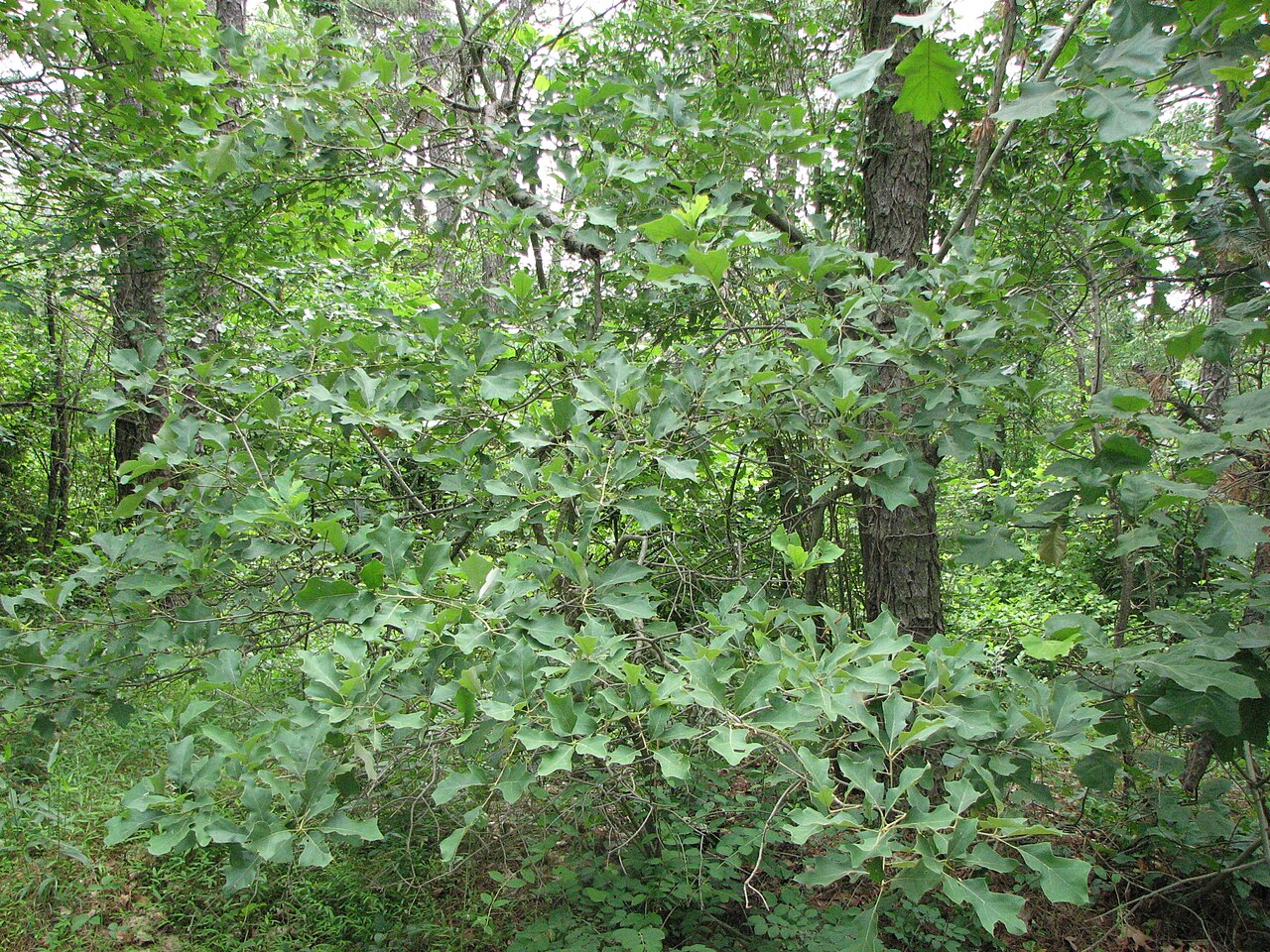
Quercus ilicifolia, commonly called Bear Oak or scrub oak, is a scrappy, low-growing shrub oak of the Eastern United States. Unlike the towering oaks most gardeners picture, Bear Oak rarely tops 20 feet and more often forms dense, gnarled thickets just 6 to 15 feet tall. It belongs to the red oak group (Fagaceae, section Lobatae) and takes its common name from black bears, which feed heavily on its small, bitter acorns while fattening up for winter denning.
Bear Oak is a true specialist of poor, droughty ground — pine barrens, serpentine outcrops, sandplains, and burned-over ridgetops where few other trees can compete. It thrives on disturbance: wildfire, repeated cutting, and even bulldozing all trigger vigorous resprouting from its massive, long-lived taproot. Because it cannot tolerate shade, Bear Oak disappears quickly once taller trees close in overhead, making it one of the best indicator species for open, sun-baked, acidic soils.
For native plant gardeners working with sandy, rocky, or otherwise difficult sites — especially in coastal pine barrens or inland serpentine and shale barrens — Bear Oak offers something few ornamental shrubs can: a genuinely wild, low-maintenance thicket that feeds an extraordinary number of moths, butterflies, birds, and mammals, including nearly a third of the rare Lepidoptera species found in southern New England.
Identification
Bear Oak is most easily recognized by its small stature, crooked branching, and tendency to form dense colonial thickets rather than a single clean trunk. Multiple stems typically arise from one root system, giving older stands a tangled, almost impenetrable structure.
Bark & Stems
Young twigs are slender, reddish-brown to gray, and often downy when new, smoothing out with age. The bark on older stems is thin, dark gray-brown, and develops shallow fissures, never becoming thick or deeply furrowed the way mature white or red oak bark does. Because the plant is shrubby, most stems stay thin — rarely more than a few inches in diameter — even on old-growth barrens where individual root systems may be centuries old.
Leaves
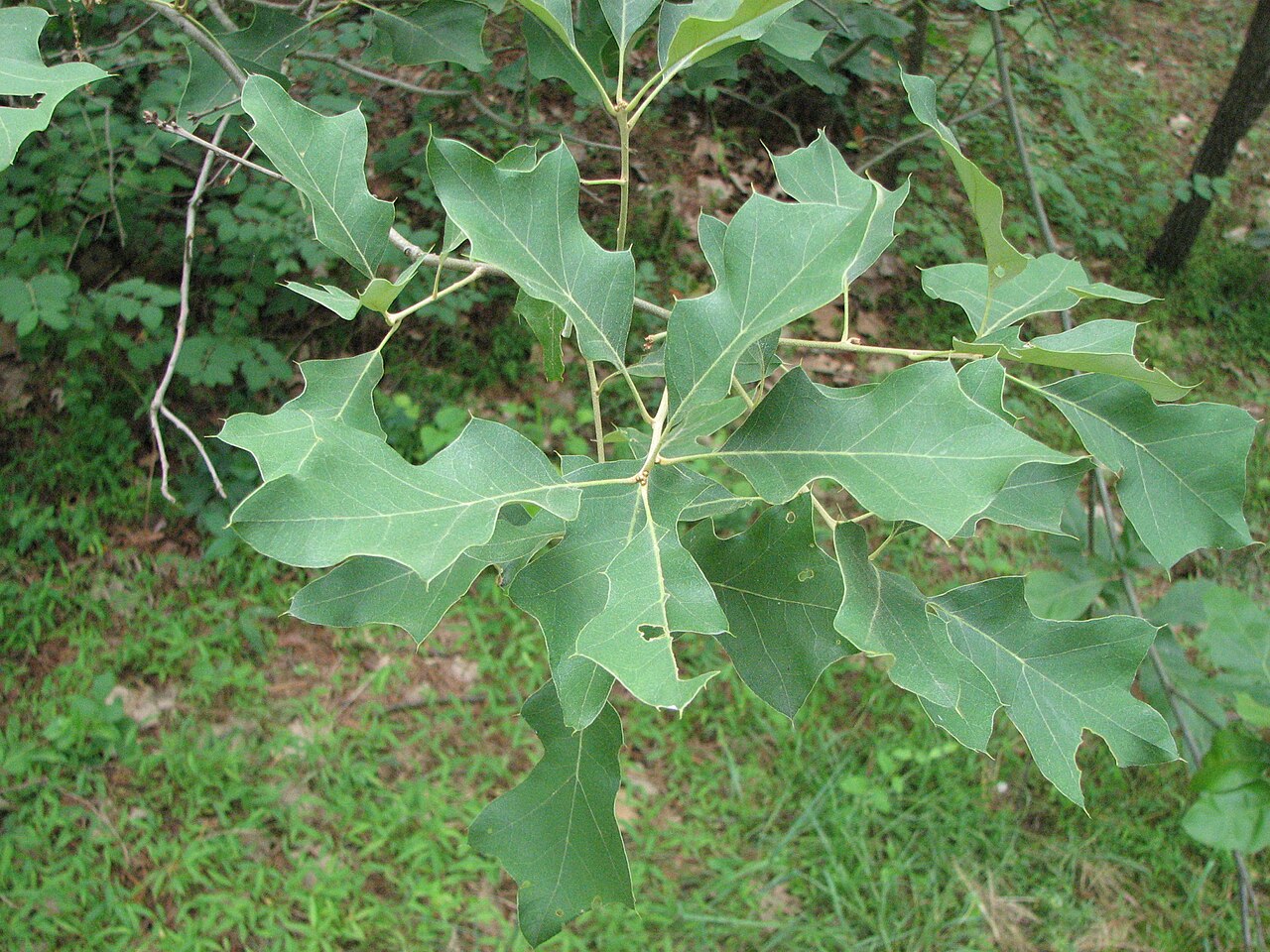
Leaves are alternate, 2 to 6 inches long, with 3 to 7 shallow to moderately deep, bristle-tipped lobes — the “holly-leaved” look that gives the species its Latin name, ilicifolia. The upper surface is shiny dark green; the underside is noticeably paler and finely hairy, sometimes with a grayish cast. Fall color is a dull yellow-brown to russet, and many leaves persist, dry and rattling, on the branches well into winter — a trait called marcescence shared with several other scrub oaks.
Flowers
Like all oaks, Bear Oak is monoecious, with male flowers in slender, drooping yellow-green catkins 1 to 3 inches long appearing in April or May as the leaves unfurl. Inconspicuous female flowers form singly or in small clusters at the base of new growth and are easy to overlook.
Fruit & Seeds
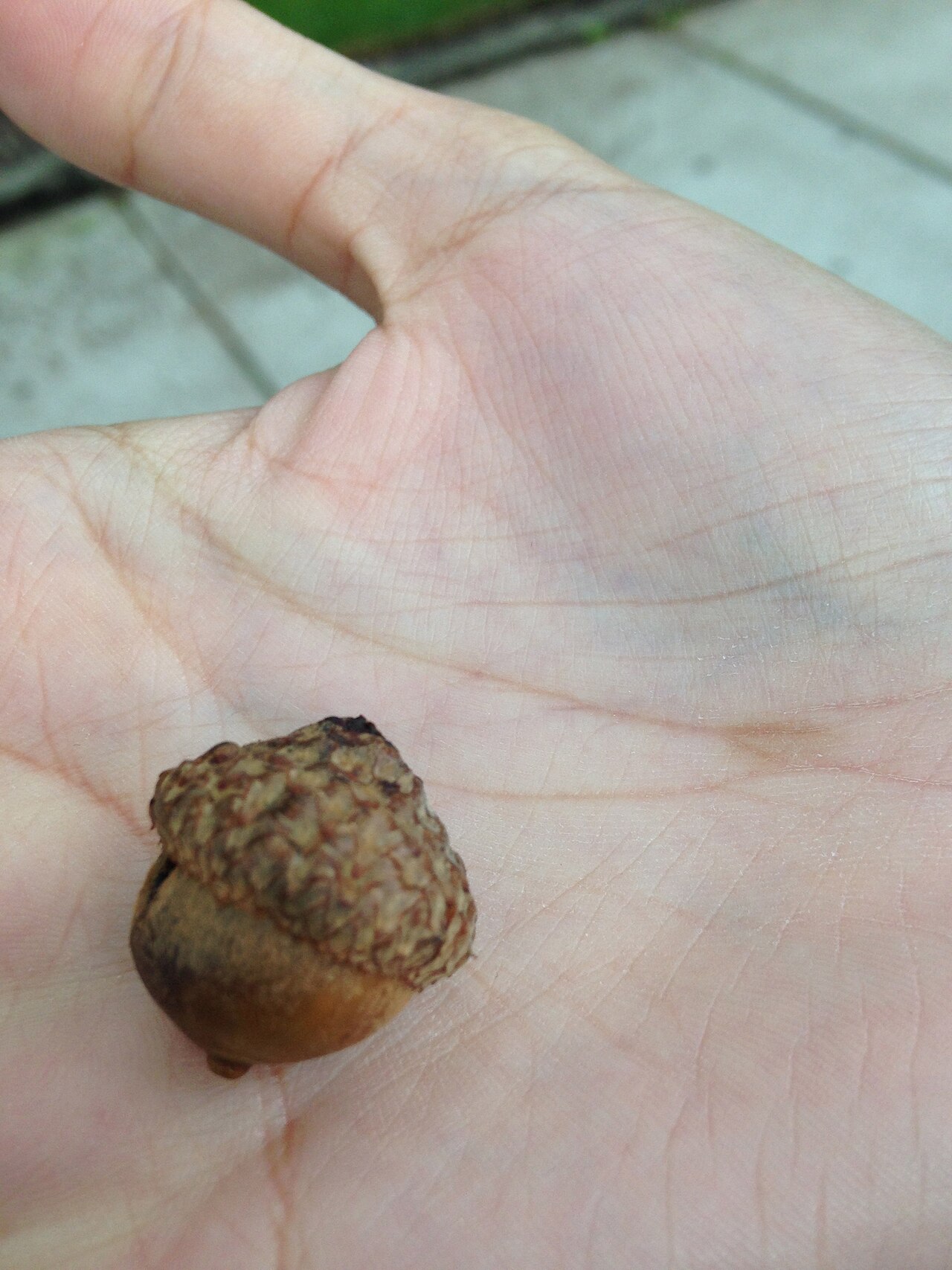
Acorns are small, roughly ½ to ¾ inch long, egg-shaped, and sit in a shallow, scaly, saucer-like cap that covers about a third of the nut. They take two growing seasons to mature, like other red oak group members, and are notably bitter with high tannin content — more palatable to wildlife than to people. A single thicket can produce acorns prolifically in good mast years, an important food pulse for wildlife heading into winter.
Quick Facts
| Scientific Name | Quercus ilicifolia Wangenh. |
| Family | Fagaceae (Beech) |
| Plant Type | Deciduous Shrub (occasionally small tree) |
| Mature Height | 6–15 ft, occasionally to 20 ft |
| Mature Spread | 8–15 ft (forms colonial thickets) |
| Growth Rate | Slow to moderate |
| Sun Exposure | Full Sun |
| Water Needs | Low |
| Soil Type | Dry, sandy, rocky, or shallow serpentine soils; well-drained |
| Soil pH | 4.5–6.0 (acidic) |
| Bloom Time | April – May |
| Flower Color | Yellow-green (inconspicuous catkins) |
| Fall Color | Dull yellow-brown to russet; leaves often persist |
| Fruit | Small, bitter acorns, ½–¾ in, 2-year maturation |
| Deer Resistant | No (deer browse foliage and stems) |
| USDA Hardiness Zones | 4–7 |
Native Range
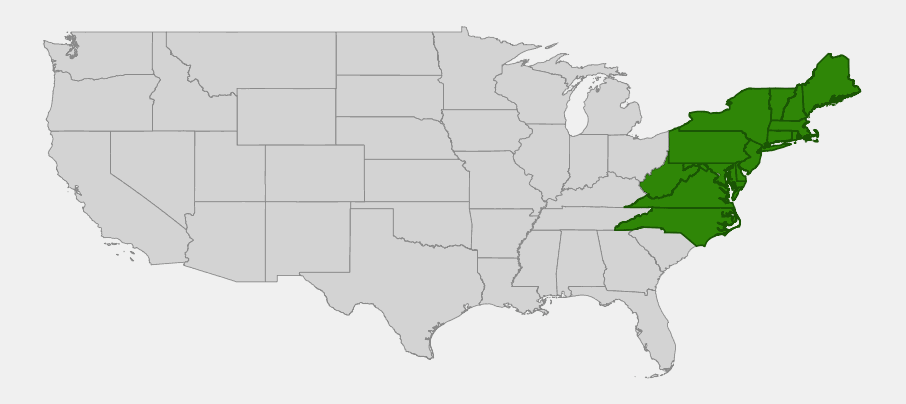
Bear Oak’s core range runs from Maine south through New Hampshire, Vermont, Massachusetts, Rhode Island, and Connecticut, then down through New York, New Jersey, and Pennsylvania into Maryland, Delaware, West Virginia, and Virginia. Scattered, disjunct populations reach into the Piedmont of North Carolina, where the species is tracked as a state-rare plant. A handful of outlying populations have also been reported just north of the border in Ontario, on granite and gneiss barrens.
Within this range, Bear Oak is strongly tied to specific poor-soil habitats rather than being a generalist. It dominates the pine barrens of New Jersey and Long Island alongside Pitch Pine (Pinus rigida), and it is a defining shrub of the heathlands on Cape Cod, Nantucket, and Martha’s Vineyard, where it often codominates with Black Huckleberry (Gaylussacia baccata). Further inland, it is one of the signature shrubs of serpentine and shale barrens in Pennsylvania, Maryland, and Virginia, and of granite summit balds in New England.
Because Bear Oak depends on open, disturbed, nutrient-poor ground, its distribution has contracted somewhat where decades of fire suppression have allowed taller trees to shade out barrens and heathlands. Prescribed burning and other active management are now used in many of these habitats specifically to maintain the open conditions Bear Oak and its associated wildlife require.
📋 Regional plant lists featuring Bear Oak: New Hampshire, Maine & Vermont · Connecticut, Massachusetts & Rhode Island · New York, Pennsylvania & Northern New Jersey · Delaware, Southern New Jersey & Long Island · Maryland, Virginia & West Virginia · North Carolina & South Carolina
Growing & Care Guide
Bear Oak is not a plant for a typical garden border — it is a specialist for the toughest, driest, sunniest, and sandiest or rockiest spot on a property, and it rewards gardeners who have exactly that kind of difficult ground.
Light
Bear Oak needs full sun. It is among the least shade-tolerant oaks in the East, and plants quickly decline and fail to regenerate once neighboring trees or shrubs begin to shade them out. Open, exposed sites — the kind most gardeners try to screen or shade — are exactly where this species performs best.
Soil & Water
This oak is built for infertile, excessively drained soils: coarse sand, gravel, shallow rocky ground, or even serpentine barrens that are toxic to many other plants. It is highly drought tolerant once established and should never be planted in rich, moist, or heavy clay soil, where it struggles and is easily outcompeted. Supplemental water is rarely needed beyond the first year of establishment.
Planting Tips
Start with small container stock; like most oaks, Bear Oak puts energy into its taproot early and resents transplanting once established. Plant in fall or early spring, choose the leanest, sunniest spot available, and resist the urge to amend the soil — rich soil works against this species. Because it spreads by root sprouts as well as seed, give it room to form a natural colony rather than trying to keep it to a single stem.
Pruning & Maintenance
Little pruning is needed or even desirable; Bear Oak’s tangled, multi-stemmed form is natural, not a flaw. Where periodic fire or mowing is used to maintain barrens or heathland habitat, Bear Oak responds with vigorous resprouting from its taproot, so occasional hard cutback can be used to rejuvenate an overgrown colony. Avoid fertilizing, which favors weedy competitors over this nutrient-poor-soil specialist.
Propagation
Propagate from fresh acorns sown shortly after fall collection; like other red oak group members, seed does not store well and benefits from cold, moist stratification over winter if spring sowing is preferred. Acorns germinate best when barely covered in sandy, well-drained medium.
Landscape Uses
Bear Oak fills a very specific but valuable niche:
- Barrens and sandplain restoration — a keystone species for pine barren and heathland projects
- Difficult, droughty slopes where little else will establish
- Wildlife thickets providing cover and mast on marginal ground
- Coastal and sandy-soil gardens in New England and the Mid-Atlantic
- Naturalized screens on rocky or serpentine outcrops
- Erosion control on sandy or shallow-soil banks
Wildlife & Ecological Value
Few shrubs in the Northeast punch above their weight ecologically the way Bear Oak does. As the dominant woody plant in some of the region’s rarest barren and heathland habitats, it supports a web of specialized wildlife found almost nowhere else.
For Pollinators
Bear Oak’s wind-pollinated catkins are not a nectar source, but the open barrens it dominates are rich in spring ephemerals and low shrubs that do support native bees, and the structurally diverse thickets provide shelter for ground-nesting bee species.
For Birds
Wild Turkeys show a strong preference for Bear Oak acorns over most other mast, and many songbirds nest in or forage through its dense thickets. The habitat Bear Oak dominates — pine barrens and heathlands — also supports regionally significant populations of ground- and shrub-nesting birds that depend on this open, low structure.
For Mammals
Black bears consume Bear Oak acorns heavily while building fat reserves before denning, a direct link reflected in the plant’s common name. White-tailed deer browse the acorns, stems, and foliage, and squirrels cache the acorns, incidentally helping disperse and plant new oaks across the barrens.
Ecosystem Role
Bear Oak is the primary or sole larval host plant for roughly 29 percent of the rare and endangered moth and butterfly species found in southern New England and southeastern New York — an outsized contribution for a shrub that most people walk past without noticing. Its fire-adapted biology, resprouting readily after burns, makes it both a product of and a driver of the disturbance regimes that keep pine barrens and heathlands open and biodiverse.
Cultural & Historical Uses
Bear Oak has never been an important timber or nut-crop species — its small size and bitter, tannin-rich acorns made it far more valuable to wildlife than to people. Its common name reflects Indigenous and early colonial observation that black bears favored its acorns as a fall food source, a pattern still documented by wildlife biologists today.
Historically, the barrens and heathlands Bear Oak dominates were shaped by Indigenous burning practices that maintained open, huckleberry- and blueberry-rich ground for foraging. European settlement initially continued this pattern through grazing, wood-cutting, and occasional fire, but twentieth-century fire suppression allowed many of these barrens to begin converting to closed forest, squeezing out Bear Oak and its associated wildlife in some areas.
In the twentieth century, Bear Oak thickets growing on disturbed ground — including reclaimed landfill sites such as New York’s Fresh Kills — have been deliberately used in revegetation projects for their toughness on poor soils and low maintenance needs, a modern echo of the species’ long history as a survivor on the region’s hardest ground.
Frequently Asked Questions
Is Bear Oak the same plant as scrub oak?
In the Northeast, “scrub oak” most often refers to Bear Oak (Quercus ilicifolia). But the name “scrub oak” is used loosely for several unrelated small oaks around the country, including Quercus turbinella in the Southwest, so always check the scientific name before buying or planting.
Can Bear Oak acorns be eaten by people?
Technically yes, after leaching out the bitter tannins, as with most oak acorns, but they are small and labor-intensive to process. They are far more valuable left for black bears, deer, turkeys, and squirrels, which rely on them as a fall food source.
Why won’t Bear Oak grow in my regular garden soil?
Bear Oak is adapted to poor, sandy, rocky, or acidic soils and full sun; rich garden soil, extra water, and any shade all work against it, favoring faster-growing competitors. It performs best when essentially neglected on lean ground.
Does Bear Oak need fire to survive?
It doesn’t strictly require fire, but it is highly fire-adapted, resprouting vigorously from its taproot after burns that kill the top growth. In the wild, periodic fire or other disturbance is what keeps the open, sunny habitat Bear Oak needs from closing in with taller trees.
Is Bear Oak endangered?
Bear Oak is secure across most of its core Northeastern range, but it is tracked as a rare, state-listed plant at the southern edge of its range in North Carolina, where suitable barrens habitat is limited and scattered.

Looking for a nursery that carries Bear Oak?
Browse our native plant nursery directory: Connecticut & Delaware · Maine, Maryland & Massachusetts · New Hampshire, New Jersey, New York & North Carolina · Pennsylvania, Rhode Island, Vermont & Virginia · West Virginia