
Cloudberry (Rubus chamaemorus)
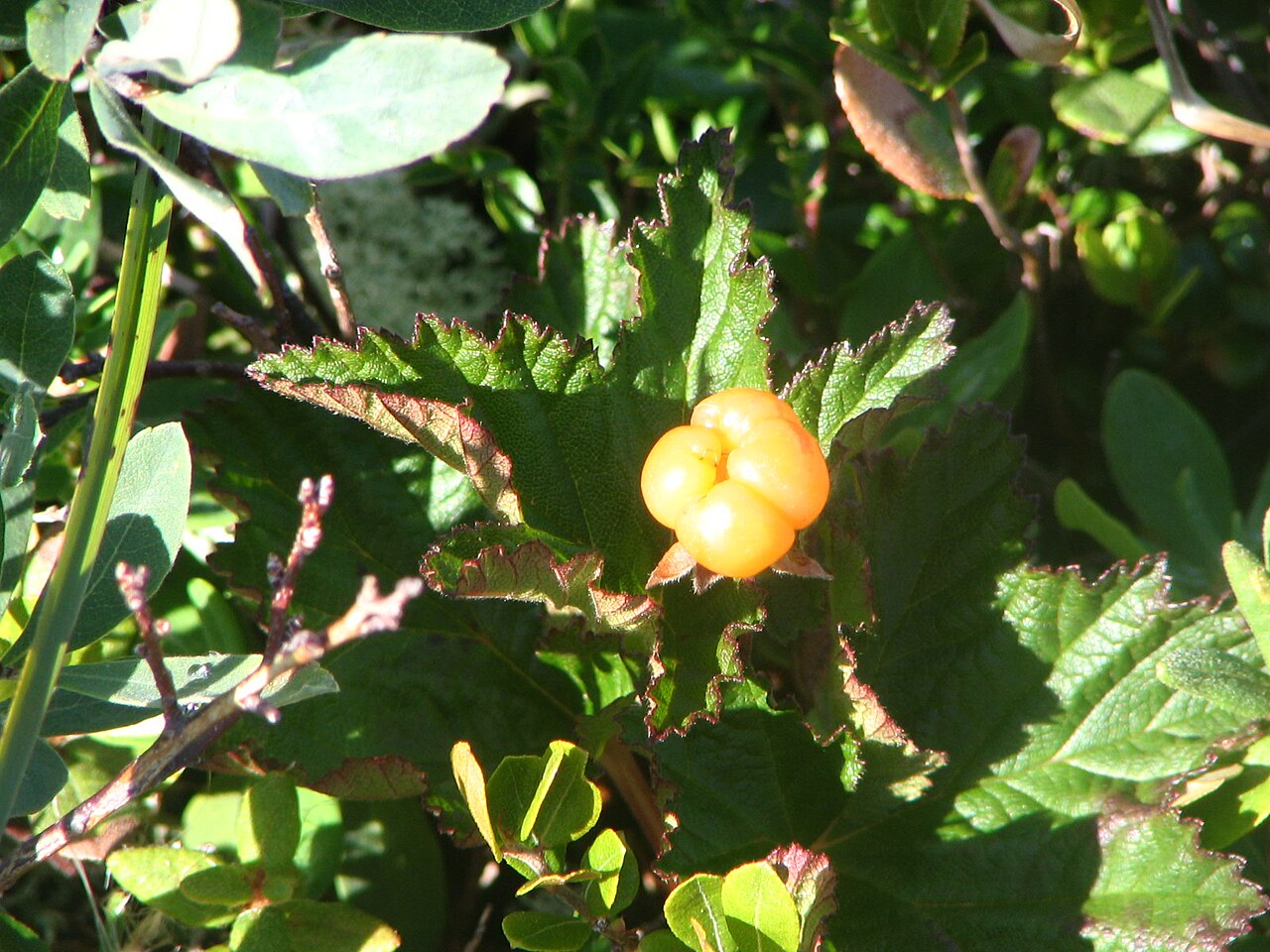
Rubus chamaemorus, the Cloudberry, is a low, creeping perennial in the rose family that forms loose patches only 4 to 10 inches tall in open peat bogs and tundra. Unlike its bramble relatives, it carries no thorns at all, and instead of long arching canes it sends up short, unbranched stems, each with one or two crinkled, maple-shaped leaves and, in season, a single white flower that ripens into one of the most prized wild berries of the far north.
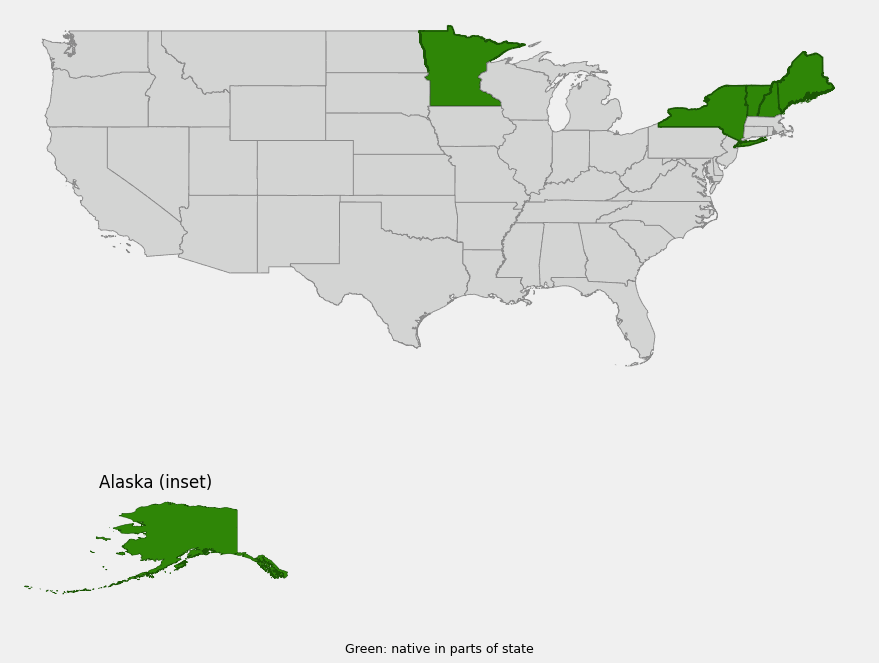
Cloudberry is circumpolar, common across Alaska, arctic and subarctic Canada, and northern Europe and Asia, but in the Lower 48 it is a true rarity. A few small, isolated colonies persist in cold, acidic peat bogs in Maine, New Hampshire, Vermont and New York, and one disjunct population was not even discovered in extreme northeastern Minnesota until 1954. These southern outposts are relicts of the last ice age, left behind in pockets of habitat cold and wet enough to still suit an arctic plant.
Where it is common, cloudberry is harvested for its soft, amber-colored berries, which taste tart and slightly musky and are turned into jams, liqueurs and desserts across Scandinavia and Alaska. In its rare Lower 48 outposts, however, the plant and its habitat are sensitive and often protected, so gardeners there should admire it in the wild rather than attempt to collect it; it is a specialty plant for bog gardens even where seed or nursery stock is legitimately available.
Identification
Cloudberry spreads by slender underground rhizomes, forming loose, open colonies rather than dense thickets. Each upright stem is unbranched, thornless, and usually bears just one or two leaves, reaching only 4 to 10 inches tall, so the plant stays low and easy to overlook except when it fruits.
Stems
The stems are thin, wiry and herbaceous, dying back to the rhizome each winter rather than persisting as woody canes the way raspberry and blackberry stems do. New shoots emerge from the rhizome each spring, so a patch slowly widens over years without the stems themselves aging into wood.
Leaves
Leaves are rounded to kidney-shaped in outline, 2 to 4 inches across, with five shallow, toothed lobes that give them a maple-leaf silhouette. They are slightly crinkled and softly hairy, bright green through summer and often flushing red or bronze in fall.
Flowers
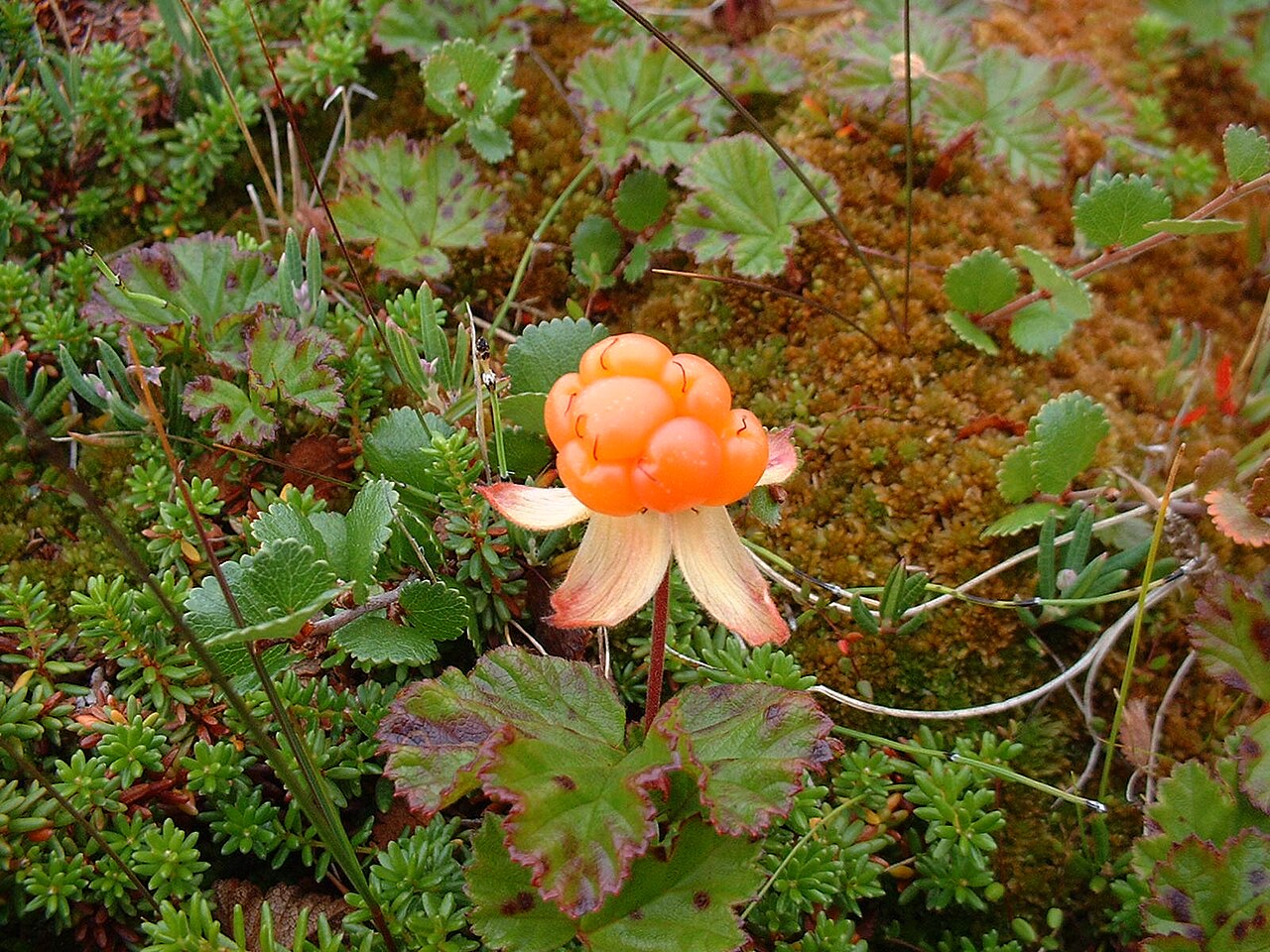
Cloudberry is dioecious, meaning individual plants are either male or female, so a colony needs both sexes present to set fruit. Each stem produces a single white, four-petaled flower about an inch across in late spring to early summer, held just above the leaves on a short stalk.
Fruit & Seeds
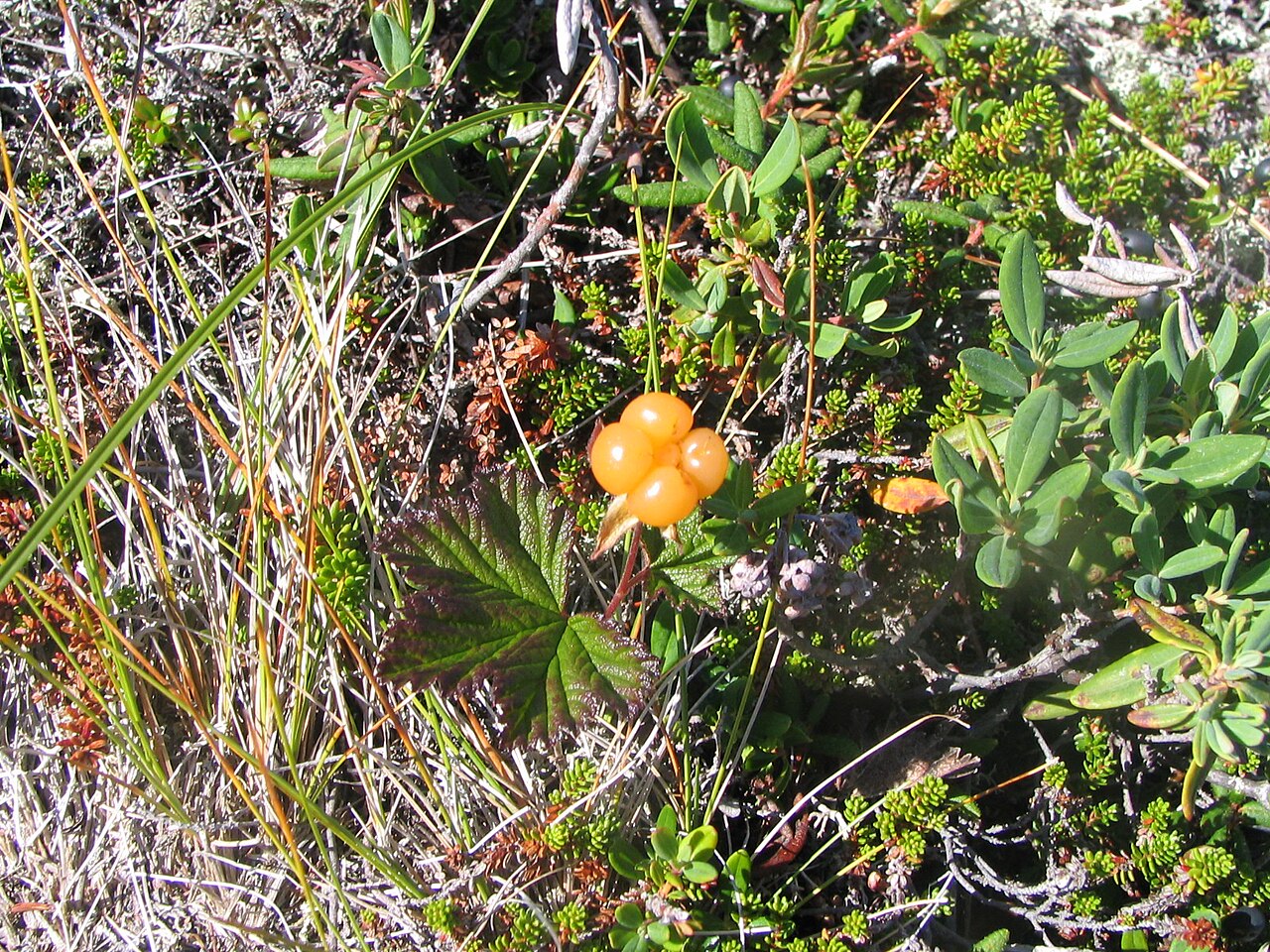
Female flowers develop into a compound drupelet fruit that looks like a raspberry but ripens from hard red to soft, translucent amber or golden-orange. The ripe berries are soft, juicy and tart-sweet, and because so few male plants may be nearby in a small colony, fruit set in isolated populations can be sparse even in a good year.
Quick Facts
| Scientific Name | Rubus chamaemorus |
| Family | Rosaceae (Rose) |
| Plant Type | Low, rhizomatous herbaceous perennial |
| Mature Height | 4–10 in |
| Mature Spread | Indefinite; spreads slowly by rhizome into loose colonies |
| Growth Rate | Slow |
| Sun Exposure | Full Sun to Part Shade |
| Water Needs | Consistently wet; needs saturated, boggy soil |
| Soil Type | Acidic peat or sphagnum bog soil |
| Soil pH | Strongly acidic (about 3.5–5.0) |
| Bloom Time | Late May – July, depending on latitude |
| Flower Color | White |
| Fall Color | Leaves often flush red to bronze before dying back |
| Fruit | Amber-orange compound drupelets, edible, ripening mid- to late summer |
| Deer Resistant | Yes |
| USDA Hardiness Zones | 1–6 |
Native Range
Cloudberry is a circumboreal species, common across the arctic and subarctic regions of North America, Europe and Asia. In the United States it is abundant across Alaska, where it grows in tundra and muskeg from the Aleutians to the North Slope. South of Alaska and Canada, it survives only as scattered glacial-relict colonies in a handful of cold bogs far from its main range.
In the Lower 48, confirmed native populations are known from peat bogs in Maine, New Hampshire, Vermont and the Adirondack region of New York, plus a single disjunct colony in extreme northeastern Minnesota near Lake Superior that was not discovered until 1954. These populations are small, isolated and considered rare to critically imperiled across their southern range, persisting in cold, nutrient-poor sphagnum bogs that mimic the conditions of the far north.
Because these outlying populations are so limited, several of the states where cloudberry occurs track or protect it as a rare plant. Visit these bogs to observe the plant, but leave it undisturbed; collecting from Lower 48 populations can damage already fragile colonies that took thousands of years to establish.
📋 Regional plant lists featuring Cloudberry: Alaska · New Hampshire, Maine & Vermont · Michigan, Wisconsin & Eastern Minnesota · New York, Pennsylvania & Northern New Jersey
Growing & Care Guide
Cloudberry is a true bog specialist, and that narrow requirement is exactly why it almost never succeeds in an ordinary garden bed. It needs conditions most gardens cannot easily provide: cold winters, cool summers, constant moisture and strongly acidic, low-nutrient soil.
Light
In the wild, cloudberry grows in open, sunny bogs with little tree cover, so full sun to light shade suits it best. Too much shade from surrounding shrubs or trees reduces flowering and fruit set.
Soil & Water
Cloudberry demands wet, acidic, peaty soil similar to a sphagnum bog, with the water table at or near the surface for most of the growing season. Ordinary garden soil, even when heavily amended, rarely replicates these conditions well enough for long-term success, which is why cloudberry is almost exclusively a plant for constructed bog gardens with a sealed, peat-filled basin kept consistently saturated.
Planting Tips
Because male and female plants are separate, a planting needs both sexes nearby to set fruit; a single plant or an all-female planting will flower but never produce berries. Source any planting stock only from reputable nurseries that propagate rather than wild-collect, since several of the native Lower 48 populations are rare and sensitive to disturbance.
Pruning & Maintenance
Little pruning is needed. Stems die back naturally each winter and regrow from the rhizome in spring; simply clear away the previous year’s dead growth if it looks untidy. Keep the bog bed free of taller, shading vegetation that can crowd out this low, light-loving plant.
Propagation
Cloudberry spreads on its own by rhizome once established, slowly widening a colony year over year. Where legally and ethically available, nursery divisions of rhizome sections are more reliable than seed, which can be slow and erratic to germinate.
Landscape Uses
- Specialty bog gardens built specifically to hold constant moisture and acidity
- Companion plantings with other true bog natives such as American cranberry, Labrador tea and purple pitcher plant
- Conservation plantings that restore or buffer existing peat bog habitat near known colonies
- Northern wildlife gardens in Alaska and similar cold climates, where it thrives with minimal care
Wildlife & Ecological Value
In bog habitat, cloudberry is a modest but genuine contributor to the food web, especially in the far north where competing food plants are scarce.
For Pollinators
The white flowers attract bees and other insects for pollination, which is essential since separate male and female plants both need visiting for fruit to set. Early-season bog flowers like cloudberry can be an important nectar source when little else is blooming.
For Birds
Ripe berries are eaten by grouse and other ground-feeding birds where cloudberry is abundant, particularly across its core Alaskan and Canadian range.
For Mammals
Black bears and other mammals forage on cloudberries in bogs and tundra, and in Alaska and the Canadian Arctic the fruit is also an important traditional food source gathered by people living close to the land.
Ecosystem Role
Cloudberry is an indicator of healthy, undisturbed peat bog habitat. Because it needs cold, saturated, acidic peat that takes centuries to form, its presence signals an intact bog ecosystem, and its rare southern colonies are considered important relicts of past cooler climates worth protecting in their own right.
Cultural & Historical Uses
Cloudberry has a long history as a prized wild food across the circumpolar north. Indigenous peoples of Alaska and arctic Canada have gathered the berries for generations, eating them fresh, mixed with fat or fish in traditional preparations, or preserved for winter. In Scandinavia, where the berry is deeply woven into culture and cuisine, cloudberries are made into jams, liqueurs and desserts and are prized enough to be harvested commercially.
In the Lower 48, the plant’s history is more a story of scientific discovery than harvest. Botanists have documented its disjunct bog populations in New England, New York and Minnesota as living evidence of the last glaciation, when arctic plants pushed much farther south and left these isolated colonies behind as the climate warmed and the main range retreated north. These southern outposts have long drawn botanists and conservationists rather than berry pickers.
Today, several of the Lower 48 states that host cloudberry track it as a rare or imperiled plant, and gathering from these wild colonies is discouraged or restricted to protect what are, in effect, living relics of the ice age.
Frequently Asked Questions
Can I eat cloudberries?
Yes, the ripe amber berries are edible and are a traditional food across Alaska, Canada and Scandinavia, prized for their distinctive tart, slightly musky flavor. Only eat berries you can confidently identify, and in the Lower 48, admire rather than pick wild colonies given how rare and sensitive they are.
Why is cloudberry so rare in the Lower 48 states?
It is an arctic and subarctic plant left behind as isolated relict colonies in a few cold, acidic peat bogs in New England, New York and Minnesota after the last ice age. Outside Alaska, it survives only where very specific cold-bog conditions persist, which makes it naturally rare and vulnerable south of Canada.
Why didn’t my cloudberry planting produce fruit?
Cloudberry plants are either male or female, and only female plants pollinated by a nearby male will set fruit. A single plant, or a planting of only one sex, will flower reliably but never produce berries.
Does cloudberry have thorns like other brambles?
No. Unlike raspberries and blackberries, cloudberry has no thorns or prickles at all, and its low, unbranched stems look more like a low wildflower than a typical bramble.
Can I grow cloudberry in a normal garden bed?
It is very difficult outside bog conditions. Cloudberry needs constantly saturated, strongly acidic peat soil and a cold climate, so success generally requires a dedicated, sealed bog garden rather than an ordinary flower bed.

Looking for a nursery that carries Cloudberry?
Browse our native plant nursery directory: Alaska · Maine & Minnesota · New Hampshire & New York · Vermont