Tall Meadow-rue (Thalictrum pubescens)
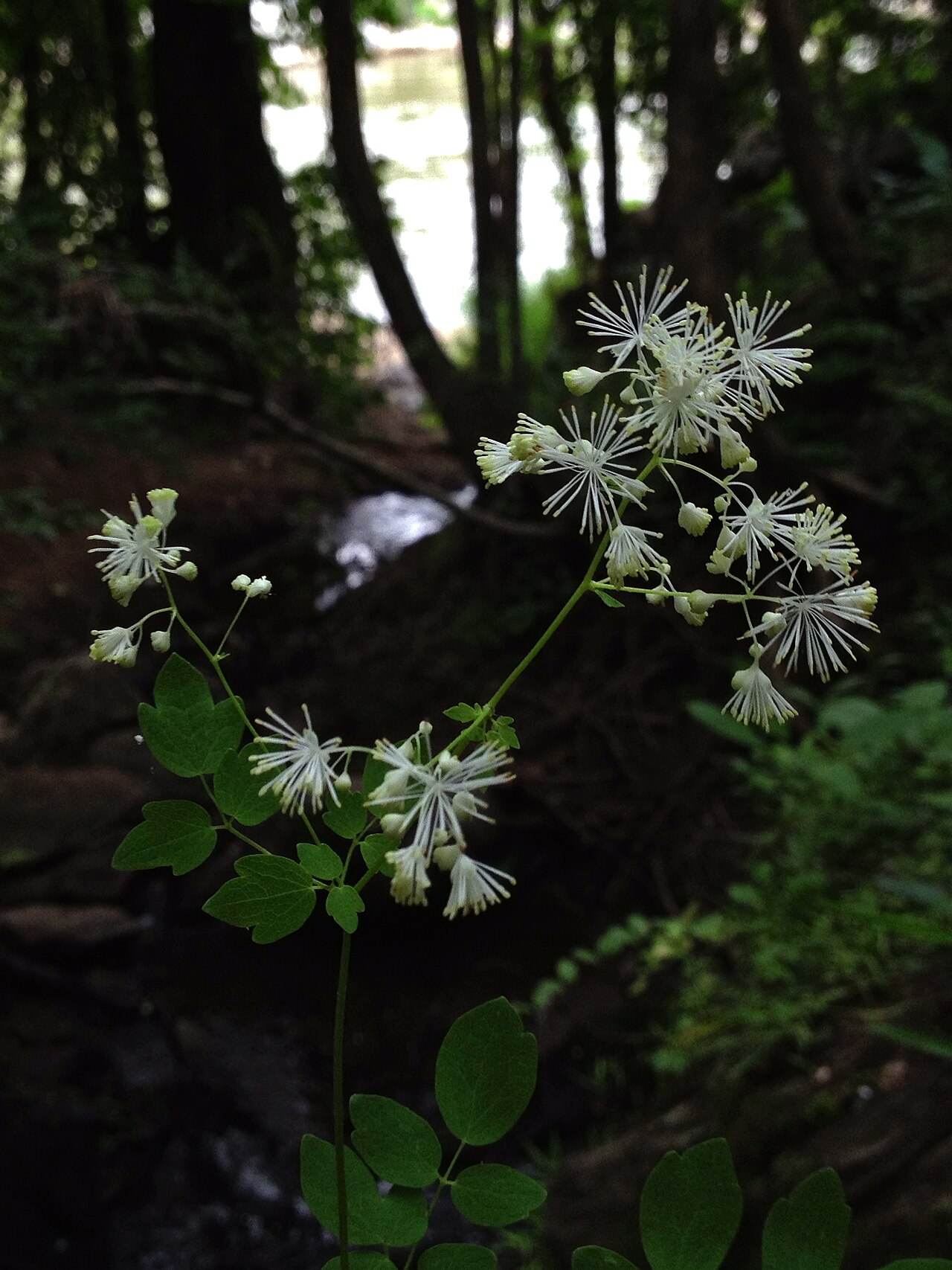
Thalictrum pubescens, commonly known as Tall Meadow-rue or King-of-the-Meadow, is a tall, airy herbaceous perennial native to wet meadows, streambanks, and forest openings across most of the eastern United States and eastern Canada. A member of the buttercup family (Ranunculaceae), it is instantly recognizable in bloom: dozens of small flowers with no true petals, each a pale burst of thread-like stamens, cluster into large branched panicles that seem to float above the foliage like a haze of white. The older botanical name Thalictrum polygamum still turns up in older field guides and some nursery catalogs, so gardeners may see it listed under either name.
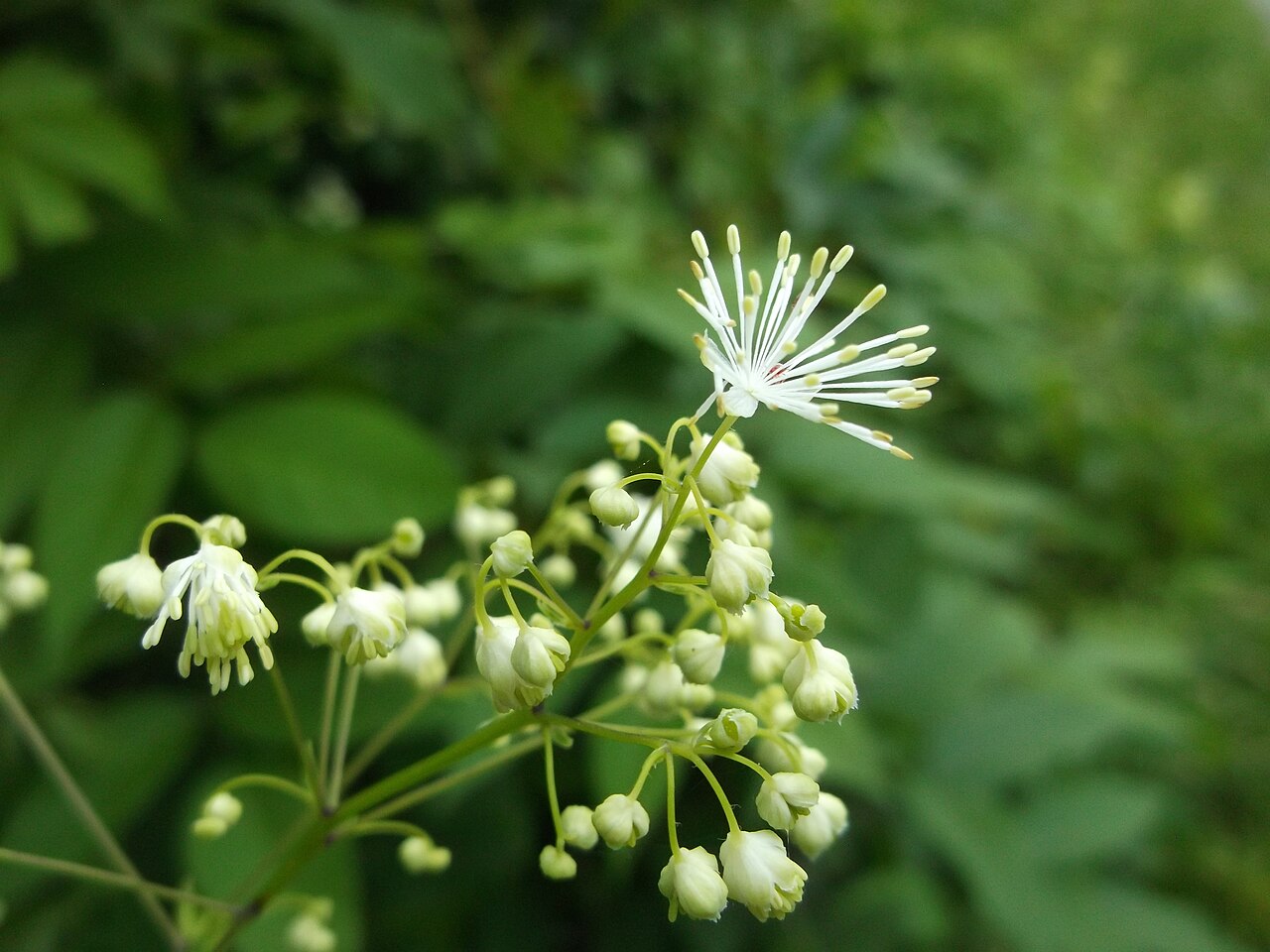
Unlike the showy, insect-pollinated flowers of most garden perennials, Tall Meadow-rue is ambophilous — its blooms can be pollinated by both wind and insects, a trait inherited from its relationship to wind-pollinated relatives. Plants are often functionally unisexual, with some individuals bearing mostly male flowers (fluffy with abundant stamens) and others mostly female or perfect flowers (more subdued, with small greenish pistils), so a colony in bloom can show noticeably different textures from plant to plant.
In the garden, Tall Meadow-rue fills a niche that few other native perennials can match: a see-through, vertical accent for the back of a moist border or the edge of a rain garden, where its fine-textured, columbine-like foliage and airy flower clouds add movement and light without blocking the view behind it. It is especially valuable for wet soils in part shade, where many flowering perennials struggle.
Identification
Tall Meadow-rue is an erect, clump-forming perennial, typically reaching 3 to 6 feet in height, with some vigorous plants in rich, moist soil climbing taller. The stems are smooth, hollow, and green, sometimes blushed with purple near the base, and branch openly in the upper third of the plant where the flower clusters are borne.
Leaves
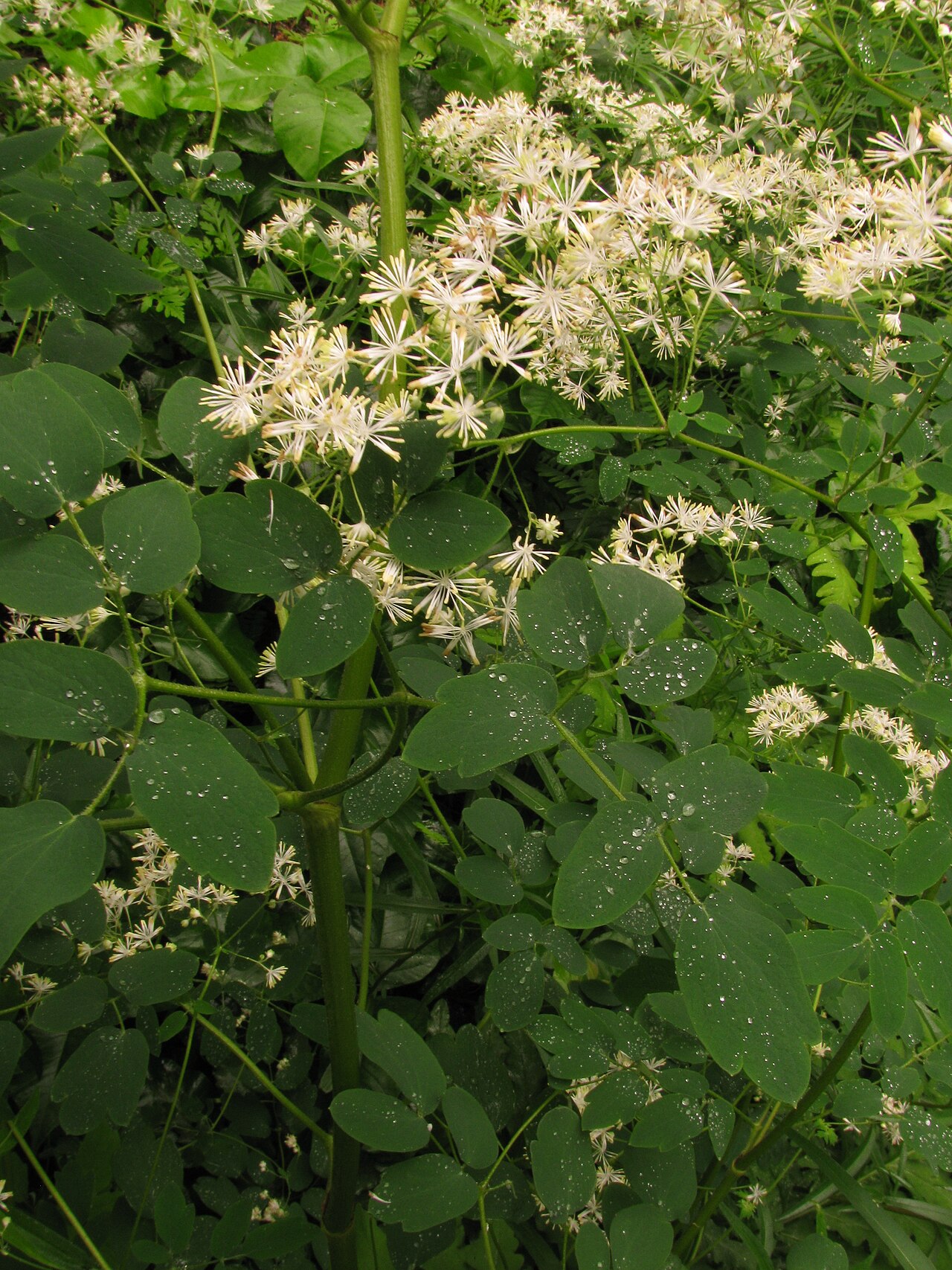
The foliage is two- to three-times pinnately compound, giving it a delicate, fern-like or columbine-like texture. Individual leaflets are rounded to lobed, usually divided into three shallow lobes, blue-green to medium green above and paler beneath. The compound leaves are alternate along the stem and become progressively smaller and simpler toward the flower clusters.
Flowers
Flowers appear in late spring to mid-summer in large, loosely branched terminal clusters (panicles). Each individual flower lacks true petals; what appears to be the “flower” is a tuft of thread-like stamens (on male flowers) or a smaller cluster of pistils (on female flowers), both in white to greenish-white. Male flowers are showier and more conspicuous from a distance, giving large colonies their characteristic white haze.
Fruit & Seeds
Female and perfect flowers develop into small, ribbed, beaked achenes clustered together, maturing from green to tan by late summer. The dry seed clusters persist into fall and add textural interest after the flowers fade, though they are far less ornamental than the bloom itself.
Quick Facts
| Scientific Name | Thalictrum pubescens (syn. Thalictrum polygamum) |
| Family | Ranunculaceae (Buttercup) |
| Plant Type | Herbaceous Perennial |
| Mature Height | 3–6 ft (rarely to 8 ft) |
| Mature Spread | 2–3 ft |
| Growth Rate | Moderate |
| Sun Exposure | Full Sun to Full Shade |
| Water Needs | Moderate to High; moist to wet soils |
| Soil Type | Moist to wet, humus-rich; loam or sandy loam |
| Soil pH | 5.5–7.0 (slightly acidic to neutral) |
| Bloom Time | June – August |
| Flower Color | White to greenish-white |
| Fall Color | Foliage yellows and dies back; not showy |
| Fruit | Small ribbed achenes in loose clusters |
| Deer Resistant | Yes (generally avoided by deer and rabbits) |
| USDA Hardiness Zones | 3–8 |
Native Range
Tall Meadow-rue is native to most of the eastern United States, from Maine and the Canadian Maritimes south through the Mid-Atlantic and Appalachians to Georgia, Alabama, and Mississippi, and west through the Ohio Valley to Illinois and Indiana. It is notably absent from Florida, and its presence in the western Great Lakes states is scattered and considered adventive rather than part of its core native range, so it is left off this site’s native-state list for those areas.
Across this range, Tall Meadow-rue favors consistently moist to wet ground: wet meadows, stream and pond margins, the edges of swamps and bottomland forests, and openings in moist woods. It tolerates a remarkably wide range of light, from full sun in open wet meadows to fairly deep shade beneath a forest canopy, though it flowers most heavily with at least a few hours of direct or filtered sun. It is more common in undisturbed wetlands and streamside forests than in heavily altered landscapes, and tends to disappear from areas after wetland drainage or forest clearing.
In Canada it occurs from the Maritime provinces west to Ontario and Quebec. Within the United States it reaches its southern limit in the Gulf Coast states, where it is restricted to moister inland sites away from the immediate coast.
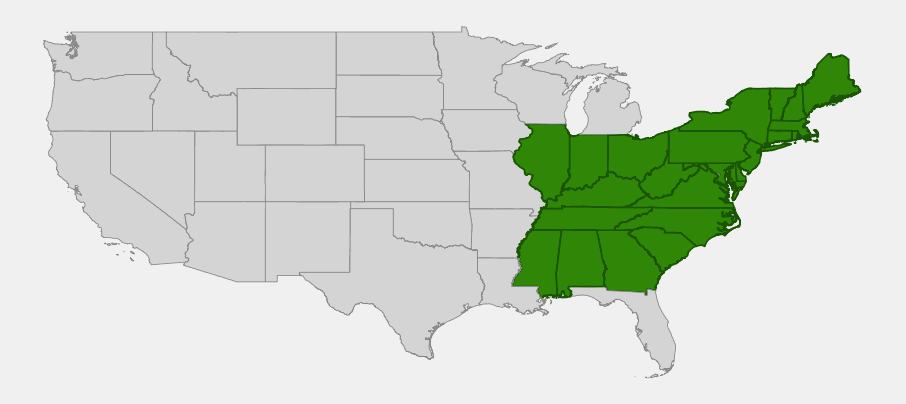
📋 Regional plant lists featuring Tall Meadow-rue: New Hampshire, Maine & Vermont · Connecticut, Massachusetts & Rhode Island · New York, Pennsylvania & Northern New Jersey · Delaware, Southern New Jersey & Long Island · Maryland, Virginia & West Virginia · North Carolina & South Carolina · Georgia, Alabama & Mississippi · Kentucky & Tennessee · Ohio & Indiana · Illinois, Iowa & Missouri
Growing & Care Guide
Tall Meadow-rue is easy to grow once it has the moisture it needs, and it rewards very little fussing with years of reliable, airy summer bloom.
Light
Give it full sun to part shade for the heaviest bloom, though it tolerates considerably more shade than most flowering perennials — even fairly deep shade beneath trees, as long as the soil stays consistently moist. In hotter, sunnier sites, afternoon shade helps prevent stress and keeps the foliage from scorching.
Soil & Water
This is a plant for the wet end of the garden: streambanks, rain garden basins, pond margins, and low spots that stay moist through summer. It does not tolerate prolonged drought well and will decline quickly in dry, well-drained soil. Humus-rich loam with reliable moisture gives the best results; established plants can handle brief standing water during storms.
Planting Tips
Plant in spring or fall, spacing clumps 2 to 3 feet apart to allow for the airy, spreading flower clusters. Because the plant is see-through in habit, it works well toward the back or middle of a border where its height and texture show without hiding shorter neighbors. Mulch to retain soil moisture, especially during the first growing season.
Pruning & Maintenance
Little maintenance is needed. Cut stems back to the ground in late fall or early spring once they have browned. Taller stems grown in rich soil or part shade can flop; staking or growing among sturdier neighbors (such as Joe-Pye Weed) helps keep the clumps upright. Divide congested clumps every few years in early spring if desired.
Propagation
Propagate by dividing clumps in early spring before growth resumes, or by sowing fresh seed in fall, as seed benefits from a period of cold stratification over winter. Division is the faster, more reliable method for most gardeners.
Landscape Uses
Tall Meadow-rue’s open, cloud-like form makes it a specialty plant for specific garden conditions:
- Rain gardens and bioswales where soils stay consistently moist
- Streambank and pond-edge plantings
- Woodland garden edges with dappled light and damp soil
- Back-of-border accent for its see-through height and texture
- Naturalized wet meadow or native plant gardens
- Pollinator gardens, paired with other wetland natives
Wildlife & Ecological Value
Tall Meadow-rue plays a modest but useful role in wetland and moist-meadow food webs, supporting a mix of pollinating insects and serving as a larval host for several moths.
For Pollinators
The flowers are ambophilous, pollinated by both wind and a variety of insects. Small bees, syrphid flies, and other pollen-feeding insects visit the pollen-rich male flowers, even though the blooms offer no nectar reward. The fine pollen is also wind-dispersed, which helps ensure seed set even when insect visitation is light.
For Birds
Songbirds of moist thickets and streamside habitat use the dense summer growth for cover, and some finches and sparrows take the small seeds in late summer and fall.
For Mammals
The foliage is seldom browsed by deer or rabbits, which makes it a dependable choice in gardens with heavy browse pressure. It does not appear to be a significant forage plant for larger mammals.
Ecosystem Role
As a characteristic plant of wet meadows and swamp-edge forest openings, Tall Meadow-rue helps indicate healthy wetland hydrology; its decline in an area often follows drainage or clearing. Its deep, fibrous root system helps stabilize moist soils along streambanks, and its flowers provide an early-summer pollen source in wetland habitats where fewer showy perennials are in bloom.
Cultural & Historical Uses
Several Indigenous peoples of eastern North America used related Thalictrum species, including Tall Meadow-rue, in traditional practice, though specific documented uses vary by nation and region and detailed ethnobotanical records for this particular species are limited compared with better-studied relatives.
Historically, Tall Meadow-rue was more often noted by botanists and naturalists for its striking appearance in wet meadows than for any commercial use. Its common name “King-of-the-Meadow” reflects the impression made by large colonies in full bloom, towering over surrounding wetland vegetation with clouds of white flowers.
In modern gardens, the plant’s primary value is ornamental and ecological rather than historical — it is increasingly used by native-plant gardeners and rain garden designers who need height and texture for consistently wet soils, a niche few other native perennials fill as gracefully.
Frequently Asked Questions
Is Tall Meadow-rue the same plant as Thalictrum dasycarpum?
No. Both are sometimes called “tall meadow rue,” but they are distinct species. Thalictrum dasycarpum is a separate, more western and central species found across the Great Plains and Midwest. Thalictrum pubescens, the plant on this page, is the eastern species native from New England and the Mid-Atlantic south to the Gulf states. Check the scientific name when buying plants or looking up native-plant lists, since the common names overlap.
Will Tall Meadow-rue grow in a regular garden bed?
Only if the soil stays consistently moist. This species struggles in average or dry garden soil and is best reserved for rain gardens, streambank plantings, or beds that receive supplemental water through summer.
Does Tall Meadow-rue need full sun to bloom?
No. It blooms well in full sun to part shade and will even flower, if more sparsely, in fairly shaded sites as long as the ground stays damp. Full sun with reliable moisture produces the heaviest bloom.
Is Tall Meadow-rue deer resistant?
Yes, it is generally left alone by deer and rabbits, making it a useful choice in gardens with heavy browsing pressure.
How do I keep Tall Meadow-rue from flopping over?
Tall stems grown in rich, shaded, or very moist conditions can lean or flop. Planting it among sturdier neighbors such as Joe-Pye Weed or ironweed provides natural support, or you can stake individual clumps in exposed sites.

Looking for a nursery that carries Tall Meadow-rue?
Browse our native plant nursery directory: Maine, Massachusetts, Maryland, Kentucky & Mississippi · New Hampshire, New York, New Jersey, Ohio & North Carolina · Vermont, Rhode Island, Pennsylvania, Virginia, Tennessee & South Carolina · Connecticut, Delaware & Georgia · West Virginia · Alabama · Indiana & Illinois