Indian Blanket (Gaillardia pulchella)
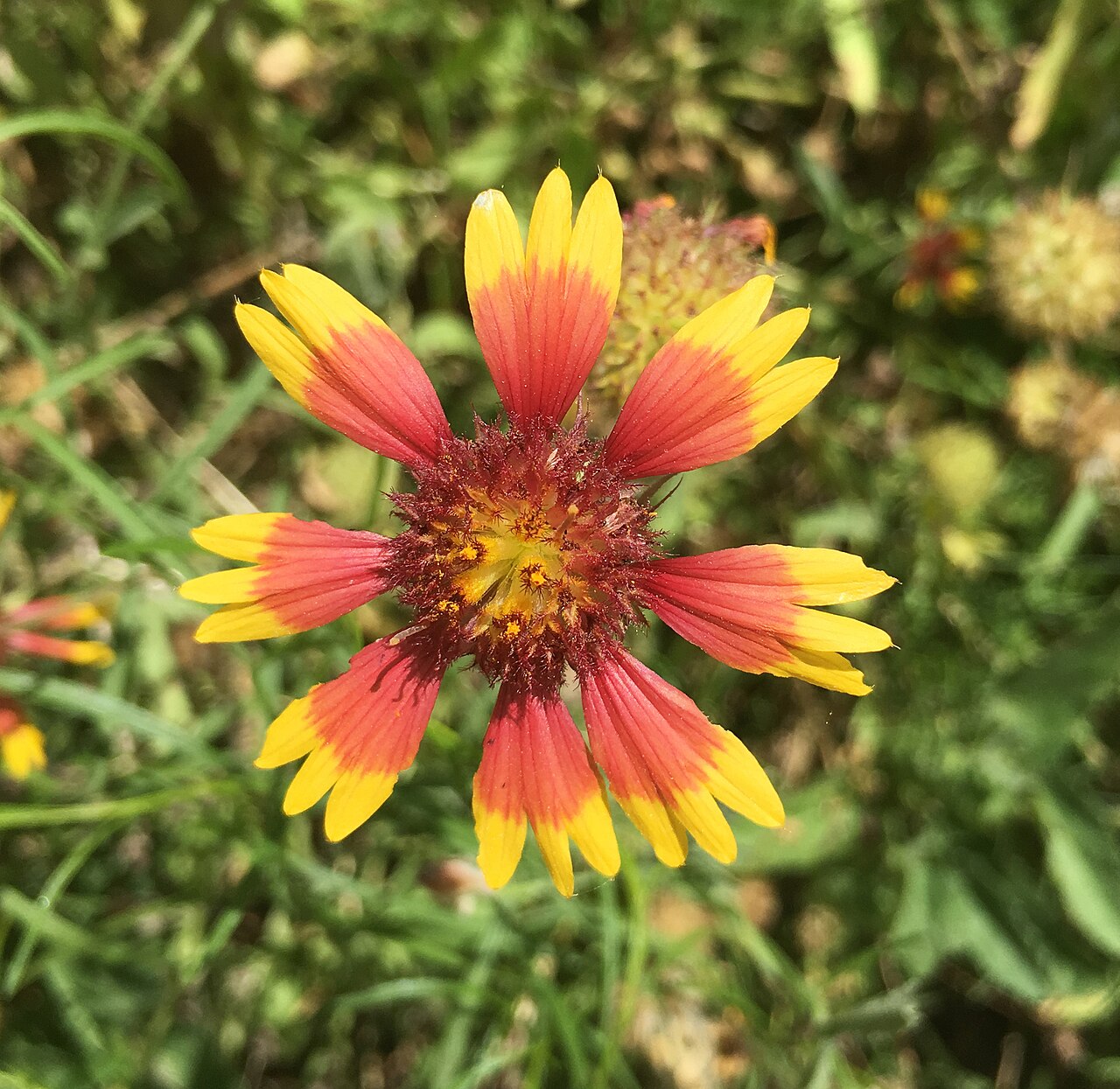
Gaillardia pulchella, commonly called Indian Blanket, Firewheel, or Sundance, is one of the most recognizable wildflowers of the southern Great Plains and Texas Hill Country. A member of the aster family (Asteraceae), it produces cheerful, pinwheel-shaped flowerheads banded in red and yellow that carpet roadsides and prairies from late spring into fall. The common name comes from the resemblance of a field of blooms to a woven blanket pattern used by Plains tribes, and the flower shares unofficial status with the Texas bluebonnet as a symbol of Texas wildflower season.
Indian Blanket is a low, bushy annual to short-lived perennial, typically 10 to 24 inches tall, with slightly hairy gray-green foliage and a long bloom season that makes it a workhorse in pollinator gardens. It reseeds readily and tolerates poor, dry, rocky soils that defeat most garden perennials, which is exactly the kind of site where it is native: open prairies, caliche flats, sandy plains, and disturbed roadside ground across the south-central United States.
Because it germinates and blooms so quickly from seed, Indian Blanket has become a staple of commercial wildflower seed mixes and is now found growing along roadsides and in gardens far outside its native range, including much of the eastern and northern United States. This page covers the plant’s true native range in the southern plains and Texas; where you see it blooming elsewhere, it is very likely a naturalized escape from seeding rather than a native population.
Identification
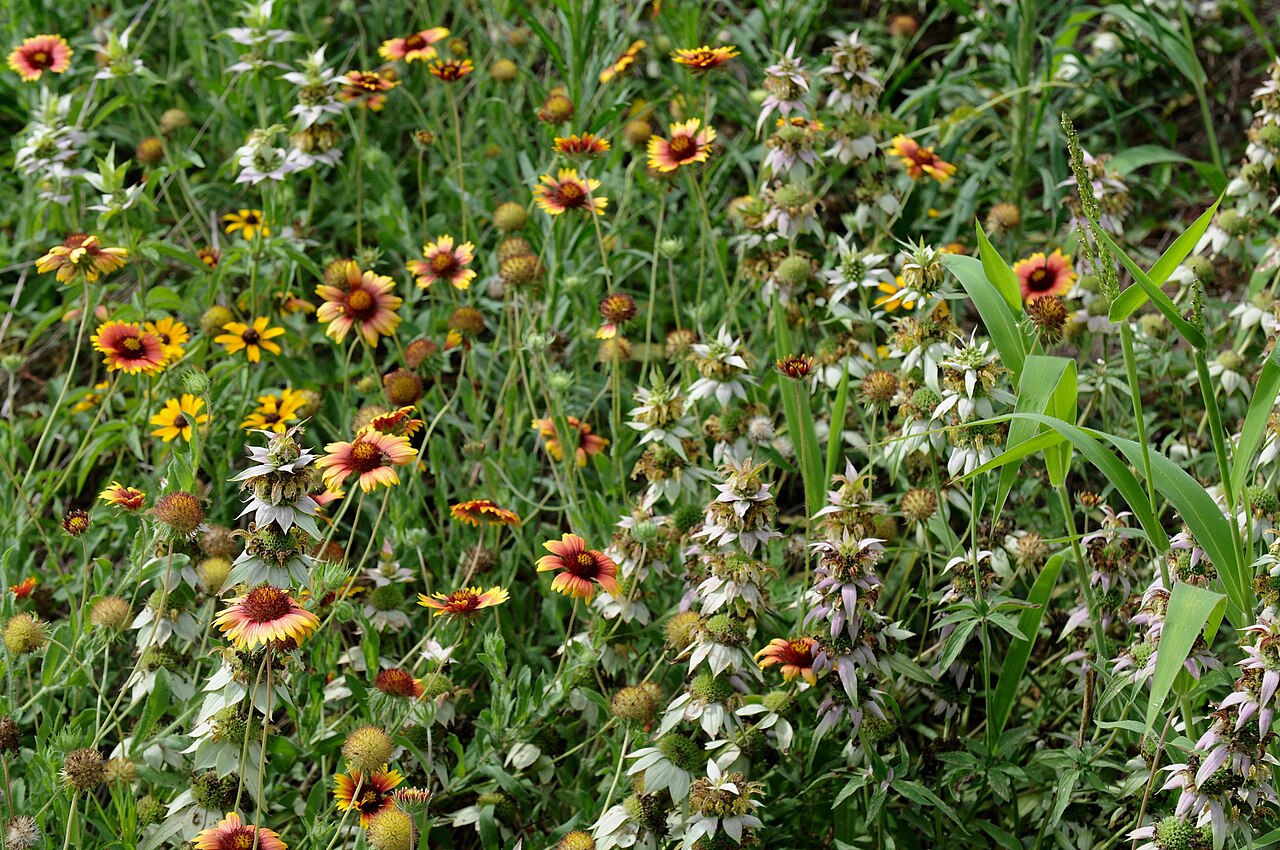
Indian Blanket is easiest to identify in bloom, when its daisy-like flowerheads stand out sharply against its low, spreading foliage.
Stems & Leaves
Plants form a basal rosette of leaves before sending up branching, slightly hairy flowering stems 10 to 24 inches tall. The leaves are alternate, gray-green, and covered in fine soft hairs, giving the whole plant a slightly fuzzy, grayish cast. Lower leaves are spoon-shaped (spatulate) and sometimes shallowly lobed; upper stem leaves are narrower and mostly untoothed. The overall growth habit is loose and mounding rather than upright and rigid.
Flowers
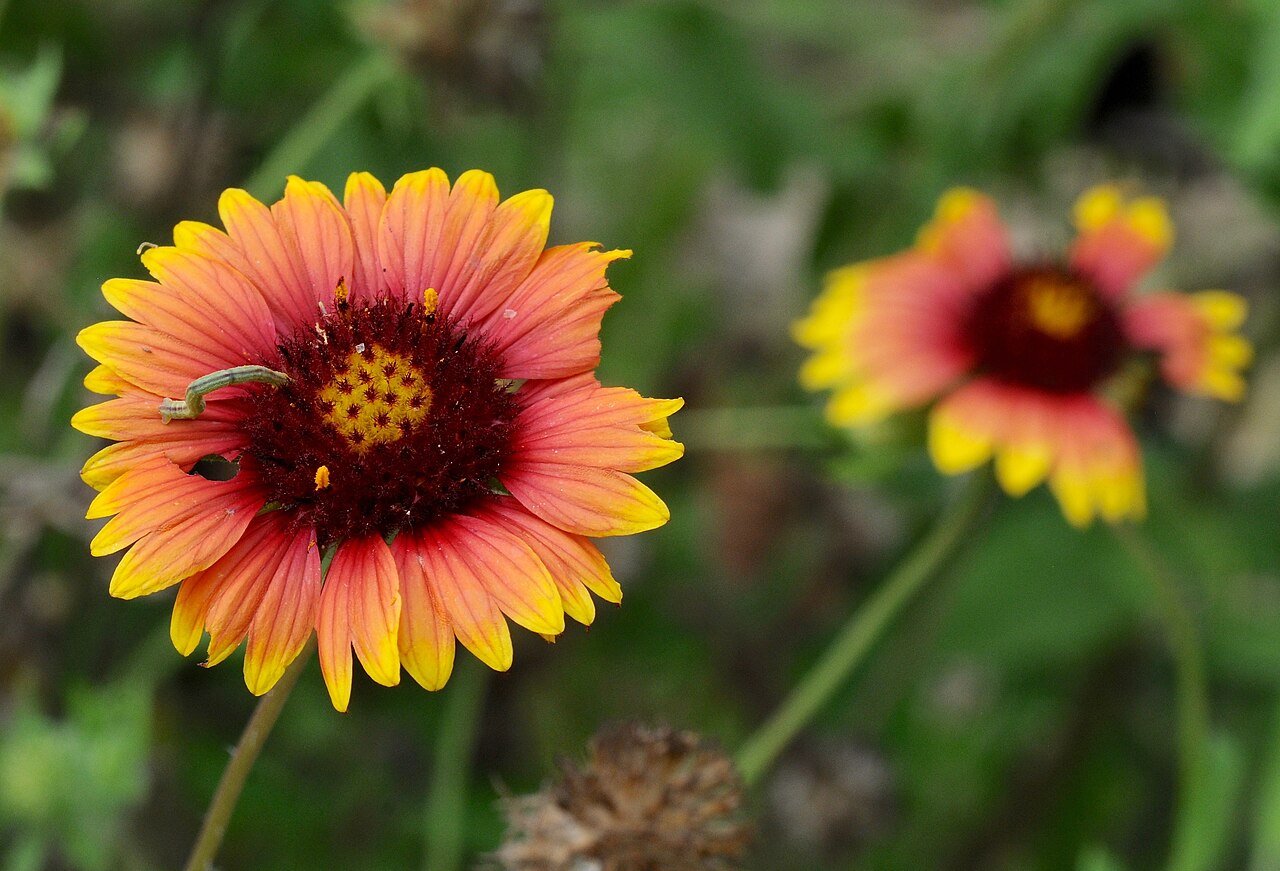
Each flowerhead is 1.5 to 2.5 inches across, with 8 to 16 ray florets that are typically yellow at the tips and deep red toward the base, giving the classic “firewheel” banded look, though some individuals are solid red, solid yellow, or nearly maroon. The ray florets are usually three-lobed at the tip. The center disk is a dome of small reddish-brown to purple-brown disk florets that darken with age. Flowers are borne singly atop long stalks held well above the foliage, opening over a very long season from April through frost in much of its range.
Fruit & Seeds
After blooming, each disk floret matures into a small, hairy, wedge-shaped achene topped with a ring of thin, papery scales instead of true pappus bristles. The seed heads turn tan and papery, and the dried husks persist on the plant into winter, which is why roadsides planted with Indian Blanket show a mix of flowers and brown seed heads through much of the season.
Quick Facts
| Scientific Name | Gaillardia pulchella |
| Family | Asteraceae (Aster) |
| Plant Type | Annual to short-lived perennial wildflower |
| Mature Height | 10–24 in |
| Mature Spread | 12–18 in |
| Growth Rate | Fast |
| Sun Exposure | Full Sun |
| Water Needs | Low |
| Soil Type | Sandy, caliche, or rocky; fast-draining |
| Soil pH | 6.5–8.0 (neutral to alkaline) |
| Bloom Time | April – October (year-round in milder winters) |
| Flower Color | Red and yellow banded, sometimes solid red or yellow |
| Fall Color | None notable |
| Fruit | Small hairy achenes in a papery seed head |
| Deer Resistant | Yes |
| USDA Hardiness Zones | 7–11 (often grown as a reseeding annual further north) |
Native Range
Indian Blanket’s core native range is the southern Great Plains and Texas: it grows wild across Texas, Oklahoma, New Mexico, southern Kansas, Arizona, and Louisiana, with scattered native populations extending into adjacent parts of the south-central United States and northeastern Mexico. It is most abundant in central, south, and west Texas, where it is a dominant spring and summer wildflower of prairies, roadsides, and open rangeland.
In its native range, Indian Blanket favors open, sunny ground with well-drained, often sandy or caliche soil: blackland and coastal prairies, limestone glades, dry washes, and disturbed roadside edges. It is a pioneer species that thrives on bare or recently disturbed soil and tends to decline as taller grasses and perennials fill in a site, which is why it is often most abundant for the first few years after a prairie restoration or along regularly mowed roadsides.
Because it germinates fast and blooms the first year from seed, Indian Blanket is a common component of highway wildflower seeding programs and commercial “wildflower mix” packets, and it has naturalized well beyond its native range along roadsides and disturbed ground in much of the eastern, midwestern, and northeastern United States. Those populations are adventive, not native; if you garden outside the states listed here, Indian Blanket is a fine pollinator plant but should be understood as a naturalized annual rather than a regional native.
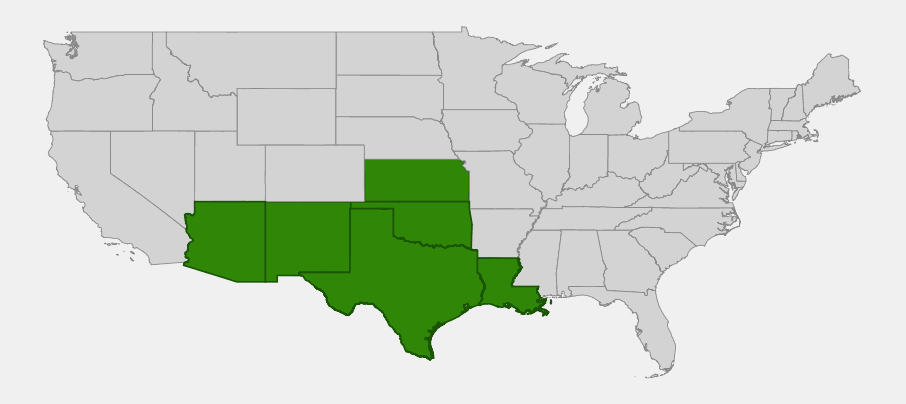
📋 Regional plant lists featuring Indian Blanket: South and West Texas · Arkansas, Louisiana, Eastern Oklahoma & Eastern Texas · Arizona & New Mexico · Nebraska, Kansas & Eastern Colorado
Growing & Care Guide
Indian Blanket is about as low-maintenance as native wildflowers get, as long as you resist the urge to baby it with rich soil and regular watering.
Light
Give Indian Blanket full sun. It needs at least 6 hours of direct sun daily to bloom well and holds up to the intense heat and sun of Texas and the southern plains without complaint. In partial shade it grows leggy and blooms sparsely.
Soil & Water
This is a plant for lean, fast-draining soil — sandy, rocky, or caliche ground is ideal, and rich, heavily amended garden soil actually shortens its life and encourages floppy growth. Once established, Indian Blanket is highly drought-tolerant and needs supplemental water only during extended dry spells or the first few weeks after planting. Soggy or poorly drained soil is the main thing that kills it, especially in winter.
Planting Tips
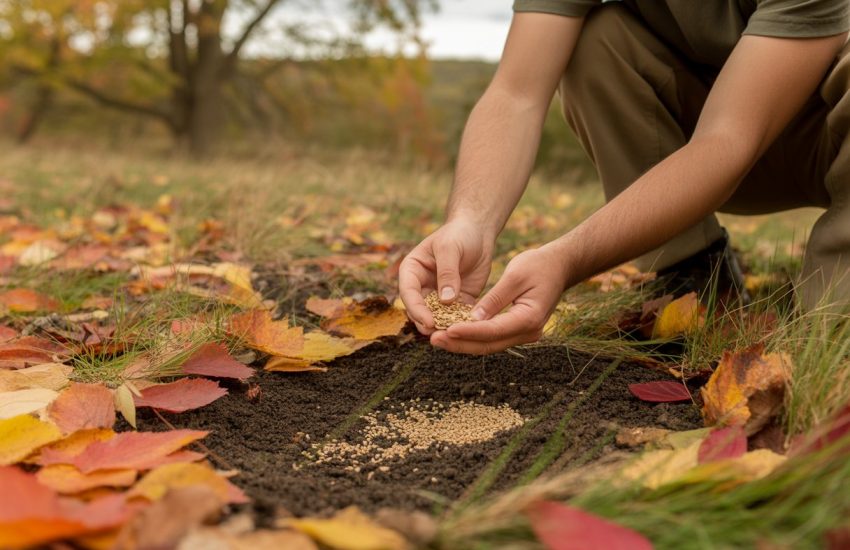
Direct-seed in fall or early spring; seed needs light to germinate, so press it onto the soil surface rather than burying it. Container plants can go in anytime during the growing season. Space plants 12 to 18 inches apart. Indian Blanket self-sows readily, so a planting that starts as a few plants typically fills in and spreads on its own within a couple of seasons — welcome in a meadow planting, less so in a tidy border.
Pruning & Maintenance
Deadhead spent flowerheads to extend bloom and reduce self-seeding if you want to keep the planting contained; leave some seed heads standing for finches and other seed-eating birds. Because individual plants are often short-lived (behaving as an annual or biennial in many gardens), count on natural reseeding rather than long-lived individual plants to keep a patch going year after year. Cut plants back hard in late winter to tidy them before new spring growth.
Landscape Uses
- Wildflower meadows and prairie restorations, especially on poor or disturbed soil
- Pollinator gardens — long bloom season feeds bees and butterflies all summer
- Roadside and highway plantings where low water and low maintenance matter
- Xeriscaping and rock gardens in hot, dry sites
- Cut flowers — long stems hold up well in arrangements
- Erosion control on sunny, sandy slopes
Wildlife & Ecological Value
Indian Blanket is a dependable nectar and seed source across a long bloom season, making it valuable well beyond its showy flowers.
For Pollinators
The flowers attract a wide range of native bees, honeybees, and butterflies, including skippers and fritillaries, which visit for nectar throughout the long bloom season. The flat, accessible flowerheads make nectar and pollen easy to reach for short-tongued insects as well as larger pollinators.
For Birds
Goldfinches and other seed-eating songbirds feed on the ripe achenes in the dry seed heads, especially in late summer and fall. Leaving some spent flowerheads standing rather than deadheading everything provides this food source.
For Mammals
Indian Blanket’s hairy, slightly bitter foliage is not a preferred browse for deer and rabbits, which is part of why it holds up so well on rangeland grazed by livestock and wildlife alike.
Ecosystem Role
As a fast-colonizing pioneer species, Indian Blanket plays an important early-succession role on bare and disturbed prairie soil, stabilizing ground and providing nectar while slower-growing perennial grasses and forbs establish. Its decline as a site fills in with perennial vegetation is a normal part of prairie succession rather than a sign of trouble.
Cultural & Historical Uses
Indian Blanket takes its common name from the resemblance of a field of the red-and-yellow banded flowers to woven trade blankets, and folklore among Plains communities associated the flower’s pattern with a weaver whose work was buried with her, the flowers springing up afterward as a memorial. The plant has long been recognized informally, alongside the bluebonnet, as an emblem of the Texas wildflower season, and it appears widely in Texas highway wildflower programs established in the twentieth century.
Some Indigenous groups within its native range used preparations of related Gaillardia species in traditional medicine, though specific, well-documented ethnobotanical uses for Gaillardia pulchella itself are limited compared to better-studied prairie plants. The species has been cultivated as a garden ornamental since at least the 1800s and has given rise to numerous horticultural selections and the hybrid blanket flower, Gaillardia × grandiflora, bred from G. pulchella and G. aristata.
Today Indian Blanket’s main cultural role is as a low-cost, high-impact component of roadside and highway wildflower seeding programs across the southern plains, prized for germinating and blooming the same season it is sown.
Frequently Asked Questions
Is Indian Blanket the same as blanket flower?
“Blanket flower” is often used loosely for the whole genus Gaillardia, including garden hybrids like Gaillardia × grandiflora. Indian Blanket specifically refers to Gaillardia pulchella, the wild annual to short-lived perennial native to Texas and the southern plains.
Is Indian Blanket an annual or a perennial?
Both occur in nature. Gaillardia pulchella behaves as an annual, biennial, or short-lived perennial depending on climate and site conditions; in gardens it is often treated as a reseeding annual because individual plants rarely persist more than two or three years.
Will Indian Blanket spread aggressively in my garden?
Within its native range it reseeds readily and can fill in a bed or meadow planting within a couple of seasons, but it is not rhizomatous or invasive — it spreads only by seed and is easy to control by deadheading or hand-pulling seedlings where they are not wanted.
Is Indian Blanket native to my state if I see it growing along the highway?
Not necessarily. Indian Blanket is a very common ingredient in commercial wildflower seed mixes used for highway beautification, so it now appears naturalized along roadsides well outside its native range in Texas, Oklahoma, New Mexico, Kansas, Louisiana, and Arizona. A roadside sighting elsewhere usually reflects seeding, not a native population.
Do I need to water Indian Blanket once it is established?
Established plants are drought-tolerant and generally need no supplemental water beyond normal rainfall in their native range, except during severe or prolonged drought. Overwatering and poorly drained soil are far more likely to harm this plant than underwatering.

Looking for a nursery that carries Indian Blanket?
Browse our native plant nursery directory: Texas · Oklahoma & New Mexico · Kansas · Louisiana · Arizona