Scrub Hickory (Carya floridana)
Carya floridana, commonly called Scrub Hickory, is a small, fire-adapted tree found nowhere in the world except the ancient interior sand ridges of peninsular Florida. It is a true Florida endemic, restricted almost entirely to the Lake Wales Ridge and a handful of other relict sand ridges — some of the oldest, driest, and most imperiled upland habitats in the eastern United States.
Scrub hickory typically grows 20 to 40 feet tall, often smaller and more shrub-like where frequent fire keeps it resprouting from a persistent underground rootstock rather than developing into a full-sized tree. It has notably smaller leaves and fewer leaflets than most other native hickories, an adaptation to the extreme drought and nutrient-poor white sand of the Florida scrub it calls home. Like other scrub-adapted plants, it is built to survive and quickly recover from the periodic wildfires that naturally sweep through this fire-dependent ecosystem.
Because Florida scrub habitat has been extensively lost to agriculture and development — the Lake Wales Ridge alone has lost the majority of its original scrub to citrus groves and housing — scrub hickory is considered a conservation priority species, even though it is not currently federally listed as threatened or endangered.
Identification
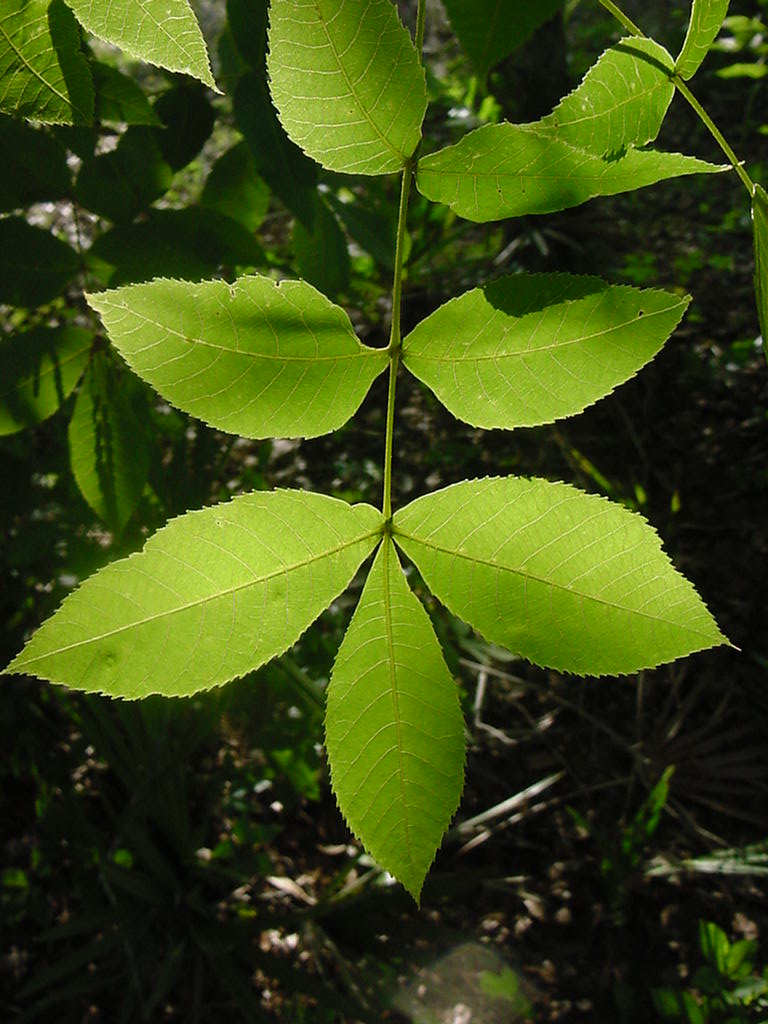
Scrub hickory is identified by its small, pinnately compound leaves typically bearing five leaflets, gray shaggy-to-platy bark, and a growth habit that ranges from a modest tree to a fire-pruned, multi-stemmed shrub depending on fire history.
Bark & Stems
Bark is gray and relatively smooth on young stems, developing a shallowly ridged, somewhat shaggy or platy texture with age, similar in character to other native hickories but generally less dramatically exfoliating than species like shagbark hickory.
Leaves
Leaves are alternate, pinnately compound, 4 to 8 inches long, usually with five (occasionally three to seven) lance-shaped to elliptical leaflets that are notably smaller than those of most other Florida hickories — a key field mark. New growth often shows fine silvery-gold scales on the leaflet undersides.
Flowers
Like other hickories, scrub hickory is monoecious, with inconspicuous male flowers borne in drooping catkins and small female flowers in short spikes at branch tips, both appearing in spring as new leaves emerge; the flowers are wind-pollinated and visually unremarkable.
Fruit & Seeds
The fruit is a small, rounded nut, roughly 1 inch across, enclosed in a thin, four-ridged husk that splits at maturity in fall. The nutmeats are edible, though smaller and more variable in flavor than those of well-known hickories such as shagbark or pecan.
Quick Facts
| Scientific Name | Carya floridana |
| Family | Juglandaceae (Walnut) |
| Plant Type | Deciduous tree or large shrub |
| Mature Height | 20–40 ft (often smaller where fire-pruned) |
| Mature Spread | 15–25 ft |
| Growth Rate | Slow |
| Sun Exposure | Full Sun |
| Water Needs | Low |
| Soil Type | Deep, excessively well-drained white sand |
| Soil pH | Acidic |
| Bloom Time | Spring |
| Flower Color | Green (inconspicuous, wind-pollinated) |
| Fall Color | Yellow |
| Fruit | Small edible nut in 4-ridged husk, ripens fall |
| Deer Resistant | Moderate |
| USDA Hardiness Zones | 8b – 10a |
Native Range
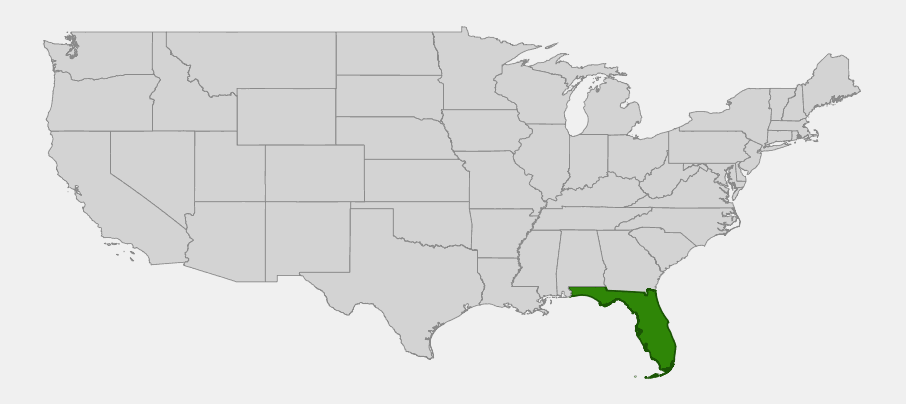
In the United States, scrub hickory is a Florida endemic, found nowhere else in the world. Its core range is the Lake Wales Ridge running through the center of the peninsula, with additional scattered populations on other ancient interior sand ridges of central Florida, roughly from Marion and Lake counties south through Polk and Highlands counties to the northern Everglades region.
Scrub hickory is restricted almost entirely to Florida scrub and sandhill habitat: the deep, excessively well-drained white sand ridges left behind by ancient, long-vanished shorelines, where it grows alongside sand pine, myrtle oak, Chapman oak, and other specialized scrub plants adapted to drought, nutrient-poor soil, and periodic fire. It is essentially absent from the moister, richer soils found elsewhere in Florida.
Because scrub hickory is a true endemic restricted to this single, naturally fragmented and now heavily developed habitat type, it does not occur naturally outside Florida, and much of its historic range has been lost to agriculture (particularly citrus) and residential development, making the remaining scrub preserves especially important for its long-term survival.
📋 Regional plant lists featuring Scrub Hickory: none yet — no plantnative.org regional list currently covers peninsular Florida scrub habitat; see our full native plant directory for other Florida-native species.
Growing & Care Guide
Scrub hickory is a specialized, slow-growing tree best suited to large, naturalistic landscapes in central Florida that can replicate its native deep-sand, well-drained, fire-adapted scrub habitat rather than a typical irrigated yard.
Light
Full sun is essential; scrub hickory is adapted to the open, sun-exposed conditions of Florida scrub and sandhill habitat and does not perform well in significant shade.
Soil & Water
This species requires deep, excessively well-drained, nutrient-poor sandy soil similar to its native scrub habitat and has very low water needs once established; it does not tolerate heavy, poorly drained, or regularly irrigated soils. Overwatering or planting in rich garden soil can shorten its life and encourage disease.
Planting Tips
Scrub hickory is best used in central Florida native landscapes, scrub restoration projects, or large sandy-soil properties rather than conventional residential yards, given its specific soil and sun requirements. It is slow-growing, so patience is needed, and it is rarely available in the conventional nursery trade, more often sourced through native plant nurseries specializing in Florida scrub species.
Pruning & Maintenance
Minimal pruning is needed; in its native habitat the plant is naturally shaped by periodic fire, which it survives by resprouting from an underground rootstock. In cultivation, little intervention is required beyond removing dead wood.
Landscape Uses
Scrub hickory is appropriate for:
- Florida scrub and sandhill restoration projects
- Xeriscaped native landscapes on sandy central Florida soils
- Wildlife habitat plantings for scrub-associated species
- Conservation plantings supporting a Florida-endemic species
Wildlife & Ecological Value
As one of the characteristic trees of Florida’s imperiled scrub ecosystem, scrub hickory supports a distinctive community of wildlife adapted to this ancient, fire-dependent habitat.
For Birds
Scrub hickory contributes to the sparse canopy structure used by scrub-associated birds, including the threatened Florida scrub-jay, which depends on open, low-statured scrub habitat of the kind this species helps characterize; the tree’s nuts also provide an occasional food source for seed-caching birds.
For Mammals
The nuts are eaten by scrub-dwelling mammals such as fox squirrels and other rodents, which in turn help disperse and bury seed, occasionally aiding natural regeneration.
For Pollinators
Like other hickories, scrub hickory is primarily wind-pollinated and does not rely heavily on insect pollinators, though the flowers can still provide incidental pollen for visiting insects in early spring.
Ecosystem Role
Scrub hickory is a fire-adapted member of one of North America’s most endangered upland ecosystems — Florida’s interior sand ridge scrub — and its ability to resprout from an underground rootstock after fire helps the species, and the broader scrub community it anchors, persist through the periodic burns the ecosystem depends on for long-term health.
Cultural & Historical Uses
Like other native hickories, scrub hickory’s nuts have historically been gathered and eaten by people, though the smaller, more variable nutmeats and thick husks made it a less significant food source than larger-nutted hickories and pecans elsewhere in the Southeast.
The wood, where it has been used at all, would share the generally hard, dense, heavy qualities typical of the hickory genus, though scrub hickory’s relatively small stature and limited, fragile habitat have meant it was never a significant commercial timber species; its primary importance today is ecological and conservation-related rather than economic.
Frequently Asked Questions
Is scrub hickory found anywhere outside Florida?
No. It is a true Florida endemic, found naturally nowhere else in the world, restricted to the Lake Wales Ridge and a few other relict central Florida sand ridges.
Why is scrub hickory considered a conservation priority?
Its native Florida scrub habitat, especially on the Lake Wales Ridge, has been extensively cleared for citrus agriculture and development, making this one of the most imperiled upland ecosystems in the eastern United States, even though the species is not currently federally listed.
Can scrub hickory survive fire?
Yes. Like many scrub plants, it is fire-adapted and typically resprouts from an underground rootstock after the periodic wildfires that naturally maintain Florida scrub habitat.
How is scrub hickory different from other native hickories?
It has notably smaller leaves with fewer leaflets (typically five, versus more on many other hickories) and a smaller, often shrubbier stature, reflecting its adaptation to extremely dry, nutrient-poor scrub sand rather than richer forest soils.
Are scrub hickory nuts edible?
Yes, like other hickory nuts they are technically edible, though smaller and more variable in flavor and husk thickness than well-known species such as shagbark hickory.

Looking for a nursery that carries Scrub Hickory?
Browse our native plant nursery directory: Florida
Scrub hickory grows alongside other central Florida scrub natives such as Sand Pine and Chapman Oak. To learn more about the ecological value of planting true natives like this Florida endemic, see our guide to the benefits of planting native trees.