
Chisos Oak (Quercus graciliformis)
Quercus graciliformis, known as the Chisos Oak or Slender Oak, is one of the rarest trees native to the United States. It exists nowhere in the wild except a handful of rocky, spring-fed canyons in the Chisos Mountains of Big Bend National Park, Brewster County, Texas — and botanists estimate fewer than 250 mature trees remain. This page describes the species honestly, as a conservation subject rather than a landscaping option: Chisos Oak is not available in the nursery trade in any meaningful way, every known wild tree grows on protected National Park Service land where collecting any plant material is a federal offense, and the species is assessed as Critically Endangered.
Chisos Oak belongs to the red oak group (section Lobatae) and is a slender, often multi-stemmed small tree, typically 25 to 30 feet tall with rare individuals reaching twice that in sheltered canyon sites. Its narrow, glossy, bristle-tipped leaves and arching, almost weeping branch habit give it a graceful, airy look quite different from the stouter oaks of the surrounding Chihuahuan Desert lowlands. It survives in its tiny range because the canyons it occupies hold a reliably high water table even through the area’s long dry seasons — a microhabitat advantage that very few other trees in the Big Bend region can exploit.
We include Chisos Oak on PlantNative not as a plant to seek out and grow, but because it belongs on any honest accounting of Texas’s native tree flora, and because understanding just how narrow its toehold on existence is may be the best argument for leaving it, and the fragile canyon springs it depends on, undisturbed.
Identification
Chisos Oak is best identified by the combination of its very restricted location — essentially nowhere else on Earth besides a few specific Chisos Mountains canyons — together with its narrow, lance-shaped leaves and slender, arching branches. Because it can resemble, and has historically been confused with, the more widespread Chisos Red Oak (Quercus gravesii) and Canby Oak (Quercus canbyi) of Mexico, confident field identification in this remote terrain is best left to botanists familiar with the local populations.
Bark & Stems
Bark is dark gray, hard, and furrowed, breaking into small irregular sections that give the trunk a rough, checkered texture. Branches are notably slender, arching, and somewhat pendulous, a distinctive silhouette among Chisos Mountains oaks. Young branchlets run straw-colored to deep reddish-brown before fading to gray in their second year, and are mostly hairless.
Leaves
Leaves are tardily deciduous (holding on later into winter than most oaks), thin but leathery, lance-shaped to elliptic, roughly 2 to 4 inches long and under 1½ inches wide. The upper surface is glossy dark green with a faint sheen; the underside is duller with a slightly coppery cast and small tufts of hair in the vein axils. Margins usually carry 8 to 10 shallow teeth or lobes, each tipped with a fine bristle — a hallmark of the red oak group.
Flowers
Like other oaks, Chisos Oak is wind-pollinated, with inconspicuous catkins appearing alongside new leaves in spring. The flowers have no ornamental value and are not a feature anyone is likely to seek out.
Fruit & Seeds
Acorns are ovoid to ellipsoid, roughly ⅓ to ¾ inch long, sitting in a shallow, saucer-shaped cup that covers a quarter to a third of the nut. As in other red oaks, acorns take two years to mature (fruiting in the second year after pollination), which slows reproduction and is one of several biological factors contributing to the species’ precarious conservation status.
Quick Facts
| Scientific Name | Quercus graciliformis |
| Family | Fagaceae (Beech) |
| Plant Type | Deciduous Tree (rare, wild-restricted) |
| Mature Height | 25–33 ft (rarely to 65 ft) |
| Growth Rate | Slow |
| Sun Exposure | Part Sun (canyon-shaded sites) |
| Water Needs | Moderate (tied to high water table) |
| Soil Type | Rocky canyon substrate over bedrock |
| Bloom Time | Spring (with leaf-out) |
| Flower Color | Green (not showy) |
| Fall Color | Bronze-brown, tardily deciduous |
| Fruit | Small acorns, biennial (2-year maturation) |
| Conservation Status | Critically Endangered; fewer than ~250 wild trees known |
| USDA Hardiness Zones | 7 |
Native Range
Chisos Oak has one of the smallest native ranges of any North American tree. It is known with certainty only from the Chisos Mountains of Brewster County in far west Texas, almost entirely within Big Bend National Park, where it grows principally in two documented populations — Blue Creek Canyon and the Ward Spring area. Both sites sit above roughly 5,400 feet elevation in narrow, rocky canyons that maintain an unusually high water table for this arid region, which appears to be the key to the species’ survival in an otherwise desert-dominated landscape.
Claims of the species occurring across the border in Coahuila or Nuevo León, Mexico, have not held up: specimens collected there have repeatedly proven to be other, related oak species on closer examination, including genetic analysis. Likewise, other reported Texas populations outside the Chisos Mountains have turned out, on verification, not to be true Chisos Oak. For practical purposes, this is a single-mountain-range endemic found in no other U.S. state and, as far as confirmed records show, nowhere else in the world.
Because the entire known wild population grows within a national park, Chisos Oak already benefits from strong legal protection: removing any plant, plant part, or seed from a U.S. National Park is prohibited under federal law, independent of the species’ endangered status. Anyone visiting Big Bend should observe this species only by looking, never by collecting.
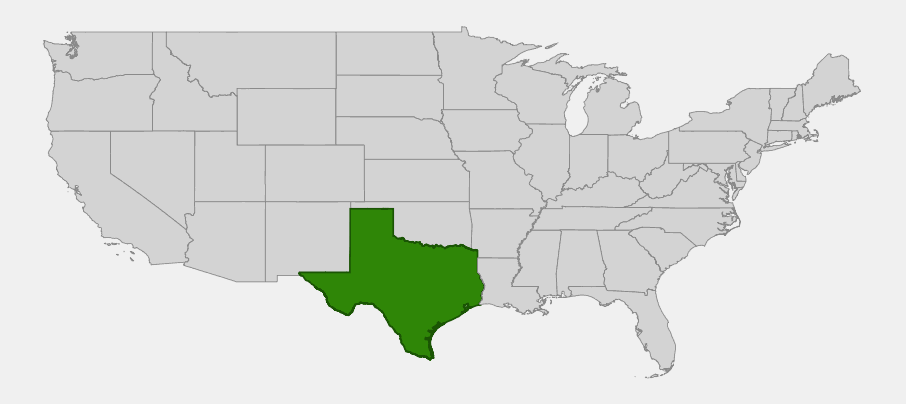
📋 Regional plant lists featuring Chisos Oak: South and West Texas (closest fitting regional list for its Trans-Pecos/Big Bend range; the species is not generally available for planting).
Growing & Care Guide
We are not providing standard planting, soil, and maintenance guidance for Chisos Oak, and deliberately so. The species is not established in cultivation, is not sold by nurseries in any regular way, and — given a wild population of likely under 250 trees confined to two canyons in a national park — propagating or distributing it outside carefully managed conservation programs could do more harm than good by creating demand for wild-collected material. Gardeners in the Big Bend region and across west Texas who want a similar graceful, narrow-leaved oak character should look to its close, far more common relatives — Gray Oak (Quercus grisea) or Chisos Red Oak (Quercus gravesii) — both of which are well suited to Trans-Pecos landscapes and widely available.
Conservation Context
Chisos Oak’s rarity comes from a combination of factors: an extremely narrow habitat requirement (canyon sites with a reliably high water table in an otherwise arid mountain range), a two-year acorn maturation cycle typical of red oaks that slows reproduction, and a total range confined to a few square miles. Climate-driven pressures on groundwater in the Chihuahuan Desert’s sky-island ranges are a recognized long-term threat to exactly the kind of spring-fed canyon habitat this species depends on.
How You Can Help
The most direct way to support this species is indirect: respect Big Bend National Park’s no-collection rules absolutely, stay on designated trails in Chisos Mountains canyons to avoid trampling seedlings or disturbing soil moisture, and support conservation organizations and botanical gardens engaged in ex-situ conservation collections of rare Texas oaks. If you are a land manager or botanical garden professional interested in conservation propagation, coordinate directly with Big Bend National Park and recognized rare-plant conservation programs rather than attempting independent collection.
Wildlife & Ecological Value
Despite its tiny population, Chisos Oak plays a meaningful role in the narrow canyon ecosystems it occupies, alongside the handful of other Chihuahuan Desert plants able to tolerate the same high-water-table canyon microhabitat.
For Birds & Mammals
Like other oaks, Chisos Oak produces acorns that provide mast for local wildlife, including small mammals and birds that forage in the Chisos Mountains’ canyon woodlands. Given the small number of trees, this contribution is necessarily modest in scale but locally meaningful within the specific canyons where the species grows.
Ecosystem Role
As one of relatively few trees able to persist on the reliable, if limited, groundwater of Blue Creek Canyon and Ward Spring, Chisos Oak is part of a distinctive community of Chihuahuan Desert “sky island” canyon specialists — including Texas Persimmon, Mexican Buckeye, Evergreen Sumac, and Desert Willow — that together create pockets of relatively lush vegetation standing out against the surrounding dry mountain slopes. The loss of even a handful of mature Chisos Oaks could meaningfully affect the structure of these already tiny plant communities.
Cultural & Historical Uses
Chisos Oak has no documented history of use by Indigenous peoples or settlers, almost certainly because its population has always been small and confined to remote, difficult-to-access canyon terrain in the Chisos Mountains, far from any historical population centers. It was formally described by the American botanist Cornelius Herman Muller in the twentieth century as part of broader work cataloging the oaks of the Trans-Pecos region, and most of what is documented about it comes from scientific collection and conservation survey work rather than any tradition of human use.
Today, the species’ significance is almost entirely as a conservation and scientific subject: a reminder of how narrow and fragile some native tree ranges can be, and a living record of the unusual canyon microclimates tucked into the Chisos Mountains within Big Bend National Park.
Frequently Asked Questions
Can I buy a Chisos Oak for my garden?
No reputable native-plant nursery offers Chisos Oak for sale, and it should not be sought out even from informal sources. With fewer than roughly 250 wild trees known, confined almost entirely to Big Bend National Park, there is no sustainable supply chain for this species, and any material claiming to be wild-collected Chisos Oak would represent an illegal removal from protected federal land.
Is Chisos Oak really found nowhere else in the world?
As far as confirmed, verified records show, yes. Reports of the species occurring in Coahuila or Nuevo León, Mexico, or elsewhere in Texas, have not held up to closer examination or genetic testing — those specimens have turned out to be other, related oak species.
Why is Chisos Oak so rare?
It depends on a very specific microhabitat: rocky canyons with a consistently high water table, found in only a couple of locations in the Chisos Mountains. Combined with the two-year acorn maturation typical of red oaks, which slows the pace of reproduction, the species has never had the opportunity to spread beyond this narrow footing.
What can I plant instead if I like the look of Chisos Oak?
Gray Oak (Quercus grisea) and Chisos Red Oak (Quercus gravesii) are both widespread, nursery-available oaks native to the Trans-Pecos region that offer a similar west Texas mountain character without any conservation concerns.
Is it illegal to collect acorns or leaves from Chisos Oak?
Yes, for all practical purposes. Because the species grows almost entirely within Big Bend National Park, removing any plant material — acorns, leaves, cuttings, or seedlings — is prohibited under National Park Service regulations, regardless of the species’ individual conservation status.

Looking for a nursery that carries Chisos Oak?
Chisos Oak is not available in the nursery trade. For similar west Texas native oaks, browse our Texas nursery directory.
For more on growing trees in Chisos Oak’s home region, see our guides to ornamental trees for every Texas region and Texas native plants for landscaping, or browse profiles of its canyon companions: Gray Oak, Texas Persimmon, Mexican Buckeye, Evergreen Sumac, and Desert Willow.

