Mountain Mint Near a Patio: Flower Visitors, Foot Traffic, and Planting Distance
Last updated: November 6, 2026
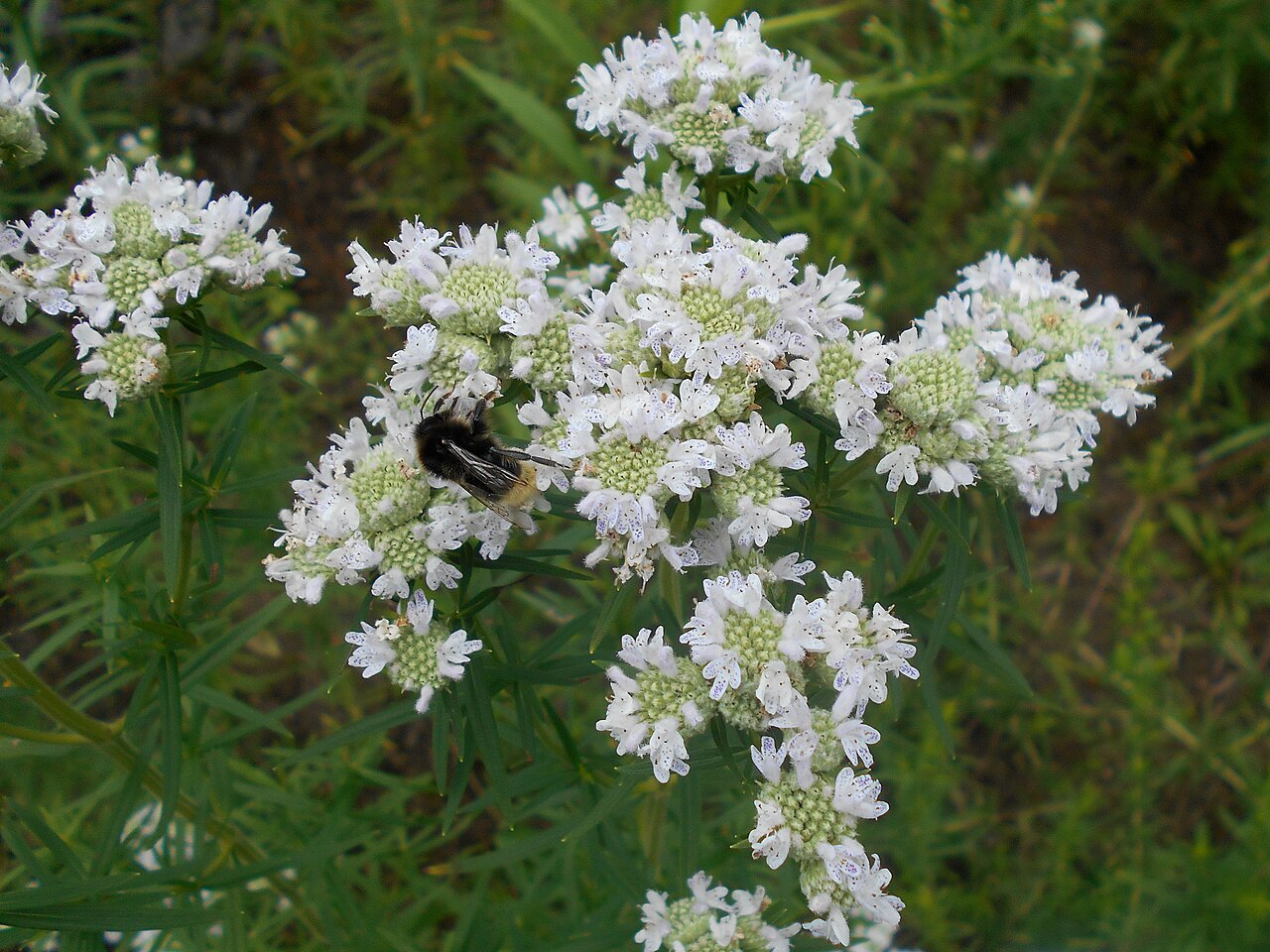
Common mountain mint is one of the busiest flowers in a summer garden. When it blooms, its flat white flower heads are covered with bees, wasps, flies and small butterflies.
That makes it a great plant to watch from a patio. It also raises fair questions: how close should it be to where people sit, eat and walk, and what happens when the clump spreads into the path?
This guide covers the practical side of planting mountain mint near outdoor living space: who visits the flowers, how to set a comfortable distance, how to handle foot traffic, and which companions keep the bed tidy.
Plan at a Glance
| Site | Bed beside a patio, deck, terrace or walkway, viewed from seating |
| Size | A bed at least 3 feet deep; 4 to 6 feet gives room for a buffer layer |
| Sun | Full sun to part shade |
| Soil | Average to moist; tolerates loam, sand, clay or gravel |
| Maintenance | Low to moderate: edge control every spring, spring cutback |
| Best regions | Eastern and central U.S. and southeastern Canada where common mountain mint is native |
Assess the Patio Edge
Start by mapping how people use the space. Note where chairs and tables sit, where people walk in and out, where children play, and where you serve food and drinks.
Then check the growing conditions along that edge. Common mountain mint prefers full or partial sun and moist to average soil, according to both Illinois Wildflowers and NC State Extension. It is not fussy about soil texture.
Paving often reflects heat and sheds rainwater onto the bed. A bed that gets runoff from the patio may stay moister than the rest of the yard, which suits mountain mint. One that dries hard every summer will produce a thinner, shorter plant; NC State notes that lower leaves yellow and drop during drought.
How Mountain Mint Grows
NC State lists common mountain mint at 2 to 3 feet tall and 1 to 1½ feet wide, with a dense, bushy habit. Illinois Wildflowers describes it as up to 3 feet, branching often.
It spreads. Illinois Wildflowers notes that rhizomes spread a short distance from the mother plant and soon form a small colony. NC State adds that it can be aggressive in ideal sites, but less so when the soil is kept dry.
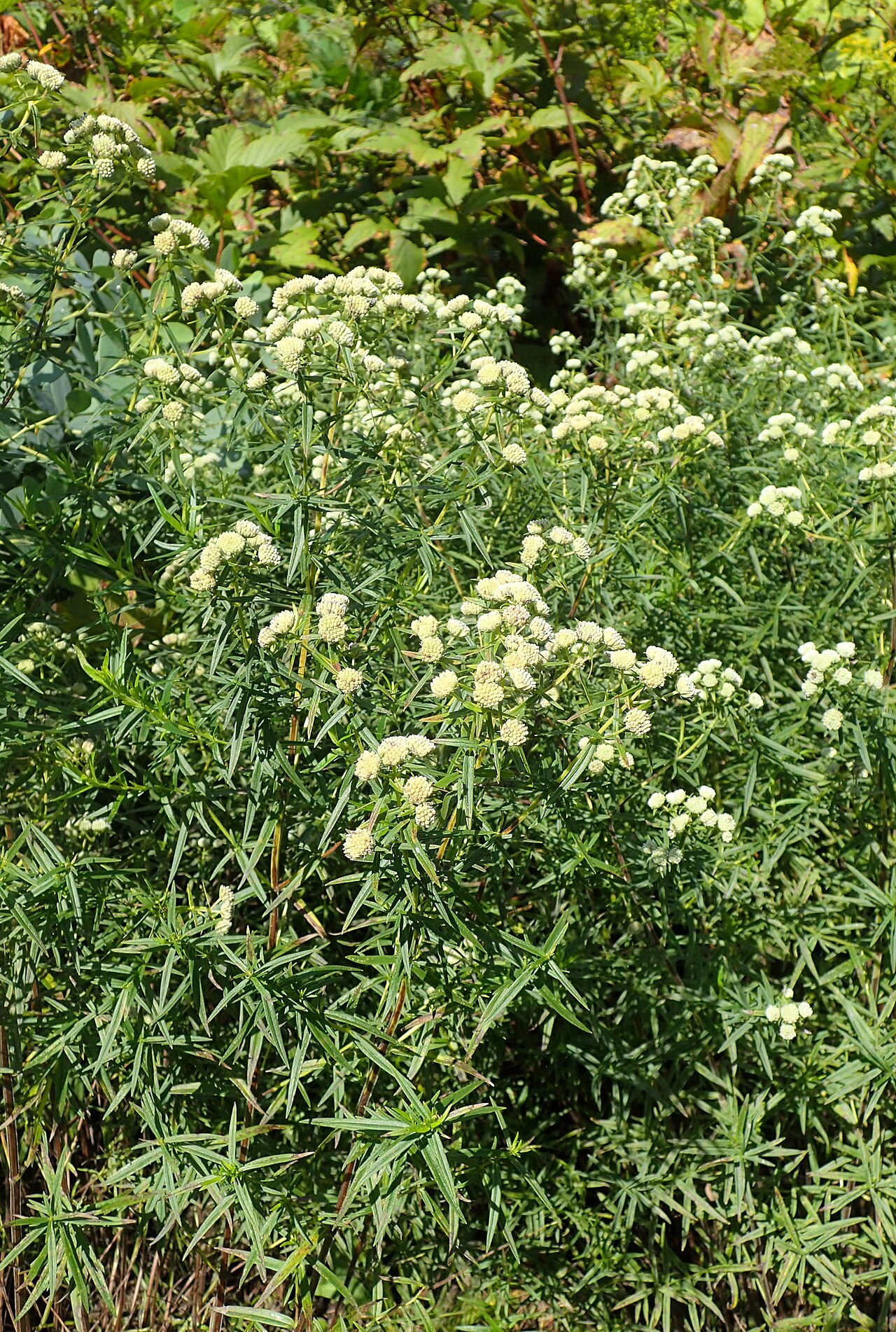
The narrow leaves release a strong mint scent when damaged or brushed. NC State notes that mammals and leaf-chewing insects seem to find the scent repellent and rarely bother the plant, which is a plus beside a patio where deer or rabbits wander.
Bloom comes in mid-summer. Illinois Wildflowers puts the season at about one month, with only a few flowers open in each head at once, starting at the outer edge and moving toward the center.
Who Visits the Flowers
Illinois Wildflowers lists honeybees, cuckoo bees, halictid (sweat) bees, sphecid and eumenine wasps, bee flies, tachinid flies, beetles and pearl crescent butterflies among the visitors, most of them seeking nectar.
Many of these are small and easy to overlook. The wasps are the ones people notice, and they are the reason some gardeners worry about putting mountain mint near a seating area.
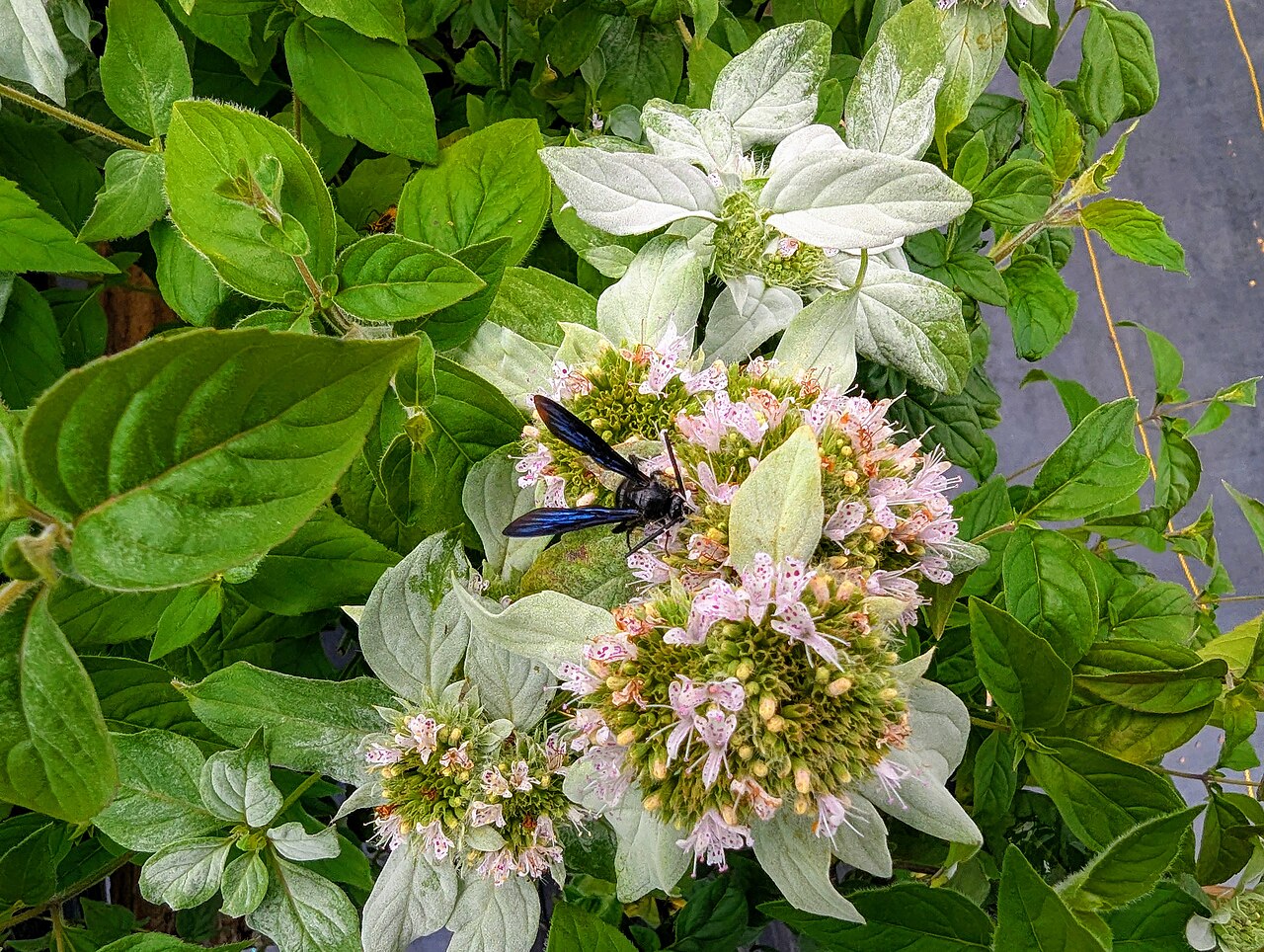
Here is what the University of California’s IPM program says about stinging insects. Most bees and wasps live solitary lives. Social species such as yellowjackets, honey bees and bumble bees defend their nests vigorously, and foraging members may sting if they are disturbed or injured. Yellowjackets are much more likely to attack than others.
In practice, that means insects working flowers are busy feeding, not guarding. Problems tend to start when someone swats at an insect, presses against the plant, or disturbs a nest.
Mountain mint does not create nests. But a flower bed packed with foraging insects is not where you want people brushing past with bare arms or setting down a drink.
If anyone in your household has a sting allergy, UC IPM advises seeing a physician or allergist and carrying prescribed emergency medication when around stinging insects. In that case, plant mountain mint where it can be seen from the patio, not right beside it.
Setting the Planting Distance
No research study sets a precise safe distance, so treat this as practical design guidance. The goal is to keep the flowers close enough to watch and far enough that nobody brushes through them.
- Keep the flowers out of the path. Set the outer edge of each clump at least 2 to 3 feet back from the edge of the paving where people walk. Remember that the clump will widen over time.
- Use a low buffer layer. Fill the strip between the paving and the mint with low plants or grasses that do not draw heavy insect traffic and can take occasional contact.
- Move it away from tables and doors. Place the mint opposite the dining table or beyond the edge of the seating area, not right behind chairs or beside the back door.
- Keep sight lines open. At 2 to 3 feet, mountain mint will not block views from a seated position if it sits a few feet away.
For a sting-allergic household, or an area where small children play, push mountain mint farther out into the yard and enjoy it from a distance. Both choices are reasonable.
Foot Traffic and Edges
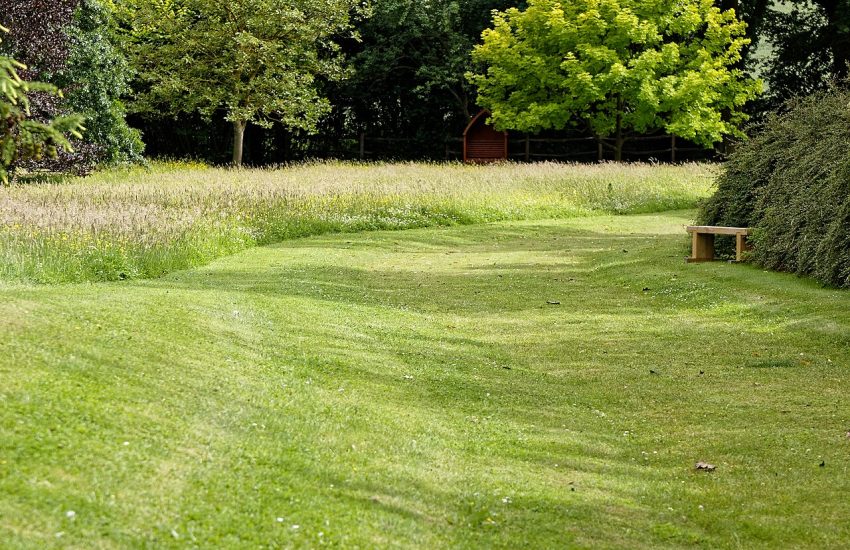
Mountain mint is a border plant, not a walkable groundcover. Stems that are stepped on or brushed every day will look battered by midsummer.
Because the rhizomes spread outward, the clump will eventually reach the paving if nothing stops it. That is the point where it starts getting stepped on and where insect traffic moves into people’s space.
Hold the line with an edge. A strip of paving, steel edging or a mown band of lawn between the bed and the patio makes it easy to spot and pull wandering shoots each spring.
The PlantNative profile suggests dividing clumps every three to four years if they spread too far. Lift the outer sections, keep a healthy piece in place, and share or replant the rest.
Layering the Patio Bed
Think in three bands, running from the paving outward.
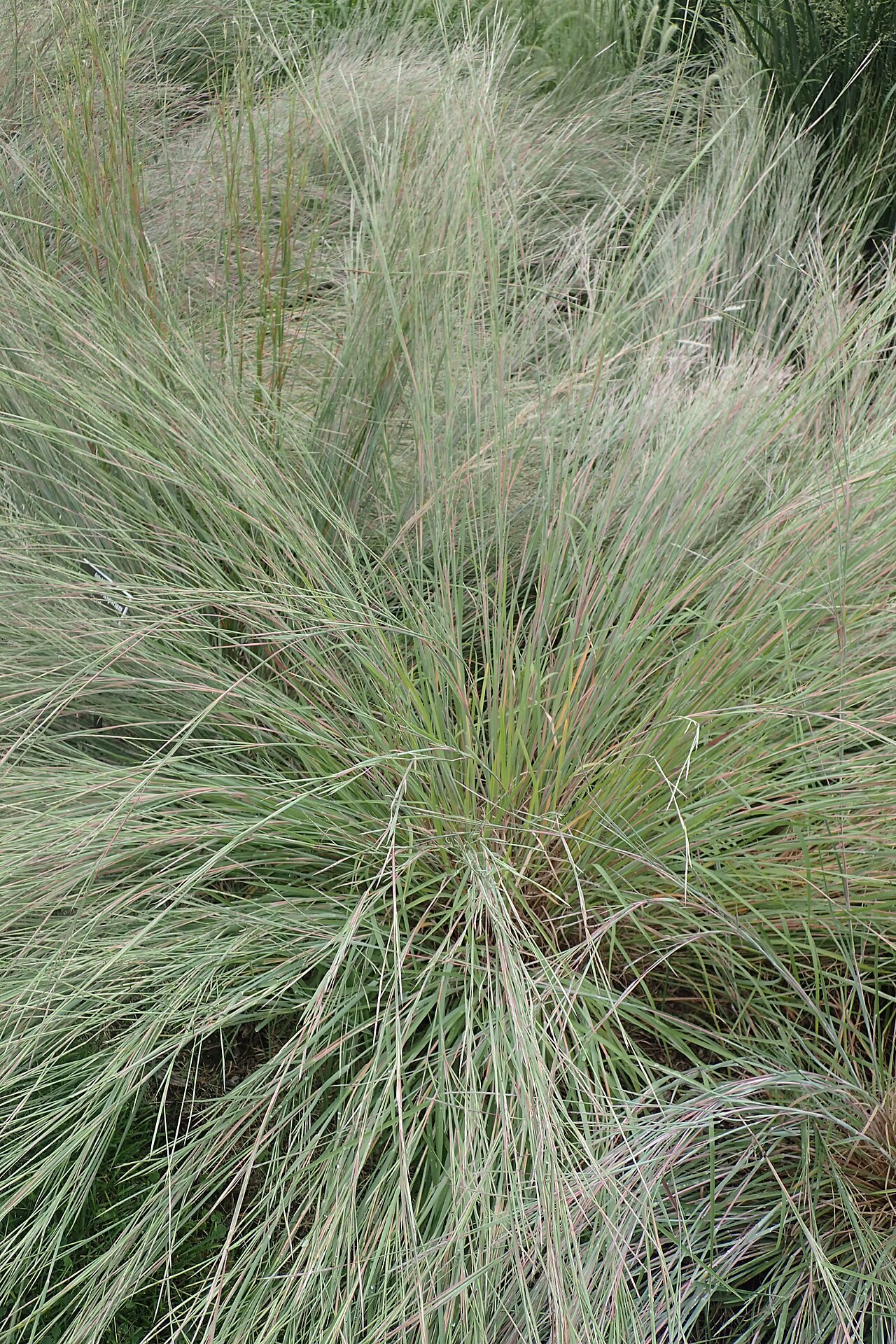
- Front band, next to paving: low plants and clump grasses that tolerate occasional contact. Little bluestem and field pussytoes work well here.
- Middle band: mountain mint in a group of three to five, with butterfly weed for orange contrast.
- Back band: taller plants such as purple coneflower and foxglove beardtongue for height and a longer bloom season.
The Wildflower Center describes little bluestem as a bunchgrass that forms dense mounds 18 to 24 inches tall, which makes it a tidy buffer; its flowering stems rise higher by September, so keep it to the front edge only where that extra height won’t block the view. If you plant it, see our guide to when to cut back little bluestem for spring timing. For a long, narrow strip along a walk, our blazing star and native grasses border plan uses the same bunchgrass approach.
Purple coneflower blooms with mountain mint and adds a bold flower shape. Leaving its seed heads in place feeds birds in fall; our guide to deadheading or keeping coneflower seed heads covers both approaches.
Plant Palette
Heights and ranges are from the Lady Bird Johnson Wildflower Center unless noted. Confirm each plant is native to your state.
| Plant | Role | Height | Sun / moisture | Native range |
|---|---|---|---|---|
| Common mountain mint (Pycnanthemum virginianum) | Pollinator magnet, middle band | 2–3 ft (NC State) | Sun to part shade / average to moist | ME to ND, south to GA and OK |
| Little bluestem (Schizachyrium scoparium) | Clumping buffer, front band | Foliage mounds 18–24 in; stems often to 5 ft by fall | Sun to part shade / dry | Que. to Alta., south through most of the U.S. east of the Rockies |
| Field pussytoes (Antennaria neglecta) | Low edge groundcover | Up to about 10 in | Sun / dry | Much of Canada; south to VA, TN, OK and CO |
| Butterfly weed (Asclepias tuberosa) | Orange contrast, middle band | 1–2 ft | Sun / dry | Ont. and New England south to FL, west to TX, CO and MN |
| Purple coneflower (Echinacea purpurea) | Summer bloom, back band | Up to about 4 ft | Sun to part shade / dry to average | GA to n.e. TX, north to NC, OH, IL and IA |
| Foxglove beardtongue (Penstemon digitalis) | Early-summer bloom, back band | Up to about 5 ft | Sun to part shade / dry to wet | ME to MI and SD, south to VA, AL and e. TX |
Regional Alternates
Common mountain mint’s range covers much of the East and Midwest. Other mountain mints may suit your area better.
- Mid-Atlantic and Southeast: silverleaf mountain mint ranges from New Hampshire and New York south to Georgia and Mississippi. It grows much taller, up to about 6 feet, so place it farther back from the patio.
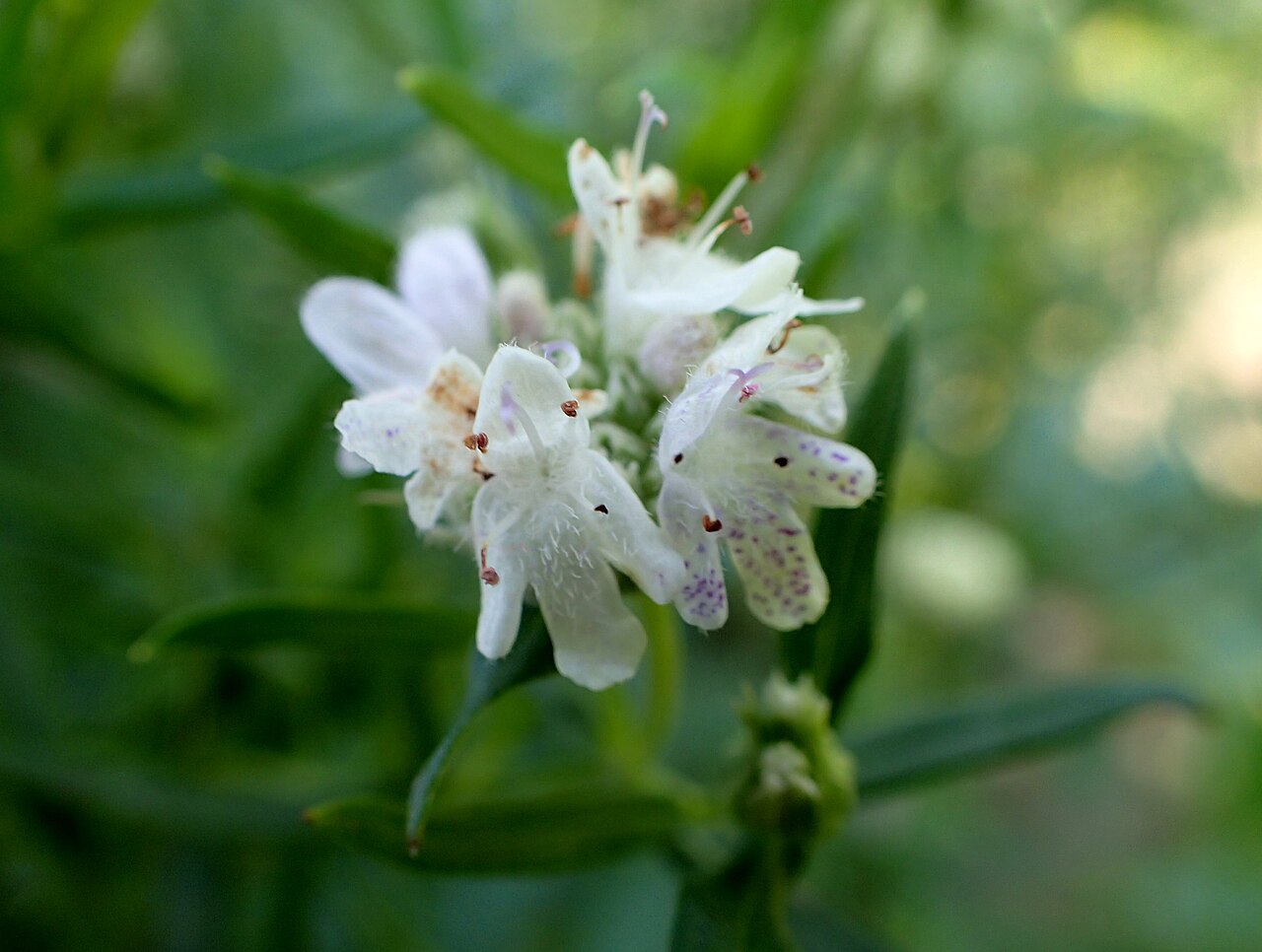
- Southern and drier sites: slender mountain mint (Pycnanthemum tenuifolium) ranges from Maine to Georgia and west to eastern Texas, and the Wildflower Center notes it usually stays around 2 feet.
- Northern Plains: where mountain mints are scarce, anise hyssop (northern Colorado to Wisconsin and adjacent Canada) gives a similar aromatic, pollinator-rich effect.
Sample Layout: 4 × 10 Foot Bed Along a Patio
| Front band (first 2 ft) | 5 little bluestem, 7 field pussytoes between them |
| Middle band | 3–5 common mountain mint in one group, 18–24 in apart; 3 butterfly weed |
| Back band | 3 purple coneflower, 3 foxglove beardtongue |
| Edge | Steel edging or a 12-inch mown strip between bed and paving |
The 18- to 24-inch spacing for mountain mint follows the PlantNative profile and fits NC State’s listed width. The clump will fill gaps between plants within a couple of seasons.
Installation Steps
Step 1: Install the edge first. Set edging or mark the mown strip before planting. It defines where the bed stops and where people can walk.
Step 2: Prepare the soil. Remove turf and weeds. Mountain mint does not need rich soil, so skip heavy amendments unless the soil is compacted fill.
Step 3: Plant in bands. Set the front band first, then the mountain mint group, then the back plants. Check distances from the paving with a tape measure.
Step 4: Water through the first season. Water new plants during dry spells until they root in. Once established, mountain mint handles average conditions.
The First Three Years
- Year one: water during dry weather and weed regularly. Expect a modest first bloom.
- Year two: the clump fills out. In early spring, cut old stems down and pull any shoots that cross the edge.
- Year three: check the distance from the paving. If the clump has crept within 2 feet of the walking edge, divide it and pull back the outer section.
- Every summer: watch the visitors. If wasps or bees are often reaching seating areas, move the clump farther out next spring.
Mistakes to Avoid
- Planting right against the paving. The clump spreads, and flowers end up where people walk and sit.
- Skipping the edge. Without a clear boundary, rhizomes creep into the patio joints and lawn.
- Using it as a groundcover. It is a 2- to 3-foot border plant, not something to walk on.
- Ignoring allergies. If someone is allergic to stings, place the mint well away from seating.
- Spraying insecticides on the bed. The point of this plant is its visitors; spraying works against it.
📋 More on this plant: read the full Mountain Mint (Pycnanthemum virginianum) profile, or see it in our native plant list for Connecticut, Massachusetts & Rhode Island.
Frequently Asked Questions
Does mountain mint attract wasps?
Yes. Illinois Wildflowers lists several kinds of wasps among its many flower visitors, along with bees, flies, beetles and small butterflies. Most are there for nectar.
Is it safe to plant mountain mint near a patio?
For most households, yes, with some distance. Keep the flowers out of walking paths and away from tables. If someone has a sting allergy, plant it farther away and follow their physician’s advice.
How far does mountain mint spread?
Its rhizomes spread a short distance and form a small colony, per Illinois Wildflowers. NC State notes it can be aggressive in ideal sites and less so in drier soil. An edge and occasional division keep it in place.
Does mountain mint keep mosquitoes away?
There is no good evidence that planting it repels mosquitoes from a patio. Grow it for its flowers and pollinators, not as pest control.
Can I walk on mountain mint?
Not regularly. It is an upright 2- to 3-foot perennial, and stems that are stepped on or brushed every day will look battered.
Sources
- Illinois Wildflowers, Common Mountain Mint: height, rhizomes and colony formation, bloom length, cultivation, and flower-visiting insects.
- NC State Extension Gardener Plant Toolbox, Pycnanthemum virginianum: height and width, sun and soil, drought response, aggressiveness in ideal sites, insect attraction and mammal avoidance.
- University of California IPM, Bee and Wasp Stings: solitary vs. social species, nest defense, foraging behavior and guidance for allergic people.
- Lady Bird Johnson Wildflower Center, Pycnanthemum virginianum: distribution and habitat. Companion and alternate data from Wildflower Center pages for little bluestem, field pussytoes, butterfly weed, purple coneflower, foxglove beardtongue, silverleaf mountain mint, slender mountain mint and anise hyssop.