Build a Pollinator Border With Overlapping Bloom Times, Not Just More Species
Last updated: November 7, 2026
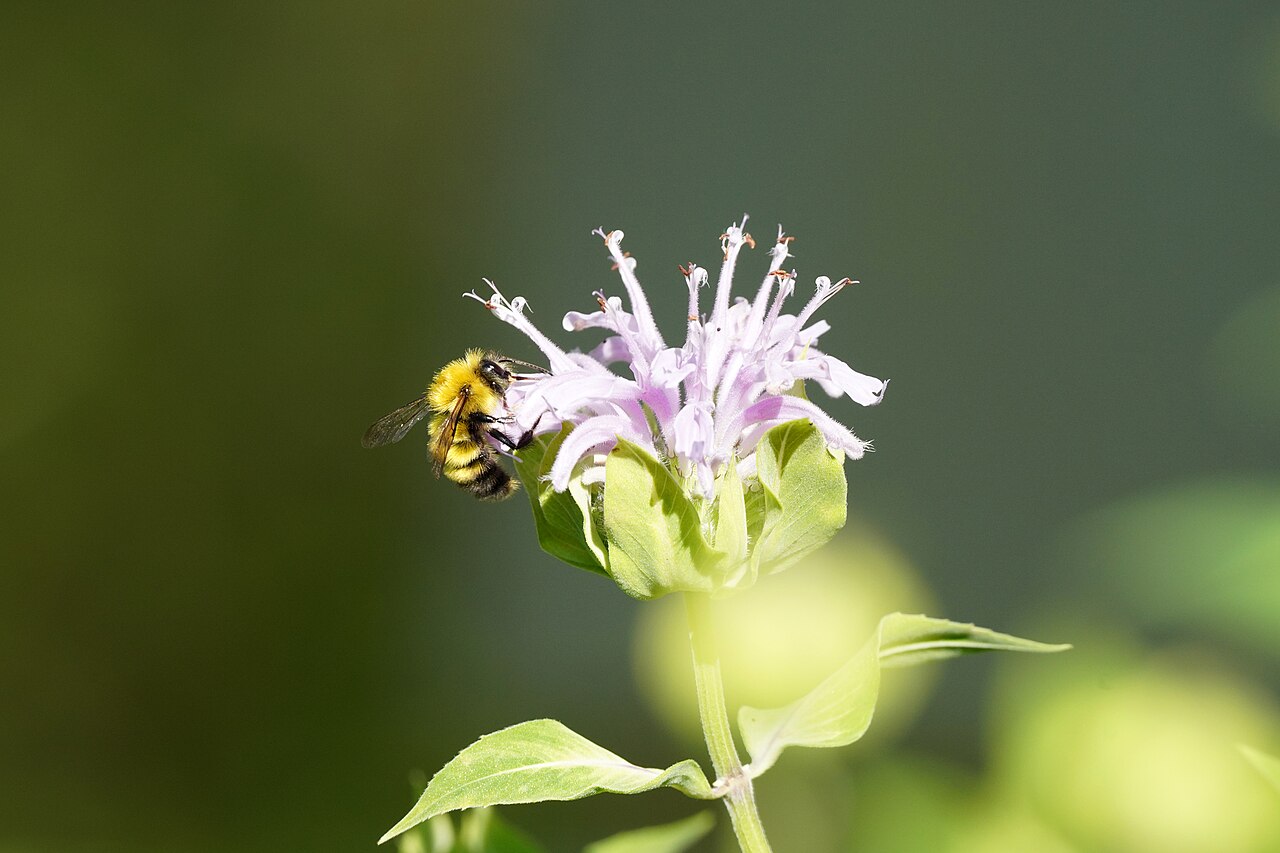
Most pollinator gardens fail in the same quiet way. They are full of species, but those species bloom in bursts, and the border goes almost flowerless for weeks between them.
Adding more kinds of plants rarely fixes this. What fixes it is arranging bloom times so they overlap, with the next group already opening before the last one fades.
This guide plans a sunny native border as a relay of overlapping bloom windows. It uses eight species planted in groups, not thirty planted as singles.
Plan at a Glance
| Site | A sunny border along a fence, driveway, lawn edge or front walk |
| Size | Example plan is 5 by 20 feet (100 square feet); scales up or down in 5-foot sections |
| Sun | Full sun, or at least most of the day |
| Soil | Average to dry, well-drained soil; no fertilizer needed |
| Maintenance | Spring cutback, weeding in the first two years, a yearly bloom check |
| Best regions | Midwest, Mid-Atlantic and upper South for this palette; regional swaps below |
Why Overlap Beats Variety
Extension guidance is consistent on two points: pollinators need flowers across the whole growing season, and they find flowers more easily in groups. Penn State Extension’s York County Master Gardeners advise buying three or more of a plant and setting them together, and choosing plants for a succession of bloom from early spring through fall.
Cornell Cooperative Extension’s Monroe County Master Gardeners put a number on it: at least three plants of at least three perennial species for each of spring, summer and fall, or a minimum of 27 plants.
Oregon State University Extension adds that single-species patches at least 3 feet across are easier for pollinators to find, and notes that food available early in spring leads to more bees later in the year. That last point is why the hand-off between seasons matters as much as the peak.
Put together, this means a border with eight species in solid groups usually does more than a border with twenty-five species planted one each. It is also easier to weed, because you can recognize every plant in it.
Site Assessment Before You Choose Plants
Bloom timing only works if the plants survive, so match the site first. Watch the bed through one full day and count the hours of direct sun. This palette needs full sun or close to it.
Check drainage by digging a hole about a foot deep, filling it with water and watching how fast it empties. Most of the plants here prefer soil that drains between rains.
Note how the border is seen. A bed along the front walk is viewed up close, so put early and late bloomers where you pass them. A bed at the back of the lot is viewed from a distance, so bigger drifts read better.
Design the Border as a Bloom Relay
Think of the season as a relay race. Each group of plants carries the bloom for a stretch, and the next group should already be running alongside before the hand-off.
Step 1: Pick two or three species for each window
Divide the season into four windows: spring, early summer, midsummer and late summer into fall. Aim for at least two species flowering in each window, with one of them still blooming as the next window opens.
Step 2: Check the hand-offs, not just the peaks
The weak points are the transitions: late spring into early summer, and the end of midsummer before goldenrods and asters open. Choose at least one long-blooming plant that spans each transition.
If you want to audit an existing garden for these gaps instead of starting from scratch, the spring-to-fall native bloom calendar walks through the month-by-month count.
Step 3: Interleave windows along the length of the bed
Do not put all the spring plants at one end and all the fall plants at the other. That leaves each section of the border bare for most of the year.
Instead, split the border into four 5-foot sections and give each section something from every window. Your eye and the pollinators then always find flowers within a few steps.
Step 4: Repeat, do not add
When you find a gap, the instinct is to buy one more new species. Usually it is better to add more plants of a species that already fills that window, so its patch reaches the 3-foot size OSU recommends. The same principle drives the three-plants-repeated approach.
Plant Palette
Overlapping-Bloom Border Palette
Heights, conditions and ranges are from the Lady Bird Johnson Wildflower Center. Confirm each species is native to your county before buying.
| Plant | Role | Height | Sun / moisture | Native range |
|---|---|---|---|---|
| Golden alexanders (Zizia aurea) | Spring opener | Up to about 3 ft | Sun to part shade; moist | Quebec to Saskatchewan and Montana, south to Florida and Texas |
| Foxglove beardtongue (Penstemon digitalis) | Late spring to early summer bridge | Up to about 5 ft | Sun to part shade; dry to wet | Maine to Michigan and South Dakota, south to Virginia, Alabama and east Texas |
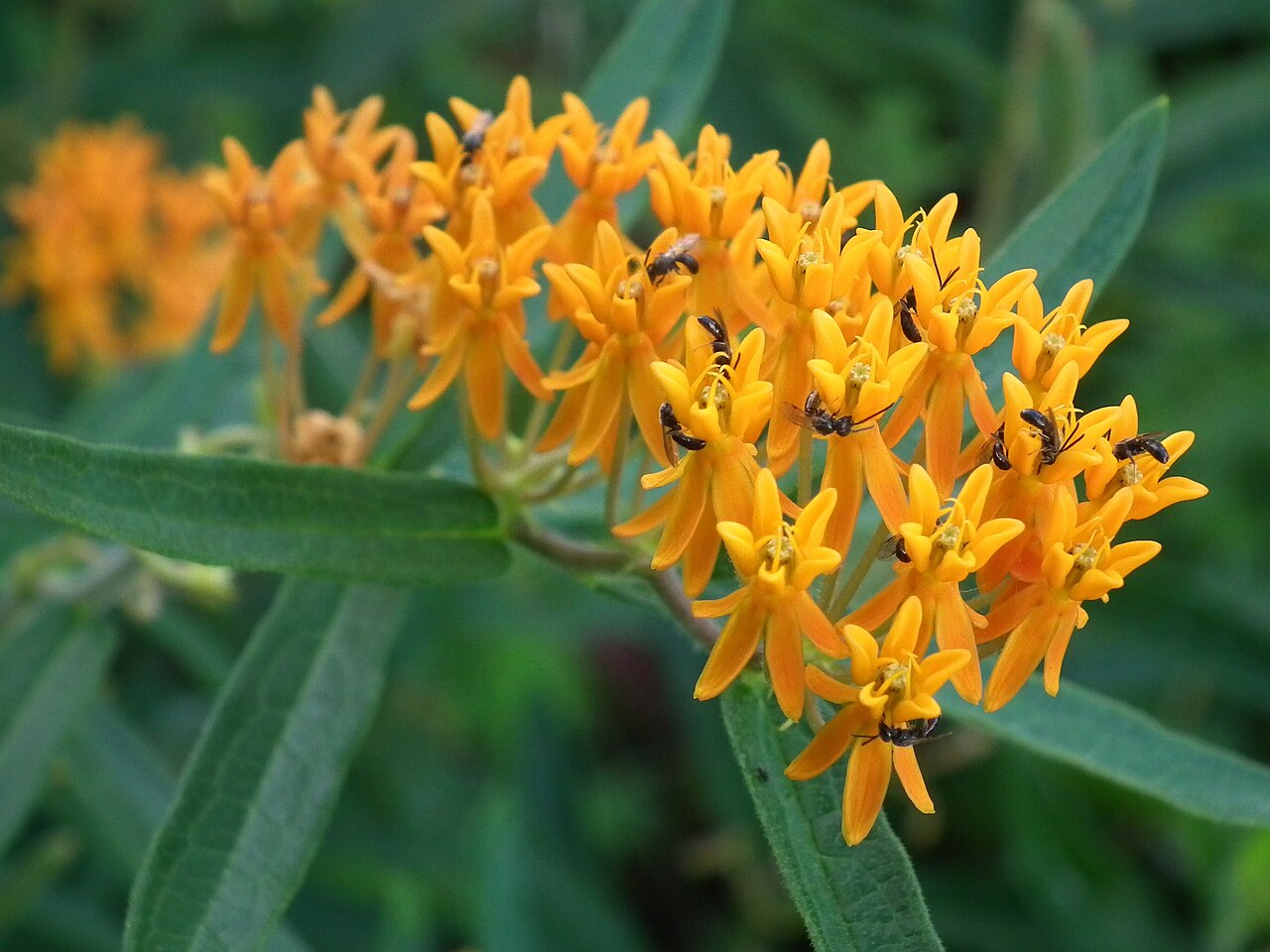
| Butterfly weed (Asclepias tuberosa) | Early-to-late summer, front of border | 1–2 ft | Sun; dry to moist, well-drained | Most of the U.S. east of the Rockies, plus parts of the Southwest |
| Wild bergamot (Monarda fistulosa) | Midsummer core | Up to about 5 ft | Sun to part shade; dry to moist | Most of southern Canada and the U.S. east of the Rockies |
| Prairie dropseed (Sporobolus heterolepis) | Grass matrix and edging | Up to about 3 ft | Sun; dry | Quebec to Saskatchewan, locally south to North Carolina, Kentucky, east Texas and Colorado |
| Rough blazing star (Liatris aspera) | Late summer hand-off | Up to about 6 ft | Sun; dry | Southern Ontario to West Virginia and South Carolina, west to North Dakota and east Texas |
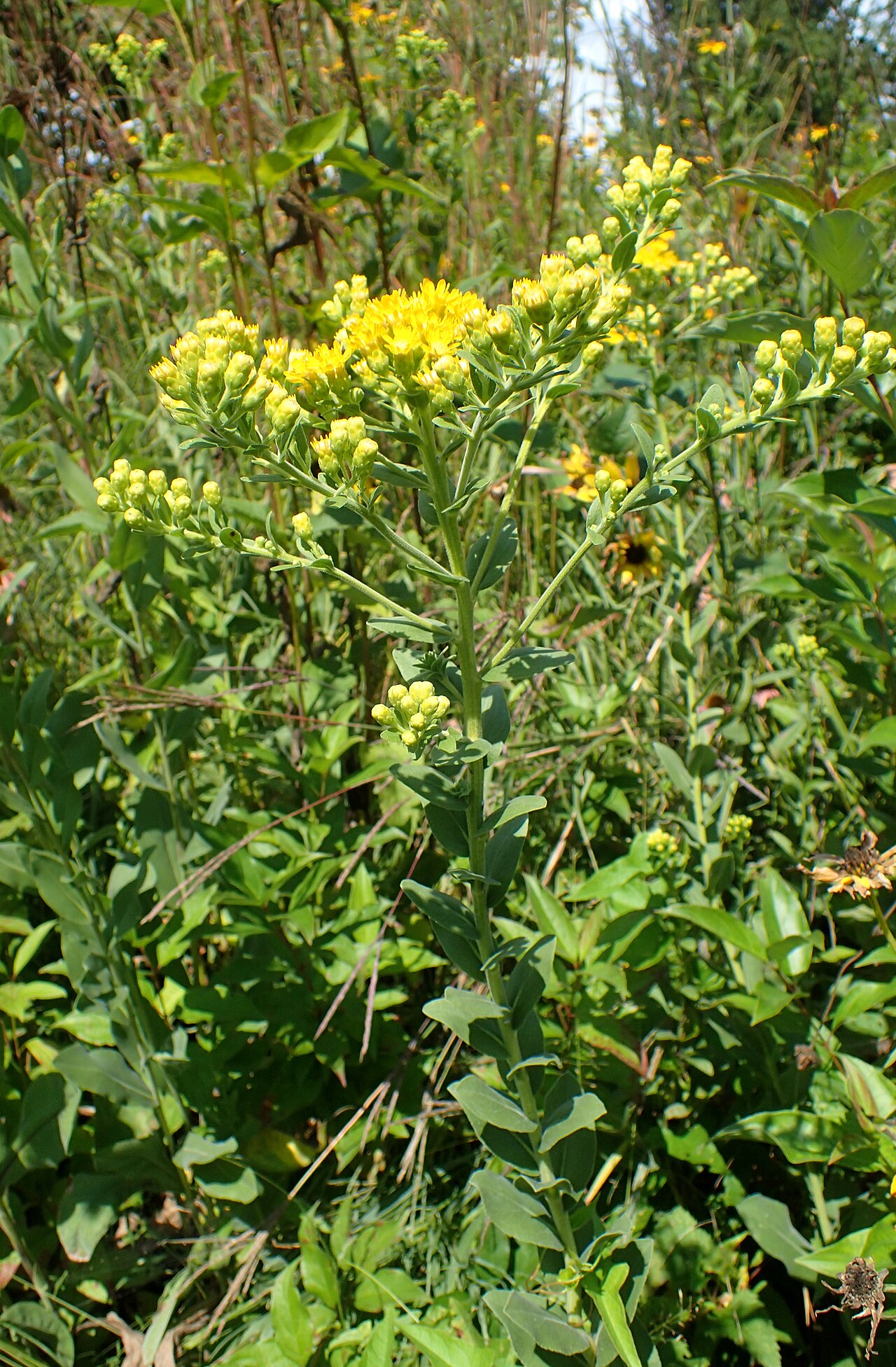
| Stiff goldenrod (Solidago rigida) | Late summer to fall, back of border | Up to about 5 ft | Sun; dry to wet | Alberta to Ontario, south through New York to Georgia, west to Texas |
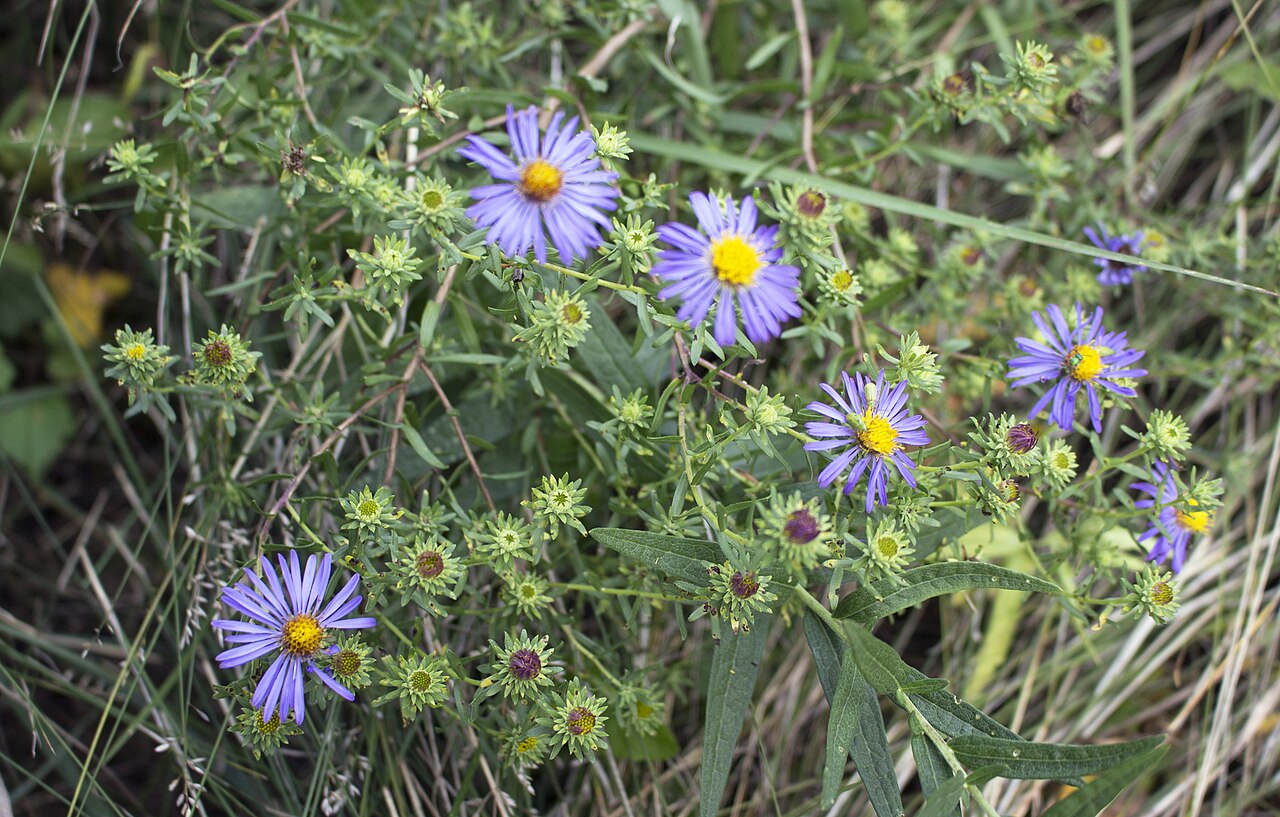
| Aromatic aster (Symphyotrichum oblongifolium) | Fall closer | Up to about 3 ft, often less | Sun to part shade; dry to moist, well-drained | Pennsylvania to North Carolina, west to Wyoming and Texas |
Prairie dropseed is a wind-pollinated grass, so it is not there for nectar. It knits the flowering groups together, keeps the front edge tidy and holds the design together between bloom peaks.
Butterfly weed is a milkweed, and the Wildflower Center lists it as a larval host for the monarch. For more ways to fit milkweeds into a formal bed, see a milkweed patch that fits a designed garden bed.
Check the Overlap Before You Plant
The Wildflower Center lists bloom months across each species’ entire range, which is broader than what any one garden sees. Use the chart below as a planning check, then record real dates in your own yard.
Bloom Overlap Check
Flowering species by month, based on the Wildflower Center’s listed bloom months. Golden alexanders’ listing runs to August, but its main show is in spring; prairie dropseed is left out because it is a grass.
| Month | In bloom | Species | Verdict |
|---|---|---|---|
| April | Golden alexanders | 1 | Thin: add a spring shrub or early bloomer from your regional list |
| May | Golden alexanders, beardtongue, butterfly weed, wild bergamot | 4 | Good overlap |
| June | Golden alexanders, beardtongue, butterfly weed, wild bergamot | 4 | Peak hand-off; strong |
| July | Beardtongue, butterfly weed, wild bergamot | 3 | Watch for a dip as beardtongue finishes |
| August | Butterfly weed, wild bergamot, rough blazing star, stiff goldenrod | 4 | Late-summer hand-off covered |
| September | Butterfly weed, wild bergamot, rough blazing star, stiff goldenrod, aromatic aster | 5 | Strongest overlap of the year |
| October | Stiff goldenrod, aromatic aster | 2 | Asters carry the end |
| November | Aromatic aster | 1 | Only where frost comes late |
The chart shows exactly where this palette is weak: the start of spring and the very end of fall. That is normal for a sunny perennial border. Penn State’s Master Gardeners point out that many woody plants provide early-season nectar, so a native shrub nearby can cover April better than another perennial.
Sample Plan: 5 × 20-Foot Border
Divide the bed into four 5-foot sections. Each section repeats the same structure with slightly different proportions, so the border reads as one planting rather than four.
- Back (about 2 feet deep): stiff goldenrod and wild bergamot alternate in groups, with beardtongue between them.
- Middle (about 2 feet deep): rough blazing star and golden alexanders in groups of three to five.
- Front (about 1 foot deep): a ribbon of prairie dropseed, broken by groups of butterfly weed and aromatic aster.
Quantities for 100 Square Feet
About 44 plants, roughly one per 2 to 2.5 square feet. That clears Cornell’s 27-plant minimum with room for groups of three or more of every species. Adjust spacing to the mature width listed on each plant tag.
| Plant | Where | Quantity |
|---|---|---|
| Prairie dropseed | Front edge, all sections | 9 |
| Golden alexanders | Middle, sections 1–4 | 6 |
| Foxglove beardtongue | Back, sections 1–4 | 5 |
| Butterfly weed | Front, sections 1 and 3 | 5 |
| Wild bergamot | Back, sections 2 and 4 | 5 |
| Rough blazing star | Middle, sections 1–4 | 6 |
| Stiff goldenrod | Back, sections 1 and 3 | 3 |
| Aromatic aster | Front, sections 2 and 4 | 5 |
Installation Steps
- Remove turf and perennial weeds completely. Weeds left now compete with the young plants for the first two seasons.
- Skip compost and fertilizer unless the soil is very poor. These are prairie and open-woodland plants, and the Wildflower Center notes stiff goldenrod does fine even in nutrient-poor soil.
- Lay out the plants in their pots before digging. Walk the length of the bed and confirm every 5-foot section has a plant from each bloom window.
- Plant in spring or early fall, setting each plant at the depth it grew in its pot.
- Mulch lightly between plants with shredded leaves or fine bark, keeping it off the crowns.
- Water deeply after planting and through dry spells in the first growing season.
- Label each group. In the first year, seedlings and weeds look alike, and labels prevent mistakes.
The First Three Years
Year one
- Spring and summer: water during dry spells and weed every two weeks.
- Expect modest bloom. Many perennials spend their first year building roots.
- Fall: leave stems standing for winter structure and shelter, as Cornell’s Master Gardeners suggest.
Year two
- Early spring: cut back old stems just before new growth emerges.
- Through the season: write down the first and last bloom dates of each species in your own yard.
- Fall: compare your notes with the overlap chart and mark any gap longer than two weeks.
Year three
- Fill gaps by enlarging an existing group or adding one species for that window, not by adding many singles.
- Divide or thin any plant that is crowding its neighbors.
- Keep standing seedheads through winter; the native seedhead winter garden guide shows how to keep that look tidy.
Mistakes to Avoid
- Planting one of everything. Single plants scatter the bloom and are harder for pollinators to find. Plant at least three together.
- Clustering seasons. A spring end and a fall end leaves each half of the border bare for months.
- Ignoring the hand-offs. Peak bloom is easy. The weeks between peaks are where a border earns its keep.
- Trusting catalog bloom months. Range-wide listings are broad. Your own dates are what matter.
- Using pesticides. Avoid insecticides in a pollinator border, including on nearby plants.
- Assuming a plant is native everywhere. Aromatic aster, rough blazing star and prairie dropseed all have limited native ranges.
Regional Alternates
The relay method works anywhere; only the plant list changes. Keep the structure of two or three species per window and swap within each window.
- New England and the Northeast: where aromatic aster is not native, use smooth blue aster or another fall aster from your state list.
- Coastal Southeast: check every species against your regional list, swap any that are not native there for local bloomers in the same window, and keep the same group sizes.
- Pacific Northwest and the West: use the same relay structure with western natives; the Oregon native pollinator plants list is one starting point.
- Shadier sites: golden alexanders, beardtongue and wild bergamot tolerate part shade, but the late-season sun lovers will flower poorly.
📋 Check these plants against your regional list, such as Michigan, Wisconsin and eastern Minnesota or Illinois, Iowa and Missouri.
Frequently Asked Questions
How many species do I need for a pollinator border?
Fewer than most people think. Cornell’s Master Gardeners suggest at least three species per season with three plants each. What matters more is that bloom windows overlap and that each species is planted in a group.
What does “overlapping bloom” mean in practice?
It means the next plant starts flowering before the current one finishes. In this plan, beardtongue overlaps golden alexanders in late spring, and rough blazing star overlaps wild bergamot in late summer.
How big should each plant group be?
Oregon State University Extension recommends single-species patches at least 3 feet across. In a small border, that usually means three to five plants of one kind together.
Why does my border still have a gap?
Bloom dates shift with weather, region and plant age. Record actual dates for two years, then enlarge a group that covers the gap or add one species for that window.
Will this guarantee more bees and butterflies?
No planting can guarantee visitors. Continuous, grouped flowers make a border more useful, but what arrives depends on the surrounding landscape and local populations.
Sources
- Cornell Cooperative Extension Monroe County: Pollinator Garden Design Requirements
- Oregon State University Extension: Providing Habitat for Native Pollinators (EC 1649)
- Penn State Extension, York County Master Gardeners: Planting for Pollinators
- Lady Bird Johnson Wildflower Center: Zizia aurea
- Lady Bird Johnson Wildflower Center: Penstemon digitalis
- Lady Bird Johnson Wildflower Center: Asclepias tuberosa
- Lady Bird Johnson Wildflower Center: Monarda fistulosa
- Lady Bird Johnson Wildflower Center: Liatris aspera
- Lady Bird Johnson Wildflower Center: Solidago rigida (Oligoneuron rigidum)
- Lady Bird Johnson Wildflower Center: Symphyotrichum oblongifolium
- Lady Bird Johnson Wildflower Center: Sporobolus heterolepis