
Big Floatingheart (Nymphoides aquatica)
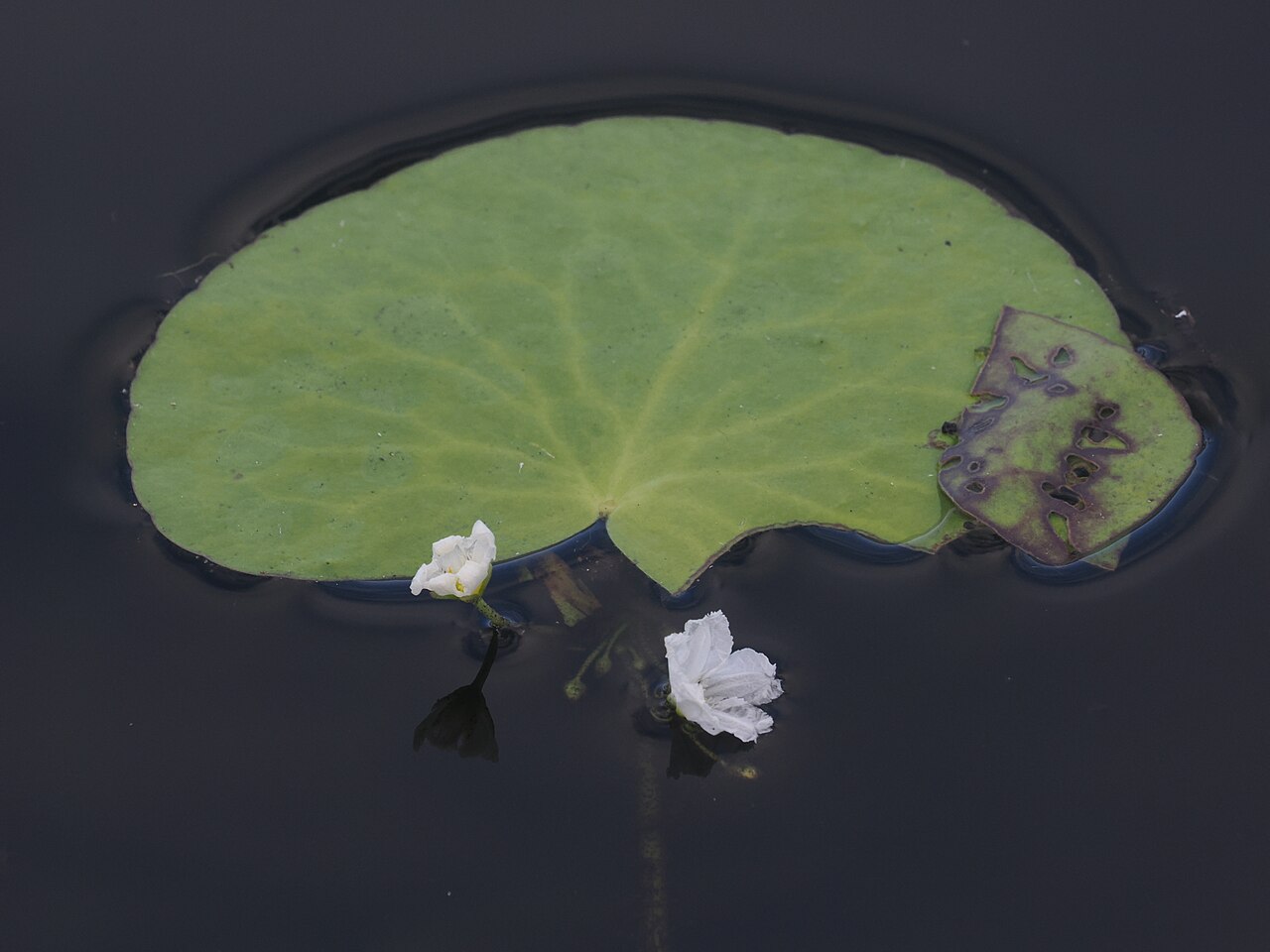
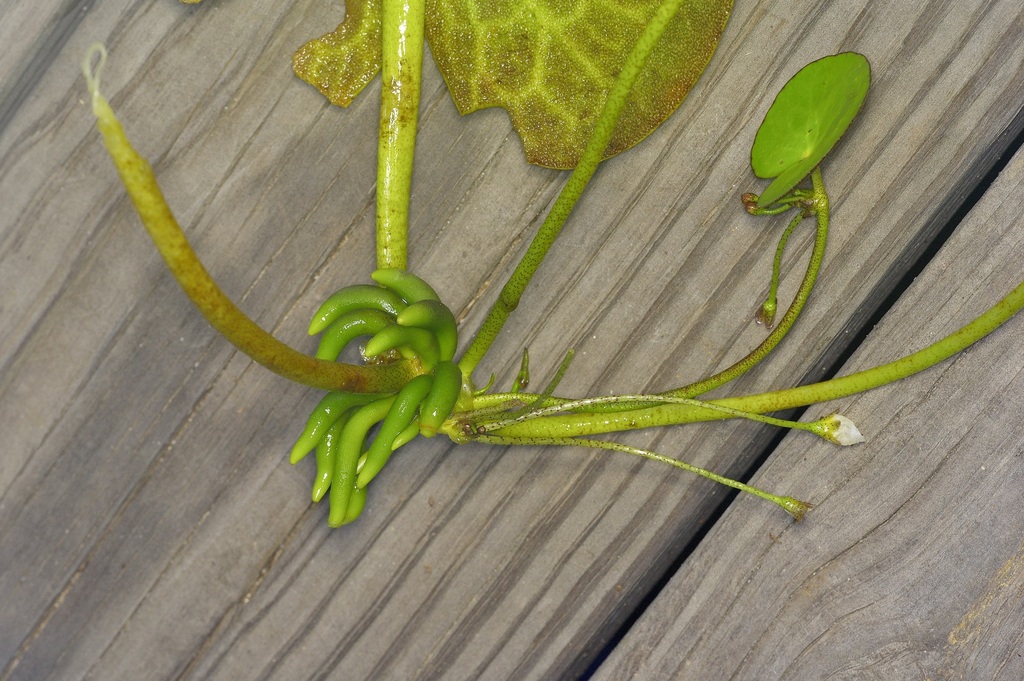
Nymphoides aquatica, known as Big Floatingheart or banana lily, is a native aquatic perennial of ponds, lakes and slow streams on the southeastern Coastal Plain. It looks like a small water lily: round, heart-shaped leaves 2 to 6 inches across float on the surface at the ends of long stalks, and clusters of small white flowers rise just above the water. Look underneath, though, and it is very different. The undersides of the leaves are purplish and rough, and clusters of fleshy, banana-shaped roots form on the stalks, which is why aquarium shops sell young plants as “banana plant.”
Floatinghearts belong to the buckbean family (Menyanthaceae), not the water lily family. The genus name Nymphoides means “like Nymphaea,” the water lily genus, because of the leaves. Unlike a water lily, big floatingheart has five-petaled flowers less than an inch across, borne several at a time from a point on the leaf stalk just below the floating blade.
Big floatingheart is a good native choice for ponds and water gardens in the Southeast and is a useful alternative to introduced floatinghearts, some of which have become invasive in Florida and other states. This guide covers how to identify it and tell it apart from those look-alikes, where it grows, how to plant and manage it in a pond, and its value to fish and wildlife.
Identification
Big floatingheart is the largest of the native floatinghearts in the eastern United States. Its thick, rough-backed leaves and banana-like root clusters make it easy to recognize once you lift a leaf.
Leaves
The leaves float on the water surface. They are nearly round with a deep notch at the base, giving them a heart shape, and usually 2 to 6 inches across, sometimes larger. They are thick and somewhat leathery. The upper surface is smooth and green, often mottled with purple when young, while the underside is purplish and distinctly rough or pitted, almost spongy. This rough, purple underside is one of the best field marks for the species.
Stems & Roots
Each leaf sits at the end of a long, slender stalk that reaches up from the rooted base, so the stalk length matches the water depth. The plant is anchored in the bottom mud by fibrous roots. At the flowering node on the leaf stalk, the plant produces a tight cluster of short, thick, fleshy roots, each about an inch long and shaped like a small banana. These store food and help new plantlets get started.
Flowers
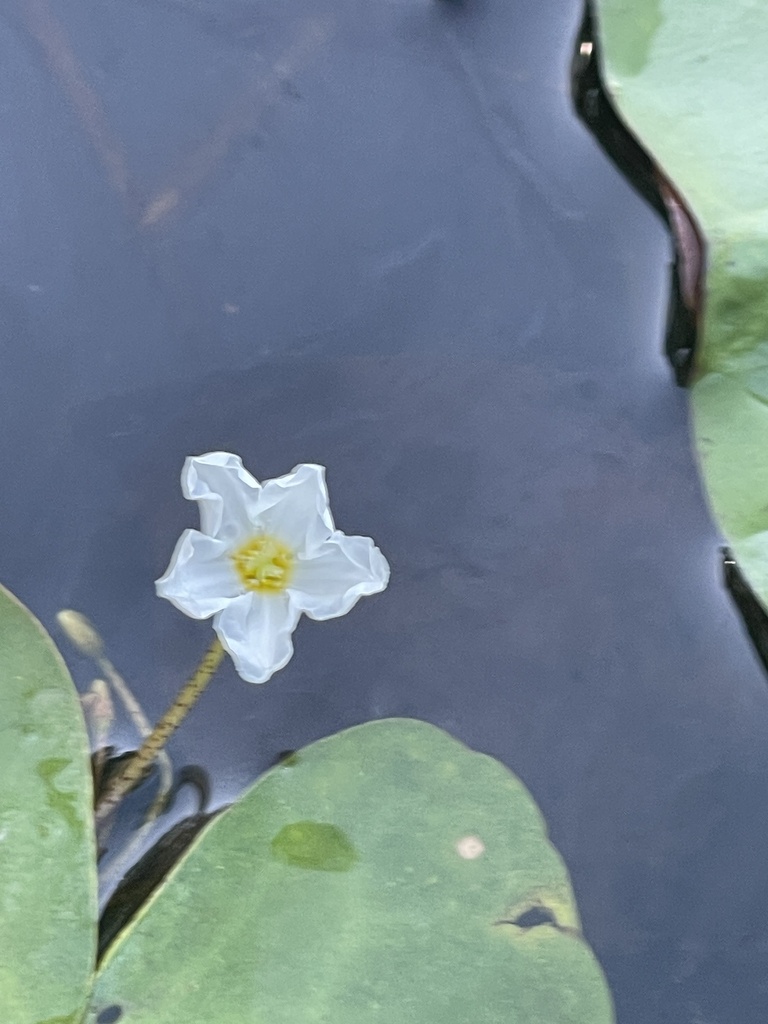
The flowers grow in a small, umbrella-like cluster from the leaf stalk just below the floating blade, and only one or two in the cluster open at a time. Each flower is about half to three-quarters of an inch across, with five white, smooth-edged petals and a yellowish center. They open in the morning and last a single day. In Florida big floatingheart blooms from spring through fall, and farther north mainly in summer.
Similar Species
Little floatingheart (Nymphoides cordata), a more northern native, has smaller leaves with smooth undersides. Two introduced Asian species are invasive in parts of the United States and should not be planted: crested floatingheart (Nymphoides cristata), which has white flowers with a ridge or crest down the middle of each petal and is a serious problem in Florida lakes, and yellow floatingheart (Nymphoides peltata), which has bright yellow, fringed flowers. Water lilies (Nymphaea) have much larger flowers with many petals, borne singly on their own stalks.
Quick Facts
| Scientific Name | Nymphoides aquatica |
| Family | Menyanthaceae (buckbean family) |
| Plant Type | Aquatic perennial with floating leaves |
| Mature Height | Floats at the water surface; flowers held 1–2 in above it |
| Mature Spread | 2–4 ft per plant; spreads by plantlets to form colonies |
| Growth Rate | Moderate to fast |
| Sun Exposure | Full sun to part shade |
| Water Needs | Aquatic; still or slow water about 1–6 ft deep |
| Soil Type | Mucky, sandy or loamy pond bottom |
| Soil pH | About 5.0–7.0 (acidic to neutral water) |
| Bloom Time | Spring–fall (nearly year-round in south Florida) |
| Flower Color | White |
| Fall Color | Leaves may turn purplish before dying back in cooler areas |
| Fruit | Small capsule with rough seeds |
| Deer Resistant | Not applicable (aquatic) |
| USDA Hardiness Zones | 7–11 |
Native Range
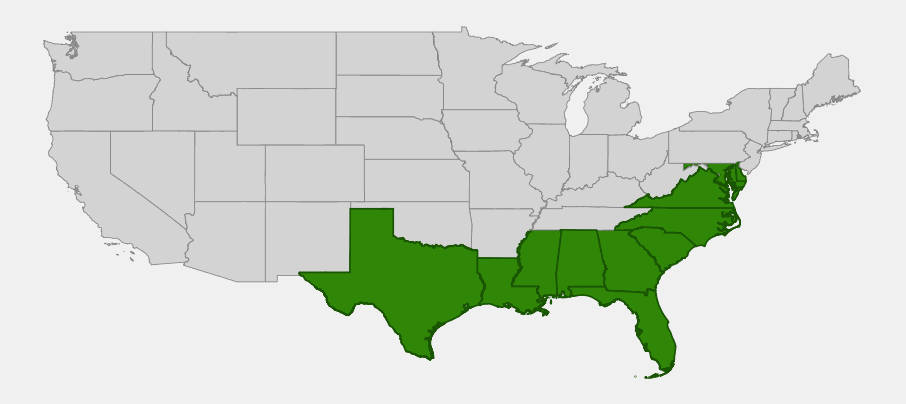
Big floatingheart is native to the Atlantic and Gulf Coastal Plain. USDA PLANTS records it from 11 states: Delaware, Maryland, Virginia, North Carolina, South Carolina, Georgia, Florida, Alabama, Mississippi, Louisiana and Texas. The Lady Bird Johnson Wildflower Center describes its range as southern New Jersey to Florida and west to Texas.
It is most common in Florida and southern Georgia, where it grows throughout the peninsula and the Panhandle in ponds, lakes, cypress swamps, marshes, canals and slow blackwater streams. Farther north and west it is more scattered, mostly in Coastal Plain ponds, millponds and sluggish rivers.
Because it is widely sold in the aquarium and water-garden trade, big floatingheart is sometimes found outside its native range. It has been recorded growing outside cultivation in Hawaii, for example, where it is not native. Within its native range it is a normal, well-behaved member of pond plant communities.
📋 Regional plant lists featuring Big Floatingheart: North & South Florida · Alabama, Georgia & Mississippi · North & South Carolina · Maryland, Virginia & West Virginia · Delaware, Southern New Jersey & Long Island · Arkansas, Louisiana, Eastern Oklahoma & Eastern Texas
Growing & Care Guide
Big floatingheart is one of the easiest native aquatic plants to grow. It is sold by water-garden and native plant nurseries, and young plants are also common in the aquarium trade as “banana plant.” For an outdoor pond, choose plants sold under the scientific name Nymphoides aquatica to avoid the invasive crested and yellow floatinghearts, which are sometimes mislabeled.
Light
It flowers best in full sun, but it tolerates part shade better than most water lilies. In deep shade it produces leaves but few flowers.
Soil & Water
Grow it in still or slowly moving fresh water about 1 to 6 feet deep, rooted in mucky, sandy or loamy bottom soil. In a garden pond, plant it in a wide, shallow pot of heavy garden soil or aquatic planting mix, top it with gravel to keep the soil from clouding the water, and set the pot so the crown sits 12 to 24 inches below the surface. It prefers soft, slightly acidic water but tolerates a range of conditions. It does not tolerate salt or brackish water.
Planting Tips
Plant in spring once the water has warmed. The leaf stalks will lengthen until the leaves reach the surface. A small banana cluster or plantlet can also simply be pressed into the mud in shallow water, where it will root and send up leaves. In a small pond, one or two plants are enough, since each produces new plantlets through the season.
Pruning & Maintenance
Remove yellowing leaves and excess plantlets to keep it from covering more than about half of the water surface in a small pond, which leaves open water for oxygen exchange and other plants. In zones 7 and 8 the leaves die back in winter, and the plant returns from its rootstock in spring. A pond fertilizer tablet in spring encourages flowering in nutrient-poor potted plantings, but avoid over-fertilizing, which feeds algae.
Propagation
Propagation is easy. The banana clusters and the plantlets that form at the flowering nodes can be detached and planted. In aquariums, a detached leaf with its banana cluster will root and grow on. Plants can also be divided in spring. Seed is rarely used.
Landscape Uses
- Water gardens and ponds: a smaller, native alternative to water lilies
- Native pond and wetland restoration: in Coastal Plain ponds and lakes within its range
- Wildlife ponds: shade and cover for fish, frogs and aquatic insects
- Aquariums: the juvenile “banana plant” is a popular aquarium plant
- Container water gardens: grows well in a tub or half-barrel in full sun
Wildlife & Ecological Value
Floating-leaved plants such as big floatingheart create a sheltered layer at the water surface that many aquatic animals use.
For Pollinators
The small white flowers attract flies, small bees and other insects, which land on the flowers at the water surface. Each flower lasts only a day, but a colony produces new flowers over many weeks.
For Birds
Ducks and other waterfowl eat the seeds and sometimes the leaves and fleshy roots, and wading birds and kingfishers hunt the small fish that shelter beneath the leaves. Purple gallinules walk across floating leaves like these to feed.
For Mammals
Muskrats and other aquatic mammals may eat the leaves and roots, but the plant is not a major mammal food.
Ecosystem Role
The floating leaves shade the water, which keeps it cooler and helps limit algae growth. The underwater stalks and leaf undersides provide surfaces for algae and small invertebrates, which in turn feed fish and tadpoles, and small fish hide among the stalks from predators. Frogs often rest on the leaves. As a native floatingheart, it fills the same niche that invasive crested floatingheart has taken over in some Florida lakes, without forming the same dense mats.
Cultural & Historical Uses
The species was first described in the late 18th century from plants of the southeastern United States and was later moved to Nymphoides by the German botanist Otto Kuntze. The genus Nymphoides was named for its resemblance to water lilies. It was later recognized that floatinghearts are related to buckbean (Menyanthes) rather than to water lilies, and they are now placed together in the Menyanthaceae.
Big floatingheart is best known to the public through the aquarium trade, where young plants with their cluster of green “bananas” are sold as banana plant or banana lily. In an aquarium the plant usually stays small and sends a few leaves to the surface; when it is moved to a pond it grows into the full-sized floating-leaved plant described here.
There is little record of human use of big floatingheart beyond its ornamental value. Its main importance today is ecological, as a native component of Coastal Plain ponds and as a safe, native alternative to the invasive floatinghearts that have become a management problem in some southern lakes.
Frequently Asked Questions
Is big floatingheart a water lily?
No. It looks like a small water lily, but it belongs to the buckbean family (Menyanthaceae). Its flowers are small, five-petaled and borne in clusters from the leaf stalk, unlike the large, many-petaled single flowers of water lilies.
Is the aquarium “banana plant” the same species?
Yes. The banana plant sold for aquariums is the juvenile form of Nymphoides aquatica. The “bananas” are fleshy storage roots. Planted in a pond, it grows into the floating-leaved plant described here.
How can I tell it from invasive floatinghearts?
Big floatingheart has large, thick leaves with a rough, purplish underside and smooth-edged white petals. Invasive crested floatingheart has white petals with a raised crest along the center, and yellow floatingheart has yellow fringed flowers. Both invasives should not be planted.
Will big floatingheart take over my pond?
It spreads by plantlets and can cover a good part of a small pond over a season, but it is easy to thin by pulling extra plants and leaves. Keep it to about half of the surface to leave open water.
Does it survive winter?
In its native range, yes. In zones 7 and 8 the leaves die back in cold weather and new growth returns in spring from the rooted base, as long as the crown does not freeze solid.

Looking for a nursery that carries Big Floatingheart?
Browse our native plant nursery directory: Alabama · Delaware, Florida & Georgia · Louisiana, Maryland & Mississippi · North Carolina · South Carolina, Texas & Virginia