
Shortleaf Rose Gentian (Sabatia brevifolia)
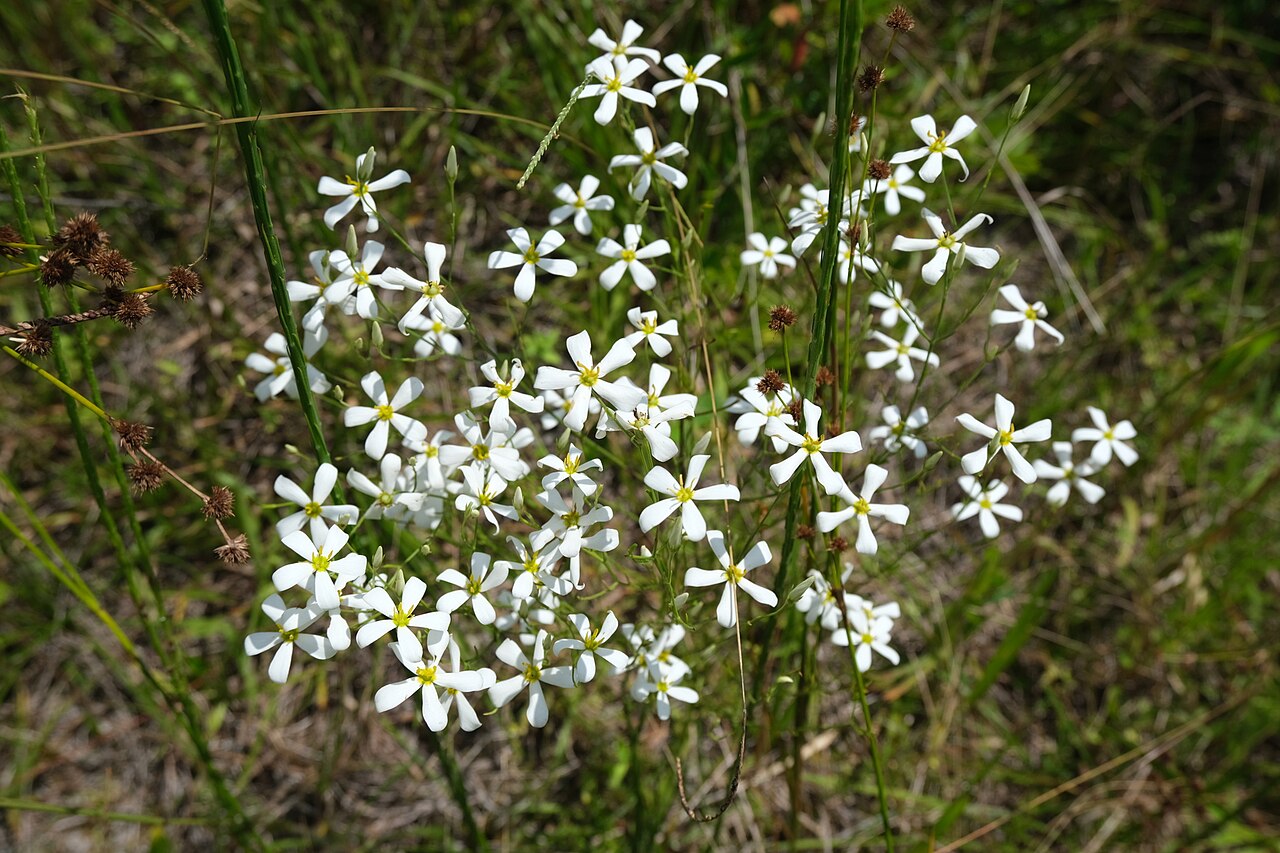
Sabatia brevifolia, known as Shortleaf Rose Gentian (also shortleaf rosegentian, narrowleaf sabatia or white sabatia), is a delicate annual wildflower of the Southeastern Coastal Plain. It belongs to the gentian family (Gentianaceae) and grows in moist pine flatwoods, wet savannas and the sandy edges of scrub. Its wiry, much-branched stems, usually 8 inches to 2 feet tall, carry dozens of starry white flowers, each with five pointed petals around a small yellow eye.
Despite the name, there is nothing rosy about this rose gentian. Many of its relatives, such as large-flowered rose gentian and Bartram’s Rose Gentian, have pink flowers, but shortleaf rose gentian is reliably white. Its leaves are short and narrow and pressed close to the stem, so in bloom the plant looks like a haze of small white stars floating above the wiregrass. Older references call it Sabatia elliottii or Sabatia paniculata, both names now treated by USDA PLANTS as synonyms.
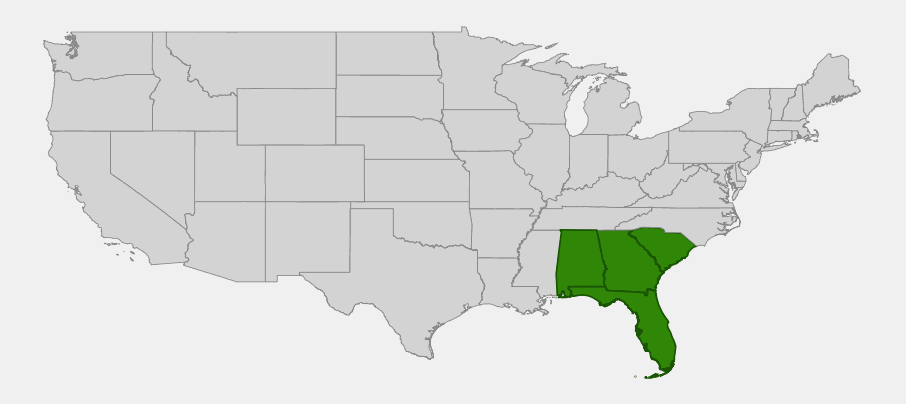
Shortleaf rose gentian is native only to Florida, Georgia, South Carolina and southern Alabama, and Florida holds the largest share of its populations. It is a plant of fire-maintained pinelands, and it is rarely seen in gardens. This guide covers how to tell it from other white sabatias, where it grows, how to grow it from seed in a sunny, sandy meadow or wildflower planting, and what it offers pollinators.
Identification
Shortleaf rose gentian is easy to miss until it blooms. Then its many-branched habit and starry white flowers stand out against the grasses of the flatwoods. Several other Sabatia species grow in the same region, so check the flower color, the number of petals and the shape of the leaves.
Stems & Habit
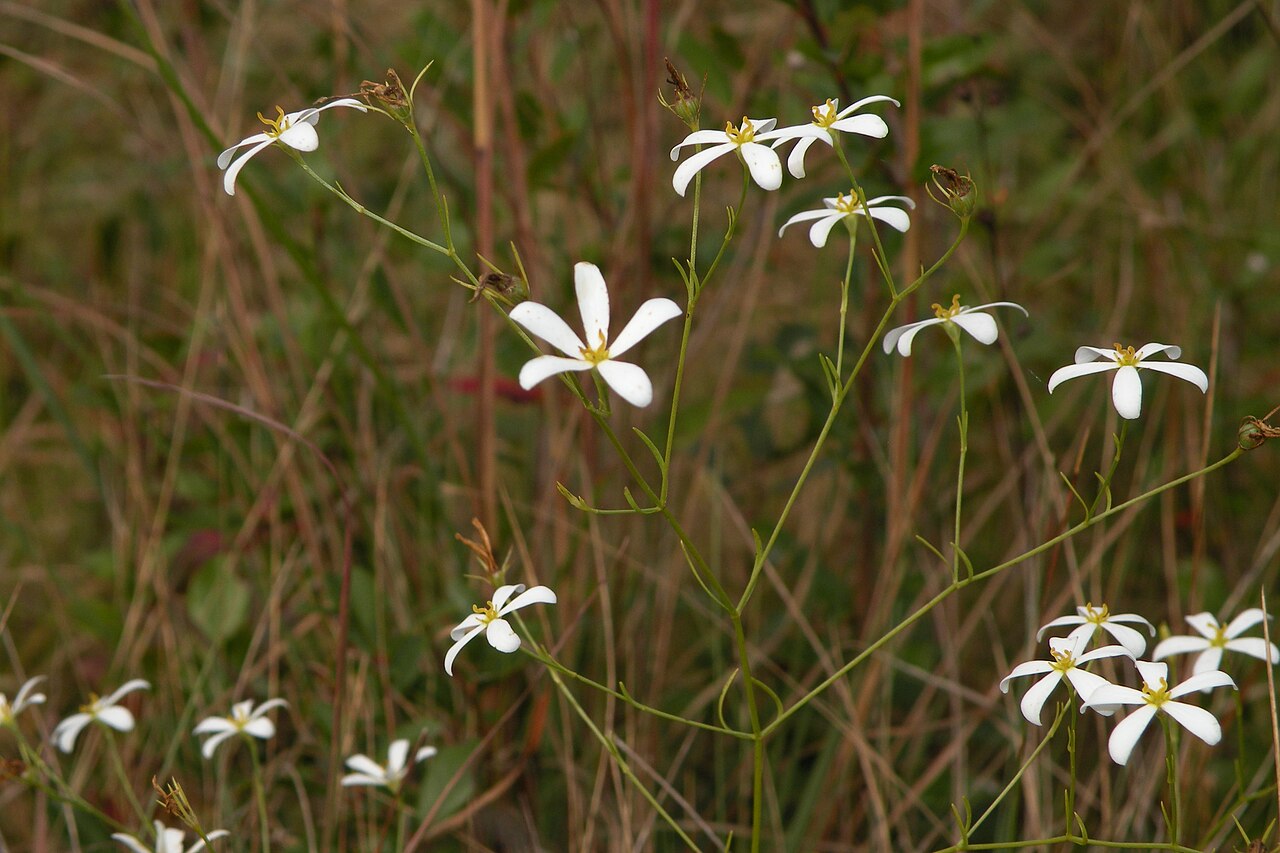
This is an annual (some sources say a short-lived biennial) that starts from a small basal rosette. The flowering stems are slender, smooth and round in cross section, usually 8 to 30 inches tall. They branch repeatedly, often from near the base, so that a well-grown plant forms a loose, airy dome. In dense wiregrass it may produce only a single stem with a few flowers.
Leaves
The stem leaves are opposite, narrow and short, mostly linear to narrowly elliptic and well under an inch long, and they grow shorter and smaller toward the top of the plant. That is the source of the species name brevifolia, “short-leaved.” The leaves are smooth and stalkless and do little to hide the stems. The basal rosette leaves are broader but often wither by flowering time.
Flowers
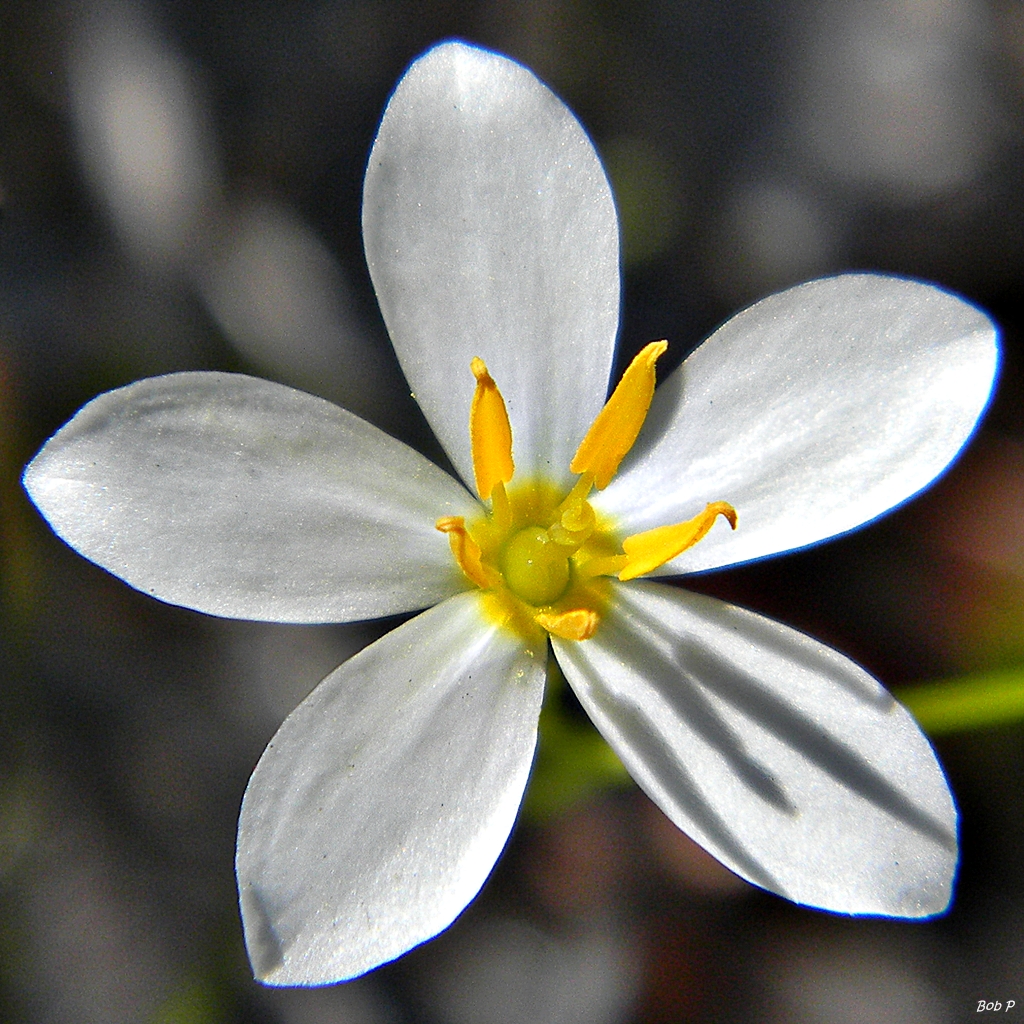
The flowers are borne singly at the tips of the branches, forming a loose, open cluster. Each flower is about 1 inch across, with usually five pure white, pointed, elliptic petals joined only at the base, a yellow or yellowish-green eye, five yellow anthers that twist after the pollen is shed, and a two-branched style. The narrow green sepals are shorter than the petals.
In Florida flowers can appear from late spring into fall, with the main show in late summer and fall. The Lady Bird Johnson Wildflower Center lists August to October.
Similar species include Sabatia difformis (lanceleaf rose gentian), which has white flowers in a flat-topped cluster and broader leaves, and Sabatia quadrangula, which has square, winged stems. White-flowered forms of pink sabatias usually have broader leaves and larger flowers.
Fruit & Seeds
After flowering, each blossom leaves a small, dry, egg-shaped capsule. It splits open to release many tiny seeds that are scattered close to the parent plant by wind and rain. The plant dies after seeding, and the next generation comes from seed.
Quick Facts
| Scientific Name | Sabatia brevifolia (syn. S. elliottii, S. paniculata) |
| Family | Gentianaceae (gentian family) |
| Plant Type | Annual (sometimes biennial) wildflower |
| Mature Height | 8–30 in |
| Mature Spread | 6–12 in |
| Growth Rate | Fast (completes its life cycle in one season) |
| Sun Exposure | Full sun to light shade |
| Water Needs | Moderate; moist to somewhat dry sandy soil |
| Soil Type | Acidic sand or peaty sand |
| Soil pH | About 4.5–6.0 (acidic) |
| Bloom Time | Late spring to fall in Florida; peak August–October |
| Flower Color | White with a yellow eye |
| Fall Color | None; plants die after setting seed |
| Fruit | Small dry capsule with many tiny seeds |
| Deer Resistant | Somewhat; gentians are bitter and seldom browsed heavily |
| USDA Hardiness Zones | 8–10 |
Native Range
Shortleaf rose gentian has a small range on the outer Southeastern Coastal Plain. USDA PLANTS and the Lady Bird Johnson Wildflower Center record it from four states: South Carolina, Georgia, Alabama and Florida. The Wildflower Center summarizes its native distribution as southeastern South Carolina to Florida and southwestern Alabama.
Florida is the heart of the range. Florida records stretch from the Panhandle well down the peninsula, and it is a familiar fall wildflower in pine flatwoods from the Apalachicola National Forest south to the pinelands of southeast Florida, such as Jonathan Dickinson State Park. In Georgia, South Carolina and Alabama it is limited to the lower Coastal Plain.
It grows in moist to fairly dry, acidic sands: pine flatwoods, wet and mesic savannas, wiregrass pinelands, the margins of scrub and the edges of depression marshes. It is not listed as threatened or endangered by the state of Florida, but NatureServe ranks it globally vulnerable (G3) because of its limited range and the loss of fire-maintained pinelands to development, pine plantations and fire exclusion.
📋 Regional plant lists featuring Shortleaf Rose Gentian: North & South Florida · Alabama, Georgia & Mississippi · North & South Carolina
Growing & Care Guide
Shortleaf rose gentian is not a common nursery plant, but seed is occasionally offered by native seed suppliers in Florida. It is best grown in a wildflower meadow, pineland restoration or a sunny, sandy bed where it can reseed on its own year after year. Always start from purchased seed or plants, not from wild-collected material.
Light
Plant it in full sun or light, dappled shade such as that under an open pine canopy. In heavy shade the stems stretch and the plant flowers poorly.
Soil & Water
It needs acidic, sandy, low-nutrient soil that stays moist through most of the growing season but is not permanently flooded. In nature it often grows where the soil is wet in summer and drier in winter. Do not fertilize or add rich compost, which encourages grasses and weeds that crowd out the small seedlings.
Planting Tips
Sow seed on the surface of bare, lightly raked sand in fall or winter. The seed is tiny and needs light to germinate, so press it in rather than covering it. Small seedlings can also be transplanted from containers in spring. Grow it among low bunchgrasses and other pineland wildflowers, where its airy stems can lean on neighbors.
Pruning & Maintenance
No pruning is needed. Let plants stand until the capsules have opened, so they can drop seed for next year. Each year keep a few patches of bare or thinly vegetated sand, because seedlings do not establish in thick turf or mulch. In larger plantings a periodic burn or a mowing in late winter mimics the fires that keep its habitat open.
Propagation
Propagate by seed only. Collect ripe capsules from your own plants in fall and scatter the seed right away, or store it dry and cool until winter sowing. Germination is often patchy, so sow generously. Once established in a suitable site, it usually maintains itself by self-sowing.
Landscape Uses
- Pineland and flatwoods restoration: adds late-season white flowers to wiregrass and pine savanna plantings in Florida and the lower Coastal Plain
- Wildflower meadows: an airy filler among bunchgrasses on moist, sandy, acidic soils
- Pollinator gardens: late-summer and fall nectar and pollen for small native bees
- Rain gardens and swale edges: on the moist, sandy margins rather than the wettest center
- Naturalistic beds: for gardeners who let annuals reseed rather than replanting each year
Wildlife & Ecological Value
Shortleaf rose gentian is small and short-lived, but it is part of the dense, varied wildflower layer that makes Southeastern pinelands among the most species-rich habitats in North America.
For Pollinators
The open, upward-facing flowers offer pollen and a little nectar that is easy to reach. They are visited mainly by small native bees, such as sweat bees, and also by flies, beetles and small butterflies. Sabatia flowers shed pollen before the stigma becomes receptive, which favors cross-pollination by visiting insects.
For Birds
It is not an important bird food. Its pineland habitat is important to birds such as Bachman’s sparrow, brown-headed nuthatch and northern bobwhite, which forage among the grasses and wildflowers.
For Mammals
The plants are bitter, like most gentians, and are browsed only lightly by deer and rabbits.
Ecosystem Role
As an annual, shortleaf rose gentian depends on the bare patches of sand that frequent fires create in pine flatwoods. Populations often surge in the years after a burn and dwindle where fire is excluded and shrubs such as saw palmetto and gallberry thicken. It is one of many small wildflowers that indicate healthy, regularly burned pineland.
Cultural & Historical Uses
The genus Sabatia honors Liberato Sabbati, an 18th-century Italian botanist and curator at the botanical garden in Rome. The common name “rose gentian” comes from the pink-flowered species, which were the best known in early American botany.
Constantine Samuel Rafinesque, the eccentric and prolific naturalist who named many American plants in the early 1800s, described Sabatia brevifolia. Over the years it has also been called Sabatia elliottii, after the South Carolina botanist Stephen Elliott, and has been combined with Sabatia paniculata. These names still appear in older floras and herbarium labels.
Many gentians are famously bitter, and several American sabatias were used in folk medicine as a bitter tonic and for fevers. There is little specific record of such uses for this species, and it should not be eaten or used medicinally. Today it is valued mainly as a wildflower of Florida’s pinelands, and it is a favorite of photographers in the fall flatwoods.
Frequently Asked Questions
Why is it called a rose gentian if the flowers are white?
“Rose gentian” is the common name for the whole genus Sabatia, many of whose species have pink flowers. Shortleaf rose gentian is one of several white-flowered members of the group.
Is shortleaf rose gentian an annual or a perennial?
It is an annual or sometimes a short-lived biennial. Each plant flowers, sets seed and dies, so it persists in a garden only if it can reseed onto bare, sunny sand.
Where can I see it in the wild?
Look in moist pine flatwoods and savannas of Florida and the lower Coastal Plain of Georgia, South Carolina and Alabama in late summer and fall. Public lands such as the Apalachicola National Forest and Jonathan Dickinson State Park have good displays, especially after prescribed burns.
How do I tell it from other white sabatias?
Look for slender, round stems, many branches, short narrow leaves pressed close to the stem, and single five-petaled white flowers at the branch tips. Lanceleaf rose gentian has broader leaves and flowers in flatter clusters, and S. quadrangula has square stems.
Can I collect seed from wild plants?
It is better to buy seed from a native seed supplier. Collecting on public lands usually requires a permit, and populations of this regional endemic should be left intact. Once you have plants, collect seed from your own garden.

Looking for a nursery that carries Shortleaf Rose Gentian?
Browse our native plant nursery directory: Alabama · Florida & Georgia · South Carolina