
Puerto Rico Hat Palm (Sabal causiarum)
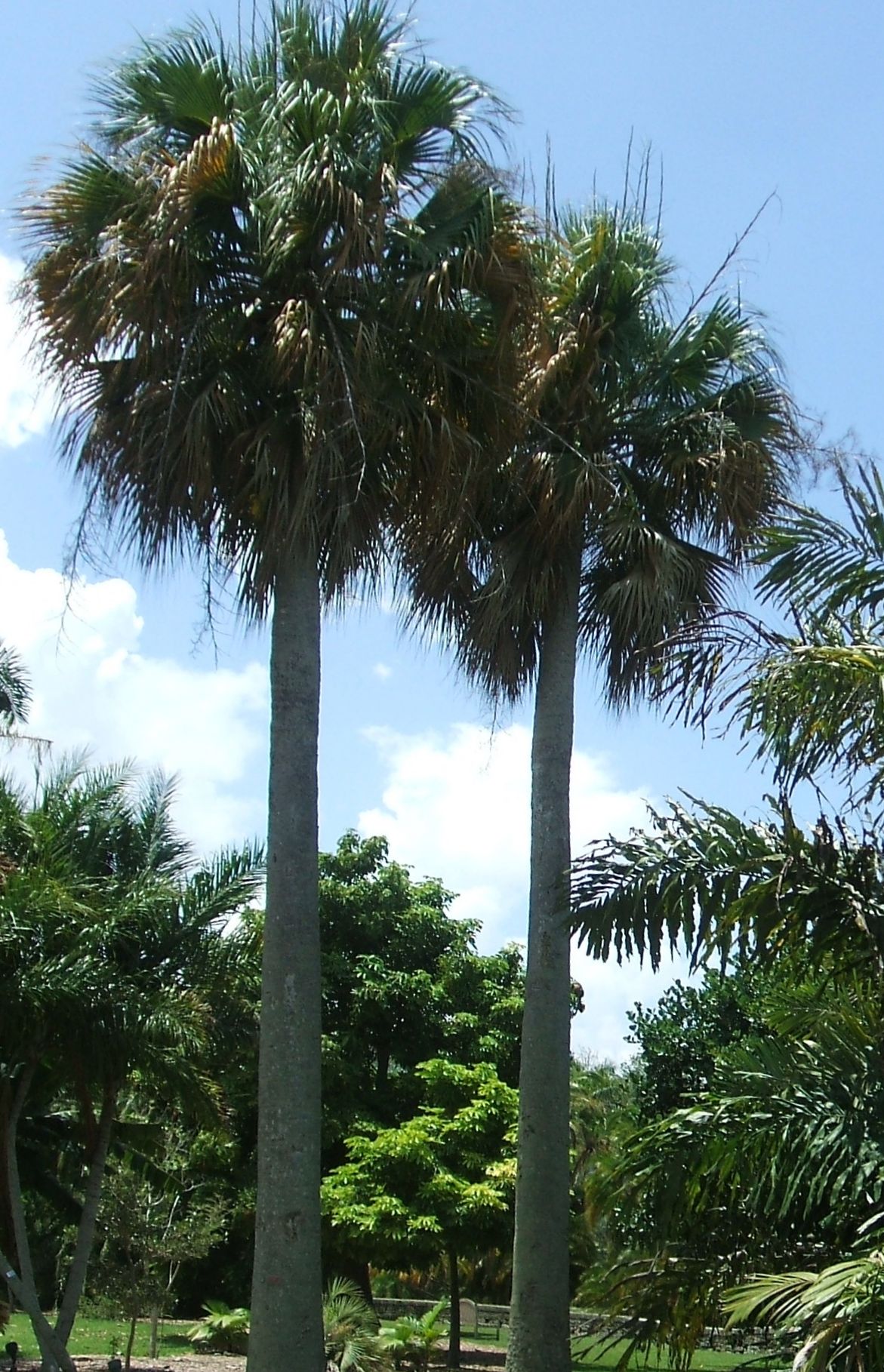
Sabal causiarum, listed by USDA as Puerto Rico palmetto and widely known as the Puerto Rico Hat Palm, is the heaviest-trunked fan palm of the Greater Antilles. On the island it goes by palma de sombrero, yarey (also spelled yaray) and palma de escoba, and older sources add palma de abanico and palma de cogollo. All of those names point at the same thing: a palm whose young leaves were the raw material for hats, brooms, baskets and thatch.
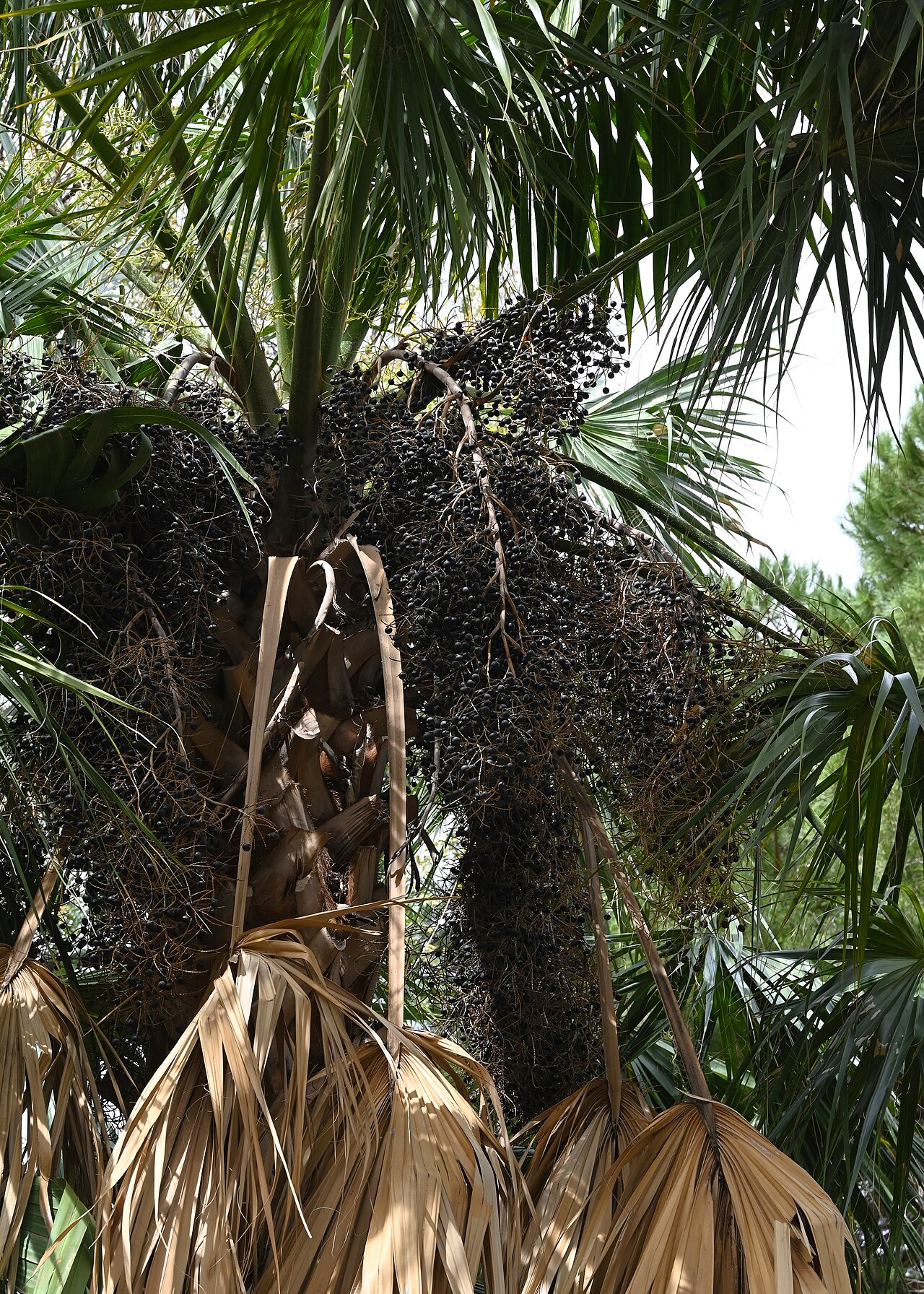
It is a big, slow, long-lived tree. The solitary trunk is smooth and pale grey, can be well over two feet thick, and carries a dense globe of 20 to 30 stiff, blue-green fan leaves. Arching flower stalks longer than the leaves swing out past the crown and ripen into huge hanging clusters of small black fruit. A mature specimen in an open pasture or along a road in southwestern Puerto Rico is unmistakable from a long way off.
The species epithet causiarum means “of hats,” from the Latin word for a broad-brimmed Macedonian hat, and it was coined for the hat industry that the botanist Orator F. Cook documented in Cabo Rojo in 1901. This guide covers identification, the native range across Puerto Rico, Hispaniola and the British Virgin Islands, growing and care, wildlife value, and the cultural history behind the name.
Identification
Puerto Rico has several native fan palms, but none has a trunk this massive. Look at trunk thickness first, then at the arching flower stalks and the small round black fruit.
Trunk
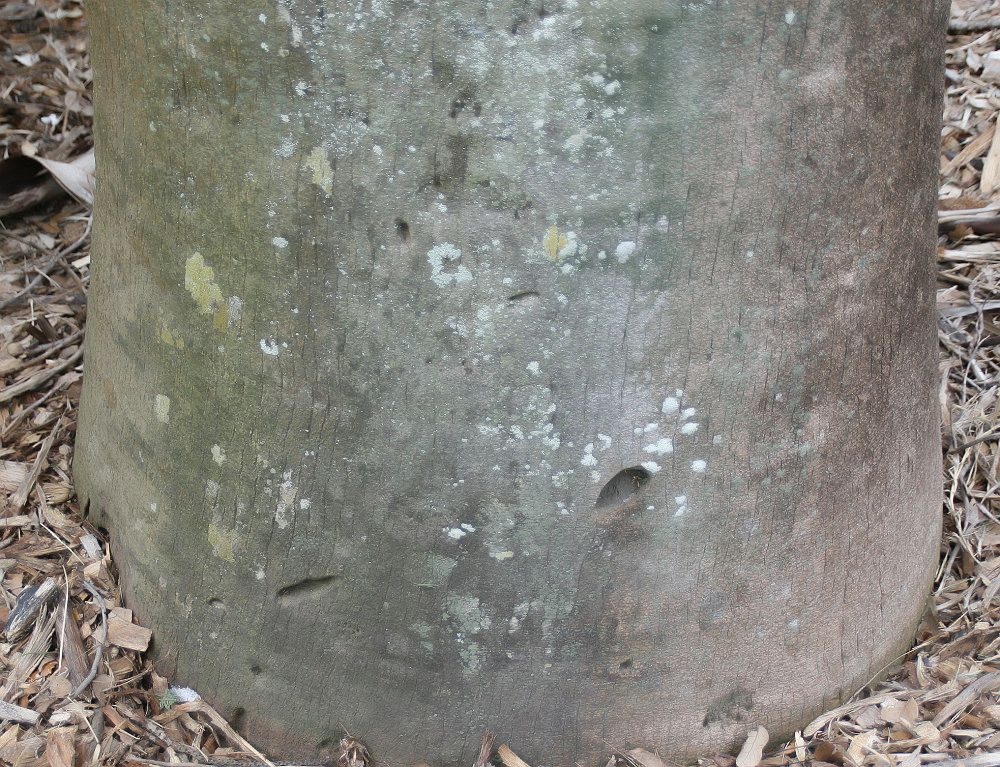
The trunk is solitary, upright, smooth and pale grey, growing to about 33 feet (10 m) tall and an exceptional 14 to 28 inches (35 to 70 cm) in diameter. Old leaf bases usually drop away cleanly, leaving faint rings rather than the shaggy “boot” pattern seen on some other palms. Young palms spend years as a ground-level rosette, building a wide base before the trunk begins to rise.
Leaves
Each palm carries roughly 20 to 30 costapalmate fan leaves, meaning the blade folds along a short extension of the leaf stalk rather than spreading flat. A single blade is divided into about 60 to 120 narrow segments, stiff and blue-green to grey-green, with thread-like fibers between the segments in younger leaves. The leaf stalks are unarmed, with no spines or teeth along the edges.
Flowers
The inflorescences are branched and arching to pendulous, and they are longer than the leaves, so they hang out well past the crown. The individual flowers are small, creamy white and fragrant, produced in very large numbers, and freely visited by bees.
Fruit
The fruit is a round black drupe about ¼ to ⅖ inch (0.7 to 1.1 cm) across, borne in enormous drooping masses. Fruit size and shape are the main characters separating this palm from the closely related Sabal domingensis of Hispaniola; botanists have noted that S. causiarum, S. domingensis and S. maritima form a complex that may eventually be treated as one species.
Quick Facts
| Scientific Name | Sabal causiarum (O.F. Cook) Becc. (syn. Inodes causiarum, Inodes glauca, Sabal haitensis, Sabal questeliana); USDA common name: Puerto Rico palmetto |
| Family | Arecaceae (palm family) |
| Plant Type | Solitary evergreen fan palm |
| Mature Height | Up to about 33 ft (10 m) |
| Mature Spread | 15–20 ft rounded crown |
| Growth Rate | Slow |
| Sun Exposure | Full sun |
| Water Needs | Low once established; drought tolerant |
| Soil Type | Sandy, limestone or clay soils; must drain |
| Soil pH | Adaptable, including alkaline limestone soils |
| Bloom Time | Spring to early summer in Puerto Rico |
| Flower Color | Creamy white, small and fragrant |
| Fall Color | None; evergreen |
| Fruit | Round black drupe 0.3–0.4 in across, in massive hanging clusters |
| Deer Resistant | Not applicable in Puerto Rico |
| USDA Hardiness Zones | 9b–11 (brief light frost only) |
Native Range
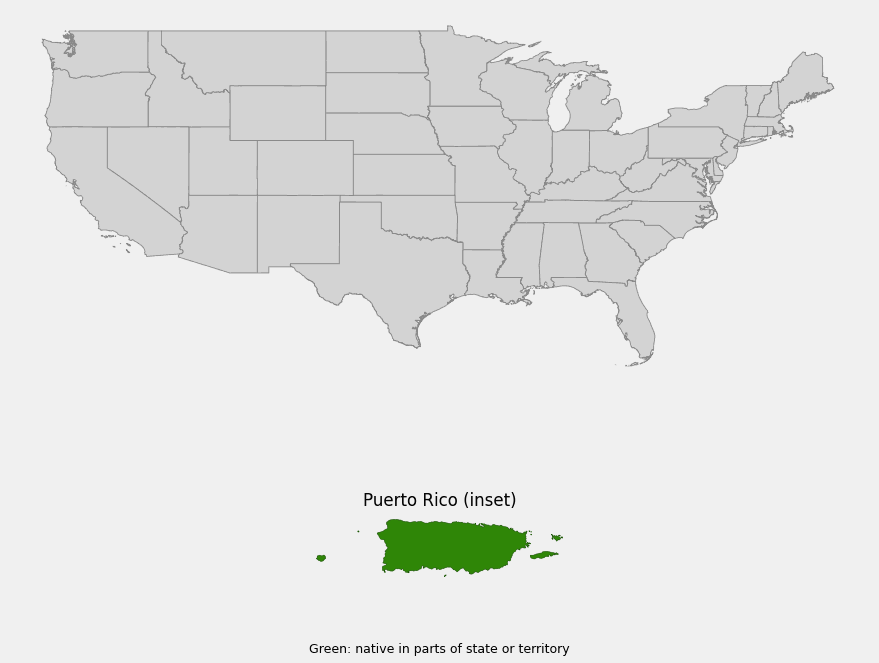
USDA PLANTS lists Sabal causiarum as native to Puerto Rico and the Virgin Islands. The Smithsonian flora of Puerto Rico and the Virgin Islands records it on the main island of Puerto Rico plus Mona and Vieques, and in the Virgin Islands on Anegada, Guana Island, Tortola, Virgin Gorda and St. Croix. Outside U.S. territory it grows on Hispaniola, in southwestern Haiti and the eastern Dominican Republic, and it has been reported from St. Lucia and St. Barthélemy in the Lesser Antilles. Records from St. John in the U.S. Virgin Islands have been reassessed as introductions.
This is a lowland palm. It grows from sea level up to roughly 330 feet (100 m), on the coastal plain and the lower hills behind it, including dry limestone country. In Puerto Rico it is most conspicuous in the southwest, around Cabo Rojo, Lajas and the Guánica area, where large palms stand scattered through pastures and open scrub. Many of those trees are survivors: when forest was cleared for grazing and cane, the palms were often left standing because their leaves were worth more than the land under them.
The IUCN Red List assessed the species as Vulnerable in 2018. It is not listed under the U.S. Endangered Species Act. The threats behind the assessment are the usual lowland ones in the Caribbean: coastal and suburban development, conversion of pasture, and the fact that scattered pasture palms rarely get a chance to regenerate because seedlings are grazed or mowed off.
📋 Regional plant lists featuring Puerto Rico Hat Palm: Puerto Rico
Growing & Care Guide
For a palm this large, the hat palm is surprisingly easy. It wants sun, drainage and patience. Once the trunk is up, it needs almost nothing: it shrugs off drought, salt wind and alkaline limestone soil, and its heavy trunk and short, stiff crown give it a good record in hurricanes compared with taller, thinner-trunked palms. The catch is speed. This is a slow palm, and a nursery specimen with real trunk height is expensive for a reason.
Light
Plant in full sun. Seedlings tolerate light shade, but the palm develops its dense, symmetrical crown and thick trunk only in the open. In shade it stretches, stays thin and never looks like itself.
Soil & Water
Almost any soil works as long as water moves through it: sand, loam, clay over limestone, or the shallow alkaline soils of the southwest coast. It is noticeably drought tolerant once established, which is why it persists in the dry southwest, and it handles coastal salt wind well. Water new plantings weekly through the first dry season, then taper off. Avoid sites that stay waterlogged.
Planting Tips
Give it room. A mature crown is 15 to 20 feet across and the trunk base is wide, so keep it well away from walls, walks and overhead lines. Plant at the same depth it grew in the container; burying the base of a palm invites rot. Palms transplant best in warm weather, and a large field-dug specimen needs bracing and a reduced crown for the first year. In Puerto Rico it suits avenues, parks, large lawns and farm entrances.
Pruning & Maintenance
Remove only completely dead, brown leaves. Cutting back green leaves to give a palm a “clean” look starves it and weakens the trunk, and leaves it more vulnerable in a storm. Never cut into the crownshaft area or damage the growing point, which is the single bud at the top: a palm cannot resprout from a broken trunk. A yearly application of a slow-release palm fertilizer with magnesium and potassium keeps the leaves dark and prevents the yellow-orange older-leaf spotting caused by potassium deficiency in sandy or limestone soils.
Propagation
Seed only. Palms do not sucker, layer or take cuttings. Collect ripe black fruit, clean the pulp off, and sow fresh in a deep container of well-drained mix; Sabal seed germinates reasonably well but unevenly, often over several months, and the seedling pushes a deep sinker root before it makes a visible leaf. Use deep pots, be patient, and expect several years before a trunk shows above ground.
Landscape Uses
- Avenue and street palm: a formal, massive trunk that tolerates pavement heat, salt and drought
- Park and campus specimen: single or in a widely spaced grove, where the trunk can be seen
- Coastal landscapes: salt-wind tolerant for dry southern and western Puerto Rico
- Pasture and farm plantings: a traditional working tree that also gives shade and shelter
- Restoration of dry lowlands: a native canopy element for Cabo Rojo, Lajas and Guánica area plantings
Wildlife & Ecological Value
A flowering hat palm is one of the better nectar events in the dry lowlands, and the fruit crop is enormous. Both matter in a landscape where much of the original forest is gone.
For Pollinators
The small white flowers are produced by the tens of thousands and are freely worked by honey bees and native bees. Palms in the genus Sabal are well known as nectar sources, and a flowering palm hums audibly in the middle of the day.
For Birds
The black fruit is eaten by birds, and the dense crown of stiff leaves makes good roosting and nesting cover. Dead and hollowing trunks of large palms are used as nest sites by cavity-nesting birds, which is one reason to leave a declining palm standing where it is safe to do so.
For Mammals
Bats are Puerto Rico’s only native land mammals, and fruit bats feed in and move among palm crowns. The fruit is also taken by introduced rats and by livestock in pastures, which is one of the reasons scattered pasture palms seldom replace themselves.
Ecosystem Role
In much of southwestern Puerto Rico the hat palm is the largest tree left in a cleared landscape. Those scattered giants act as perches, roosts and seed-dispersal hubs that help woody plants recolonize pasture, and they are living remnants of the lowland vegetation that preceded cane and cattle.
Cultural & Historical Uses
The hat industry is the reason for both names. In 1901 Orator F. Cook described hat making centered on the village of Joyuda in Cabo Rojo, where “large quantities” of hats were produced from the unopened young leaves of this palm; he named the species Inodes causiarum, “of hats,” and Odoardo Beccari later transferred it to Sabal. Andrew Henderson reported that the industry had declined considerably by the 1980s, though hats, baskets, mats and hammocks are still woven from yarey leaves by craftspeople.
Nothing on the palm went unused. Mature leaves were used for thatching roofs, the stiff leaf segments and fiber for brooms, which is where palma de escoba comes from, and the trunks for rough posts and construction. The names record the uses: palma de sombrero for hats, palma de escoba for brooms, palma de abanico for the fan-shaped leaves.
The species also has a tangled taxonomic record that reflects how widely it grows. Udo Dammer described Inodes glauca in 1903 from Paul Sintenis’s collections near Peñuelas in Puerto Rico, Beccari described Sabal haitensis from Haiti in 1931, and Liberty Hyde Bailey described Sabal questeliana from St. Barthélemy in 1944. All three are now treated as the same palm.
Frequently Asked Questions
Is the Puerto Rico hat palm the same as the cabbage palm?
No, but they are close relatives. The Cabbage Palm of the southeastern United States is a different Sabal with a much more slender trunk. Sabal causiarum is stouter in the trunk and is a Caribbean species; it is not native to the mainland United States.
How fast does it grow?
Slowly. A seedling spends several years as a ground-level rosette before any trunk appears, and trunk height is added at a modest rate after that. Buy the largest specimen your budget allows if you want immediate effect.
Can I grow it in Florida or California?
It is grown as a landscape palm in South Florida and other frost-free areas, and large old specimens exist there, including one planted by Thomas Edison in Fort Myers. It is not native to the mainland, so if you garden there, treat it as an ornamental and choose a locally native palm when you want wildlife and habitat value.
Is it endangered?
It is not listed under the U.S. Endangered Species Act. The IUCN Red List assessed it as Vulnerable in 2018, mainly because of lowland development and poor regeneration in grazed pastures. Buy nursery-grown plants and never dig palms from the wild.
Can I still get a real yarey hat?
Hats, baskets and mats are still woven from the young leaves of this palm in Puerto Rico, though far less than in 1901, when the Cabo Rojo hat trade was a significant local industry. Buying from craftspeople who harvest leaves sustainably supports both the craft and a reason to keep the palms standing.

Looking for a nursery that carries Puerto Rico Hat Palm?
Our nursery directory does not yet include Puerto Rico. Browse the native plant nursery directory by state: Alabama–Arkansas · California · Colorado–Hawaii · Idaho–Kansas · Kentucky–Montana · Nebraska–Oklahoma · Oregon · Pennsylvania–Virginia · Washington · West Virginia–Wyoming