
Sierra Palm (Prestoea acuminata var. montana)
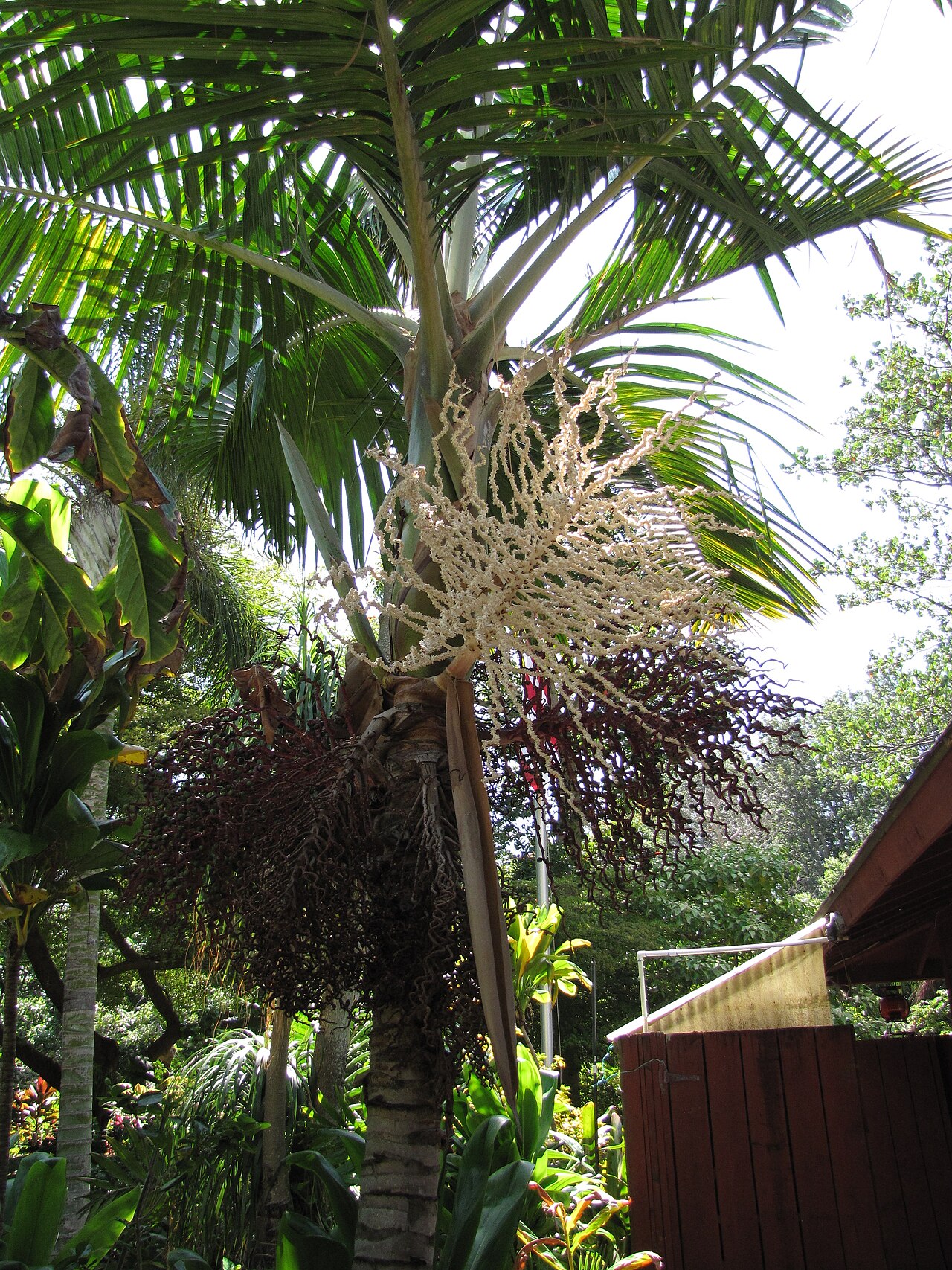
Prestoea acuminata var. montana, the sierra palm or palma de sierra (USDA PLANTS: Sierran palm), is the slender feather palm that fills the wet mountain slopes of eastern Puerto Rico. Anyone who has driven up PR-191 into El Yunque has seen it: thin gray trunks standing on a cone of prop roots, narrow crowns of arching fronds, and whole hillsides and ravines where the palm is the main tree. Most older books and many signs still call it Prestoea montana, and it was first described as Euterpe montana; Euterpe globosa is another old synonym.
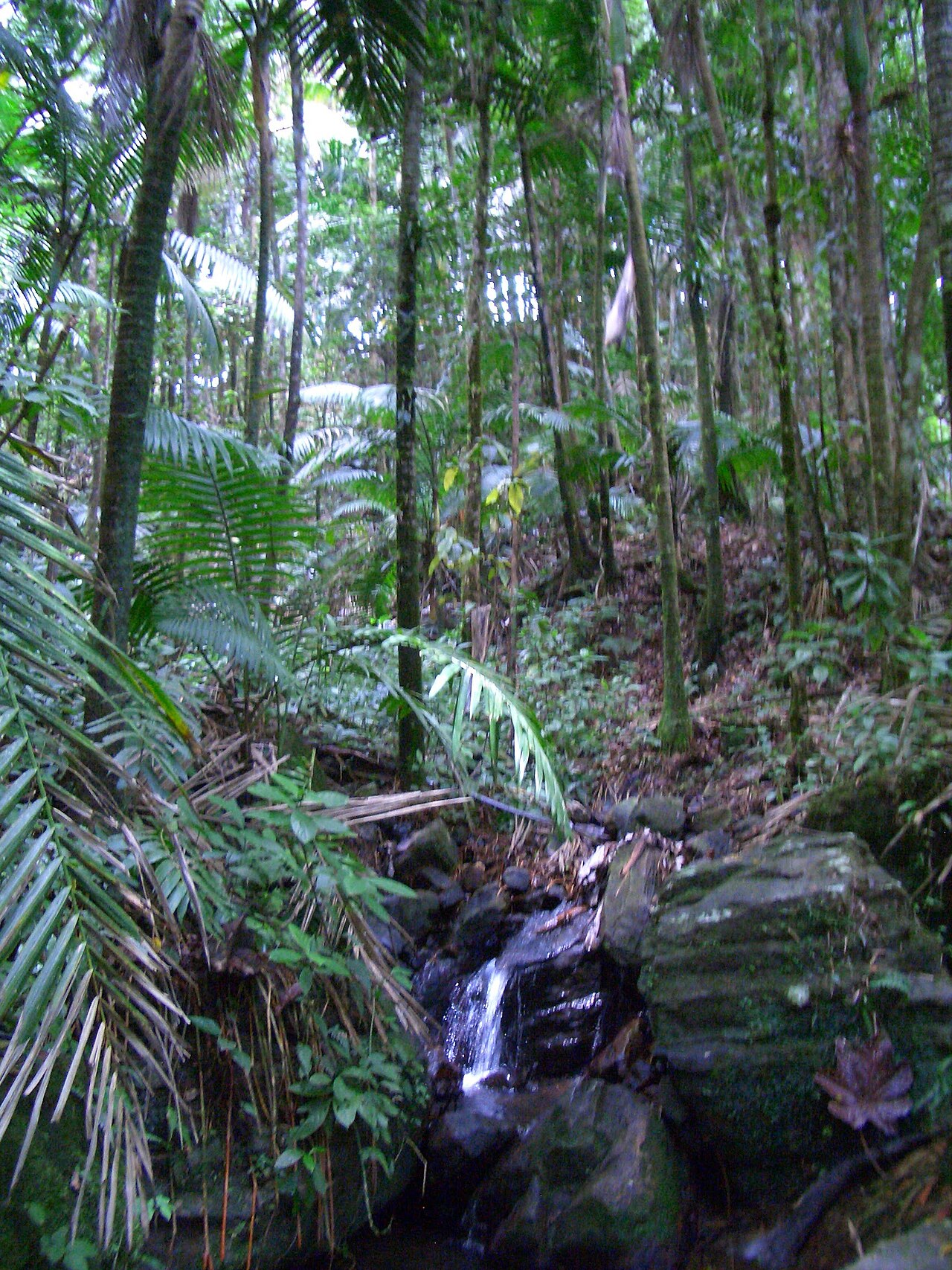
In the Luquillo Mountains the sierra palm gives its name to an entire forest type, the palm forest or bosque de palma de sierra, which takes over on steep slopes, along mountain streams and on shallow, waterlogged soils above about 600 m (2,000 ft). It also grows in the Cordillera Central, including Toro Negro State Forest. Outside Puerto Rico this variety is found in Cuba, Hispaniola, the Lesser Antilles and Trinidad and Tobago.
For gardeners in Puerto Rico, the sierra palm is a native palm for shady, constantly moist sites in the wetter uplands. It is not a palm for dry coastal yards, and it is frost-tender, so in the mainland United States it is only a collector’s plant for the warmest, wettest gardens. This guide covers how to recognize it, where it grows, and what it needs to thrive.
Identification
Sierra palm is easiest to recognize by three things together: a slim, uniform trunk on a cluster of stilt roots, a narrow crown of pinnate (feather) leaves, and flower clusters that hang from the trunk below the leaves rather than emerging among them.
Form & Size
A slender palm with a thin, tall trunk of nearly uniform diameter, commonly up to about 15 m (roughly 45 to 50 ft) in the wild. The crown is narrow, carrying several pinnate leaves. In dense palm forest the trunks stand close together and form an almost pure stand of palms over a layer of ferns and young palms.
Roots & Trunk
One of the most distinctive features is the cluster of prop or stilt roots at the base of the trunk. These root cones are conspicuous along trails in El Yunque, especially on slopes and streambanks, and help anchor the palm in saturated, shallow soil. The trunk is gray to greenish and marked by rings where old leaves have fallen.
Leaves
The leaves are pinnate, with many narrow, pointed leaflets arranged along a central stalk, and arch out from the top of the trunk. Fallen leaves are a common sight on the forest floor beneath palm stands. The soft, whitish, cylinder-shaped inner leaf bases at the top of the stem are the palm heart (palmito).
Flowers
Tiny whitish flowers are borne in a short, narrow, branched cluster on a whitish stalk that hangs below the crown. Flowering and fruiting take place throughout the year, so flowering clusters and fruiting clusters are often present on the same palm at once.
Fruit
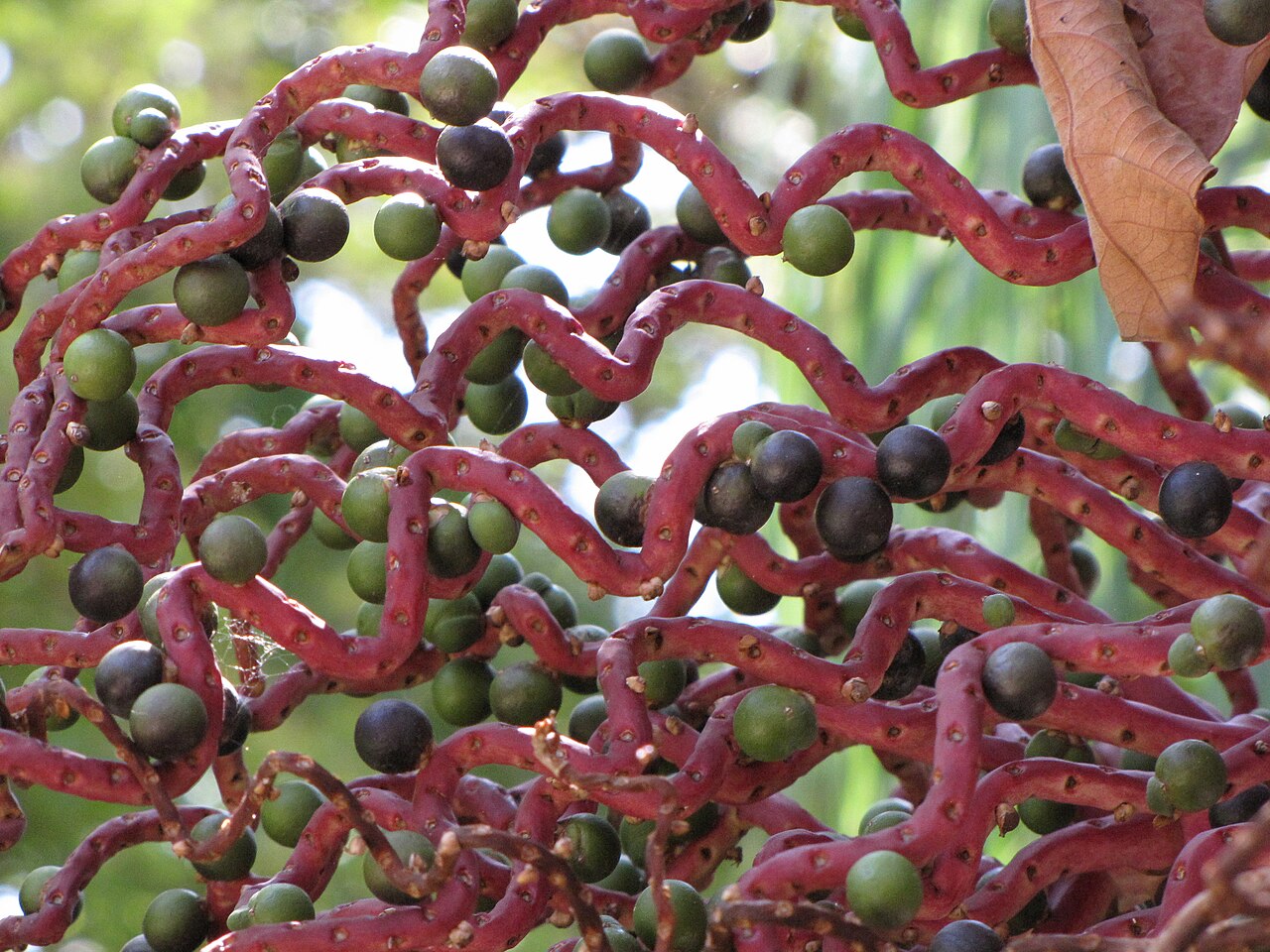
The fruit is a small, round, one-seeded fruit about 1 cm (⅜ in) across, green at first and ripening purplish black. As the fruits develop, the branches of the cluster turn reddish and take on a noticeable zigzag shape between the fruits.
Similar Species
Palma de lluvia or llume (Gaussia attenuata) is also called palma de sierra in some sources, which causes confusion, but it is a karst palm of the northern and western limestone hills, with a gray trunk that is swollen at the base and tapers upward, and orange-red fruit. The Puerto Rico royal palm (Roystonea borinquena) is far stouter, with a smooth green crownshaft. In the mountains, sierra palm grows with the West Indian tree fern, whose lacy, divided fronds and scaly trunk are easy to tell from a palm.
Quick Facts
| Scientific Name | Prestoea acuminata (Willd.) H.E. Moore var. montana (Graham) A. Hend. & G. Galeano |
| Family | Arecaceae (palm family) |
| Plant Type | Evergreen feather palm |
| Mature Height | Up to about 45–50 ft (15 m) in the wild; usually less in gardens |
| Mature Spread | Narrow crown, roughly 8–15 ft (2.5–4.5 m) |
| Growth Rate | Moderate where soil stays wet; slow in dry or exposed sites |
| Sun Exposure | Part shade to shade; tolerates sun only with constant moisture |
| Water Needs | High; needs constantly moist to wet soil and humid air |
| Soil Type | Moist to saturated, acid, organic soils; clay and rocky streambanks |
| Soil pH | Acid |
| Bloom Time | Year-round |
| Flower Color | Whitish |
| Fall Color | None; evergreen |
| Fruit | Round purplish-black fruit about 1 cm, on zigzag reddish branches |
| Deer Resistant | Not applicable in Puerto Rico |
| USDA Hardiness Zones | 11–13 (frost-tender; wet, humid tropics) |
Native Range
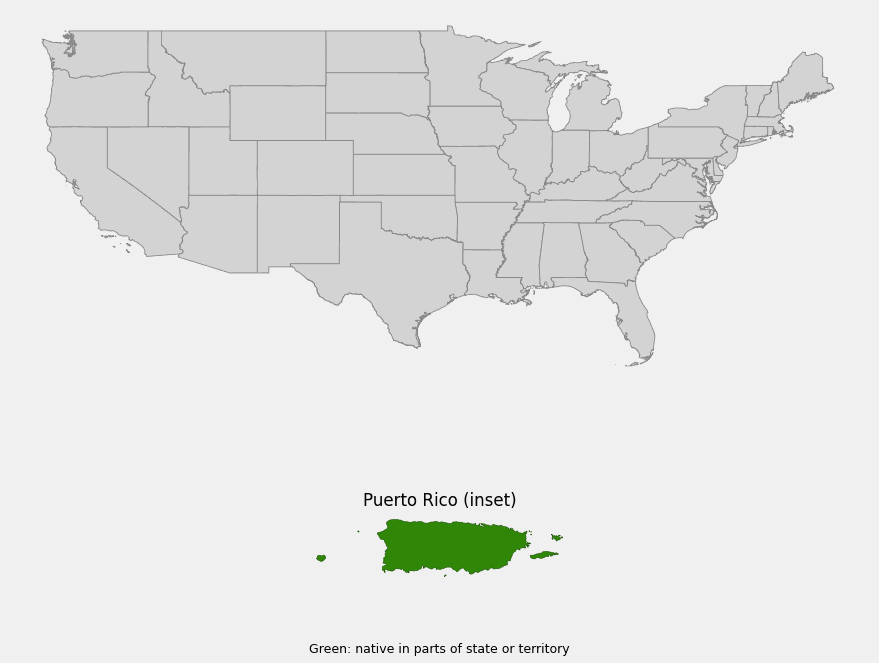
USDA PLANTS lists the sierra palm (symbol PRACM, Sierran palm) as native in Puerto Rico. It does not list it as native in any U.S. state, and it is not native to Florida. Beyond Puerto Rico, Prestoea acuminata var. montana grows in Cuba, Hispaniola, the Leeward and Windward Islands of the Lesser Antilles, and Trinidad and Tobago. The other varieties of Prestoea acuminata range from Nicaragua through the Andes to Bolivia.
In Puerto Rico the palm is best known from the Luquillo Mountains of El Yunque National Forest, where it is found throughout the forest but becomes the dominant tree around 600 m (about 2,000 ft) and above. There the shallow, frequently saturated soils of steep slopes and ravines favor the palm over broadleaf trees, creating the distinctive sierra palm forest that sits alongside the palo colorado forest and below the dwarf cloud forest of the summits. It also grows in the creek forests of the mountains, on the steep slopes of the island’s highest peaks, and in the Cordillera Central, including Toro Negro State Forest.
Studies in the Luquillo Mountains associate the palm with landslides: the steep, rain-soaked slopes slip often, and sierra palm is one of the trees that colonizes and holds this disturbed ground. Rainfall in these mountains is among the highest in Puerto Rico, and the palm forest spends much of its time in cloud and drizzle. That combination of wet, unstable soil and constant humidity is the habitat gardeners need to imitate.
📋 Regional plant lists featuring Sierra Palm: Puerto Rico
Growing & Care Guide
Sierra palm is a palm for wet, shady, humid places. In Puerto Rico it does best in the cooler, rainy interior and the eastern uplands; in drier lowland gardens it needs a sheltered, irrigated spot. It is occasionally grown in botanical gardens in Florida and Hawaii, but it is not native to Florida and only suits the warmest, wettest sites there. Buy nursery-grown plants; never dig palms or harvest seed in El Yunque National Forest or other public forests.
Light
In nature the palm grows under cloud and forest canopy, so part shade to full shade suits it best, especially when young. It can take more sun only where soil moisture and humidity stay high; in hot, sunny, dry spots the leaves scorch and growth stalls.
Soil & Water
Give it deep, acid, organic soil that never dries out. The palm thrives on saturated mountain soils and streambanks, so a low spot, a stream edge or a regularly irrigated bed is ideal. It is not suited to alkaline limestone soils, coastal sand or salt spray. Water generously during dry spells and keep a thick mulch of leaf litter over the roots.
Planting Tips
Plant in a sheltered, humid site out of strong wind. Set the palm at the same depth it grew in the container; the stilt roots will develop on their own above the soil line. Because the crown is narrow, it fits between larger trees or at the edge of a shaded garden, and a small group of palms looks more natural than a single specimen.
Pruning & Maintenance
Remove only fully brown leaves. Never cut into the growing point: harvesting the palm heart (palmito) from the top of the trunk kills the stem. Fallen leaves and fruit stalks can be left as mulch. Little else is needed where the soil stays wet.
Propagation
Grow from fresh seed. Collect ripe, purplish-black fruits from cultivated palms, clean off the pulp and sow promptly in a moist, shaded seed bed; palm seeds generally lose viability if they dry out. Germination and early growth are slow, and seedlings need steady moisture and shade.
Landscape Uses
- Native palm for shady, wet gardens: a slender, airy palm for moist upland yards in Puerto Rico
- Streambank and slope plantings: its stilt roots and tolerance of saturated soil suit wet slopes and creek edges
- Wildlife gardens: fruits year-round, a favorite food of the Puerto Rican parrot and other fruit eaters
- Forest restoration: a characteristic species of Puerto Rico’s montane palm forest
- Botanical collections: a West Indian palm grown in a few tropical botanical gardens
Wildlife & Ecological Value
Because it flowers and fruits all year, the sierra palm is a steady food source in the mountain forests of Puerto Rico.
For Pollinators
The small whitish flowers are produced in large numbers on branched clusters through the whole year, and are visited by small insects. Their year-round availability adds a constant nectar and pollen supply to the mountain forest.
For Birds
The fruit of the sierra palm is the favorite food of the critically endangered Puerto Rican parrot (Amazona vittata), which eats the fleshy outer part of the fruit. Other fruit-eating birds of the Luquillo forest also take the fruits, and the year-round fruit supply is especially valuable when other trees are not fruiting.
For Mammals
Puerto Rico’s native land mammals are bats; the palm contributes mainly fruit and forest structure.
Ecosystem Role
Sierra palm is a foundation species in the Luquillo Mountains, forming its own forest type on the steepest, wettest ground. Its stilt roots help hold soil on unstable slopes, and it is closely associated with the landslide scars that are a natural part of these rain-soaked mountains. The palm forest also shelters the common coquí (Eleutherodactylus coqui), Puerto Rico’s famous tree frog.
Cultural & Historical Uses
The palm was first described as Euterpe montana by Robert Graham and was later moved to Prestoea as Prestoea montana, the name used in most Puerto Rican field guides. Andrew Henderson and Gloria Galeano treated it as a variety of the wider-ranging Prestoea acuminata in 1996, which is the name USDA PLANTS accepts today. The genus honors Henry Prestoe (1842–1923), an English botanist who collected the plant in Trinidad, and montana is Latin for “of the mountains.”
In Puerto Rico the tree is palma de sierra, the mountain palm, and the name is everywhere in El Yunque: the Palma de Sierra picnic and recreation area and the Sierra Palm visitor area along PR-191 are named for it, and the sierra palm forest is one of the forest types interpreted for visitors.
Like many palms, the sierra palm has an edible heart (palmito), the soft, whitish inner leaf bases at the top of the stem, which can be eaten in salad. Taking it kills the stem. Its wider-ranging relative, Prestoea acuminata var. acuminata, was once harvested heavily for palm hearts in Ecuador until overharvesting made it uncommon; in Puerto Rico, wild palms in public forests are protected and should be left alone.
Frequently Asked Questions
Is the sierra palm the same as Prestoea montana?
Yes. Prestoea montana is the older name still used in many guides. USDA PLANTS and current palm references treat the plant as Prestoea acuminata var. montana, the Caribbean variety of a palm that also grows in Central and South America. Euterpe montana and Euterpe globosa are older synonyms.
Where can I see sierra palm forest in Puerto Rico?
El Yunque National Forest is the classic place. Palm forest dominates steep slopes and ravines around 600 m and higher, and roads and trails such as PR-191 and the trail to Mount Britton pass through it. The palm also grows in the Cordillera Central, including Toro Negro State Forest.
Can I grow sierra palm in a coastal or dry part of Puerto Rico?
Only with a lot of help. The palm needs constantly moist, acid soil, shade and high humidity. In dry southern or coastal gardens it struggles; native palms such as Puerto Rico hat palm are better choices there.
Is sierra palm native to Florida?
No. USDA PLANTS lists it as native only in Puerto Rico among U.S. states and territories. It is occasionally grown in South Florida botanical collections, but Florida gardeners looking for native palms should grow cabbage palm, Florida thatch palm or Florida silver palm.
Why is the sierra palm important to the Puerto Rican parrot?
Its fruit is the parrot’s favorite food, and because the palm fruits all year it provides food when other trees are bare. Protecting the palm forest of the Luquillo Mountains protects one of the parrot’s key food sources.

Looking for a nursery that carries Sierra Palm?
Our nursery directory does not yet include Puerto Rico. Browse the native plant nursery directory by state: Alabama–Arkansas · California · Colorado–Hawaii · Idaho–Kansas · Kentucky–Montana · Nebraska–Oklahoma · Oregon · Pennsylvania–Virginia · Washington · West Virginia–Wyoming