
Saw Greenbrier (Smilax bona-nox)
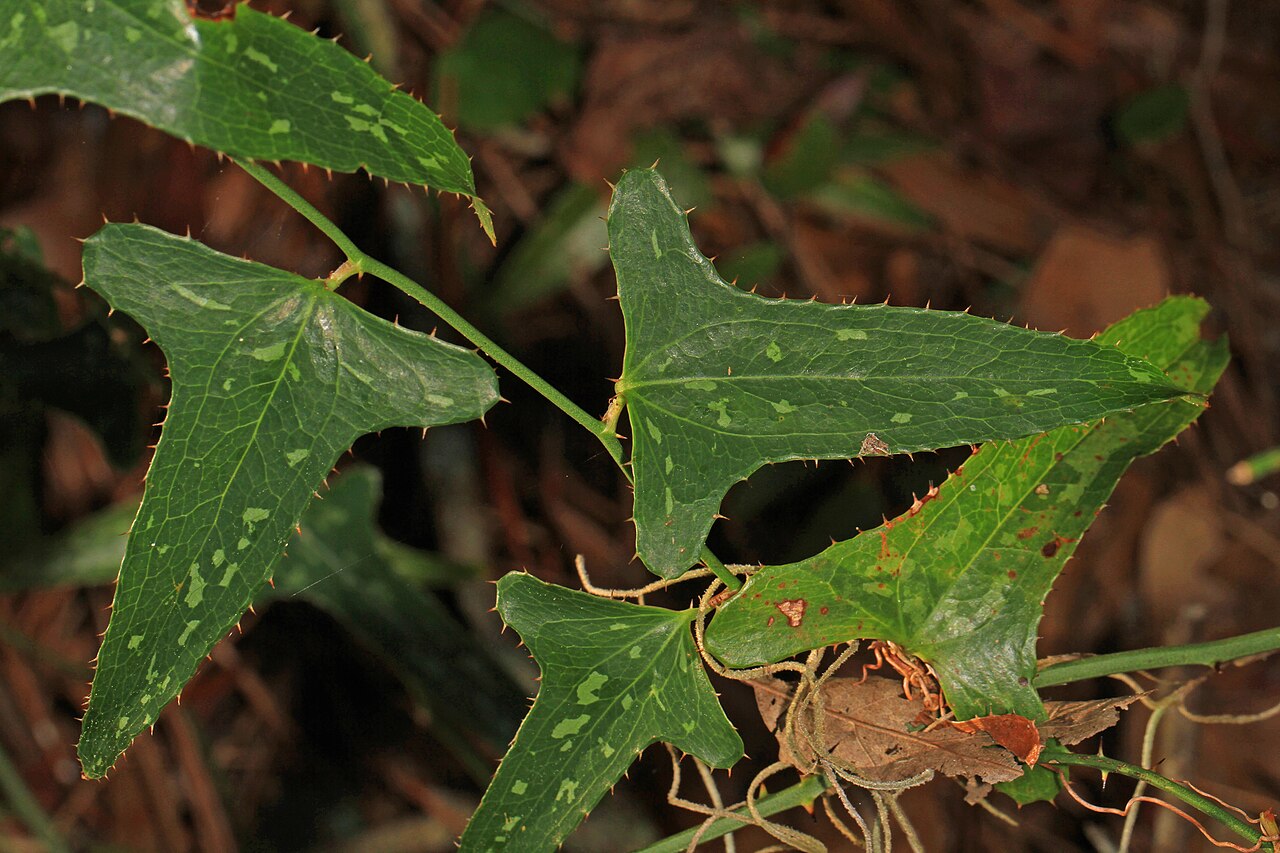
Smilax bona-nox, known as Saw Greenbrier, is a tough, prickly, semi-evergreen vine of the southeastern and south-central United States. It climbs with paired tendrils over shrubs, fences and small trees, and where it has room it forms dense, nearly impenetrable thickets. Its common names say a lot about how people have met it: catbrier, bullbrier, stretchberry and tramp’s trouble. The “saw” refers to the fine, bristly prickles that line the edges of many of its leaves.
Greenbriers belong to the family Smilacaceae, and they are among the few woody vines that are monocots, related more closely to lilies than to grapes or honeysuckles. Saw greenbrier is one of the most variable members of the genus. Its leaves range from nearly heart-shaped to sharply three-lobed like an arrowhead or fiddle, they are often marbled with pale spots, and in mild winters many of them stay green until spring.
Few gardeners plant saw greenbrier on purpose, and most meet it as a thorny volunteer. It is still a valuable native plant. Its black berries hang on the vine all winter and feed songbirds, turkeys and mammals, its thickets shelter wildlife, and its young shoots are a well-known wild edible. This guide covers how to identify it, where it grows, how to manage or use it in a native landscape, and what it does for wildlife.
Identification
Saw greenbrier shares tendrils, prickles and parallel-veined leaves with other greenbriers, and the species can be hard to separate. The best clues are the thickened, often bristle-toothed leaf margins, the frequent fiddle or arrowhead leaf shape, pale mottling on the leaves, and prickles concentrated on the lower stems.
Roots & Stems
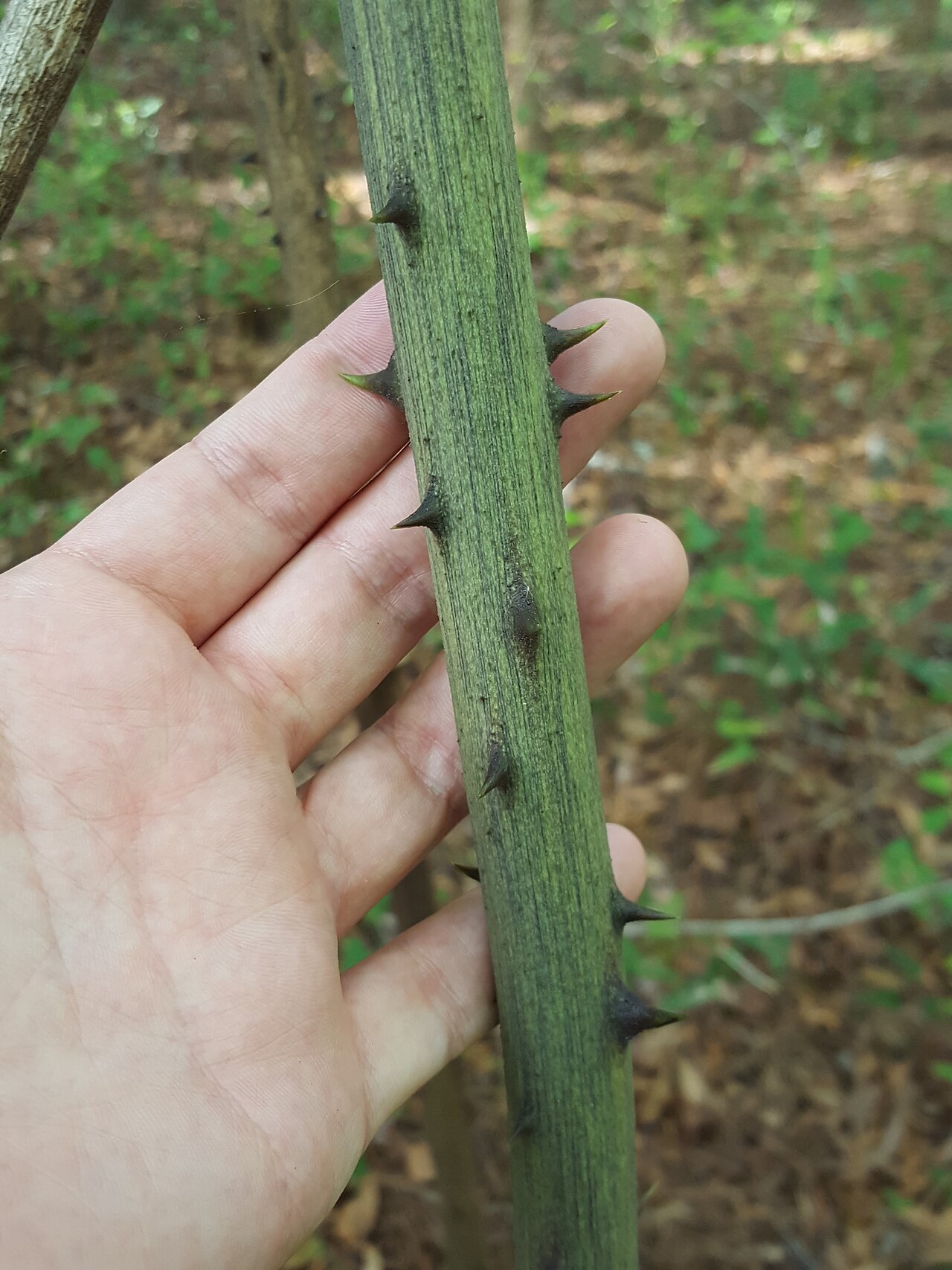
Saw greenbrier grows from a network of long rhizomes with knotty, swollen tubers that store starch and let the plant resprout after cutting, grazing or fire. The stems are green, smooth and somewhat angled, and they stay green and photosynthetic for years. The lower stems carry stout, flattened, sharp prickles, while the upper stems are often nearly unarmed. Vines typically climb 10 to 20 feet into shrubs and trees, and they can reach higher on tall supports.
Leaves
The leaves are alternate, leathery to firm, and up to about 4½ inches long and 4 inches wide. Their shape is remarkably variable even on one plant: ovate, heart-shaped, triangular, or fiddle-shaped with a broad, rounded lobe on each side near the base. The margins are thickened and, on many leaves, lined with small, bristly prickles, and the midrib may also have a few prickles on the underside. Upper surfaces are often mottled with pale green or whitish blotches. A pair of tendrils grows from the base of each leaf stalk. The leaves are semi-evergreen, staying on the vine through mild winters in the Deep South.
Flowers
Like other greenbriers, saw greenbrier is dioecious, with male and female flowers on separate plants. In spring (roughly March to May) small, round umbels of greenish to yellowish-green, six-parted flowers appear on short stalks in the leaf axils. The flowers are only about ¼ inch across and are easy to miss, though they have a faint sweet scent.
Fruit & Seeds
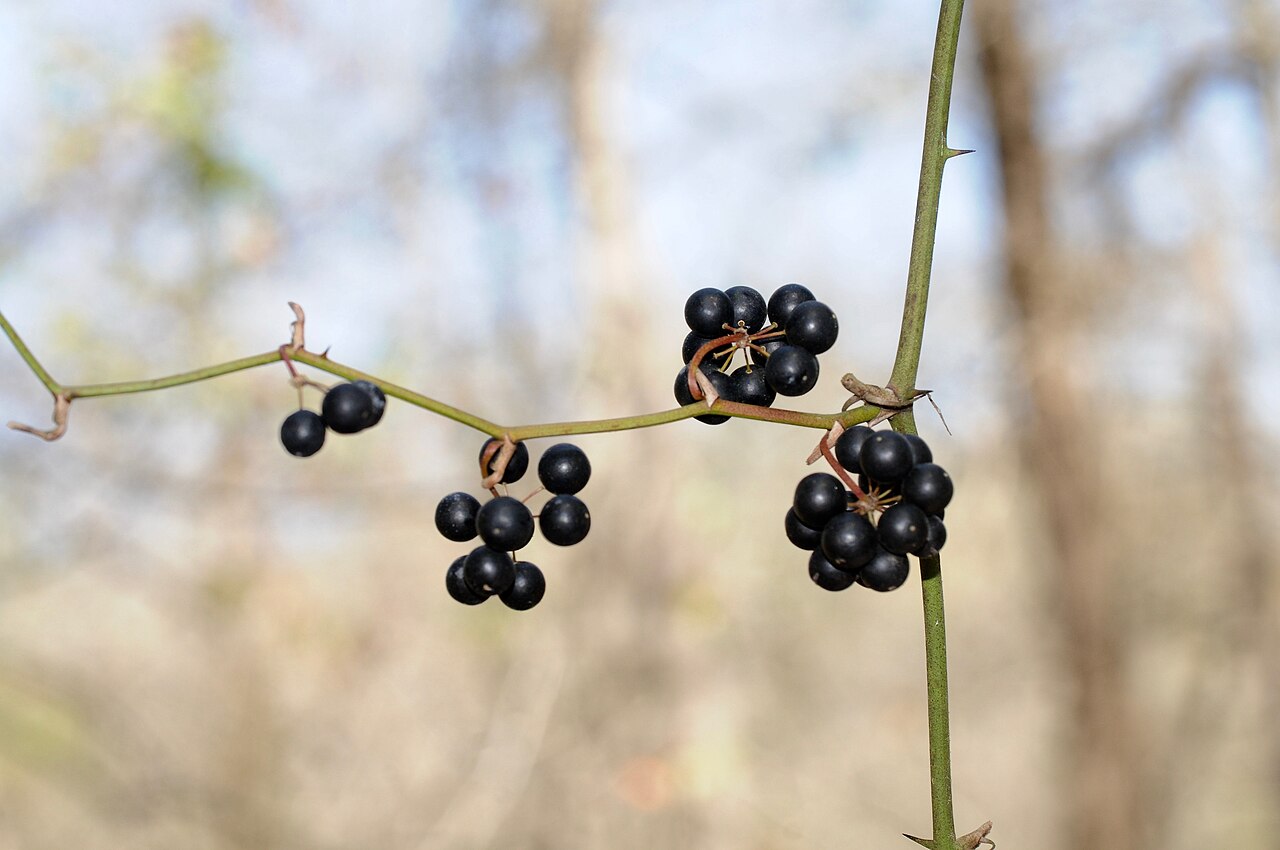
Female plants produce round umbels of berries about ¼ inch across. They ripen from green to glossy black, often with a slight bloom, in fall, and they persist on the vine through winter. Each berry usually contains a single seed. Birds and mammals spread the seeds, which is why new plants appear along fence lines, under trees and wherever birds perch.
Quick Facts
| Scientific Name | Smilax bona-nox L. |
| Family | Smilacaceae (greenbrier family) |
| Plant Type | Semi-evergreen woody vine with tendrils; climbs or forms thickets |
| Mature Height | Climbs 10–20 ft or more on supports |
| Mature Spread | Spreads by rhizomes into thickets several yards across |
| Growth Rate | Moderate to fast |
| Sun Exposure | Full sun to shade |
| Water Needs | Low to moderate; drought tolerant once established |
| Soil Type | Sand, loam or clay; well-drained to periodically moist |
| Soil pH | About 5.0–8.0; tolerates some limestone |
| Bloom Time | March–May |
| Flower Color | Greenish to yellowish green, small |
| Fall Color | Leaves mostly stay green; some turn bronze or fall in cold winters |
| Fruit | Black berries in round clusters, ripening in fall and persisting through winter |
| Deer Resistant | No; deer browse the leaves and tender shoots |
| USDA Hardiness Zones | 6–10 |
Native Range
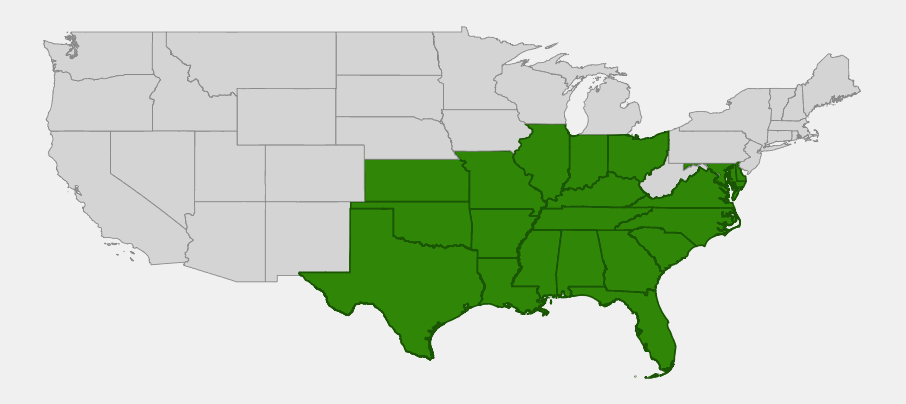
Saw greenbrier is a plant of the southeastern and south-central United States. USDA PLANTS records it as native in 20 states: from Delaware and Maryland south along the coast to Florida, west across the Gulf States to Texas and Oklahoma, and north through Tennessee, Kentucky, Arkansas and Missouri to southern Illinois, Indiana, Ohio and eastern Kansas. Its range continues south into northeastern Mexico.
It is most abundant on the Coastal Plain and in the woodlands and prairies of Texas, Oklahoma and Arkansas, where it is one of the commonest vines in post oak savannas, cross timbers, coastal hammocks and fencerows. Toward the northern edge of its range in the Ohio Valley and the lower Midwest it is scattered and mostly confined to southern counties. It does not grow in the Appalachian high country.
Saw greenbrier tolerates a wide range of conditions, which helps explain how common it is. It grows on dry sandhills and coastal dunes, in upland oak and pine woods, along floodplain forests and stream banks, and in old fields, hedgerows and disturbed ground. Its tubers let it survive fire, and in fire-maintained pine woods it often resprouts quickly after a burn.
📋 Regional plant lists featuring Saw Greenbrier: Ohio & Indiana · Kentucky & Tennessee · Nebraska, Kansas & Eastern Colorado · Maryland, Virginia & West Virginia · Delaware, Southern New Jersey & Long Island · Illinois, Iowa & Missouri · Alabama, Georgia & Mississippi · North & South Florida
Growing & Care Guide
Saw greenbrier is almost never sold by nurseries, and most gardeners deal with it as a volunteer. In a naturalistic or wildlife-focused landscape, though, it can be worth keeping where it has room. A greenbrier thicket at the back of a property, along a fence or in a hedgerow provides winter fruit and safe cover that few other plants can match. The key is to decide where you want it and control it everywhere else.
Light
Saw greenbrier grows in everything from deep woodland shade to full sun. It fruits most heavily where it gets at least half a day of sun, such as woodland edges, fencerows and the top of a shrub layer it has climbed through.
Soil & Water
It is not fussy about soil and grows in sand, loam and clay, from acidic coastal sands to soils over limestone. Its deep tubers make it very drought tolerant once established. No watering or fertilizer is needed after the first season, and rich soil only makes it more vigorous.
Planting Tips
If you want to establish it deliberately, choose a place where a thorny thicket is an asset: along a back fence, a wildlife hedgerow, or a woodland edge away from paths. Give it something to climb, such as a fence, a sturdy shrub or a small tree. Keep it well away from walkways, play areas and places where you will need to work, because the prickles are sharp enough to tear skin and clothing.
Pruning & Maintenance
Wear heavy gloves and long sleeves. Cutting vines back to the ground in late winter keeps a planting in bounds, but the tubers will resprout, so control takes persistence. To remove unwanted plants, repeatedly cut new shoots or dig out the tubers, which can be large and deep. Pulling seedlings while they are small is far easier than removing an established clump. Leave fruiting vines in place through winter for the birds.
Propagation
Saw greenbrier can be grown from cleaned seed sown outdoors in fall. Germination is slow and irregular, and seedlings may take a year or more to appear. Divisions of rhizome with a tuber attached establish more reliably and can be moved in late winter. In practice, birds do most of the planting.
Landscape Uses
- Wildlife hedgerows: a thorny, fruiting layer that gives birds safe nesting and roosting cover
- Woodland edges: lets it climb into existing shrubs and small trees where it does not need to be managed
- Living barrier: a dense, prickly tangle along fences or property lines discourages foot traffic
- Erosion control: its rhizomes and tubers help hold soil on banks and dunes
- Wild food gardens: young shoot tips are a traditional spring wild edible
Wildlife & Ecological Value
Greenbriers rarely get credit from gardeners, but wildlife biologists value them highly. Saw greenbrier provides food in the leanest part of the year and cover all year round.
For Pollinators
The small, fragrant spring flowers are visited by bees and flies, including small native bees, which carry pollen between male and female plants. The flowers are a modest resource but they come early in the season.
For Birds
The berries persist into late winter, long after most other fruit is gone, and are eaten by many birds, including wild turkeys, northern bobwhite, ruffed grouse, fish crows, northern mockingbirds, gray catbirds, cardinals, hermit thrushes and other songbirds, as well as wood ducks. The thorny tangles are excellent nesting and roosting cover for cardinals, brown thrashers, catbirds and other thicket birds, and they provide protection from hawks and cats.
For Mammals
White-tailed deer browse the leaves and tender shoot tips heavily, and greenbriers are an important deer food in many southern forests. Black bears, raccoons, opossums and squirrels eat the berries, and rabbits use the thickets for cover.
Ecosystem Role
Saw greenbrier is a classic edge and thicket plant. Its tubers let it survive fire, drought, browsing and cutting, so it persists in woods and fields as conditions change. Its long-lasting fruit links winter bird populations to the plant, and the birds in turn spread its seeds across the landscape.
Cultural & Historical Uses
Linnaeus named Smilax bona-nox in 1753. The epithet means “good night” in Latin. Its origin is not documented, and it may be an ironic reference to how unpleasant it is to blunder into a greenbrier thicket in the dark. Older works list several varieties, such as var. hederifolia and var. hastata, based on leaf shape, but most modern botanists treat these as forms of a single variable species.
Greenbriers have a long history as food. The tender, unarmed young shoots and tendrils of saw greenbrier and its relatives can be eaten raw or cooked like asparagus in spring, and they are a staple of southern foraging guides. Several Native American peoples in the Southeast used the starchy rhizomes and tubers of greenbriers as a source of starch and used parts of the plant medicinally. As with any wild food, be certain of the identification, harvest only from clean sites, and take only what you need.
Rural names such as tramp’s trouble and bullbrier come from generations of farmers, hunters and hikers who have struggled through its thickets. Southern hunters also know greenbrier tangles as reliable places to find rabbits, quail and deer, since all of them shelter and feed there.
Frequently Asked Questions
How do I tell saw greenbrier from other greenbriers?
Look at the leaves. Saw greenbrier leaves often have a broad lobe on each side near the base, giving a fiddle or arrowhead shape, and their thickened edges are frequently lined with tiny bristly prickles. They are also often mottled with pale spots. Roundleaf greenbrier (Smilax rotundifolia) has rounder, smooth-edged leaves, and laurel greenbrier (S. laurifolia) has narrow, leathery, evergreen leaves.
How do I get rid of saw greenbrier?
Persistence is the key. Dig out the tubers where possible, or cut every new shoot to the ground repeatedly through the growing season so the tubers gradually exhaust their reserves. Removing seedlings while they are small is easy. Wear thick gloves and long sleeves.
Are saw greenbrier berries edible?
The berries are not poisonous to people, but they are seedy and not particularly tasty. The young shoot tips are the part people eat. The berries are much more valuable as winter food for birds and mammals.
Is saw greenbrier evergreen?
It is semi-evergreen. In the Deep South many leaves stay green through winter, while at the northern edge of its range in the Ohio Valley and Kansas more of them drop or turn bronze in cold weather. The green stems stay alive and photosynthetic year-round.
Why do some greenbrier vines never produce berries?
Greenbriers are dioecious: each plant is either male or female. Only female plants produce berries, and they need a male plant somewhere nearby to be pollinated.

Looking for a nursery that carries Saw Greenbrier?
Browse our native plant nursery directory: Alabama & Arkansas · Delaware, Florida & Georgia · Illinois, Indiana & Kansas · Kentucky, Louisiana, Maryland, Mississippi & Missouri · North Carolina, Ohio & Oklahoma · South Carolina, Tennessee, Texas & Virginia