
Green Antelopehorns (Asclepias viridis)
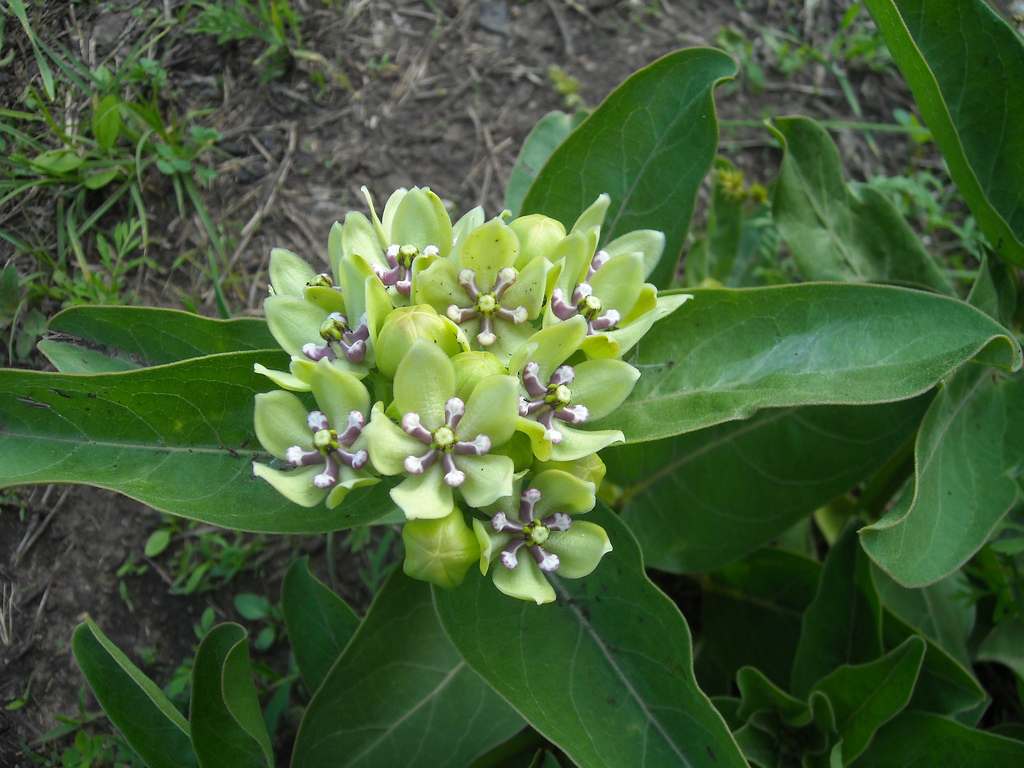
Asclepias viridis, known as Green Antelopehorns (USDA: green antelopehorn), green milkweed or spider milkweed, is a sturdy prairie milkweed of the southern Great Plains, the Ozarks and the Southeast. Its stems are 1 to 2 feet long, often leaning or sprawling, with broad, wavy-edged leaves. In spring it carries rounded clusters of some of the largest flowers of any North American milkweed: pale green, star-shaped blossoms nearly an inch across with a ring of purple hoods at the center. It belongs to the dogbane family (Apocynaceae), which now includes the milkweeds.
Green antelopehorns is a plant of open, sunny ground: tallgrass and mixed-grass prairies, rocky limestone glades, pastures, old fields and roadsides. It flowers early, mostly from April to June, and sometimes again in late summer after mowing or rain. That timing makes it one of the most important host plants for monarch butterflies on their spring journey north. Monarchs returning from Mexico lay their eggs on it across Texas and Oklahoma, and the caterpillars that hatch become the first new generation of the year.
Like other milkweeds, green antelopehorns contains toxic cardiac glycosides in its milky sap, which protect it and the monarch caterpillars that feed on it. This guide covers how to identify it, where it grows natively, how to grow it from seed, and why it matters so much to pollinators.
Identification
Green antelopehorns is easiest to recognize in bloom, when its large, pale green flowers with purple centers are unmistakable. Out of flower, look for the broad, alternate, wavy-edged leaves and milky sap.
Stems & Roots
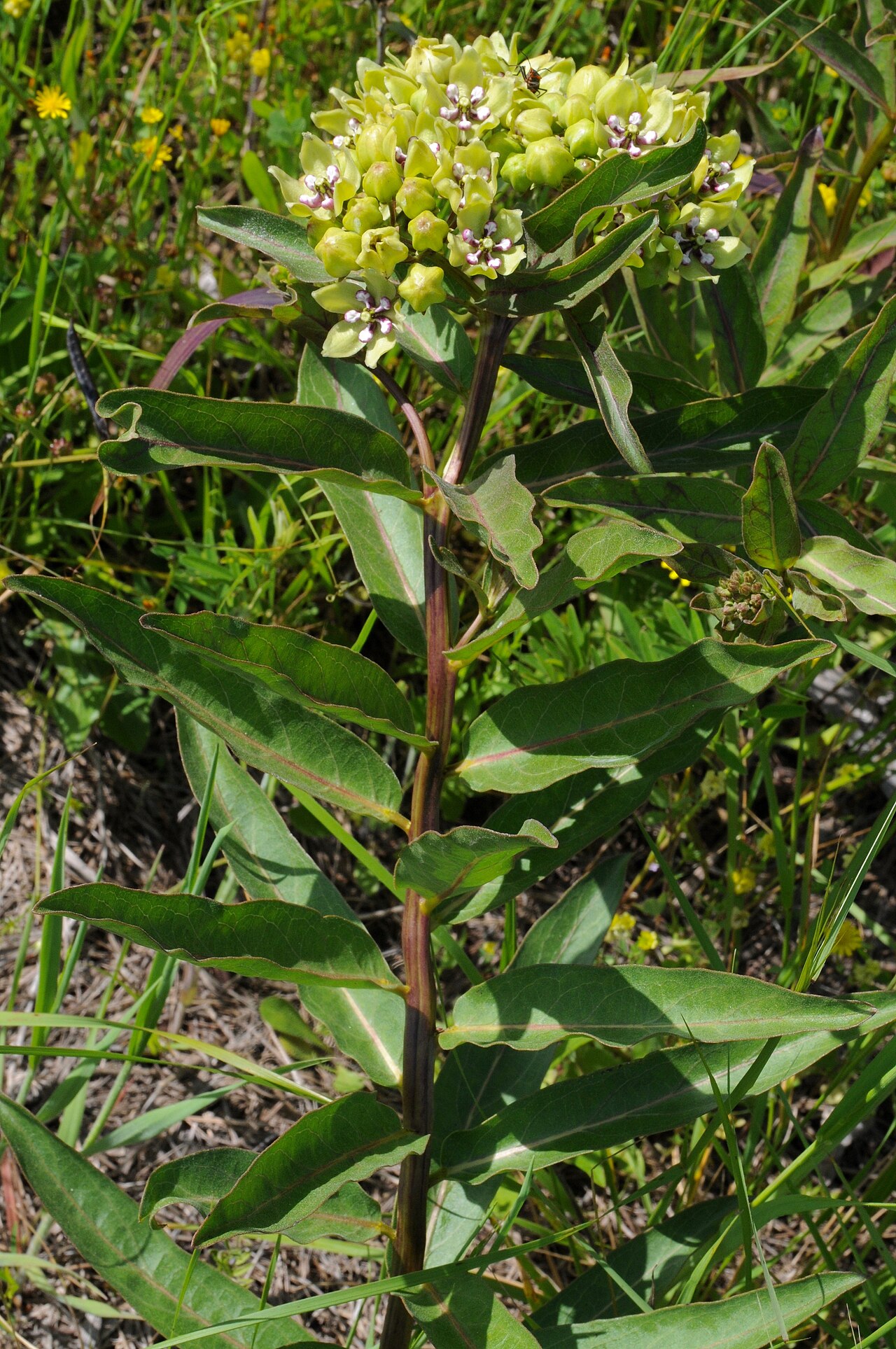
Each plant grows from a deep, thick taproot. One to several stems arise from the crown each spring, usually 1 to 2 feet long. They often lean outward or sprawl along the ground in drier, windy prairies and stand more upright among taller grasses. Stems are stout, smooth or finely hairy, and often reddish. Broken stems and leaves bleed a sticky, white latex.
Leaves
The leaves are mostly alternate or scattered along the stem, a useful difference from the many milkweeds with opposite leaves. They are oblong to oval, 2 to 5 inches long and up to about 2 inches wide, thick, with short stalks and wavy margins. The upper surface is smooth and the underside is paler with a prominent pale midrib.
Flowers
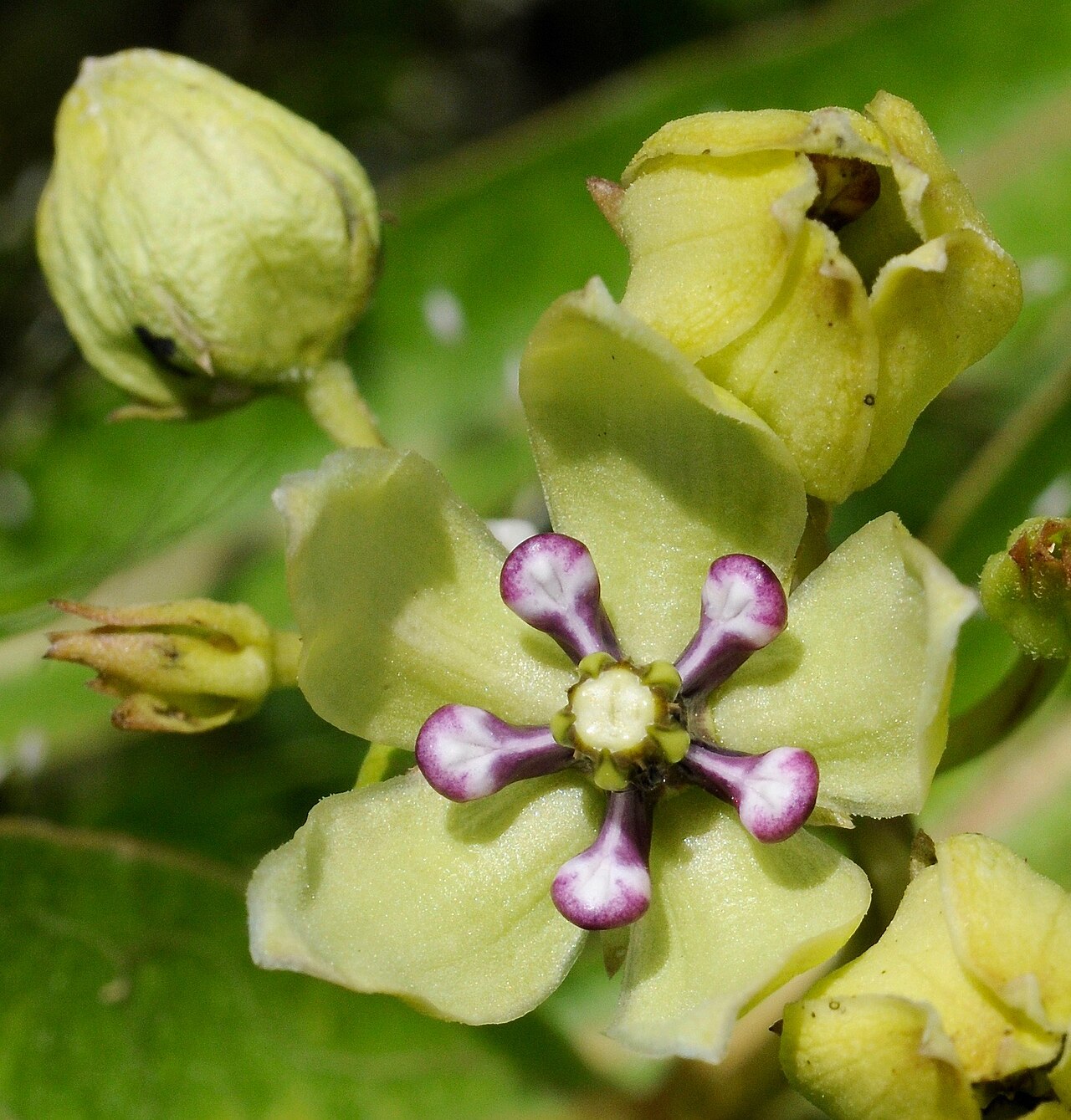
The flowers grow in one to several rounded umbels, usually at the tip of the stem, each with roughly 10 to 50 flowers. Each flower is about ¾ to 1 inch across, with five pale green petals that spread outward and upward rather than bending back, as they do in most milkweeds. In the center, five purple or maroon hoods surround the pale column. Unlike many milkweeds, the hoods have no horns sticking out of them. The flowers have a light, sweet fragrance.
Fruit & Seeds
Pollinated flowers develop into upright, smooth, plump seed pods (follicles) about 3 to 5 inches long, which are often held on bent stalks. In summer they split along one side and release flat brown seeds with tufts of silky white hairs that carry them on the wind.
Look-alikes
Antelope horns (Asclepias asperula) grows in drier, more western habitats and has narrow, folded leaves and greenish flowers with maroon hoods. Green comet milkweed (A. viridiflora) has much smaller, bent-back petals. Common milkweed is taller, with opposite leaves and pink flowers.
Quick Facts
| Scientific Name | Asclepias viridis (syn. Asclepiodora viridis) |
| Family | Apocynaceae (dogbane family; milkweed subfamily) |
| Plant Type | Herbaceous perennial from a deep taproot |
| Mature Height | 1–2 ft (stems often leaning or sprawling) |
| Mature Spread | 1–2 ft |
| Growth Rate | Moderate |
| Sun Exposure | Full sun |
| Water Needs | Low to medium; drought tolerant once established |
| Soil Type | Well-drained clay, loam, sand or rocky limestone soils |
| Soil pH | About 6.0–8.0 (slightly acidic to alkaline; tolerates limestone) |
| Bloom Time | April–June, sometimes again in late summer |
| Flower Color | Pale green with purple hoods |
| Fall Color | None of note; foliage yellows |
| Fruit | Smooth, upright seed pod 3–5 in long with silky-tufted seeds |
| Deer Resistant | Yes; toxic milky sap |
| USDA Hardiness Zones | 5–9 |
Native Range
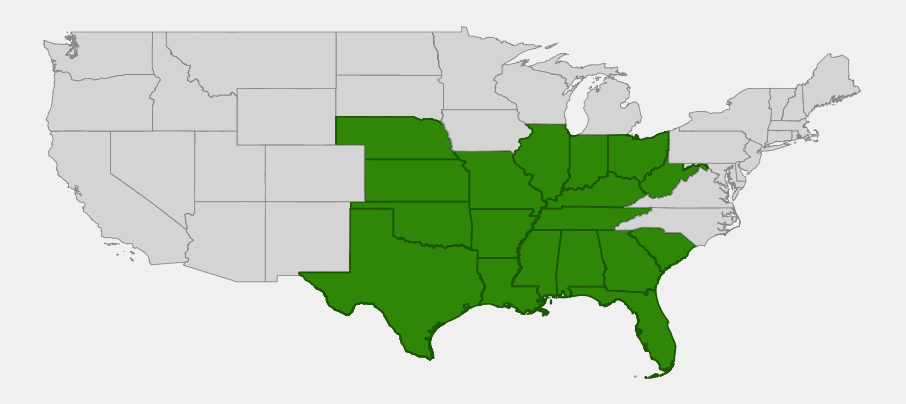
Green antelopehorns is native to the south-central and southeastern United States. USDA PLANTS lists it as native in 18 states, from Nebraska, Kansas and the lower Midwest (Illinois, Indiana, Ohio and West Virginia) south through Missouri, Kentucky, Tennessee and Arkansas to Texas, Louisiana, the Gulf states, Georgia, South Carolina and Florida. It is not native to Canada.
Its heartland is the southern Great Plains and Ozarks. It is common in the tallgrass and mixed-grass prairies of Kansas, Oklahoma and Texas, in the Ozark and Ouachita region of Missouri and Arkansas, and on the limestone glades and barrens of Tennessee and Kentucky. East of the Mississippi it becomes more local, found mostly on glades, prairie remnants and dry calcareous openings, and in the Southeast it is scattered in dry pinelands and sandhills, including northern and central Florida.
At its northeastern edge in Ohio, Indiana and West Virginia it is uncommon and confined to scattered prairie, glade or barrens sites. Across the core of its range, however, it remains a common sight along rural roads and in grazed pastures.
📋 Regional plant lists featuring Green Antelopehorns: Ohio & Indiana · Kentucky & Tennessee · Nebraska, Kansas & Eastern Colorado · Maryland, Virginia & West Virginia · Illinois, Iowa & Missouri · Alabama, Georgia & Mississippi · North & South Florida
Growing & Care Guide
Green antelopehorns is a tough, low-maintenance plant for sunny, well-drained sites within its native range. Its deep taproot makes it very drought tolerant once established, but also means it dislikes being moved, so choose its spot carefully. It grows best from seed or from young plants in deep containers.
Light
Plant it in full sun. It tolerates very light shade but becomes leggy, sprawls more and flowers less with any real shade.
Soil & Water
It grows in almost any well-drained soil, from heavy clay to sand and thin, rocky limestone soils, and it tolerates alkaline conditions well. Avoid sites that stay wet in winter, which can rot the crown. Water young plants during their first summer; after that it seldom needs watering except in severe drought. Do not fertilize. Rich soil makes plants floppy.
Planting Tips
Set out small plants in spring or fall, when the taproot is still short. Older plants are hard to transplant successfully. Space plants about 12 to 18 inches apart and mark them, because green antelopehorns emerges late in some springs and dies back in summer droughts. It looks best among low and medium prairie grasses and wildflowers that help support its leaning stems.
Pruning & Maintenance
Little maintenance is needed. Leave seed pods to ripen if you want volunteers, or bag them before they split if you want to collect seed. Mowing or cutting back the plants after the first flowering can trigger fresh, tender regrowth in late summer, which monarchs use for egg-laying in fall migration. Wear gloves when handling the stems, and avoid getting the sap in your eyes.
Propagation
Grow it from seed. Collect seed when pods begin to split, before the fluff releases. Sow outdoors in fall, or give the seed about 30 to 60 days of cold, moist stratification before sowing in spring. Plant seedlings in deep pots, or sow directly where they are to grow, because the taproot develops quickly. Seedlings usually take two to three years to flower.
Landscape Uses
- Monarch and pollinator gardens: an early-blooming host plant for monarch caterpillars and a nectar source for many insects
- Prairie plantings and restorations: a characteristic wildflower of southern tallgrass and mixed-grass prairies
- Dry, rocky and limestone sites: thrives in thin, alkaline soils where many perennials struggle
- Roadside and pasture restoration: tolerates mowing and summer heat once established
- Native meadows: pairs well with little bluestem, coneflowers and other short prairie plants
Wildlife & Ecological Value
Green antelopehorns is one of the most valuable milkweeds in the southern Great Plains, both for its flowers and as a caterpillar host plant.
For Pollinators
The flowers produce abundant nectar and attract bumblebees, honey bees, digger bees, large wasps and many butterflies. Their pollen is packaged in pollinia, small paired sacs that clip onto the legs of insects that walk across the flowers and are carried to the next blossom. Like all milkweeds, the plant is a larval host for the monarch and queen butterflies. In Texas and Oklahoma, green antelopehorns and antelope horns are among the main host plants for monarchs returning in spring from their Mexican wintering grounds. The caterpillars absorb cardiac glycosides from the leaves, which make them distasteful to birds. Milkweed bugs, milkweed beetles and milkweed tussock moth caterpillars also feed on it.
For Birds
Birds do not eat the toxic foliage or seeds, but the insects the plant supports are food for many grassland birds. Some birds gather milkweed seed fluff and stem fibers as nest material.
For Mammals
Deer, rabbits and cattle generally avoid it. Livestock may eat it when other forage is scarce, which can cause poisoning.
Ecosystem Role
Green antelopehorns is a long-lived prairie perennial that recovers well from grazing, fire and mowing thanks to its deep taproot. It supports a whole community of specialist insects that depend on milkweeds, and it is one of the plants conservation groups recommend for restoring monarch breeding habitat in the southern Plains.
Cultural & Historical Uses
The genus name Asclepias honors Asclepius, the Greek god of medicine, and viridis means “green,” for the flower color. For a time it was placed in its own genus, Asclepiodora, because of its large flowers with upturned petals and hornless hoods. Its common names are not always used consistently: “green antelopehorns” and “green milkweed” both appear in field guides, and green milkweed is also used for A. viridiflora, so the scientific name helps avoid confusion. The name “spider milkweed” refers to the flower shape.
Native Americans and settlers on the Plains used several milkweeds for food, fiber and medicine, but milkweed sap contains cardiac glycosides, and eating the plant can cause serious poisoning in people, pets and livestock. Symptoms can include vomiting, irregular heartbeat and weakness. Do not eat any part of green antelopehorns, keep children and pets from chewing on it, and wash your hands after handling the sap.
In recent decades, concern about falling monarch numbers has made milkweeds a symbol of pollinator conservation. Green antelopehorns has been widely recommended for monarch habitat in Texas, Oklahoma and the southern Plains, and native seed suppliers in the region now offer it for gardens, roadsides and prairie restoration.
Frequently Asked Questions
Is green antelopehorns good for monarchs?
Yes. It is one of the most important milkweeds for monarchs in the southern Great Plains. Monarchs returning north in spring lay eggs on it in Texas and Oklahoma, and its regrowth after summer mowing can support fall caterpillars too.
Is green antelopehorns poisonous?
Yes. Like all milkweeds, it contains cardiac glycosides in its milky sap. It can poison people, pets and livestock if eaten, and the sap can irritate skin and eyes. Grow it where children and pets will not chew on it, and wash your hands after handling it.
What is the difference between green antelopehorns and antelope horns?
Green antelopehorns (Asclepias viridis) has broad, wavy-edged leaves and large pale green flowers with purple hoods, and it prefers prairies in the central and eastern part of the range. Antelope horns (A. asperula) has narrow, folded leaves and is more common in drier, rockier western habitats.
Can I transplant green antelopehorns?
Only when young. Established plants have a deep taproot and rarely survive being moved. Start new plants from seed or buy small container plants.
When does green antelopehorns bloom?
Mostly from April to June, earlier in the south of its range. Plants often bloom again in late summer after rain or mowing.

Looking for a nursery that carries Green Antelopehorns?
Browse our native plant nursery directory: Alabama & Arkansas · Florida & Georgia · Illinois, Indiana & Kansas · Kentucky, Louisiana, Mississippi & Missouri · Nebraska, Ohio & Oklahoma · South Carolina, Tennessee & Texas · West Virginia