Pale Purple Coneflower (Echinacea pallida)
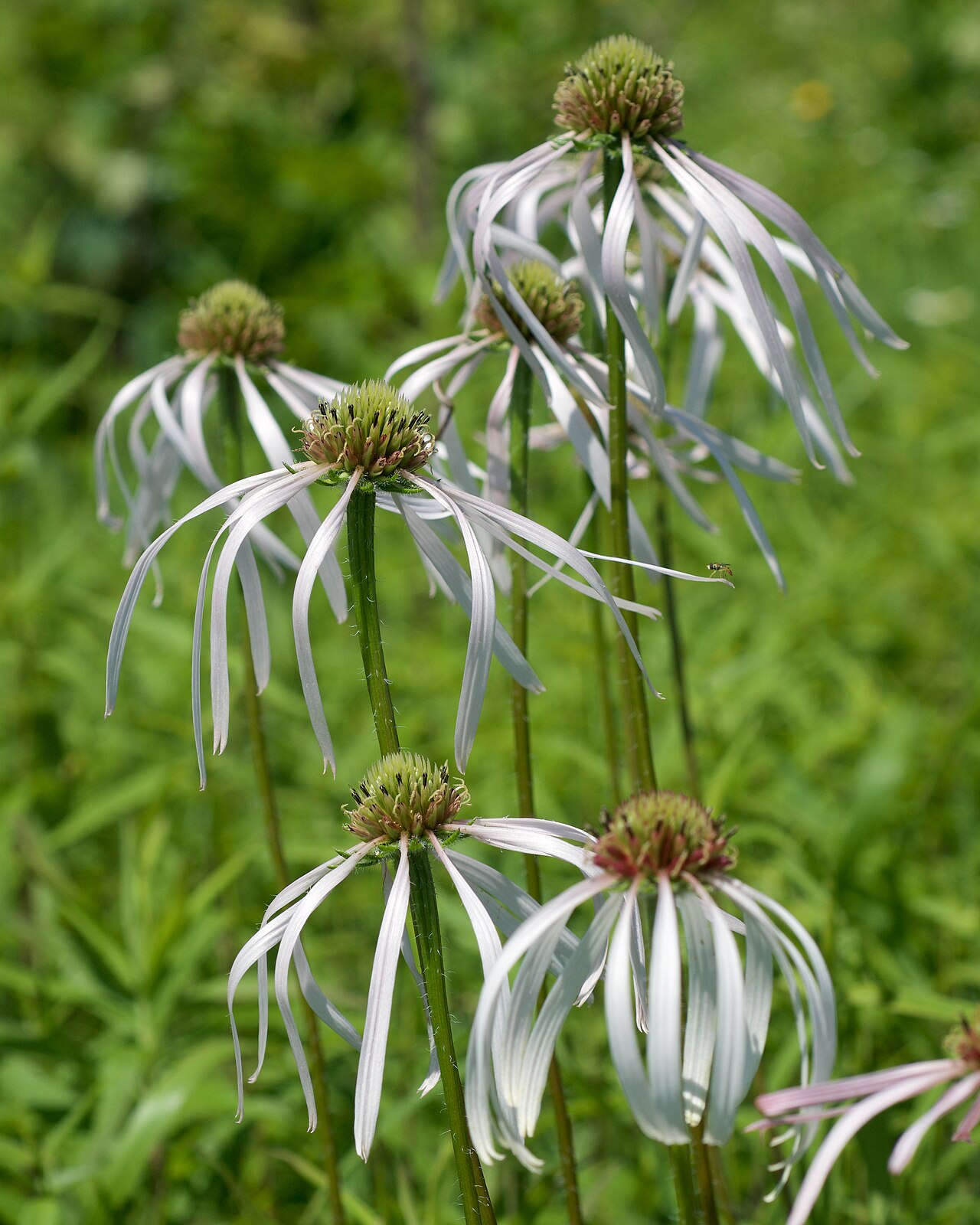
Pale purple coneflower brings a different shape to a sunny planting: long, narrow rays hang below a raised central cone, while rough, slender leaves stay mostly near the base. It is an upright prairie perennial rather than a broad mound of garden daisies.
The airy flowers can be seen through rather than simply looked at. Repeated among low grasses, their widely spaced stems make an attractive early-summer layer without hiding everything behind them. Established plants suit an open, well-drained bed much better than a wet depression. A new transplant still needs water while its root system develops; drought tolerance is not an instruction to let a nursery root ball dry out completely.
There is an important regional qualification. This species is native mainly to central and parts of southern North America, and many eastern records are introductions. Its presence in our New York–Pennsylvania–New Jersey table must not be read as proof that it is indigenous throughout that region. For a restoration or strictly local-native garden, obtain county-level evidence before buying it. This page retains the plant as an accurately identified species while making that limitation visible.
Identification
Leaves and growth form
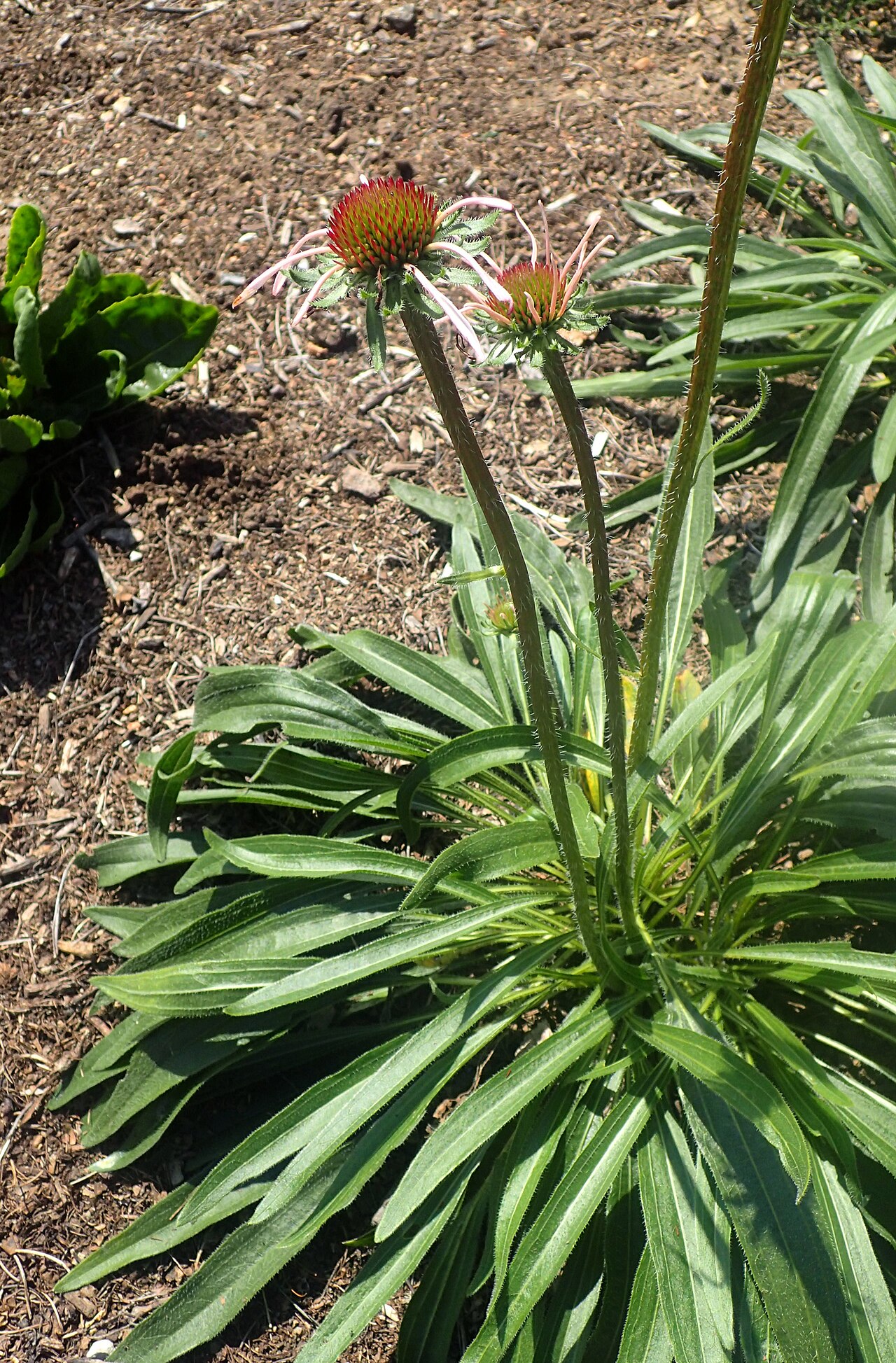
Look below the flower heads. Most leaves are long and narrow, with rough surfaces and largely untoothed edges; their outline is quite unlike the broader, frequently toothed leaves of Echinacea purpurea. Flowering stems stand above the basal foliage. A close photograph of the lower leaves is therefore more useful than a distant picture of pink flowers when checking a nursery plant.
The flower is a community of florets
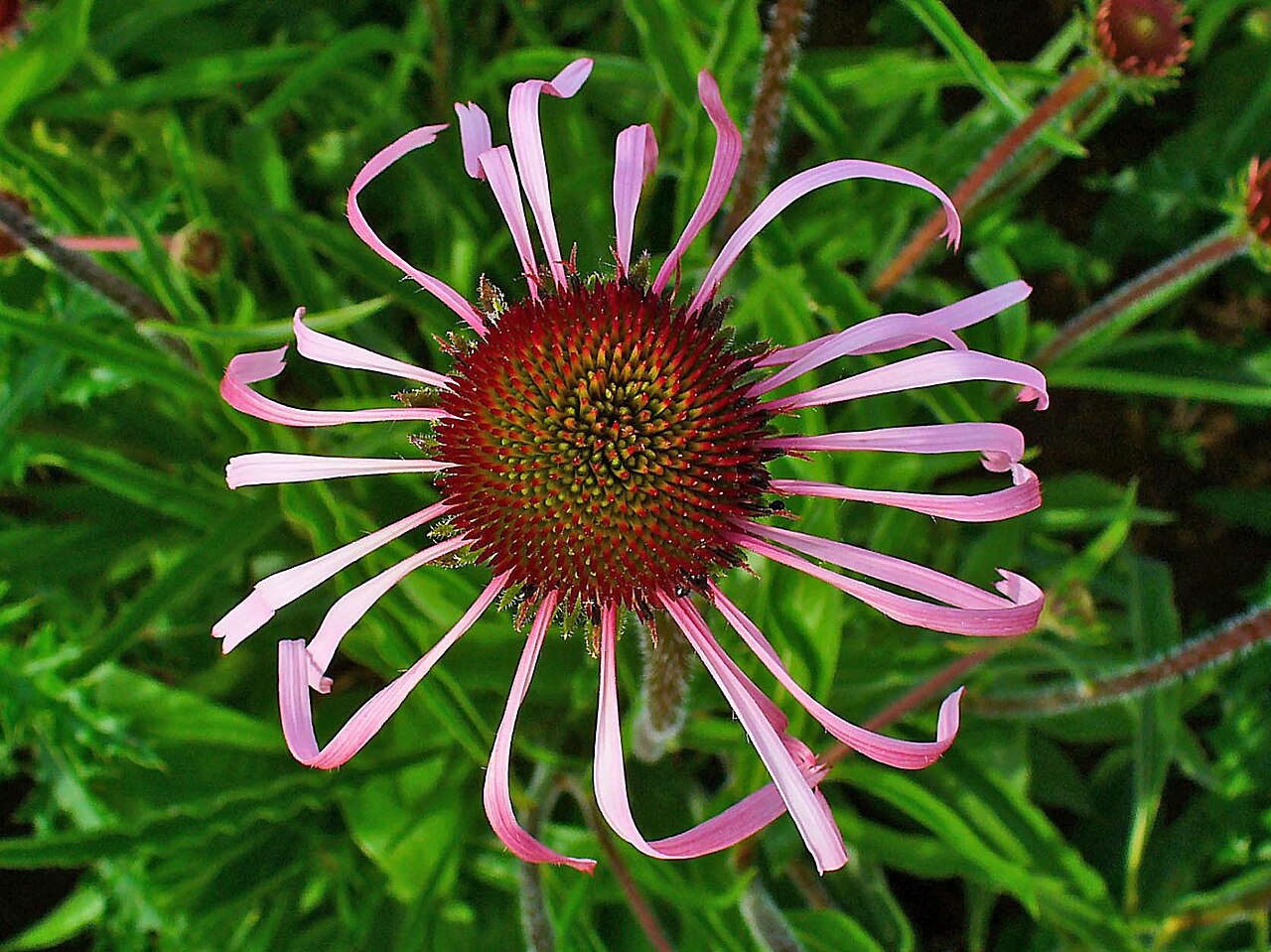
The central mound contains numerous tiny disk florets; the conspicuous hanging strips around it are ray florets. Pale color alone is not diagnostic, but the very slender, strongly drooping rays combined with narrow foliage are helpful. A nearly white flower can be a normal expression of the species rather than a separate white-flowered cultivar. Do not confuse it with Echinacea tennesseensis, whose rays often project outward or upward.
Pollen and similar species
Yellow-pollen coneflowers can look surprisingly similar. Echinacea pallida produces pale or white pollen, whereas the closely similar glade coneflower, Echinacea simulata, has yellow pollen. Inspect a fresh, actively flowering cone rather than relying on petal length alone. If a seed lot is for conservation use, ask the supplier how the plants were identified and kept separate from other coneflowers.
Persistent crown and seed head
The perennial crown survives the winter below the dead shoots, supported by a substantial taproot. The head dries to a stiff brown structure after the rays fade. Mark the position of young plants before clearing the bed, because a dormant crown is easy to mistake for an empty gap. Do not dig up a wild plant merely to examine its roots.
Quick Facts
| Scientific Name | Echinacea pallida |
| Family | Asteraceae |
| Plant Type | Taprooted herbaceous perennial |
| Mature Height | 24–36 inches (60–90 cm) in typical garden conditions |
| Mature Spread | About 12–18 inches per mature crown |
| Growth Rate | Seasonal; seed-grown plants need establishment time |
| Sun Exposure | Full sun; tolerates light partial shade |
| Water Needs | Dry to average after establishment; good drainage essential |
| Soil Type | Well-drained prairie soil, sandy or rocky loam; avoid stagnant wet ground |
| Soil pH | Adaptable within ordinary garden soils; use a soil test rather than routine amendment |
| Bloom Time | Late spring into early summer; dates vary by latitude |
| Flower Color | Pale pink-purple to nearly white, with a dark raised cone |
| Fall Color | Foliage senesces; brown seed heads remain ornamental |
| Fruit | Dry single-seeded fruits retained in the cone |
| Deer Resistant | Not deer-proof; protect young crowns where browsing is frequent |
| USDA Hardiness Zones | Commonly grown in USDA zones 3–9; provenance and drainage matter |
Native Range
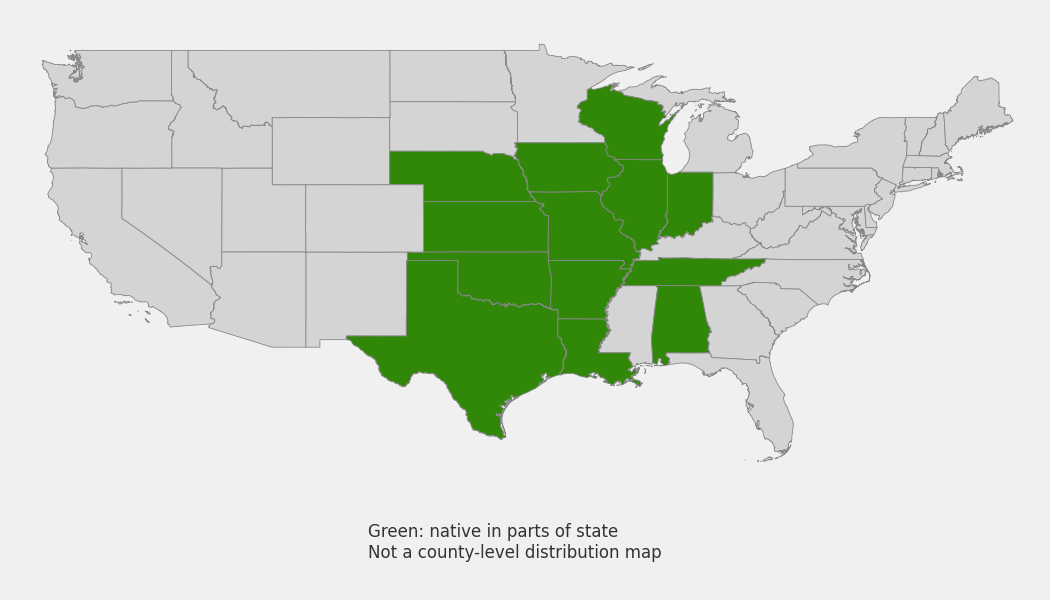
The broad native core lies in the central United States. The map here conservatively shades Alabama, Arkansas, Illinois, Indiana, Iowa, Kansas, Louisiana, Missouri, Nebraska, Oklahoma, Tennessee, Texas and Wisconsin, using the regional conservation evidence alongside the broader Kew treatment. These are state-level indications, not claims that every county contains a natural population.
Range compilations disagree at the eastern and northern edges. Kew includes several northeastern states as native, while Native Plant Trust explicitly treats New England populations as introduced; NatureServe also describes exotic establishments in eastern states. We therefore do not shade those disputed eastern occurrences as assured native range. New York is not a safe blanket-native recommendation, and neither Pennsylvania nor New Jersey is established as native by the sources used here.
Natural settings include open prairie and glade-like ground with enough light and drainage for a deep-rooted perennial. A successful garden patch in a northeastern city is evidence of horticultural adaptability, not historical distribution. For local habitat work, consult a state flora or herbarium record and choose regionally documented seed. The USDA link is a distribution aid, not a substitute for interpreting whether a record is native or planted.
📋 Regional plant list: New York, Pennsylvania and New Jersey
Growing & Care Guide
Choose an open site
Observe the site in summer, when nearby trees are fully leafed out. A bed that looks sunny in March can be heavily shaded by June. For a strong flowering display, favor the open part of the garden and keep taller companions from closing over the crown. If stems lean persistently toward a gap, reassess light and competition before adding fertilizer.
Prepare the root zone
Remove established turf and aggressive perennial weeds before planting. Dig only deeply enough to set the crown at its nursery soil level, and loosen circling container roots carefully. Do not create a richly composted pocket surrounded by dense, water-holding soil. Where rainfall lingers, choose a naturally raised planting area rather than trying to rescue the site with a handful of gravel at the bottom of the hole.
Water during establishment
Check the soil at root-ball depth instead of judging by the dry surface alone. Water thoroughly when the young root zone is drying, then allow air back into the soil. Once rooted into an appropriate site, reduce supplemental irrigation gradually. A drooping flower ray is normal for this species and should not be mistaken for a drought symptom; assess leaves and soil before turning on the hose.
Mulch and winter care
Keep mulch from burying the basal crown. A light, open surface treatment can help suppress seedlings, but thick wet material pressed against the plant is counterproductive. Leave at least some seed heads through fall and winter if they are stable and healthy. Cut dead stems back before new shoots become entangled in them, taking care not to pull the crown out of the soil.
Growing from seed
Autumn sowing lets seasonal cold provide the chilling that many seed lots need. For indoor sowing, follow the supplier’s lot-specific cold-moist treatment and use a labeled container. Cover lightly and maintain even moisture without saturation. Keep a few seedlings in a clearly marked nursery area until their leaves are recognizable; this makes it easier to weed around them without losing the crop.
Division and moving
A deep-rooted plant is not the best choice for annual rearrangement. Decide on spacing before it becomes established. If a clump genuinely needs moving, work during a cool period, preserve as much of the root system as practical and provide aftercare. Seed is often the simpler route to more plants. Avoid automatically dividing every native perennial on a calendar, regardless of how well it is growing.
Troubleshooting the display
Poor flowering can reflect shade, young age or crowding rather than a nutrient shortage. Persistent collapse in a wet pocket calls for a site change. For deformed heads or conspicuous discoloration, compare several shoots and consult extension diagnostics before spraying. Record where and when the symptom appears; a photograph of both the whole plant and the affected head is much more informative than a petal close-up alone.
Landscape Uses
- Repeated accents in a sunny prairie-style border within its appropriate native region.
- A see-through middle layer above low grasses, with room around each crown.
- An educational comparison planting showing how pale purple coneflower differs from broad-leaved purple coneflower.
- A cut-flower planting that leaves some heads to mature for seed and seasonal structure.
Wildlife & Ecological Value
Flowers and visiting insects
The exposed central disk provides a place for insects to forage. Choose undoubled, correctly identified plants when the goal is to retain the ordinary flower structure. Watch which visitors occur at your own site rather than assuming that every published visitor list applies everywhere. Avoid treating a blooming patch with broad-spectrum insecticide.
Seed and standing stems
Allowing mature heads to remain keeps seed available and extends the useful season of the planting. Not every head will fill equally, especially in a small isolated planting. A mix of several seed-grown plants is a better educational collection than repeated divisions of one clone if you want to observe variation and reproduction.
Habitat context
A coneflower does not replace an entire grassland community. Include different flowering seasons and locally native grasses, and keep invasive competitors out of the planting. In a region where Echinacea pallida is introduced, favor documented local species for restoration rather than making a pollinator claim do the work of a native-range assessment.
Cultural & Historical Uses
The names Brauneria pallida and Rudbeckia pallida occur in older botanical literature. They refer to the taxon now generally accepted as Echinacea pallida, not to a second plant that needs its own garden space. Botanical naming matters here because nursery common names such as pale coneflower are sometimes applied loosely.
Coneflowers have a substantial history in herbal commerce, but a gardening guide should not turn that history into medical advice. Species, plant parts and preparations are not interchangeable, and the presence of a medicinal claim in an old horticultural account does not establish an effective treatment. Grow this plant for its ecological and ornamental qualities rather than harvesting wild roots.
The conservation story is particularly relevant to purchasing. NatureServe identifies habitat change and root collection among pressures on the species. Nursery propagation allows gardeners to enjoy the plant without removing a mature individual from a remnant prairie. Ask for provenance when a planting has a conservation purpose, and keep the supplier’s label with your garden records.
Frequently Asked Questions
Is pale purple coneflower native to New York?
Do not assume so from its inclusion in a regional gardening list. Eastern range treatments conflict, and introduced populations are documented. For a local-native project, require a state or county flora confirmation; the map here deliberately omits disputed northeastern states.
Why do its petals hang down?
Very narrow drooping rays are a characteristic feature, not in themselves a sign that the plant needs water. Check leaf condition and the root zone before irrigating.
Can I grow it in a wet rain-garden basin?
It is better suited to a well-drained, dry-to-average position. Use the upper, freely draining edge only if the rest of the site and climate fit, rather than the basin that stays saturated.
Is it the same as Echinacea purpurea?
No. Pale purple coneflower has narrower, rough leaves and much more slender drooping rays. Fresh pollen and a regional key help separate it from other similar coneflowers.
Should I remove every spent flower?
You can remove selected heads for appearance, but leaving others permits seed maturation and winter structure. Keep the plant’s purpose in mind rather than treating all fading flowers as waste.
Sources & Further Reading
- NC State Extension — species description and garden conditions
- Native Plant Trust — regional status and identification
- NatureServe — range, conservation and eastern introductions
- Kew POWO — accepted name and broader range treatment
- University of Northern Iowa Tallgrass Prairie Center — seed production guide
Find Native Plants
Ask growers about nursery propagation and regional provenance. Browse our NY native plant nurseries, PA native plant nurseries, NJ native plant nurseries directory for suppliers. Explore the native nursery finder.