
Dwarf Ginseng (Panax trifolius)
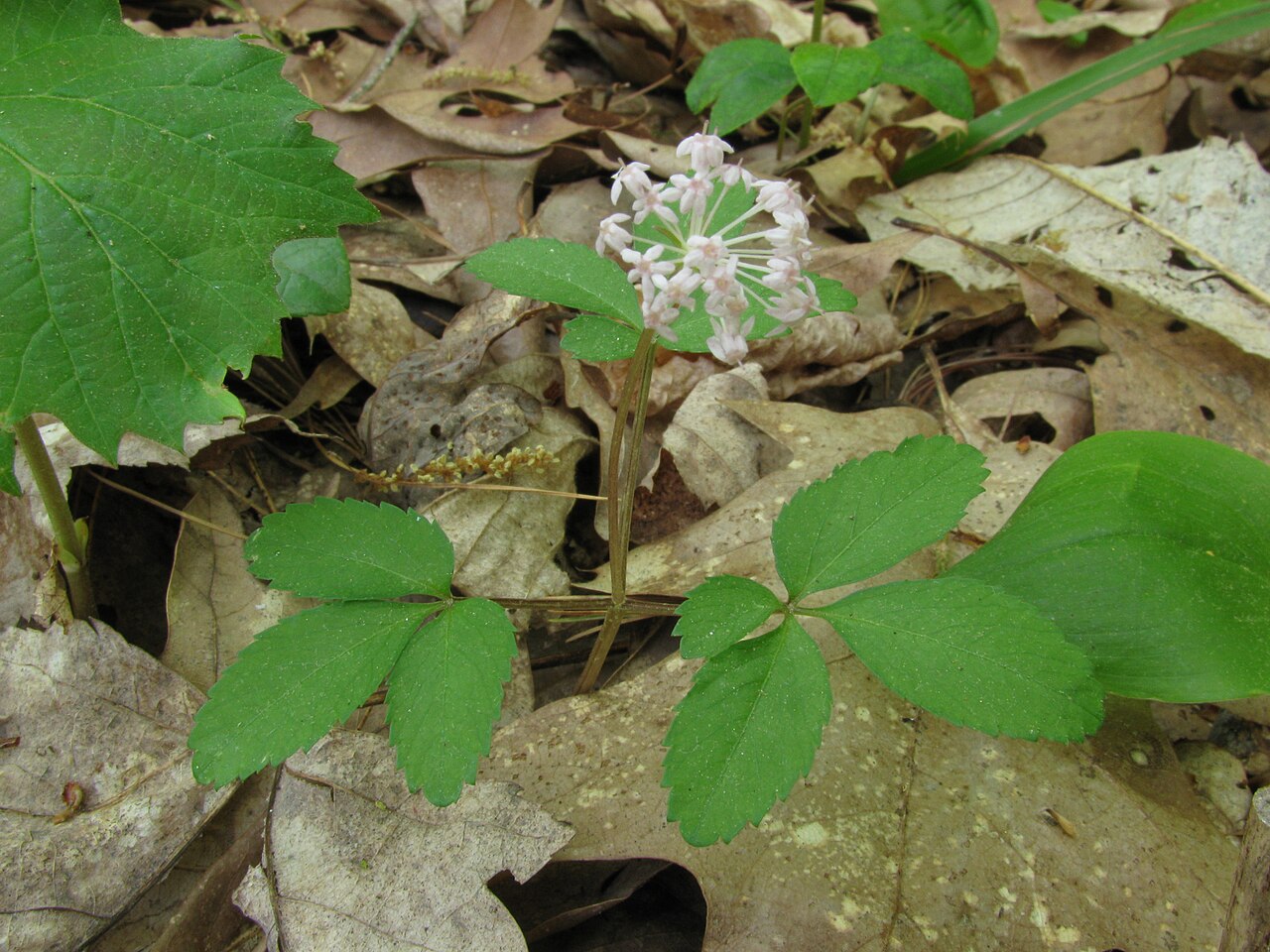
Panax trifolius, known as Dwarf Ginseng or groundnut, is a tiny spring wildflower of moist eastern North American forests and the smaller cousin of the famous American ginseng. It belongs to the ginseng family (Araliaceae). From a round underground tuber it sends up a single stem only 3 to 8 inches tall, topped with a whorl of three leaves, each divided into three to five toothed leaflets. Above them, in April and May, sits a ball of tiny white flowers about an inch across, like a little firework on the forest floor.
Dwarf ginseng is a spring ephemeral. It emerges early, flowers and sets fruit while the trees overhead are still leafing out, and then withers and disappears below ground by early to midsummer. It grows in rich, moist deciduous and mixed forests, floodplain woods, swamp edges and hemlock ravines from Nova Scotia and Quebec to Minnesota and south through the Appalachians to Georgia.
Unlike its relative, dwarf ginseng has never been a commercial herb, and it is not harvested for the ginseng trade. It is still a slow, specialized woodland plant that depends on undisturbed forest soil and is rarely available from nurseries. This guide explains how to recognize it, where it grows, what gardeners can and cannot reasonably do with it, and its place in the spring woods.
Identification
Dwarf ginseng is small enough to miss, but its combination of a single whorl of three compound leaves and a round head of white flowers is distinctive. Look for it in early spring alongside trout lilies, spring beauties and wood anemones.
Tuber & Stem
Each plant grows from a small, nearly round tuber, about ½ inch across, buried a few inches deep in moist, loose woodland soil. A single smooth, slender stem rises from it each spring. The plant is 3 to 8 inches tall, rarely a little taller.
Leaves
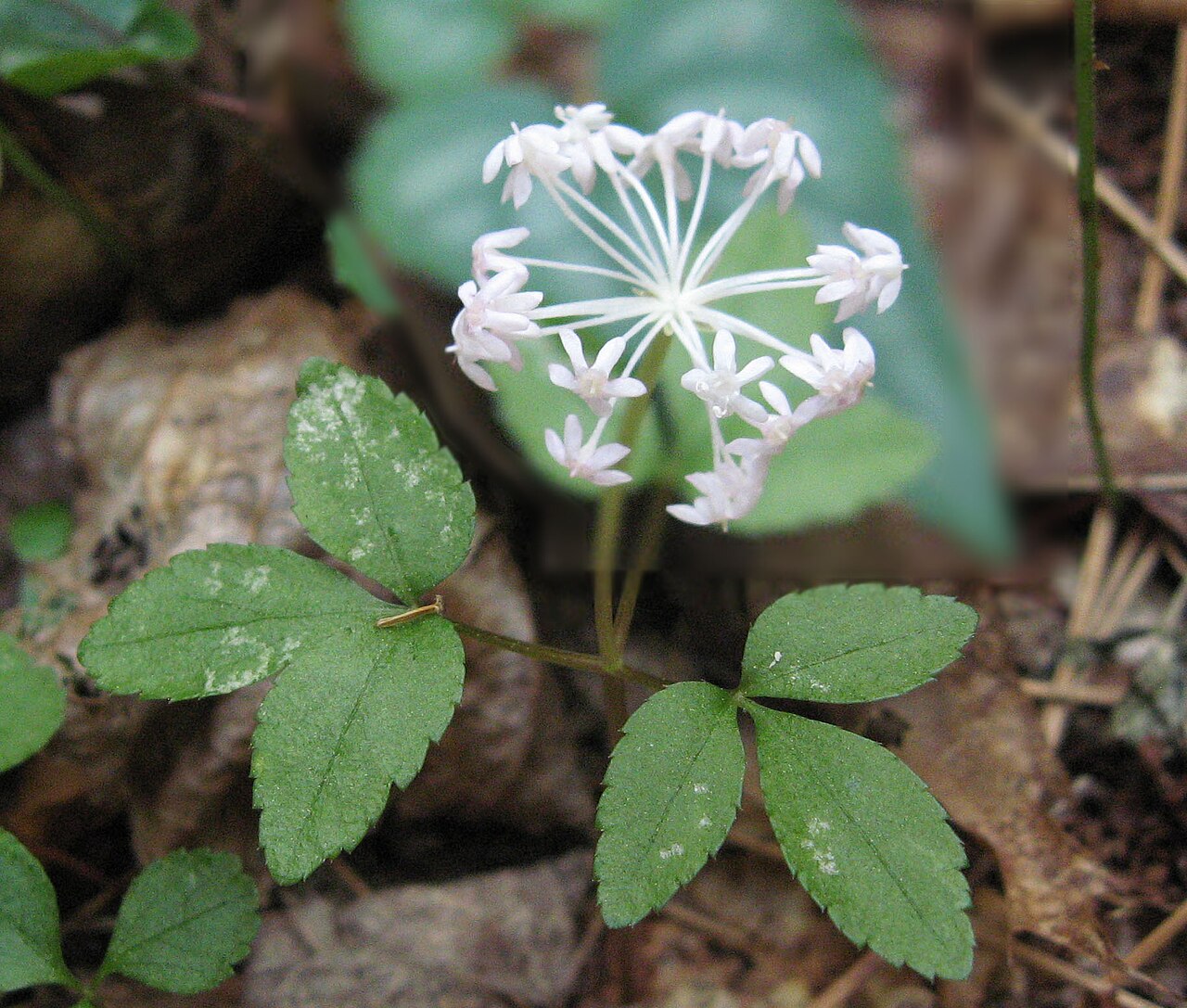
Three leaves spread in a single whorl near the top of the stem. Each leaf has a short stalk and is palmately divided into three to five leaflets, most often three. The leaflets are narrowly oval to lance-shaped, 1 to 3 inches long, finely toothed, and nearly stalkless where they join the leaf stalk. In American ginseng (Panax quinquefolius), by contrast, the leaflets are larger, usually five, and attached by distinct short stalks, and the plant is far taller.
Flowers
A single rounded cluster (umbel) of 15 to 30 or more tiny flowers rises on a short stalk from the center of the leaf whorl. Each flower is about ⅛ inch across, with five white petals and five stamens, and the cluster may fade to pinkish as it ages. Flowering is mostly April to May, a little earlier in the South and as late as June in the far North. Plants differ in their flowers: some produce only male (pollen-bearing) flowers, while others have bisexual flowers that can set fruit. Studies have found that individual plants can switch from one form to the other between years, depending largely on their size.
Fruit & Seeds
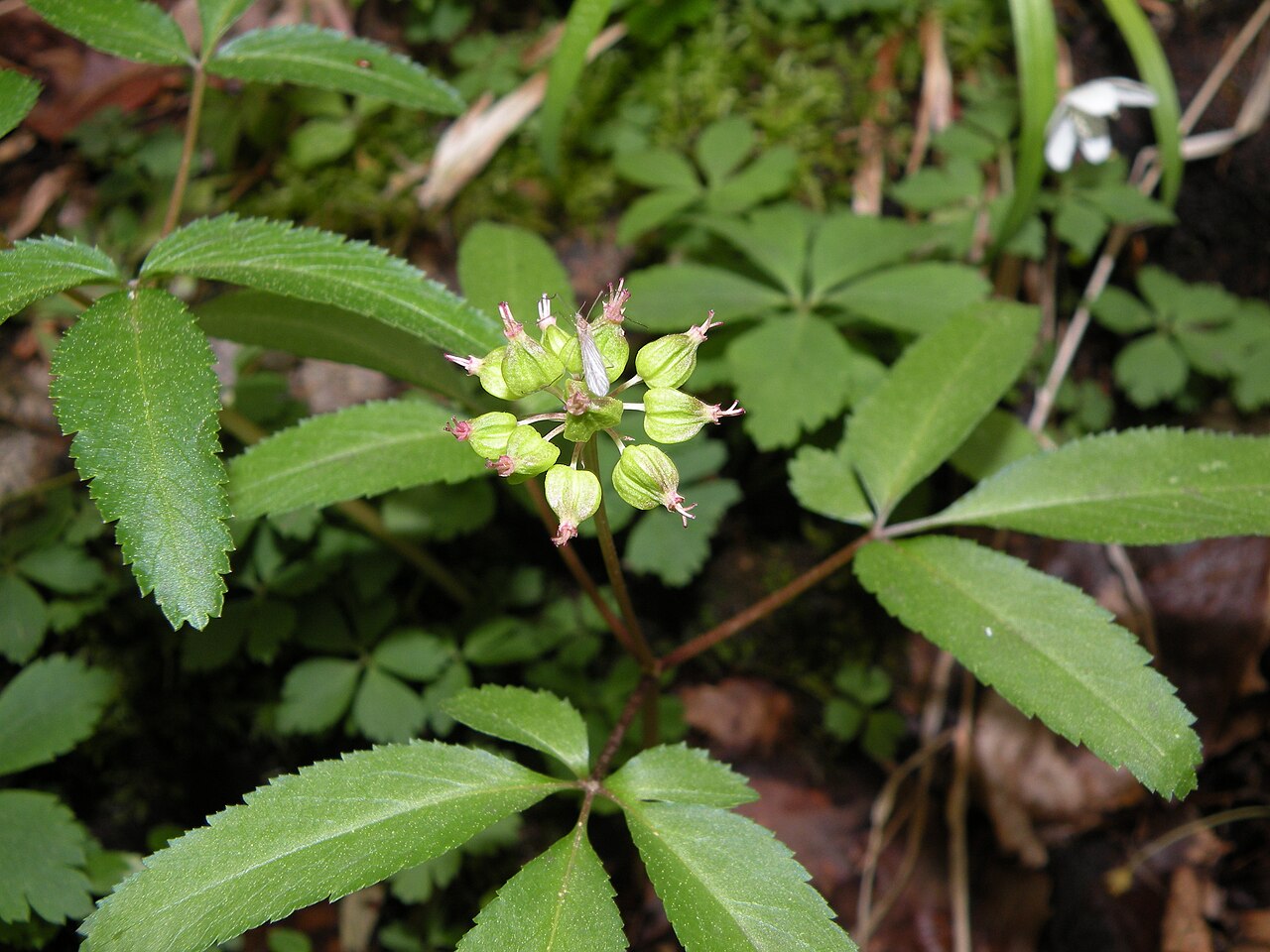
Bisexual flowers develop into small, angular, greenish yellow to yellow fruits, each holding a few seeds. They ripen in late spring and early summer, just before the plant dies back. American ginseng, in contrast, has bright red berries in late summer.
Similar Species
Wood anemone (Anemone quinquefolia) also has a whorl of three divided leaves but bears a single larger white flower with five petal-like sepals. Wild sarsaparilla (Aralia nudicaulis), another ginseng relative, is much larger and holds its umbels of greenish flowers below an umbrella-like leaf. Young American Ginseng plants have only a few leaflets but are not as early or as small, and their leaflets have stalks.
Quick Facts
| Scientific Name | Panax trifolius |
| Family | Araliaceae (ginseng family) |
| Plant Type | Herbaceous perennial spring ephemeral from a round tuber |
| Mature Height | 3–8 in |
| Mature Spread | 3–6 in; forms loose colonies over time |
| Growth Rate | Slow |
| Sun Exposure | Partial shade to full shade (spring sun before tree leaf-out) |
| Water Needs | Medium to high; soil should stay evenly moist in spring |
| Soil Type | Rich, loose, humus-rich loam; moist woodland soil |
| Soil pH | About 5.0–7.0 |
| Bloom Time | April–May (to June in the North) |
| Flower Color | White, sometimes fading pinkish |
| Fall Color | None; the plant is dormant by early to midsummer |
| Fruit | Small, angular greenish yellow fruits in late spring |
| Deer Resistant | Unknown; too small and short-lived above ground to be a regular target |
| USDA Hardiness Zones | 3–7 |
Native Range
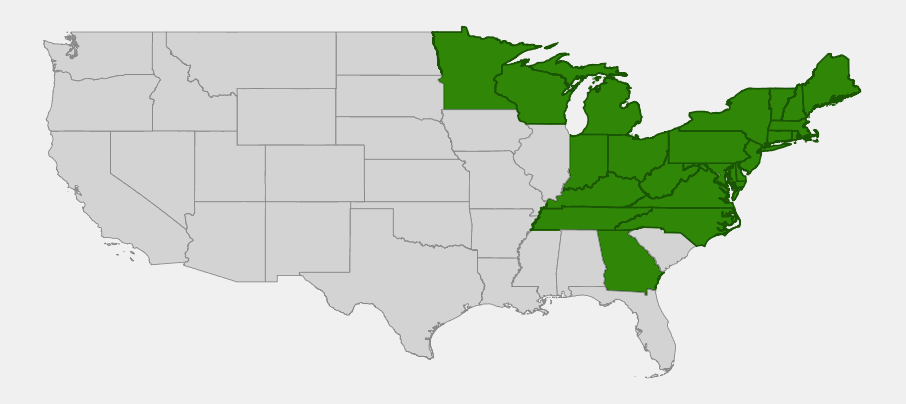
Dwarf ginseng is a plant of the northeastern quarter of the United States and adjacent Canada. USDA PLANTS records it from 22 states and the District of Columbia: throughout New England, New York, New Jersey and Pennsylvania, west through Ohio, Indiana and Michigan to Wisconsin and Minnesota, and south along the Appalachians through Maryland, Virginia, West Virginia, Kentucky, Tennessee and North Carolina into northern Georgia. In Canada it grows in Ontario, Quebec, New Brunswick, Nova Scotia and Prince Edward Island.
Within this range it is a plant of rich, moist forests. It is most often found in mixed hardwood and hemlock-hardwood woods, along wooded floodplains and stream terraces, in moist ravines and on the edges of wooded swamps. It favors spots with deep leaf litter and loose, moist soil, and it can be locally abundant, forming carpets of hundreds of plants under the right conditions.
Toward the south and west of its range it becomes scarce. In the southern Appalachians it is mostly found at higher elevations or in cool ravines, and at the western edge of its range in Minnesota and Indiana it is uncommon. Losses of old, undisturbed forest and heavy deer browsing on the forest herb layer affect it along with other spring ephemerals.
📋 Regional plant lists featuring Dwarf Ginseng: New York, Pennsylvania & Northern New Jersey · Ohio & Indiana · Michigan, Wisconsin & Eastern Minnesota · Kentucky & Tennessee · Connecticut, Massachusetts & Rhode Island · New Hampshire, Maine & Vermont · Maryland, Virginia & West Virginia · Delaware, Southern New Jersey & Long Island · Alabama, Georgia & Mississippi
Growing & Care Guide
Dwarf ginseng is a plant to appreciate and protect more than one to plant casually. It is slow, it is short-lived above ground, and it depends on a stable, undisturbed woodland soil with a rich layer of decaying leaves and the fungi and soil life that come with it. It is rarely offered by nurseries. If you find it, buy only nursery-propagated plants from a reputable native plant source, and never dig it from the wild. Wild-collected tubers seldom establish, and digging damages populations that grow back slowly.
Light
It needs the light pattern of a deciduous forest floor: bright spring sun before the trees leaf out, followed by shade for the rest of the year. The north side of a building or a site under evergreens alone is usually too dark in spring.
Soil & Water
Give it loose, moist, humus-rich soil that never dries out in spring. A site in an established woodland garden, with years of accumulated leaf litter, is far better than a newly made bed. It tolerates wet soils on floodplains and swamp edges but not standing water. Once the plant goes dormant in summer, the soil can dry somewhat, though it should not bake.
Planting Tips
If you obtain nursery-grown tubers or potted plants, plant them in fall or very early spring, about 1 to 2 inches deep, in small groups. Mark the spot, because the plants vanish by early summer and are easily disturbed while dormant. Plant them among other small spring ephemerals and low ferns rather than vigorous groundcovers, which can smother them.
Pruning & Maintenance
No pruning is needed. Leave fallen leaves in place every autumn; that natural mulch is essential. Avoid digging, raking or heavy foot traffic near the colony, and keep aggressive non-native groundcovers such as English ivy, periwinkle and pachysandra well away.
Propagation
Seeds have complex dormancy and may take two years to germinate, and seedlings grow slowly for several years before flowering. Colonies spread slowly as tubers multiply. Propagation is best left to specialist nurseries. Woodland gardeners who already have it can help it by protecting the site and letting fruit ripen and fall.
Landscape Uses
- Woodland gardens: a small spring accent for gardeners with rich, moist, established woodland soil
- Spring ephemeral collections: alongside trout lily, spring beauty, hepatica and toothworts
- Forest conservation and restoration: an indicator of intact, rich forest floor worth protecting
- Shade rock gardens: for small plants in moist, leafy pockets where it will not be overrun
- Nature study: a good example of a spring ephemeral life cycle and of plants that switch flower types
Wildlife & Ecological Value
Dwarf ginseng is part of the brief spring flush of life on the forest floor, when light reaches the ground before the canopy closes. Its small flowers feed early insects, and its tubers and colonies are a sign of healthy forest soil.
For Pollinators
The tiny white flowers are visited by small early-season insects, including small native bees such as sweat bees and mining bees, flies and small beetles. Because some plants carry only male flowers and others bisexual ones, insects moving between plants help carry pollen from one to another.
For Birds
Dwarf ginseng is not an important bird food. The forests where it grows support many ground-foraging birds such as wood thrushes, ovenbirds and veeries, which rely on the same moist leaf litter.
For Mammals
Small mammals may eat the tubers and fruit, and white-tailed deer may browse small forest herbs when spring food is scarce. Where deer are overabundant, the whole spring wildflower layer, dwarf ginseng included, can decline.
Ecosystem Role
Like other spring ephemerals, dwarf ginseng captures sunlight and nutrients early in the season, before trees leaf out, and returns nutrients to the soil when its leaves die back. Ecologists have suggested that such plants act as a “vernal dam,” holding nutrients that might otherwise wash away in spring rains. Its colonies are typical of older, undisturbed forest soils.
Cultural & Historical Uses
Linnaeus described Panax trifolius in 1753, in the same genus as American ginseng. The genus name comes from the Greek panakeia, “all-healing,” the same root as the word panacea, reflecting the reputation of Asian and American ginseng. The species name means “three-leaved.” The older name groundnut refers to the round, edible-looking tuber, but it is shared with several other plants, including Apios americana.
Dwarf ginseng appears in records of Native American medicine, including among Iroquois and Cherokee communities, and the tuber was reportedly eaten. It never had the commercial value of American ginseng, whose roots have been exported to Asia since the 1700s, so dwarf ginseng escaped the heavy harvesting that made its relative scarce.
Today dwarf ginseng is valued mostly by naturalists and woodland wildflower enthusiasts as a sign of spring and of intact forest floor. It has also interested botanists because individual plants can change between male and bisexual flowering from year to year. That makes it a useful subject for studies of plant reproduction.
Frequently Asked Questions
Is dwarf ginseng the same as American ginseng?
No. They are in the same genus but are different species. Dwarf ginseng is a tiny spring ephemeral with a round tuber, usually three stalkless leaflets per leaf and yellowish fruit. American ginseng is a taller, longer-lived plant with a forked root, five stalked leaflets per leaf and red berries.
Can I grow dwarf ginseng in my garden?
Only if you have rich, moist, undisturbed woodland soil with spring sun and summer shade, and only from nursery-propagated plants. It is slow, difficult to establish and rarely sold. Protecting an existing wild colony on your property is usually more valuable than trying to plant it.
Is it legal to dig dwarf ginseng?
Never dig it from the wild. Unlike American ginseng, it is not regulated for trade, but it grows slowly, rarely survives transplanting, and may be protected in states where it is rare. Digging on public land or without the landowner’s permission is illegal in any case.
Why does dwarf ginseng disappear in summer?
It is a spring ephemeral. It grows, flowers and fruits in the few weeks of spring sunshine on the forest floor, then dies back to its tuber by early to midsummer and stays dormant until the following spring.
Does dwarf ginseng have medicinal uses?
It has a history of use in Native American medicine, but it has never been an important medicinal plant commercially, and there is little modern research on it. Do not harvest it for home remedies.

Looking for a nursery that carries Dwarf Ginseng?
Browse our native plant nursery directory: Connecticut, Delaware & Georgia · Indiana · Kentucky, Maine, Maryland, Massachusetts, Michigan & Minnesota · New Hampshire, New Jersey, New York, North Carolina & Ohio · Pennsylvania, Rhode Island, Tennessee, Vermont & Virginia · West Virginia & Wisconsin