American Ginseng (Panax quinquefolius)
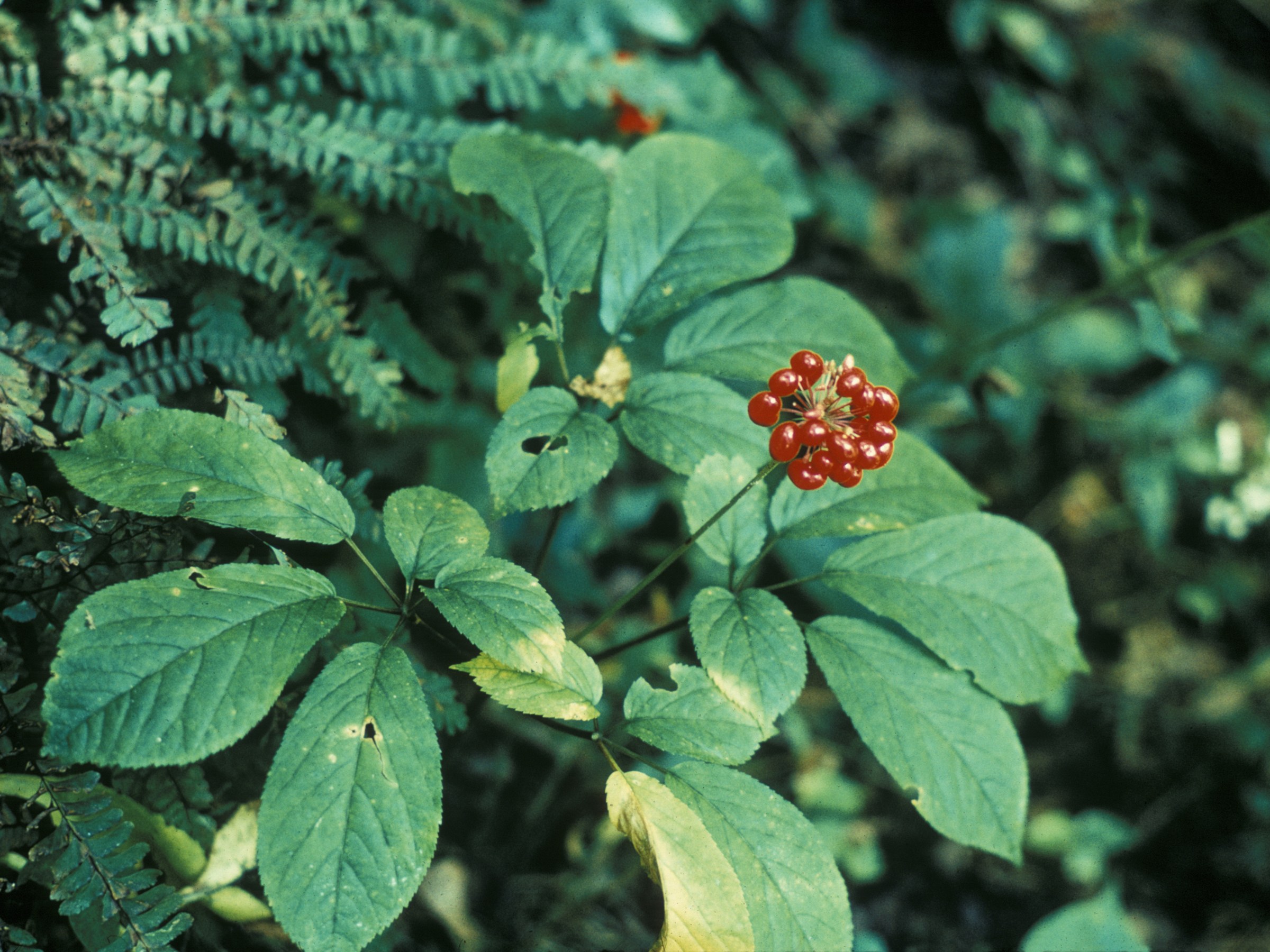
Panax quinquefolius, commonly called American Ginseng, is a small, slow-growing perennial herb of the rich, shaded hardwood forests of eastern North America. It belongs to the ginseng family (Araliaceae) and is best known for its branched, human-shaped root, which has been collected and traded for more than two centuries. In the garden and in the wild alike, it is a quiet, unassuming plant — a single stem topped by a whorl of compound leaves and, later in the season, a tight cluster of bright red berries — that is far better known for its root than for its appearance above ground.
American ginseng grows from 8 inches to 2 feet tall, usually staying under knee height, and spends most of the year as a small rosette of leaves rising from the forest floor. It is a true woodland specialist, needing the deep shade, steady moisture, and calcium-rich soil of mature deciduous forest to thrive, and it grows extremely slowly — a root large enough to show commercial value may take 10 to 20 years or more to develop. That slow growth, combined with heavy demand for wild root, has made wild American ginseng far scarcer than it once was across its native range.
Because of that history, this is a plant better suited to a shaded woodland garden than to wild-collecting. Wild populations of American ginseng have been seriously depleted by decades of harvest, and the species is now protected under state regulation and listed under CITES Appendix II, which controls its international export. This page describes the plant’s history and trade as background, not as an endorsement or guide to harvesting wild roots — anyone interested in growing ginseng should start with nursery-propagated seed or roots and follow their state’s rules if they intend to grow it for sale.
Identification
American ginseng is easy to overlook in the forest understory, where its modest size and shade-dappled leaves blend into the surrounding vegetation. Learning its distinctive leaf arrangement and berry cluster will help you tell it apart from similar-looking woodland plants such as Virginia creeper seedlings or young hickories.
Root
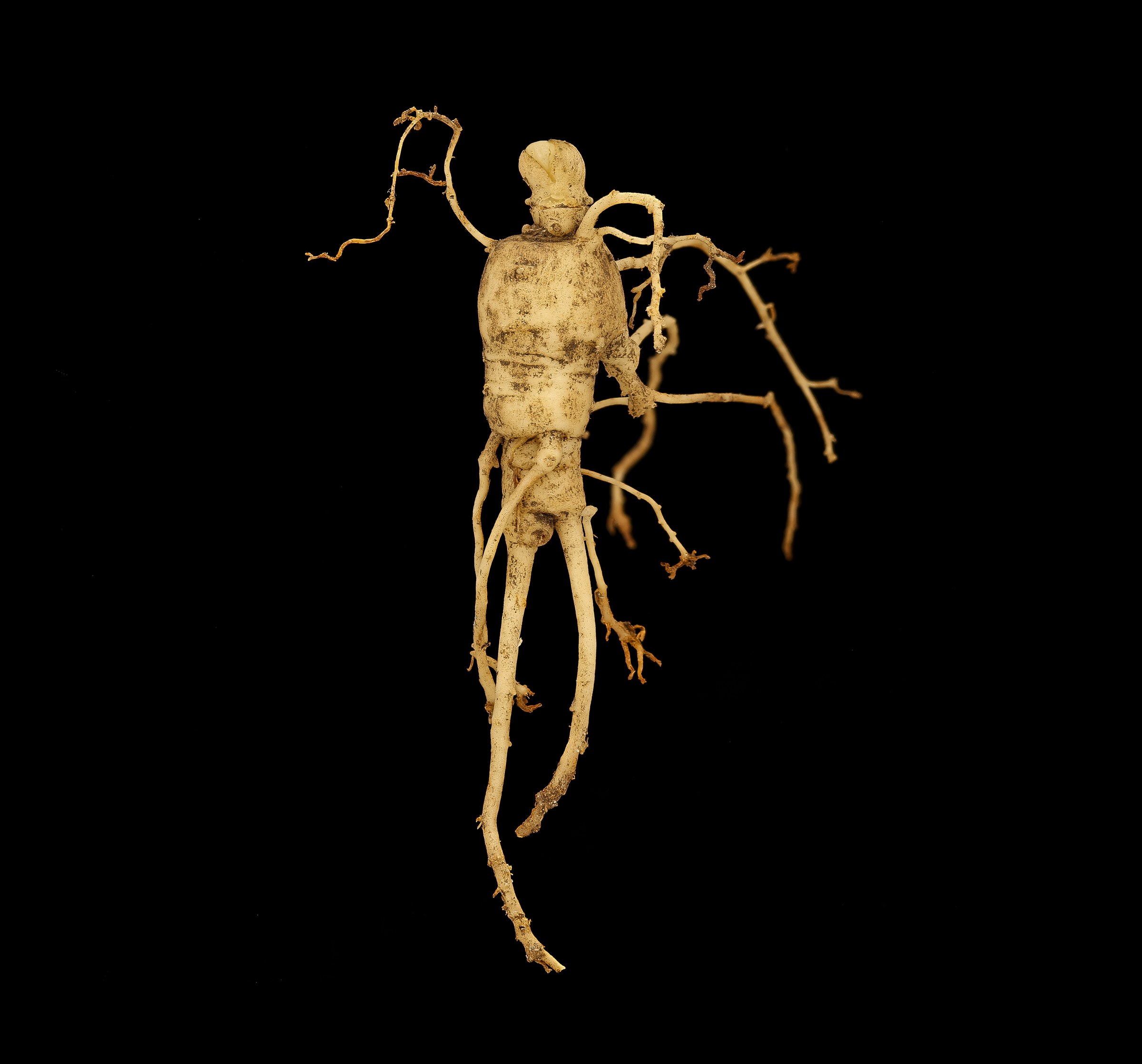
The root is the plant’s most famous feature: a pale, fleshy taproot that is often forked or branched, sometimes resembling a human figure with “arms” and “legs,” which is part of why the plant has been prized in trade for so long. The root develops a new growth scar, or “neck” wrinkle, each year the plant produces a stem, so older wild roots can be aged by counting these annual scars — some documented wild roots have been well over 50 years old. The root is aromatic and mildly bitter-sweet, with a flavor that has made it a long-standing article of herbal trade, discussed further below as history rather than as a growing recommendation.
Stem & Leaves
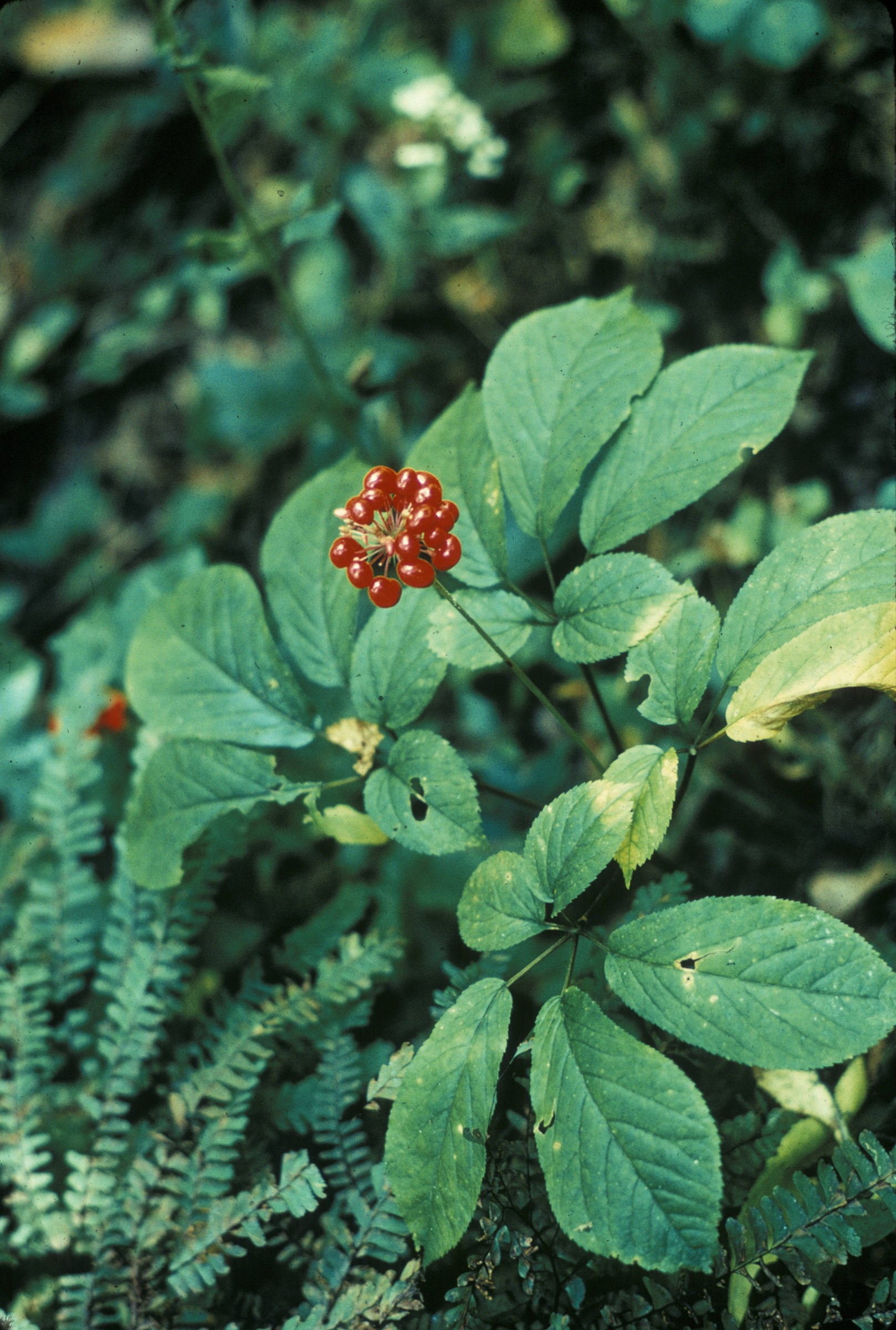
A single, smooth, upright stem rises from the root each spring, typically branching at the top into one, two, or (on older, mature plants) three prongs, each bearing a palmately compound leaf. Each compound leaf is made up of three to five leaflets arranged like fingers on a hand — the species name quinquefolius means “five-leaved,” referring to the five-leaflet form typical of mature plants. Leaflets are oval with a pointed tip and finely toothed edges, 2 to 6 inches long, thin-textured, and dull green, turning yellow in autumn before the plant dies back to the root for winter. Young plants typically have just one compound leaf with three leaflets; the number of prongs and leaflets increases as the plant ages, which foragers and growers use as a rough guide to plant age.
Flowers
In early summer, a slender flower stalk rises from the center of the leaf whorl, topped by a small, rounded umbel of inconspicuous greenish-white flowers, each only about 1/8 inch across. The flowers are easy to miss and are mostly self-pollinated or visited by small native bees and other insects, producing seed by midsummer.
Fruit & Seeds
By late summer and into fall, the flower cluster matures into a tight knot of bright red, pea-sized berries sitting at the center of the leaf whorl — the most visible and recognizable feature of the plant from a distance. Each berry typically holds one or two hard, pale seeds. Seeds have a long, complex dormancy and typically take about 18 months from ripening to germinate, which is one reason commercial ginseng growers stratify seed for over a year before planting.
Quick Facts
| Scientific Name | Panax quinquefolius |
| Family | Araliaceae (Ginseng) |
| Plant Type | Herbaceous Perennial (forb) |
| Mature Height | 8–24 in (20–60 cm) |
| Mature Spread | 8–12 in |
| Growth Rate | Very slow |
| Sun Exposure | Part Shade to Full Shade |
| Water Needs | Moderate, consistent moisture |
| Soil Type | Rich, loose, well-drained forest loam, high in organic matter |
| Soil pH | 5.5–7.0 (slightly acidic to neutral) |
| Bloom Time | June – July |
| Flower Color | Greenish-white |
| Fall Color | Yellow foliage before dieback |
| Fruit | Bright red berry cluster, late summer–fall |
| Deer Resistant | No (deer browsing is a major threat to wild stands) |
| USDA Hardiness Zones | 3–8 |
Native Range
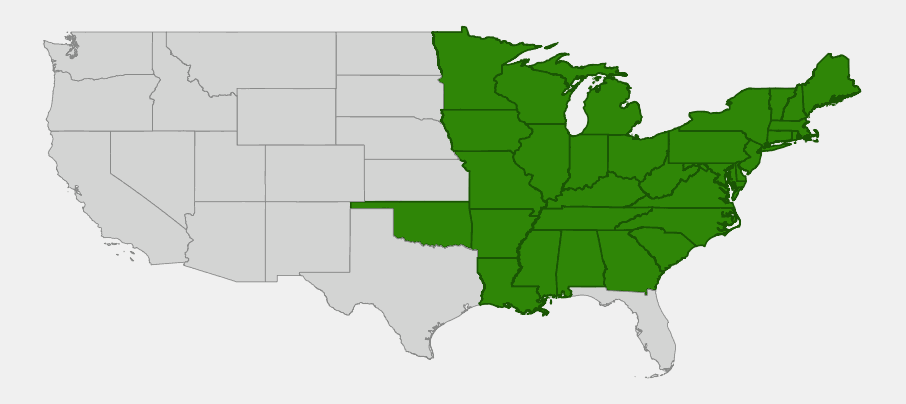
American ginseng is native to the deciduous forests of eastern North America, from the Appalachian Mountains and the Ohio and Mississippi River valleys north into the Great Lakes states and New England, and into adjacent southern Canada. In the United States, it historically ranged from Maine and the Canadian border states south through the Appalachians to Georgia and Alabama, and west to Missouri, Oklahoma, and Minnesota. It is absent from Florida, the Gulf Coastal Plain, and essentially all of the country west of the eastern Great Plains, where the humid, calcium-rich forest conditions it needs do not occur.
Within that range, American ginseng grows almost exclusively in mature, undisturbed deciduous and mixed hardwood forest, favoring north- and east-facing slopes with deep leaf litter and soils derived from limestone or other calcium-rich bedrock. It is most frequently found growing with sugar maple, American beech, tulip poplar, basswood, and other “rich-site” hardwoods, often alongside other calciphile understory herbs such as blue cohosh, black cohosh, and various trilliums.
Because of a long history of wild collection for the root trade, American ginseng is now considered uncommon to rare across much of its range, and in many areas populations are smaller and more scattered than historical records suggest. The U.S. Fish and Wildlife Service and individual state agencies regulate wild harvest (where it is still legal) through harvest seasons, minimum plant age and berry requirements, and export permits tied to the species’ CITES Appendix II listing; several states prohibit wild harvest entirely. Gardeners who want to grow American ginseng should obtain nursery-propagated seed or rootstock rather than transplanting wild plants.
📋 Regional plant lists featuring American Ginseng: New Hampshire, Maine & Vermont · Connecticut, Massachusetts & Rhode Island · New York, Pennsylvania & Northern New Jersey · Delaware, Southern New Jersey & Long Island · Maryland, Virginia & West Virginia · North Carolina & South Carolina · Georgia, Alabama & Mississippi · Arkansas, Louisiana, Eastern Oklahoma & Eastern Texas · Kentucky & Tennessee · Ohio & Indiana · Illinois, Iowa & Missouri · Michigan, Wisconsin & Eastern Minnesota
Growing & Care Guide
American ginseng is not a plant for a typical sunny border — it is a true shade-garden specialist that rewards patience and the right site far more than active management. Grow it from nursery-propagated seed or roots, never from wild-dug plants, and expect to wait years rather than seasons to see a mature plant.
Light
Give American ginseng 70–80% shade, similar to the dappled light under a mature deciduous canopy. Deep, deciduous woodland shade from oaks, maples, or hickories is ideal; a lath or shade-cloth structure set at about 75% shade works well where natural tree cover isn’t available. Too much sun scorches the leaves and stresses the plant; too little light slows growth even further.
Soil & Water
Plant in loose, well-drained, humus-rich soil with a near-neutral pH, ideally over limestone-derived subsoil. Heavy clay or soil that stays waterlogged promotes root rot and should be avoided or amended with leaf mold and coarse sand. Keep the soil consistently moist but never soggy — a thick layer of leaf-litter mulch, replenished each fall, helps retain moisture and mimics the natural forest floor the plant depends on.
Planting Tips
Start from stratified seed (sold already cold-stratified by ginseng seed suppliers) sown in fall, about 1/2 inch deep, or from certified nursery-grown rootstock planted with the bud eye just below the soil surface. Space plants about 8 inches apart under a shade structure or in a naturalized woodland bed. Growth the first couple of years is minimal above ground while the root system establishes — this is normal for the species.
Propagation
American ginseng is propagated almost entirely by seed, since the slow-growing root is easily damaged by division. Fresh seed needs roughly 18 months of warm-then-cold stratification before it will germinate, which is why growers usually buy pre-stratified seed rather than collecting and sowing their own the same year. Patience is the main requirement: expect three to four years before a seedling-grown plant flowers and many more before the root reaches any useful size.
Pruning & Maintenance
Established plants need very little attention beyond maintaining shade, moisture, and leaf-litter mulch. There is no pruning in the usual sense; simply remove the dead stem each fall after it yellows and dies back to the root for winter. Watch for slugs and fungal leaf spot in overly wet conditions, and improve air flow and drainage if either becomes a recurring problem.
Landscape Uses
American ginseng fits best into these specialized, shade-forward roles:
- Native woodland gardens under mature deciduous trees
- Shade perennial collections alongside trillium, bloodroot, and wild ginger
- Conservation plantings that support regional seed stock and genetic diversity
- Small-scale forest-farmed plots grown under natural canopy with proper permits where applicable
- Educational and demonstration gardens focused on woodland medicinal-trade history
Fire Ecology
American ginseng has little tolerance for fire. Because it grows in the deep shade and moist leaf litter of mature forest interiors, it is rarely exposed to fire under natural conditions, and even light surface fire can kill the above-ground stem and damage the shallow crown of the root. It is not a species associated with fire-adapted habitats.
Wildlife & Ecological Value
American ginseng’s ecological role is modest compared to showier woodland natives, but it is a genuine part of the understory community it grows in, and its presence is often used as an indicator of high-quality, undisturbed forest.
For Pollinators
The small greenish-white flowers are visited by small native bees, syrphid flies, and other generalist insects, though the plant also self-pollinates readily. Because it flowers in early summer in deep shade, it adds a minor nectar source in a forest layer where blooming plants are relatively scarce at that time of year.
For Birds
Wood thrushes and other forest-floor and understory birds occasionally eat the bright red berries, helping to disperse the seeds short distances through the forest. The dense leaf litter the plant grows in also supports the invertebrates that many woodland birds forage for.
For Mammals
White-tailed deer readily browse American ginseng foliage, and in many areas heavy deer populations are now considered one of the biggest threats to wild stands, rivaling root harvest itself. Small mammals such as chipmunks and white-footed mice occasionally eat the berries and may help move seed short distances.
Ecosystem Role
As a long-lived, slow-growing herb restricted to mature forest with intact soil and canopy, American ginseng is often used by botanists as an indicator species for high-quality, undisturbed hardwood forest. Its presence signals stable soil, an intact canopy, and a long history without major disturbance such as logging or heavy grazing, making its conservation closely tied to the broader health of the forests it grows in.
Cultural & Historical Uses
American ginseng has one of the longest and most economically significant trade histories of any North American woodland plant. Several Indigenous nations of the eastern forests, including Cherokee and Iroquoian communities, used the root in traditional medicine long before European contact, and knowledge of the plant’s location and uses was passed down within these communities. This history is described here for background only; it is not a recommendation to forage or use the plant medicinally today.
European and American interest in the root exploded in the early 1700s after Jesuit missionaries recognized American ginseng as a close relative of Asian ginseng (Panax ginseng), which was already highly valued in Chinese traditional medicine. By the mid-1700s, American ginseng root had become a major export crop, shipped from Appalachian and New England ports to China in exchange for tea, porcelain, and silk — in fact, ginseng root was among the very first American exports to China, predating the country’s formal founding. Daniel Boone and other frontier figures are recorded among the wild-root diggers and traders of the era.
That export trade never really stopped, and American wild ginseng root remains a valued commodity in parts of Asia today, commanding high prices because of its reputation and the labor involved in finding and aging wild roots. The scale and persistence of that demand drove centuries of wild harvest that, combined with the plant’s slow growth and habitat loss, significantly reduced wild populations across the Appalachians and the rest of its range. In response, nearly every state within the plant’s native range now regulates wild harvest — commonly restricting the season to fall after berries ripen, requiring diggers to replant seed from harvested plants, and setting minimum root age — and all interstate and international shipment of wild root is controlled under the species’ CITES Appendix II listing. Commercial cultivation under artificial shade, mostly concentrated in Wisconsin and parts of the Appalachians, supplies much of the legal trade today and takes pressure off wild stands.
Frequently Asked Questions
Is it legal to dig wild American ginseng?
It depends entirely on the state and, often, the specific land. Where wild harvest is still legal, states set strict rules covering season, minimum plant age, and replanting of seed, and export of any wild root requires a permit under the plant’s CITES Appendix II listing. Many areas, including most public lands, prohibit wild digging outright. Check your state agriculture or natural resources agency before assuming wild harvest is allowed, and consider growing nursery stock instead.
Can I grow American ginseng in my yard?
Yes, if you have a deeply shaded site with rich, well-drained soil — conditions similar to a mature hardwood forest floor. Start from nursery-propagated seed or certified rootstock, never wild-dug plants, and be prepared to wait many years for the root to reach any size. It is a patience plant, not a quick-reward one.
Why is American ginseng root shaped like a little person?
The root naturally forks and branches as it grows and ages, and older roots sometimes develop “arms” and “legs” that resemble a human figure. This resemblance is part of why the plant was prized historically, and especially humanlike roots have traditionally commanded the highest prices in the root trade.
Is American ginseng endangered?
It is not federally listed as endangered, but it is considered uncommon to rare across much of its range due to historical overharvest, and several states track or protect it individually. It is listed under CITES Appendix II, which regulates international trade in wild-collected root to help prevent further decline.
How long does American ginseng take to mature?
Very long by garden standards. Plants typically need three to four years before first flowering, and the root does not reach a size valued in trade for 10 to 20 years or more. This slow timeline is a major reason wild populations recover so slowly from overharvest.

Looking for a nursery that carries American Ginseng?
Browse our native plant nursery directory: Alabama & Arkansas · Connecticut, Delaware & Georgia · Iowa, Illinois & Indiana · Kentucky, Louisiana, Maine, Maryland, Massachusetts, Michigan, Minnesota, Mississippi & Missouri · New Hampshire, New Jersey, New York, North Carolina, Ohio & Oklahoma · Pennsylvania, Rhode Island, South Carolina, Tennessee, Vermont & Virginia · Wisconsin & West Virginia