
Whorled loosestrife (Lysimachia quadrifolia)
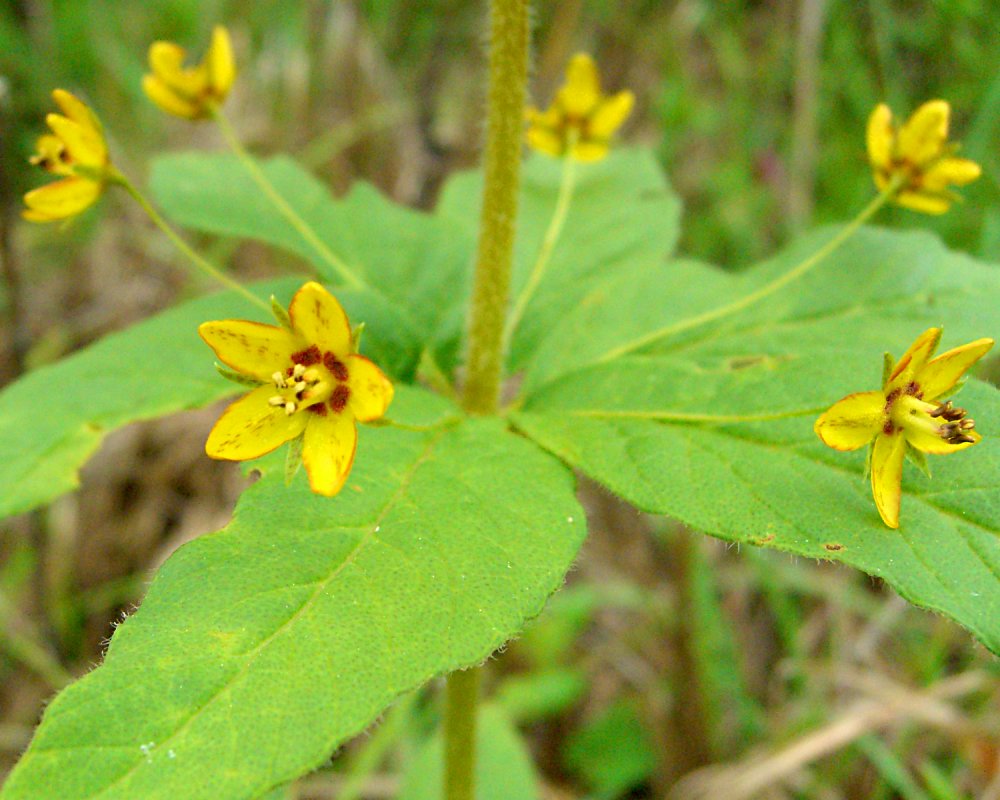
Lysimachia quadrifolia, known as Whorled loosestrife (USDA: whorled yellow loosestrife; also called four-leaved loosestrife or crosswort), is a graceful woodland wildflower of eastern North America. Its upright stems carry tier upon tier of leaves arranged in neat whorls, usually four at each level, and in early summer slender stalks rise from the base of each leaf, each holding a single star-shaped yellow flower marked with red at the center. A patch in bloom looks like a scattering of small yellow stars floating above layered green pinwheels.
Despite the name, whorled loosestrife is not related to the notorious purple loosestrife (Lythrum salicaria), the invasive Eurasian wetland plant that has taken over marshes across much of North America. Purple loosestrife belongs to a different family (Lythraceae), has tall spikes of magenta flowers, and grows in wet ground. Whorled loosestrife is a native member of the primrose family (Primulaceae), has yellow flowers, and grows mainly in dry to moist open woods. The two only share an old common name.
Whorled loosestrife ranges from Maine and southern Canada west to Minnesota and south through the Appalachians to Georgia and Alabama. It is a good plant for naturalistic woodland edges and partly shaded gardens with lean, acidic soil, and it supports a specialized group of native bees that depend on Lysimachia flowers. This guide covers how to identify it, where it grows, and how to grow it.
Identification
Whorled leaves are the key feature. Several other woodland plants have whorled leaves, including Indian cucumber-root (Medeola virginiana) and young Turk’s-cap lilies (Lilium superbum), but whorled loosestrife is the only one with small yellow flowers on long stalks arising from each leaf in the whorl.
Stems & Roots
Plants grow from slender, creeping rhizomes and often form loose colonies. The stems are erect, usually unbranched, 1 to 3 feet tall, round, and finely hairy. In good conditions a patch can contain dozens of stems.
Leaves
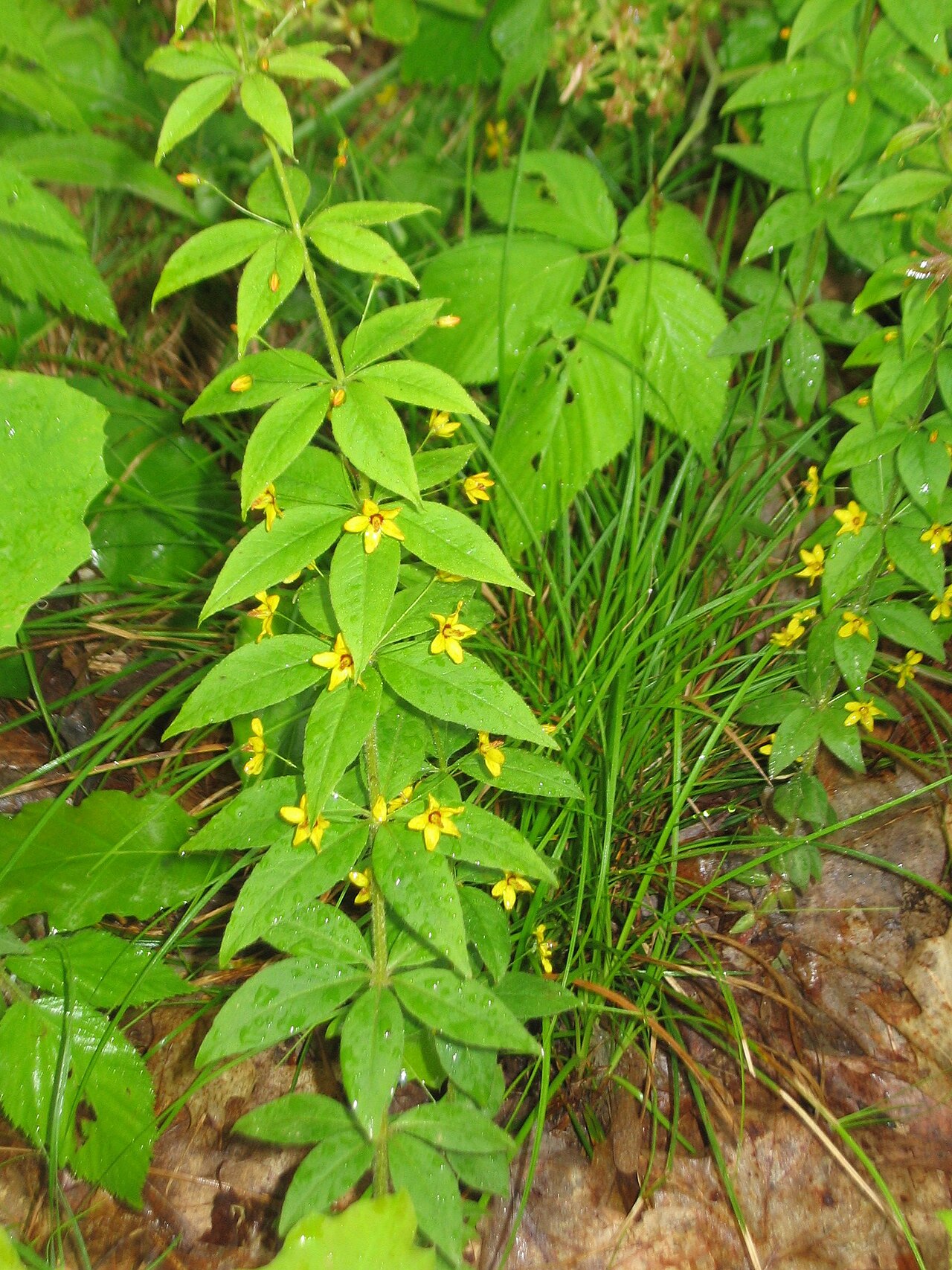
The leaves are arranged in whorls of 3 to 6, most often 4, at several levels up the stem. Each leaf is lance-shaped to narrowly oval, about 2 to 4 inches long, stalkless or nearly so, with smooth edges and a pointed tip. If you hold a leaf up to the light you can often see tiny dark dots or streaks, which are resin glands typical of the genus. The lower whorls are often smaller and more widely spaced than the upper ones.
Flowers
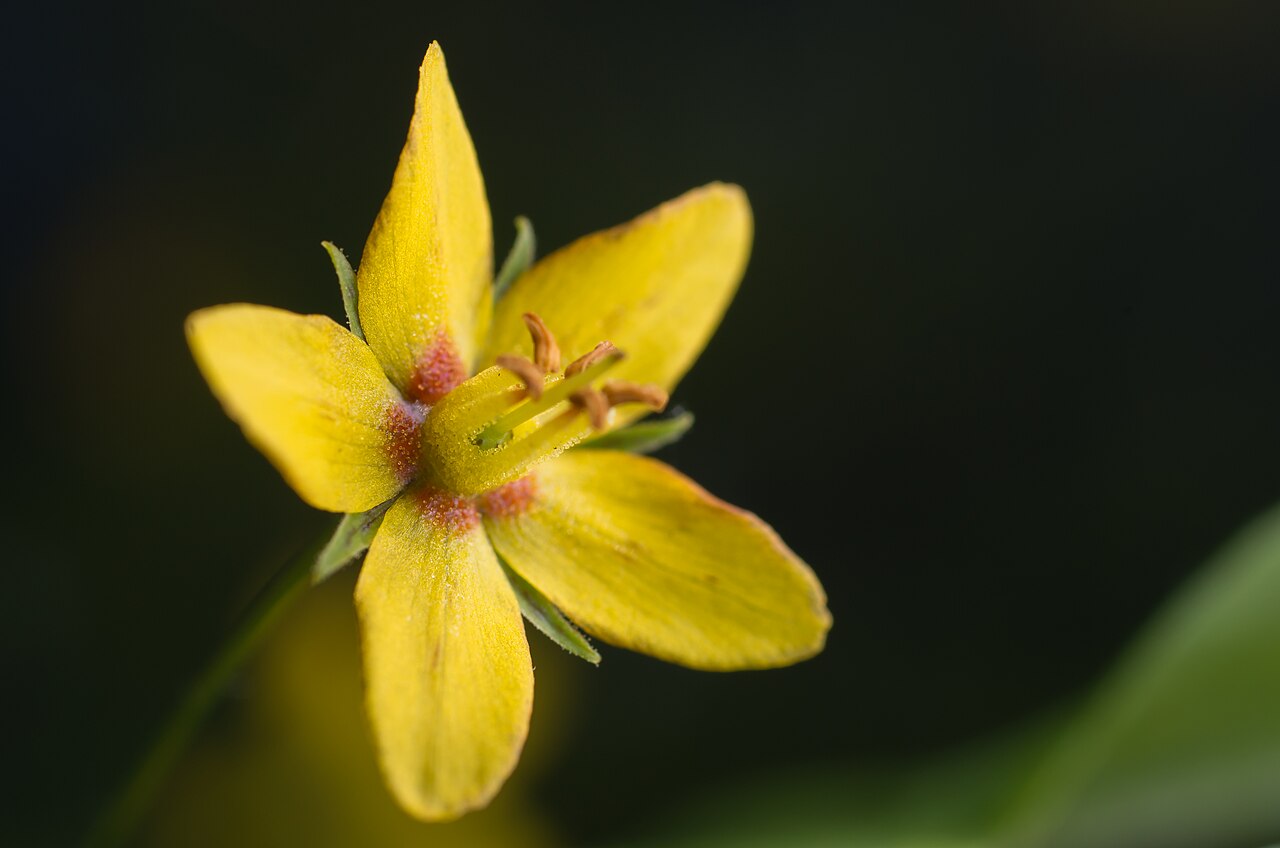
The flowers grow singly on long, very slender stalks, 1 to 2 inches long, from the axils of the leaves in the middle and upper whorls. Each whorl usually produces one flower per leaf, so a four-leaved whorl may hold four flowers radiating outward. The flowers are about ½ inch across, with five pointed yellow petals. The petals are streaked or dotted with red, and the center has a red to orange ring around the stamens. Bloom is from late May to July, depending on latitude and elevation.
Fruit & Seeds
After flowering, each flower forms a small, round capsule on its thread-like stalk. In late summer the capsules split to release a few small brown seeds. The plant also spreads by rhizomes, so established patches gradually widen.
Look-alikes
Swamp candles (Lysimachia terrestris) has opposite leaves and a terminal spike of yellow flowers, and it grows in wetter ground. The two sometimes hybridize, producing intermediate plants known as Lysimachia ×producta. Fringed loosestrife (L. ciliata) has opposite leaves with fringed leaf stalks and nodding flowers. Whorled loosestrife’s combination of whorled leaves and long-stalked axillary flowers is distinctive.
Quick Facts
| Scientific Name | Lysimachia quadrifolia |
| Family | Primulaceae (primrose family); formerly placed in Myrsinaceae |
| Plant Type | Herbaceous perennial with creeping rhizomes |
| Mature Height | 1–3 ft |
| Mature Spread | 1–2 ft; slowly forms colonies |
| Growth Rate | Moderate |
| Sun Exposure | Partial shade to full sun |
| Water Needs | Low to medium; tolerates dry spells once established |
| Soil Type | Sandy or rocky loam; well-drained, often lean, acidic soils |
| Soil pH | About 4.5–6.5 |
| Bloom Time | Late May–July |
| Flower Color | Yellow with red streaks and a red center |
| Fall Color | Leaves turn yellow to bronze |
| Fruit | Small round capsule with a few seeds |
| Deer Resistant | Moderately; occasionally browsed |
| USDA Hardiness Zones | 3–8 |
Native Range
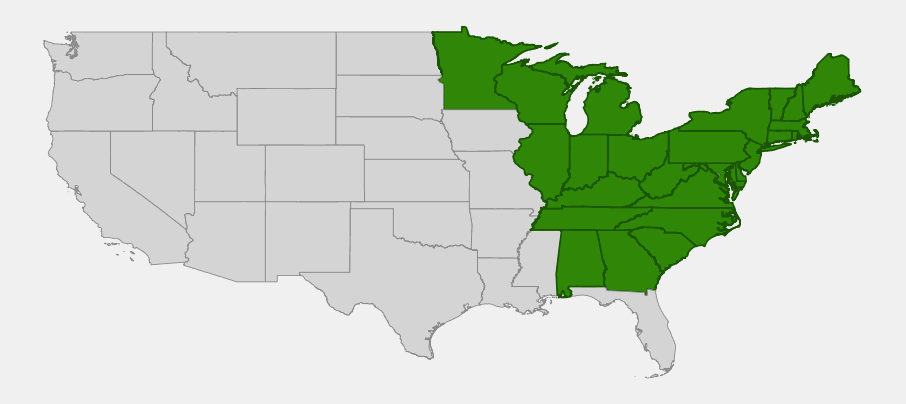
Whorled loosestrife is native across much of the eastern United States and adjacent Canada. USDA PLANTS records it in 25 states: from Maine, New Hampshire and Vermont south through New England, New York, New Jersey, Pennsylvania, Delaware and Maryland, through Virginia, West Virginia and the Carolinas to Georgia and Alabama, and west through Ohio, Indiana, Kentucky, Tennessee, Illinois, Michigan, Wisconsin and Minnesota. In Canada it grows in Ontario, Quebec and New Brunswick.
It is most common in the Northeast, the Appalachian Mountains and Piedmont, and the Great Lakes region. Toward the southern and western edges of its range it becomes more local. In Georgia, Alabama and South Carolina it grows mainly in the mountains and upper Piedmont, and in Illinois, Minnesota and Wisconsin it is mostly found in sandy oak woods and openings in the eastern parts of those states.
Its typical habitats are dry to moist open woods, especially oak and oak-pine forests, as well as woodland edges, thickets, clearings, power-line corridors, roadside banks and sandy barrens. It prefers acidic, well-drained soils and partial sun, and it often shows up along trails and old woods roads where the canopy is broken.
📋 Regional plant lists featuring Whorled loosestrife: New York, Pennsylvania & Northern New Jersey · Ohio & Indiana · Michigan, Wisconsin & Eastern Minnesota · Kentucky & Tennessee · Connecticut, Massachusetts & Rhode Island · New Hampshire, Maine & Vermont · Maryland, Virginia & West Virginia · Delaware, Southern New Jersey & Long Island · Illinois, Iowa & Missouri · Alabama, Georgia & Mississippi
Growing & Care Guide
Whorled loosestrife is an easy, low-maintenance native for woodland edges, shade gardens and naturalized areas. It spreads gently by rhizomes but is not aggressive the way some garden loosestrifes are, and it does best in the lean, acidic, well-drained soils where many other perennials struggle. Use nursery-grown plants or seed rather than digging from the wild.
Light
Give it partial shade or dappled sun, such as under high oak canopy or along the sunny edge of a woodland. It also grows in full sun if the soil does not dry out completely, but it flowers less in deep shade.
Soil & Water
It prefers sandy, rocky or loamy soil that is well drained and somewhat acidic. It tolerates poor soils and short dry spells once established, but it looks best with evenly moist soil in spring and early summer. No fertilizer is needed; rich soil leads to floppy stems.
Planting Tips
Plant container-grown plants in spring or early fall, about 12 to 18 inches apart. Grouping several plants creates the best effect, since the tiered whorls of leaves look most striking in a small drift. Combine it with low woodland plants and grasses such as pussytoes, wild oats, Pennsylvania sedge and poverty oatgrass.
Pruning & Maintenance
Little maintenance is needed. Leave the stems standing after flowering to ripen seed, then cut them back in late fall or early spring. A light mulch of shredded leaves helps keep the soil cool and moist. If the colony spreads beyond where you want it, pull or dig the extra rhizomes in spring.
Propagation
Divide established clumps in early spring or fall, keeping a section of rhizome with each shoot. It can also be grown from seed. The seeds benefit from a period of cold, moist stratification over winter and need light to germinate, so sow them on the surface of the soil in fall or after about 60 days of cold treatment.
Landscape Uses
- Woodland edges: for the transition zone between lawn and trees, especially under oaks
- Dry shade gardens: one of the few summer-flowering natives that tolerates lean, dry, acidic soils
- Pollinator gardens: supports the specialist oil-collecting bees of the genus Macropis
- Naturalized areas and meadow edges: spreads slowly to form loose colonies
- Rain garden margins: on the higher, drier edges rather than in the wettest zones
Wildlife & Ecological Value
Whorled loosestrife is a modest plant, but it is part of one of the most interesting pollination partnerships in eastern North America.
For Pollinators
Like other yellow loosestrifes, whorled loosestrife flowers produce floral oils instead of nectar. These oils are collected by bees of the genus Macropis, which are specialists on Lysimachia. The female bees mix the oil with pollen to provision their nests and use it to waterproof their brood cells, which are often in moist ground. Without native Lysimachia such as this one, these bees cannot reproduce. A rare cuckoo bee, Epeoloides pilosulus, in turn depends on Macropis. Other small bees and syrphid flies also visit the flowers for pollen.
For Birds
Whorled loosestrife has little direct food value for birds, though its seeds may be eaten by ground-feeding birds. The open oak woods and woodland edges where it grows are important habitat for many songbirds, including eastern towhees, ovenbirds and chestnut-sided warblers.
For Mammals
White-tailed deer occasionally browse the stems. Rabbits and other small mammals may nibble young plants, but it is not a major food plant.
Ecosystem Role
Its creeping rhizomes help bind the soil of slopes and woodland edges. It persists in partly open woods and spreads after light disturbance, such as thinning, fire or the creation of trail edges. The specialized relationship between Lysimachia and Macropis bees makes native loosestrifes important for conserving native bee diversity.
Cultural & Historical Uses
The genus name Lysimachia comes from Greek and is traditionally linked to Lysimachus, a king of ancient Thrace and general of Alexander the Great. The English name “loosestrife” is a translation of the Greek, meaning “ending strife”. The Roman writer Pliny claimed that placing loosestrife on the yokes of oxen calmed them and stopped them from quarreling. The species name quadrifolia means “four-leaved”.
Whorled loosestrife was described by Linnaeus in 1753. Ethnobotanical records note medicinal uses by several Native American nations in the eastern United States, mostly as a tea. These uses are historical and are not recommendations for home remedies.
For eastern naturalists, whorled loosestrife is one of the plants that marks early summer in the oak woods, appearing after the spring ephemerals have faded and before the late-summer asters and goldenrods. Its tidy, geometric leaves make it a favorite of botanical illustrators and photographers.
Frequently Asked Questions
Is whorled loosestrife invasive like purple loosestrife?
No. Whorled loosestrife is a native wildflower that spreads slowly by rhizomes. Purple loosestrife (Lythrum salicaria) is an unrelated invasive species from Eurasia. They share only part of a common name.
Where does whorled loosestrife grow best?
It does best in dry to moist, acidic, well-drained soil in partial shade, such as the edge of an oak woodland. It tolerates poor and sandy soils.
When does whorled loosestrife bloom?
Usually from late May through July. In the southern Appalachians it flowers earlier, and in the North and Great Lakes region mostly in June and July.
Does it attract pollinators?
Yes. Its flowers produce floral oils that are collected by specialist Macropis bees, which depend on native loosestrifes. Other small bees and flies also visit for pollen.
Is whorled loosestrife deer resistant?
It is moderately deer resistant. Deer occasionally browse it, but it is not usually a favorite.

Looking for a nursery that carries Whorled loosestrife?
Browse our native plant nursery directory: Alabama · Connecticut, Delaware & Georgia · Illinois & Indiana · Kentucky, Maine, Maryland, Massachusetts, Michigan & Minnesota · New Hampshire, New Jersey, New York, North Carolina & Ohio · Pennsylvania, Rhode Island, South Carolina, Tennessee, Vermont & Virginia · West Virginia & Wisconsin