
American Wintergreen (Pyrola americana)
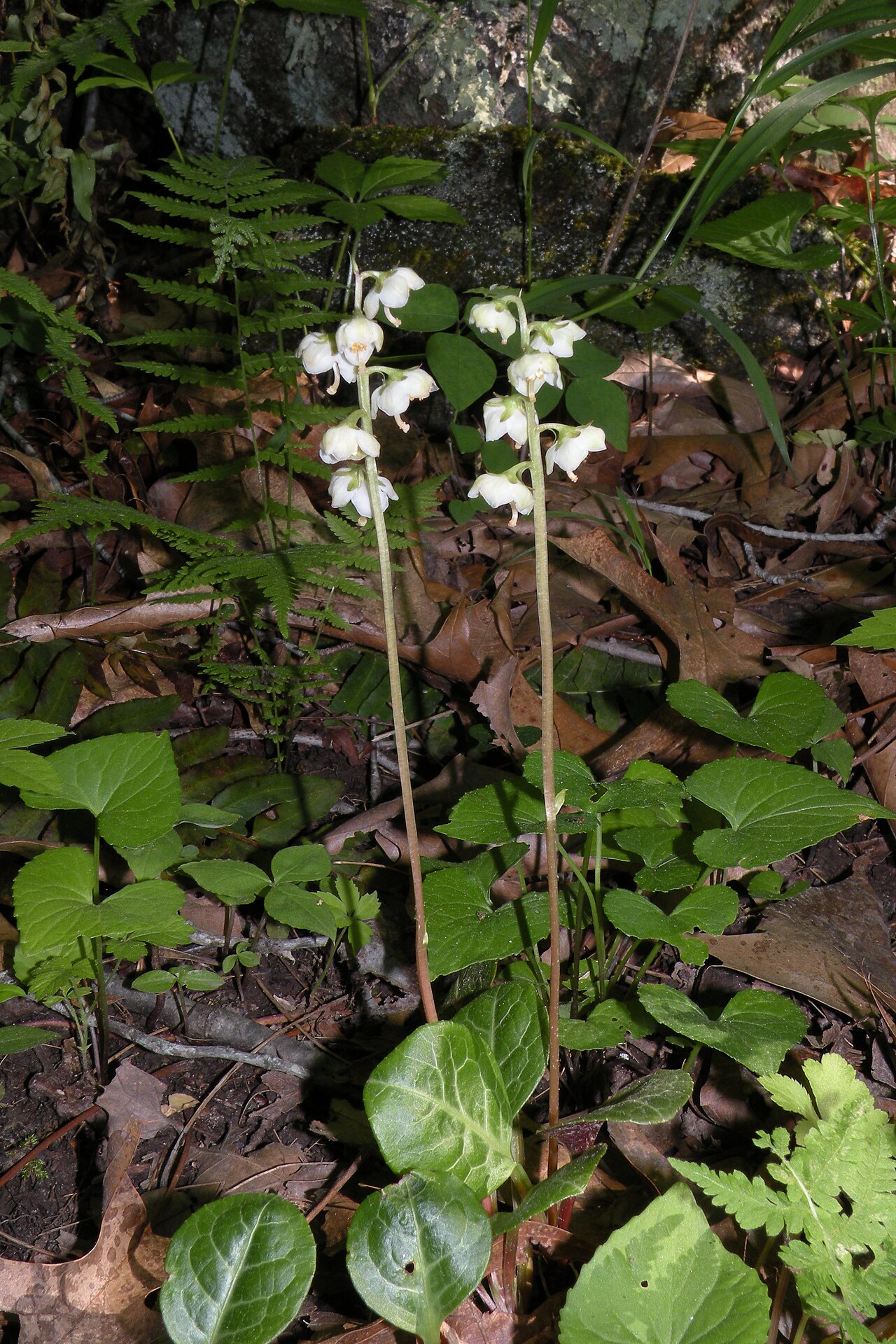
Pyrola americana, known as American Wintergreen, round-leaved pyrola or American shinleaf, is a small evergreen wildflower of eastern North American woodlands. A low rosette of round, glossy, leathery leaves stays green all winter on the forest floor. In early summer it sends up a leafless stalk 4 to 12 inches tall that carries a loose spike of nodding, waxy white flowers with a sweet fragrance. It belongs to the heath family (Ericaceae), together with blueberries, trailing arbutus and the true wintergreen, Gaultheria procumbens.
American wintergreen is a plant to find and admire in the woods, not one to bring home. Like its relatives the pipsissewas and Indian pipe, it depends on soil fungi, and research on Pyrola species has shown that they draw part of their food from fungi connected to the roots of nearby trees. Plants dug from the wild almost always die, and they rarely establish from nursery stock either. This page is mainly an identification and appreciation guide.
Older books often treat it as Pyrola rotundifolia var. americana, a variety of the Eurasian round-leaved wintergreen, and USDA PLANTS lists several such names as synonyms. Today most North American floras treat American wintergreen as its own species. This guide explains how to recognize it, where to find it, how it lives, and why it is best left where it grows.
Identification
Several wintergreens and their relatives share the eastern forest floor, and they are easiest to tell apart by their leaves and flowers. American wintergreen stands out for its round, shiny, thick leaves and its relatively large, pure white, fragrant flowers with a strongly curved style.
Rosette & Stems
The plant grows from a slender, creeping rhizome just below the leaf litter, producing scattered rosettes that can form loose colonies. Each rosette holds a few leaves at ground level. The flowering stalk (scape) is 4 to 12 inches tall, smooth, reddish-green and leafless except for one or two small, papery bracts.
Leaves
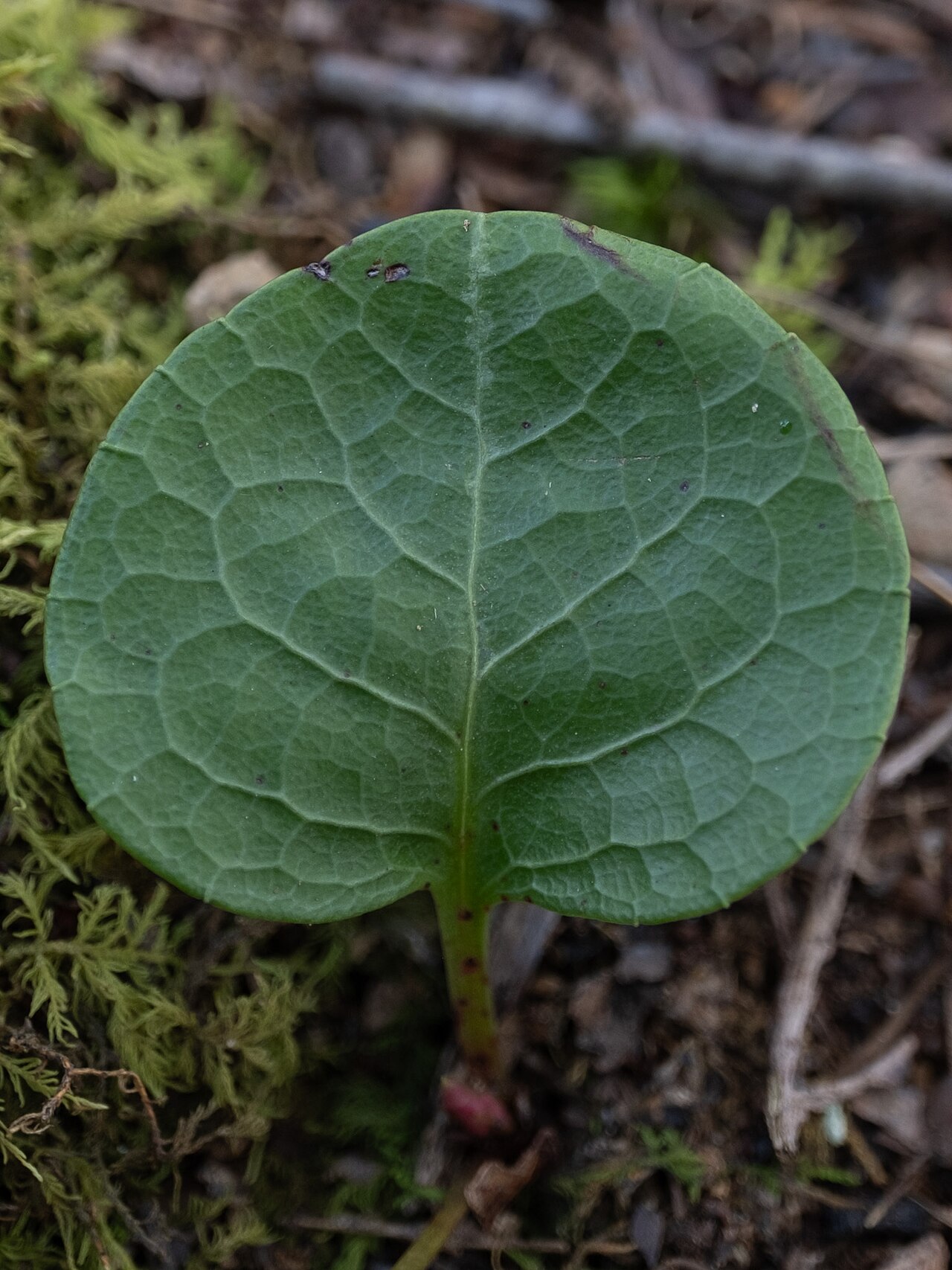
The leaves are round to broadly oval, about 1 to 2½ inches long, thick, leathery and noticeably glossy, dark green above and paler below, with smooth or finely scalloped edges. The leaf stalk is about as long as the blade or a little shorter. They remain green over winter, which is the origin of the name wintergreen. In shinleaf (Pyrola elliptica), a common look-alike, the leaves are thinner, dull rather than glossy, elliptical, and longer than their stalks.
Flowers
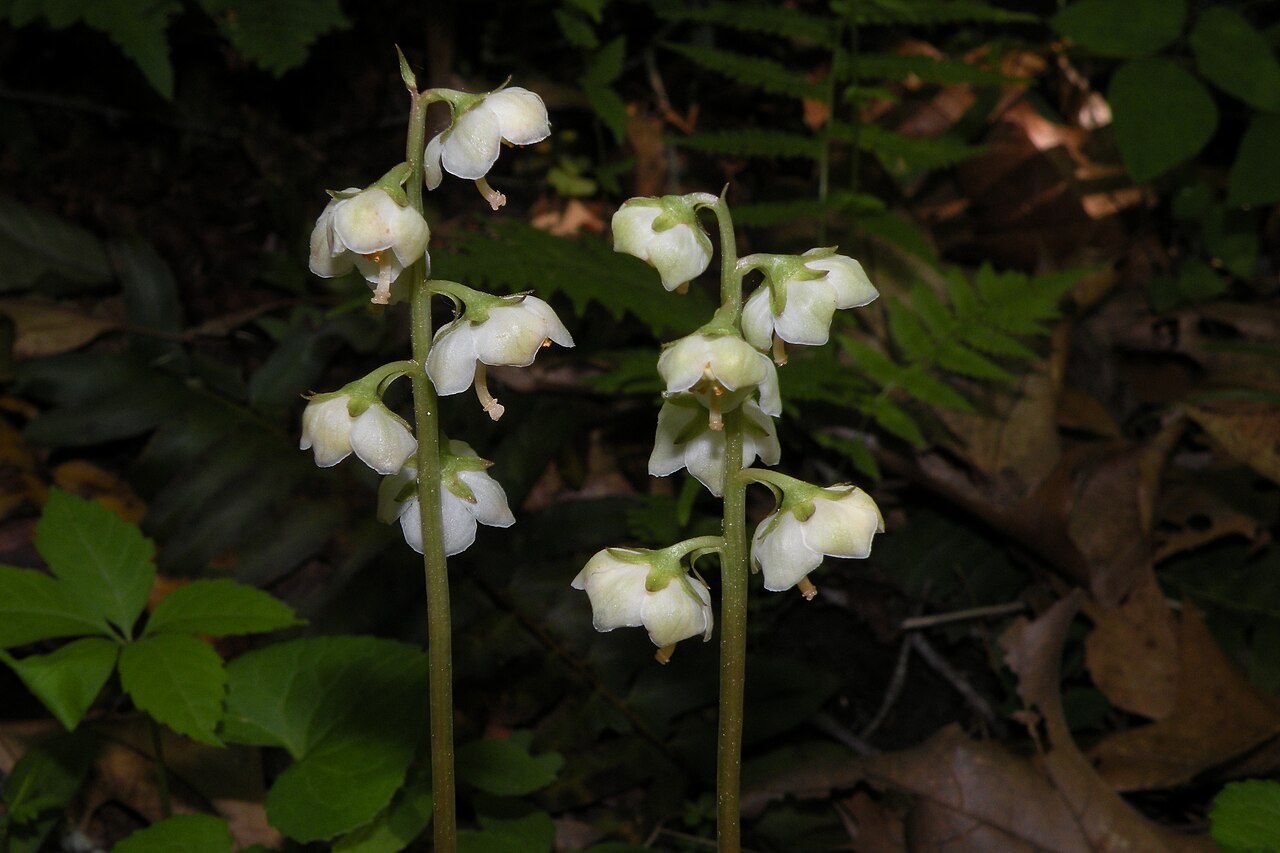
Five to more than twenty flowers hang from short stalks along the upper part of the scape, all around the stem rather than to one side. Each is about ½ inch across, nodding and cup-shaped, with five thick, waxy, white petals that may be tinged with pink, and narrow, pointed sepals. Ten stamens with yellowish to reddish anthers cluster inside. The most useful feature is the long style, which projects from the flower, curves downward and then turns upward at the tip. The flowers are fragrant and bloom from late spring into summer, mostly in June and July.
One-sided wintergreen (Orthilia secunda) has all its flowers on one side of the stalk and a straight style. Green-flowered wintergreen (Pyrola chlorantha) has small, dull leaves and greenish-white flowers. Pink pyrola (P. asarifolia) has pink to reddish flowers.
Fruit & Seeds
Flowers are followed by rounded, five-chambered capsules about ¼ inch across, which hang from the stalk with the persistent style still attached. When they split in late summer and fall they release great numbers of dust-fine seeds, which carry almost no stored food and depend on a fungal partner to germinate and grow. Dry fruiting stalks often remain upright into winter.
Quick Facts
| Scientific Name | Pyrola americana (syn. P. rotundifolia var. americana) |
| Family | Ericaceae (heath family) |
| Plant Type | Evergreen perennial herb (subshrub); partly dependent on mycorrhizal fungi |
| Mature Height | 4–12 in in flower; leaves at ground level |
| Mature Spread | Rosettes 3–5 in; slowly forms loose colonies |
| Growth Rate | Very slow |
| Sun Exposure | Partial to full shade |
| Water Needs | Moderate; dry to moist forest soils |
| Soil Type | Acidic, humus-rich forest soil; often sandy or rocky |
| Soil pH | Acidic (about 4.5–6.0) |
| Bloom Time | Late May–August (mostly June–July) |
| Flower Color | White, sometimes tinged pink |
| Fall Color | Evergreen; glossy leaves persist through winter |
| Fruit | Nodding five-chambered capsule with dust-like seeds |
| Deer Resistant | Usually; rarely browsed |
| USDA Hardiness Zones | 3–7 |
Native Range
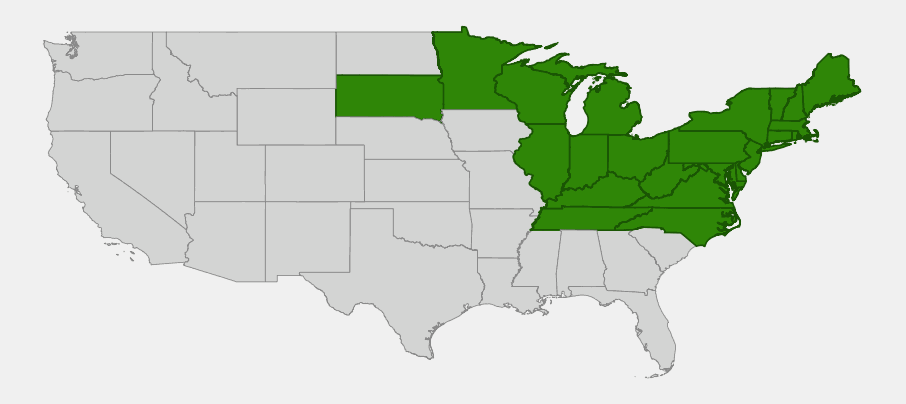
American wintergreen is a plant of the northeastern and north-central United States and eastern Canada. USDA PLANTS lists it as native in 23 states and the District of Columbia, from Maine and the Great Lakes states south through the Appalachians to Kentucky, Tennessee, Virginia and North Carolina, and west to Minnesota, with an outlying record in South Dakota. In Canada it grows from Manitoba and Ontario east through Quebec to the Maritime provinces and Newfoundland.
It is most common in New England, New York, Pennsylvania and the upper Great Lakes, where pine, oak, hemlock and northern hardwood forests cover large areas. Toward the south it follows the cooler uplands of the Appalachians, and at the southern and western edges of its range, in parts of the Midwest and the Southeast, it is scattered and uncommon.
Typical habitats include dry to moist oak and pine woods, mixed hardwood-conifer forests, sandy pine barrens, hemlock ravines, rocky wooded slopes and the edges of bogs and swamps. It often grows in deep leaf litter or moss under trees, in the same places as striped wintergreen, pipsissewa, partridgeberry and trailing arbutus.
📋 Regional plant lists featuring American Wintergreen: New York, Pennsylvania & Northern New Jersey · Ohio & Indiana · Michigan, Wisconsin & Eastern Minnesota · Kentucky & Tennessee · Connecticut, Massachusetts & Rhode Island · New Hampshire, Maine & Vermont · Maryland, Virginia & West Virginia · Delaware, Southern New Jersey & Long Island · Illinois, Iowa & Missouri
Growing & Care Guide
American wintergreen is not a garden plant in the usual sense. It relies on a three-way partnership with soil fungi and the trees they connect to, and that partnership cannot be moved. It rarely transplants or establishes from nursery stock, and it should never be dug up from the wild. The best way to “grow” it is to protect the woodland where it already lives.
Light
In the wild it grows in partial to full shade under a forest canopy, often under pines, oaks or hemlocks. It disappears when woods are cleared and the forest floor is exposed to full sun.
Soil & Water
It needs undisturbed, acidic forest soil with an intact layer of leaf litter, humus and fungal threads. It tolerates both fairly dry, sandy woods and moist ones, but it does not survive in compacted, fertilized or heavily amended garden soil.
Planting Tips
Do not plant or transplant it. Wild plants almost never survive digging, because the fine roots and their fungal connections are destroyed, and taking them harms populations that are uncommon in many states. If you are lucky enough to have American wintergreen in your woods, protect the spot from foot traffic, digging, raking and leaf blowing, and keep invasive plants such as Japanese stiltgrass and garlic mustard out.
Pruning & Maintenance
None. Leave the leaf litter and fallen needles where they fall; they are part of the plant’s habitat. Avoid applying fertilizer, lime or herbicides nearby, as these disrupt the soil fungi it depends on.
Propagation
Propagation is not practical for home gardeners. Its tiny seeds need specific fungi to germinate, and rhizome divisions taken from the wild rarely establish away from their original site. Conservation of existing habitat is the only reliable way to keep it.
Landscape Uses
- Woodland conservation: an indicator of intact, undisturbed forest floor
- Wildflower walks and nature study: an excellent example of fungus-dependent heath-family plants
- Botanical photography: fragrant, waxy flowers on the forest floor in early summer
- Protection on wooded properties: leave existing colonies undisturbed; do not transplant
- Citizen science: record sightings on iNaturalist or with state natural heritage programs
Wildlife & Ecological Value
American wintergreen is a quiet but interesting part of the forest-floor community, and it is a good example of how many woodland plants depend on hidden partnerships below ground.
For Pollinators
The fragrant, nodding flowers are visited by bumble bees and other bees, which hang beneath them and collect pollen. Like many heath-family plants, Pyrola flowers release pollen through small pores in the anthers, and bees can shake it loose by vibrating their flight muscles (buzz pollination). Flies and small beetles also visit.
For Birds
The plant offers little direct food for birds, though grouse and other forest birds may nibble the evergreen leaves in winter. The mature forests where it grows support ovenbirds, wood thrushes, hermit thrushes and other forest-floor birds.
For Mammals
Deer and rabbits seldom eat it, perhaps because the leaves contain bitter compounds. Its leaves are among the few green plants available on the winter forest floor, but it is not an important food source.
Ecosystem Role
Pyrola species are partially mycoheterotrophic: in addition to making sugars through photosynthesis in their leaves, they obtain carbon from mycorrhizal fungi that also connect to the roots of forest trees. This makes them sensitive to anything that breaks the underground network, including clear-cutting, soil compaction and repeated disturbance. A healthy colony of American wintergreen is often a sign of a mature, long-undisturbed forest floor.
Cultural & Historical Uses
The genus name Pyrola is a diminutive of Pyrus, the pear, because the leaves of some species resemble small pear leaves. The species was described by the English botanist Robert Sweet in the 1820s. Common names such as “shinleaf” come from an old practice of applying the leaves of Pyrola species as plasters on bruises and sores, including injuries to the shins.
Native American peoples and European settlers used several Pyrola species as medicine, typically as poultices or teas for sores, swelling and other ailments. The leaves of wintergreens contain compounds with mild astringent properties. These uses are of historical interest only, and harvesting wild plants for medicine is not appropriate given their slow growth and sensitivity to disturbance.
The name “wintergreen” is shared by several unrelated groups of evergreen woodland plants, including Gaultheria procumbens, the source of wintergreen flavoring. American wintergreen does not have that minty scent. Its appeal lies in its glossy leaves in winter and its delicate, fragrant flowers in summer, a reward for anyone who walks quiet pine and oak woods in June.
Frequently Asked Questions
Can I grow American wintergreen in my garden?
Not realistically. It depends on soil fungi linked to forest trees, rarely transplants or establishes from nursery stock, and should never be dug from the wild. If it already grows on your property, the best thing you can do is protect its habitat.
Is American wintergreen the same as the wintergreen used for flavoring?
No. Wintergreen flavoring comes from checkerberry or teaberry (Gaultheria procumbens). American wintergreen (Pyrola americana) is a different plant in the same heath family and does not have the minty wintergreen scent.
How do I tell American wintergreen from shinleaf?
American wintergreen has thick, glossy, nearly round leaves with stalks about as long as the blade, and pure white flowers. Shinleaf (Pyrola elliptica) has thinner, dull, elliptical leaves that are longer than their stalks, and greenish-white flowers.
Why does it die when transplanted?
American wintergreen gets part of its food from mycorrhizal fungi that are linked to the roots of surrounding trees. Digging it up cuts it off from that network, and garden soil rarely has the right fungi, so the plant slowly starves.
When does American wintergreen bloom?
Mostly in June and July, with some flowers from late May to August depending on latitude and elevation. The evergreen leaves can be found year-round.

Looking for a nursery that carries American Wintergreen?
Browse our native plant nursery directory: Connecticut & Delaware · Illinois & Indiana · Kentucky, Maine, Maryland, Massachusetts, Michigan & Minnesota · New Hampshire, New Jersey, New York, North Carolina & Ohio · Pennsylvania, Rhode Island, South Dakota, Tennessee, Vermont & Virginia · West Virginia & Wisconsin