
Southern Dewberry (Rubus trivialis)
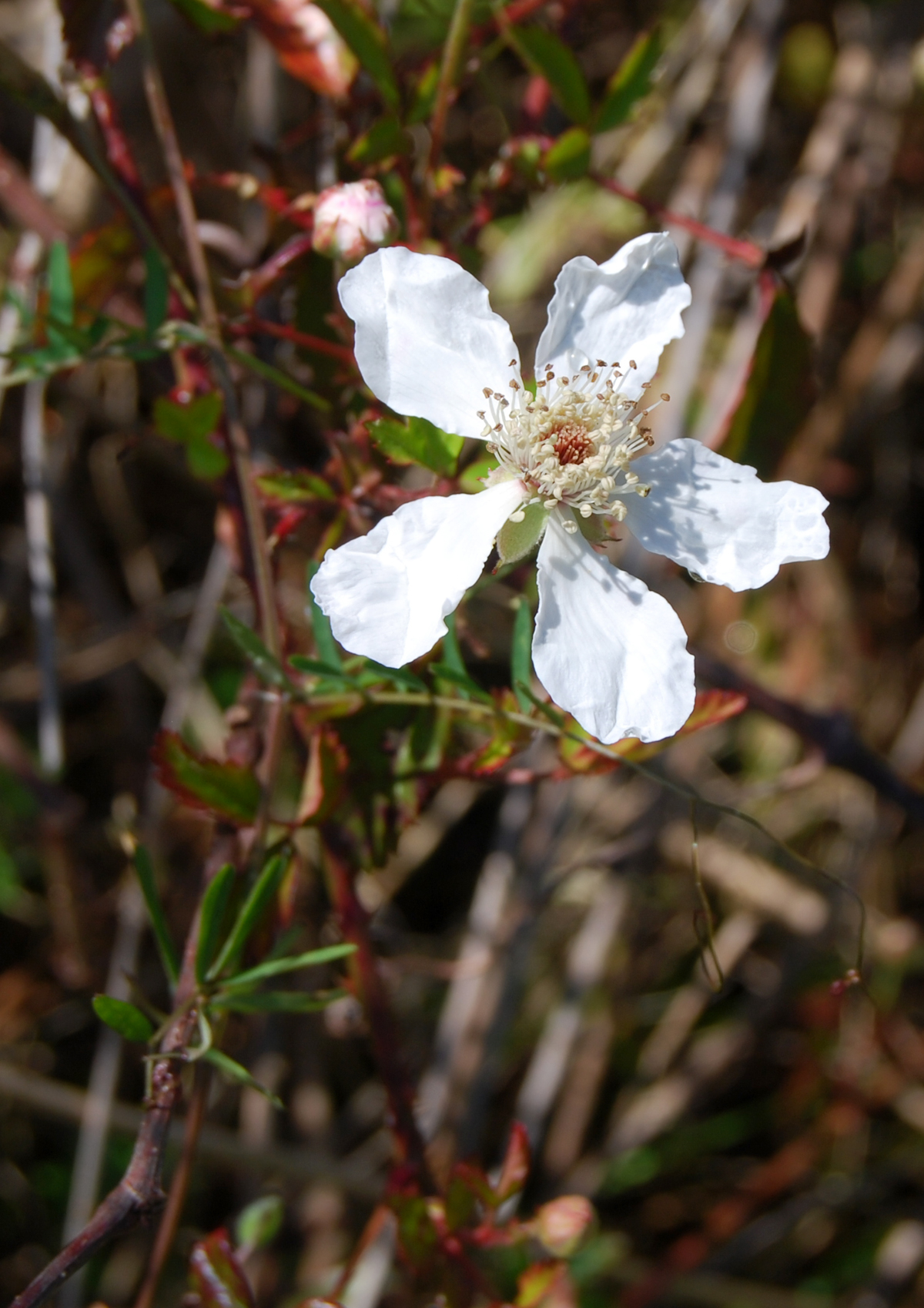
Rubus trivialis, known as Southern Dewberry, is a low, trailing bramble of the rose family (Rosaceae) and one of the most familiar wild fruits of the American South. Its long, prickly canes run along the ground through fields, pine woods, roadsides and sandy clearings, rooting at their tips, and in early spring they are covered with large white flowers. By late spring they carry juicy black berries, often the first wild berries of the year.
Dewberries are blackberries that trail instead of standing upright. Southern dewberry is distinguished from its relatives by its reddish, bristly canes armed with hooked prickles, its leathery, often semi-evergreen leaves, and its early bloom, from February in Florida and along the Gulf Coast to April farther north. The fruit is sweet to tart and excellent for eating fresh, in cobblers and pies, and in jelly, and it has been gathered by Southern families for generations.
It can be a nuisance in pastures and lawns, where its canes spread quickly and catch on ankles and clothing. In the right place, though, southern dewberry is a valuable native groundcover for sunny, poor soils, an important food plant for wildlife, and an early nectar source for bees. This guide covers identification, range, how to grow it, and how to keep it in bounds.
Identification
Southern dewberry often grows mixed with other Rubus species, which hybridize and can be hard to separate. Look at the cane surface, the growth habit and the timing of flowers and fruit.
Canes & Growth Habit
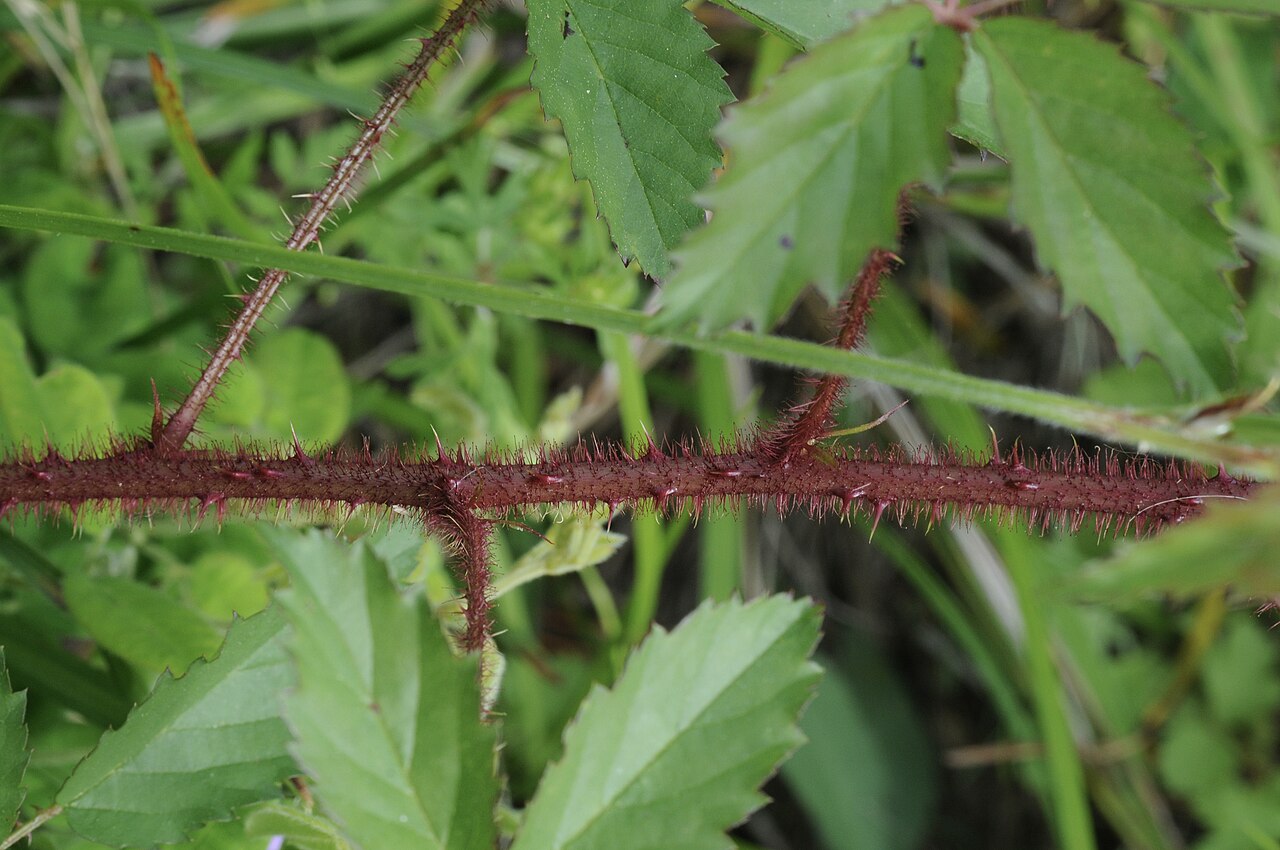
The canes are slender, woody and trailing or low-arching, usually less than 2 feet high but often 3 to 10 feet long or more. They are reddish to purplish and armed with stout, curved prickles, and they are also covered with stiff, reddish bristles, some of them gland-tipped. As in other brambles, first-year canes (primocanes) grow leaves only. Their tips root where they touch the ground and start new plants. In the second year the same canes (floricanes) send up short, upright shoots that bear flowers and fruit, and then die.
Leaves
Leaves are alternate and compound, with 3 leaflets on flowering shoots and usually 5 on vigorous first-year canes. The leaflets are elliptic to lance-shaped, about 1 to 3 inches long, sharply toothed, dark green and somewhat leathery and shiny above. The leaf stalks and midribs carry small prickles. In mild climates many leaves persist through winter, often turning reddish or purplish in cold weather.
Flowers
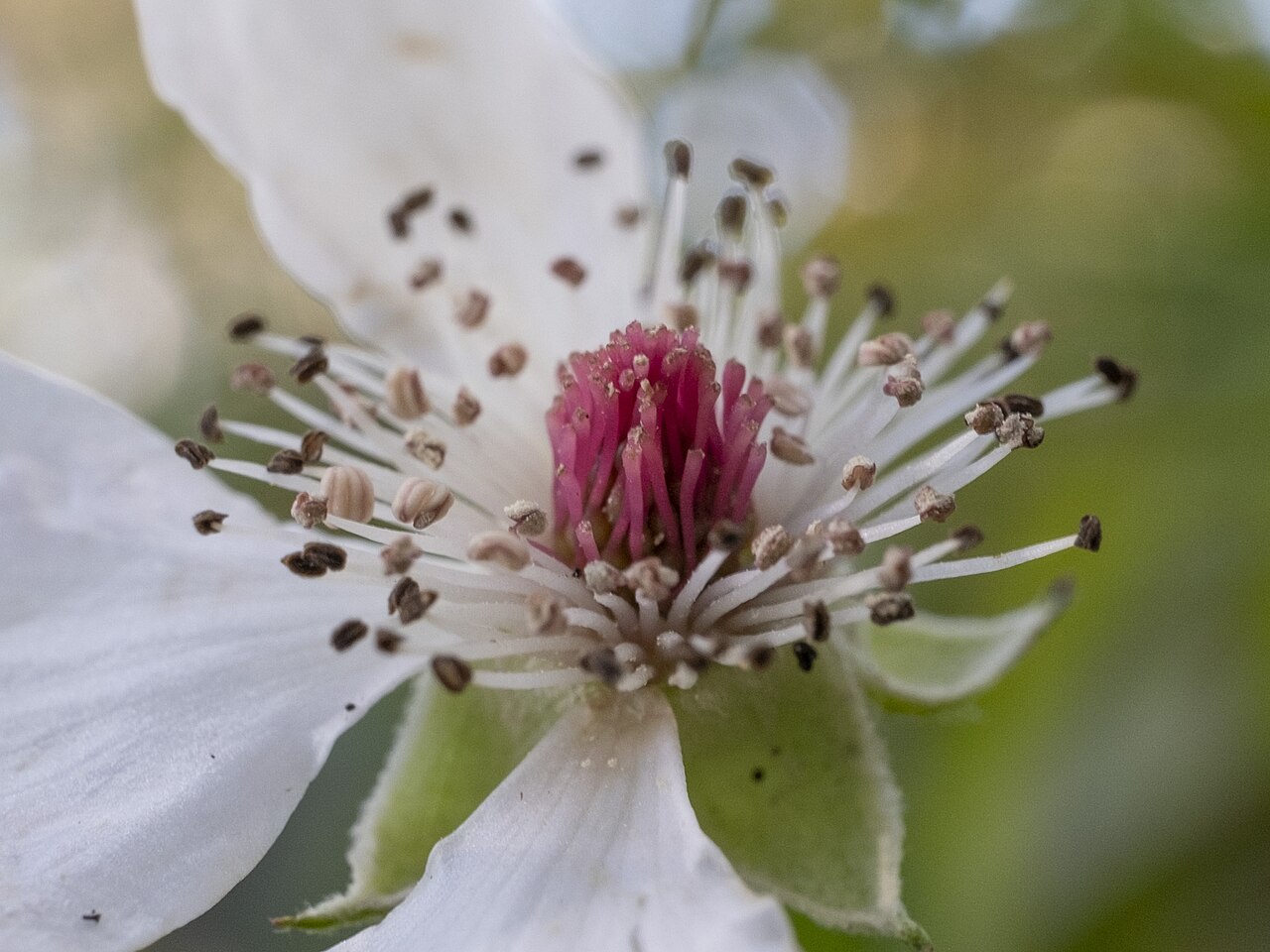
Flowers appear early, from February in Florida and South Texas to April or early May at the northern edge of the range. They are usually borne singly or in small groups on long stalks, and are large for a bramble, about 1 to 1½ inches across, with five white or occasionally pale pink, crinkled petals around a ring of many stamens and a green to pinkish cluster of pistils.
Fruit
The fruit is an aggregate of small, juicy drupelets, about 1/2 to 1 inch long, that turns from green through red to glossy black as it ripens in April to June. Like other blackberries, the fruit comes off the plant with its core (receptacle) inside, unlike a raspberry, which separates from the core and is hollow. The berries are sweet when fully ripe, and each drupelet holds a small hard seed.
Look-alikes
Northern dewberry (Rubus flagellaris) has green canes with scattered prickles but few or no bristles, and it blooms later. Swamp dewberry (Rubus hispidus) has small, glossy leaves and red to purple-black, sour fruit. Upright blackberries, such as Rubus pensilvanicus and R. argutus, have arching canes several feet tall. Hybrids between these species are common.
Quick Facts
| Scientific Name | Rubus trivialis (syn. R. continentalis, R. mississippianus, R. rubrisetus, R. okeechobeus) |
| Family | Rosaceae (rose family) |
| Plant Type | Trailing, semi-evergreen woody subshrub (bramble) |
| Mature Height | 6–24 in |
| Mature Spread | 3–10 ft or more per cane; forms spreading patches |
| Growth Rate | Fast |
| Sun Exposure | Full sun to part shade |
| Water Needs | Low to medium; dry to seasonally moist soil |
| Soil Type | Sandy, loamy or clay; tolerates poor, disturbed soils |
| Soil pH | About 5.0–7.5 |
| Bloom Time | February–April (to early May in the north) |
| Flower Color | White, occasionally pale pink |
| Fall Color | Leaves often turn red to purple in winter |
| Fruit | Black aggregate berry, ripening April–June; edible |
| Deer Resistant | No; deer browse the leaves and shoots |
| USDA Hardiness Zones | 6–10 |
Native Range
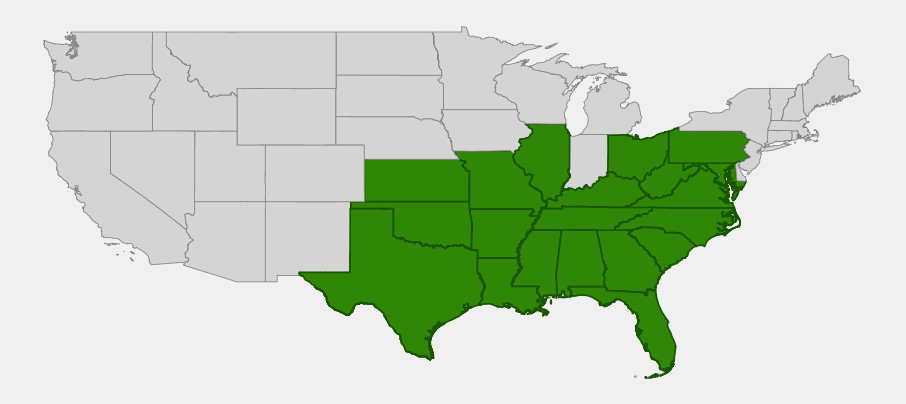
Southern dewberry is native to the southeastern and south-central United States and northeastern Mexico. The Lady Bird Johnson Wildflower Center describes its range as Maryland south to Florida and west to Texas and Kansas. USDA PLANTS records it from 20 states: Alabama, Arkansas, Florida, Georgia, Illinois, Kansas, Kentucky, Louisiana, Maryland, Missouri, Mississippi, North Carolina, Ohio, Oklahoma, Pennsylvania, South Carolina, Tennessee, Texas, Virginia and West Virginia.
It is abundant throughout the Coastal Plain and the Gulf states, from the Carolinas and Florida west through Louisiana and eastern Texas, and it is common in the Piedmont and the Ozarks. Toward the northern edge of its range, in the Ohio Valley, southern Illinois, Pennsylvania and Maryland, it is local and uncommon. It grows in old fields, pastures, roadsides, fencerows, open pine and oak woods, sandhills, coastal dunes, savannas, prairies and the edges of marshes and swamps, from dry to seasonally wet soils.
Southern dewberry thrives on disturbance. It is quick to move into cleared land, burned areas, abandoned fields and roadsides, and it is one of the first woody plants to appear in old fields across the South.
📋 Regional plant lists featuring Southern Dewberry: New York, Pennsylvania & Northern New Jersey · Ohio & Indiana · Kentucky & Tennessee · Nebraska, Kansas & Eastern Colorado · Maryland, Virginia & West Virginia · Illinois, Iowa & Missouri · Alabama, Georgia & Mississippi · North & South Florida
Growing & Care Guide
Southern dewberry is tough, fast and almost impossible to kill in a sunny spot. That makes it an excellent native groundcover for dry banks, wildlife areas and food forests, and a poor choice next to paths, lawns or play areas. Plan for its prickles and its tip-rooting canes before planting.
Light
It fruits best in full sun. It tolerates light shade, such as under open pines, but produces fewer flowers and berries there.
Soil & Water
Southern dewberry grows in almost any well-drained soil, including poor sand and gravel, and also in clay and seasonally damp ground. Once established it is very drought tolerant. Watering during dry spells in spring improves berry size. Fertilizer is unnecessary and mainly encourages cane growth.
Planting Tips
Plant rooted tips or nursery plants in late winter or early spring, 3 to 4 feet apart. Choose a site where trailing canes can spread, such as a sunny bank, a meadow edge or a dedicated berry patch, away from walkways. Gloves and long sleeves are essential when handling it.
Pruning & Maintenance
Canes that have fruited die after their second year. Cut them out at ground level after harvest to keep a patch productive and tidy. To limit spread, cut or mow trailing first-year canes before their tips root in late summer and fall. In a pasture or lawn, regular mowing keeps it low. A late-winter mowing or prescribed burn every few years renews old patches.
Propagation
The easiest method is tip layering: bury the tip of a first-year cane an inch or two deep in late summer, and it will root by winter. Rooted tips and suckers can be dug and moved in late winter. Seeds need warm and then cold stratification and germinate slowly and unevenly, so seed is rarely used.
Landscape Uses
- Wild fruit: early, sweet berries for eating fresh, cobblers, pies, jams and jelly
- Wildlife plantings: food and dense, prickly cover for birds and small mammals
- Erosion control: trailing, tip-rooting canes quickly cover and hold bare, sunny slopes
- Pollinator gardens: one of the earliest spring nectar and pollen sources for bees
- Old-field and savanna restoration: a natural early-successional native in the Southeast
Wildlife & Ecological Value
Few native plants feed as many animals in the South as dewberries and blackberries. Their early flowers, ripe fruit in late spring and thorny, low cover make them a key food and shelter plant in fields and open woods.
For Pollinators
The large, open flowers produce abundant nectar and pollen early in the season, when few other plants are in bloom. They are visited by honey bees, bumblebee queens, mining bees, small carpenter bees, sweat bees, flies and early butterflies. Rubus species are also larval hosts for many moths, whose caterpillars in turn feed nesting songbirds.
For Birds
The berries are eaten by many birds, including northern mockingbirds, gray catbirds, brown thrashers, northern cardinals, thrushes, woodpeckers, wild turkeys and northern bobwhite. The low, prickly tangles provide protected nesting and escape cover for ground-nesting and shrub-nesting birds such as quail and sparrows.
For Mammals
Raccoons, opossums, foxes, coyotes, black bears, squirrels and many smaller mammals eat the berries. White-tailed deer browse the leaves and tender shoots, especially in winter, when the semi-evergreen foliage is still green. Rabbits use the thickets for cover and nibble the canes.
Ecosystem Role
Southern dewberry is an early-successional plant. It colonizes open, disturbed ground soon after clearing or fire, holds soil, and provides food and cover until taller shrubs and trees take over. Seeds passed by birds and mammals spread it widely, and its tip-rooting canes help it hold ground.
Cultural & Historical Uses
The species was described by the French botanist André Michaux in his Flora Boreali-Americana (1803), based on plants he collected in the southeastern United States. The name trivialis means “common” or “ordinary,” a fair description of a plant found along nearly every country road in the South. Later botanists split the southern dewberries into many minor species, such as Rubus continentalis and R. mississippianus, most of which are now treated as synonyms.
Dewberry picking has long been a spring tradition across the South, and dewberry cobbler is a regional favorite. Many rural families still gather dewberries along fencerows and field edges in April and May. Native American peoples of the Southeast also ate the fruit and used Rubus roots and leaves in traditional medicine.
Farmers have long had mixed feelings about the plant. It can take over neglected pastures and old fields, and its prickles make it unpopular with livestock and anyone walking through. Wildlife managers, on the other hand, value dewberry and blackberry thickets as some of the best food and cover for quail, turkey, rabbits and songbirds, and they often manage fields with fire or rotational mowing to keep some brambles on the land.
Frequently Asked Questions
Are southern dewberries edible?
Yes. The ripe, glossy black berries are sweet to tart and safe to eat fresh, in cobblers and pies, or in jam and jelly. Pick them when they are fully black and come off easily. As with any wild food, be sure of your identification and avoid plants along heavily sprayed roadsides.
What is the difference between a dewberry and a blackberry?
Dewberries are a kind of blackberry with trailing canes that run along the ground, while most blackberries have upright or high-arching canes. Dewberries usually ripen earlier, and their berries tend to be larger and juicier but fewer per plant.
How do I control southern dewberry in a lawn or pasture?
Mow regularly to keep canes from rooting at their tips, and dig out the crowns where possible. In pastures, repeated mowing or prescribed fire combined with improving the grass stand reduces it over a few years.
Is southern dewberry evergreen?
It is semi-evergreen. In the Deep South and along the Gulf Coast many leaves stay on through winter, often turning red or purple, while farther north most leaves drop in hard freezes.
When do southern dewberries ripen?
Usually from April to early June, about six to eight weeks after bloom. In Florida and South Texas they can ripen in March and early April.

Looking for a nursery that carries Southern Dewberry?
Browse our native plant nursery directory: Alabama & Arkansas · Florida & Georgia · Illinois & Kansas · Kentucky, Louisiana, Maryland, Mississippi & Missouri · North Carolina, Ohio & Oklahoma · Pennsylvania, South Carolina, Tennessee, Texas & Virginia · West Virginia