
Dwarf Larkspur (Delphinium tricorne)
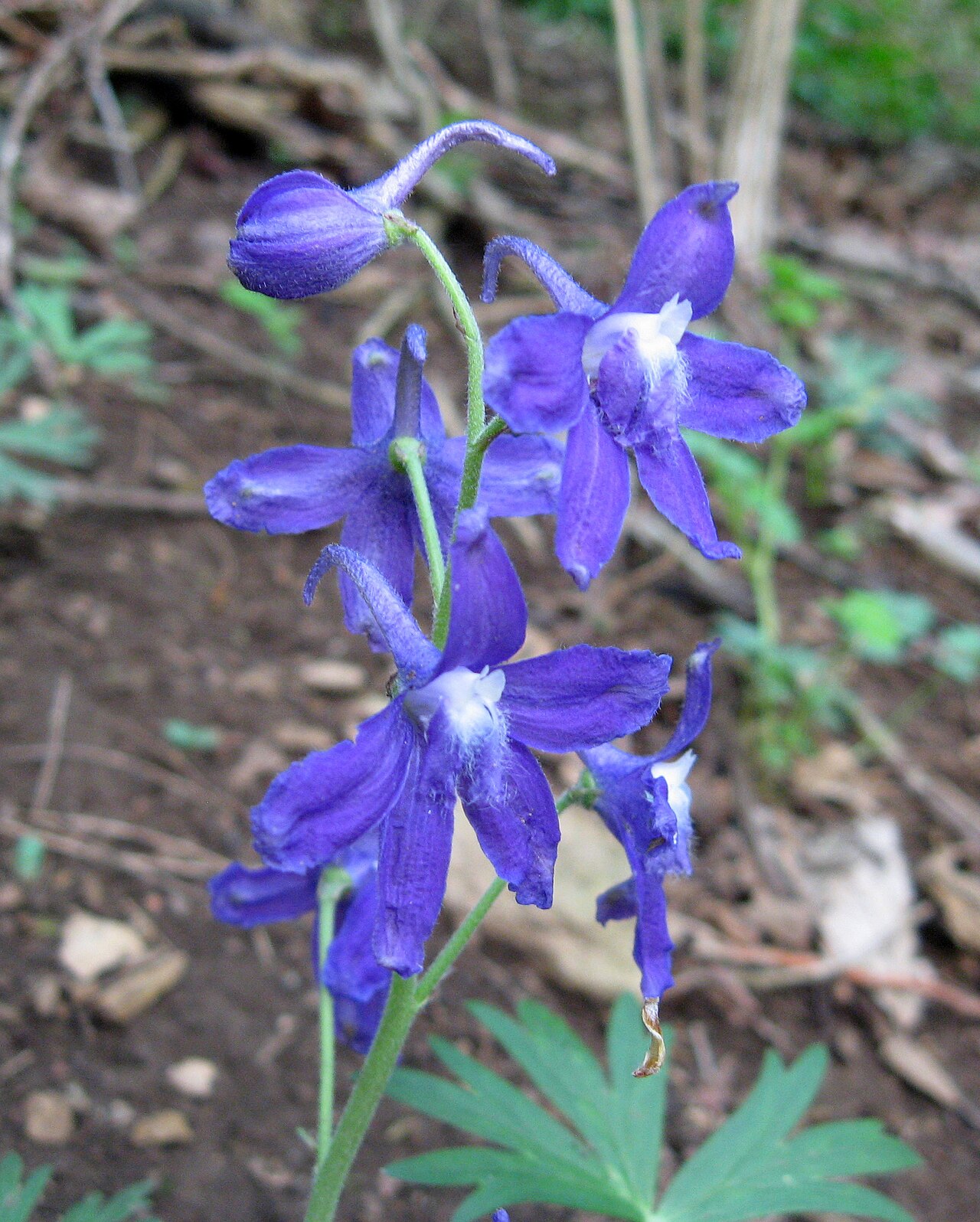
Delphinium tricorne, known as Dwarf Larkspur, spring larkspur or rock larkspur, is a spring wildflower of rich deciduous woods in the eastern and central United States. In April and May it raises a single stem 6 to 24 inches tall, carrying a loose spike of spurred flowers in deep blue-violet, lavender, white or mottled combinations, above deeply cut, palmately lobed leaves. Within a few weeks of flowering it sets seed, and by early summer the plant disappears underground until the following spring.
Dwarf larkspur is a member of the buttercup family (Ranunculaceae), together with columbines, anemones and hepaticas. Its name tricorne, “three-horned,” refers to its fruit, a cluster of three spreading pods. It is one of the few native larkspurs of the eastern woodlands, and in places it carpets slopes and floodplains together with Virginia bluebells, woodland phlox and Dutchman’s breeches.
Safety note: like all larkspurs, dwarf larkspur is poisonous. All parts of the plant, especially the young growth and seeds, contain toxic alkaloids that can cause serious illness or death if eaten by people, pets or livestock. Grow it where children and animals will not chew on it, and never use it as food or medicine. This guide covers identification, range, woodland garden care, wildlife value and toxicity.
Identification
In spring woods, dwarf larkspur is easy to recognize by its long-spurred flowers, which look like small versions of garden delphiniums, and its deeply divided, hand-shaped leaves.
Roots & Stems
The plant grows from a cluster of small, tuberous roots. Each spring it produces a single, unbranched, succulent stem, usually 6 to 24 inches tall, smooth or finely hairy. Leaves are concentrated in the lower half of the plant, and the upper stem carries the flowers.
Leaves
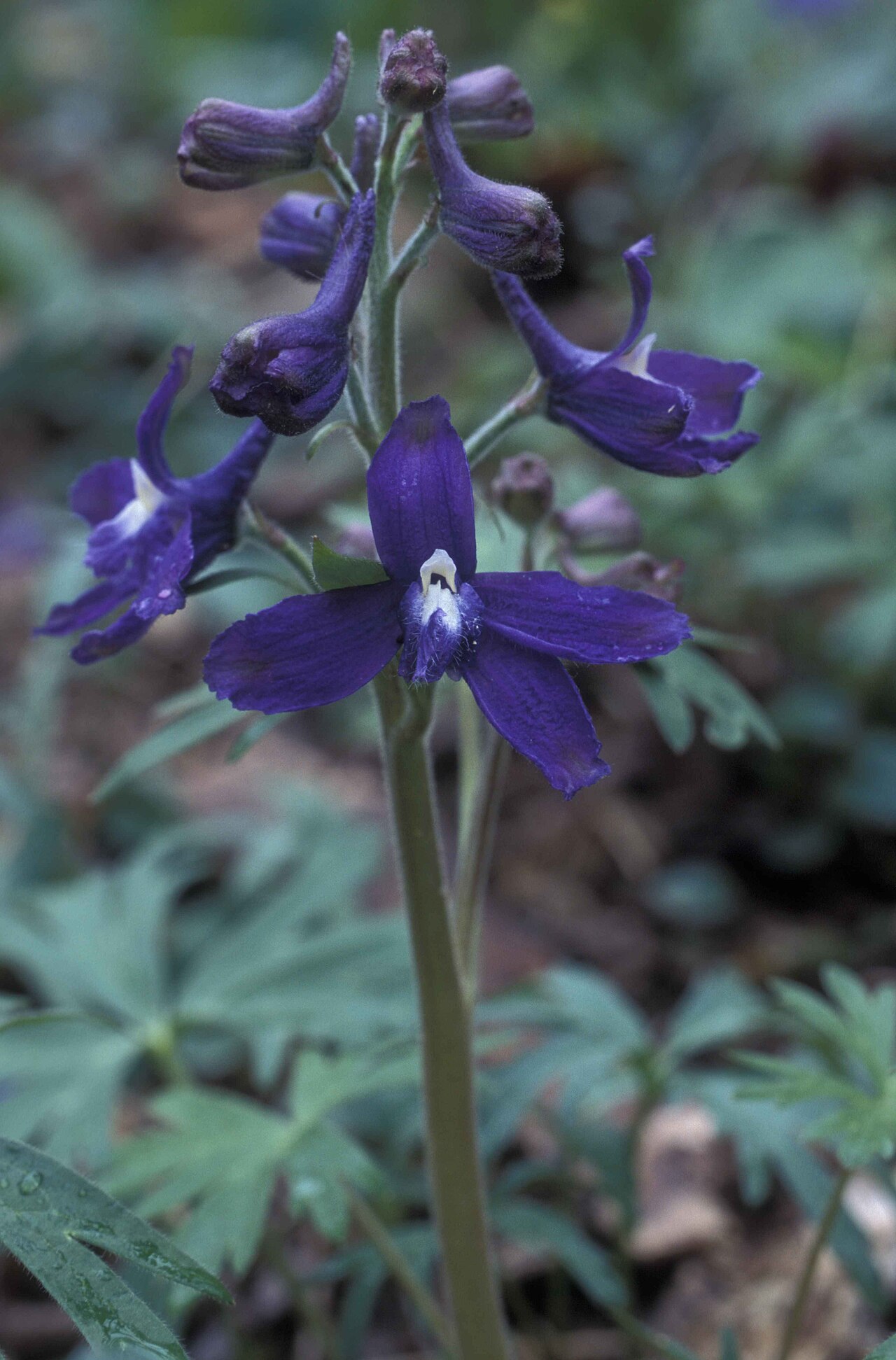
The leaves are palmately divided into five main lobes, each further cut into narrow, pointed segments, giving them a lacy, crowfoot look. They are 2 to 4 inches across on long stalks near the base and become smaller and short-stalked higher on the stem. Leaves appear early in spring, often before the surrounding trees leaf out, and turn yellow and wither by early summer.
Flowers
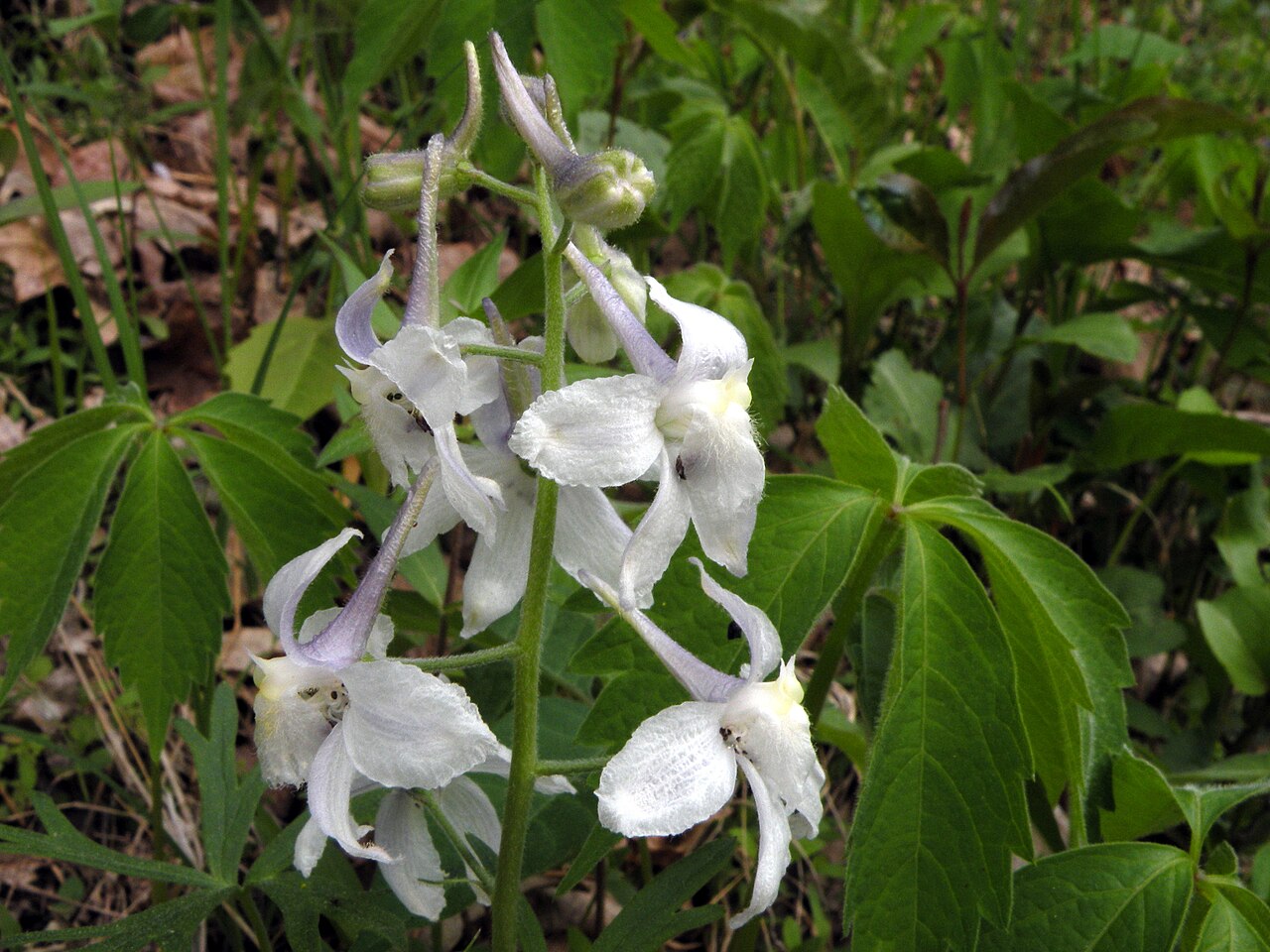
The flowers are arranged in a loose, upright raceme of about 5 to 20 or more. Each flower is about 1 inch long and has five petal-like sepals: four spreading or forward-pointing and the upper one extended into a straight or slightly curved spur ½ to ¾ inch long, angled upward or backward. Inside, four small true petals form a central cluster, often paler or whitish and lightly hairy. Color ranges from deep blue-violet through lavender and pale blue to pure white, and some plants have bicolored or mottled flowers. Bloom time runs from March in the South to May in the North.
Fruit & Seeds
Each flower produces three (sometimes more) upright, spreading pods (follicles) about ½ to ¾ inch long. They split along one side in late spring to release small, dark, angular seeds. The three-horned look of these pods gives the species its name. The plant goes dormant soon after the seeds ripen.
Quick Facts
| Scientific Name | Delphinium tricorne |
| Family | Ranunculaceae (buttercup family) |
| Plant Type | Herbaceous perennial; spring ephemeral from tuberous roots |
| Mature Height | 6–24 in |
| Mature Spread | 6–12 in |
| Growth Rate | Moderate; dormant by early summer |
| Sun Exposure | Partial shade (sun in spring, shade in summer) |
| Water Needs | Moderate; moist soil in spring |
| Soil Type | Rich, humusy loam; often over limestone |
| Soil pH | About 6.0–7.5 (neutral preferred) |
| Bloom Time | March–May |
| Flower Color | Blue-violet, lavender, white or bicolored |
| Fall Color | None; summer-dormant |
| Fruit | Three spreading pods (follicles) |
| Deer Resistant | Yes; toxic and rarely browsed |
| USDA Hardiness Zones | 4–8 |
Native Range
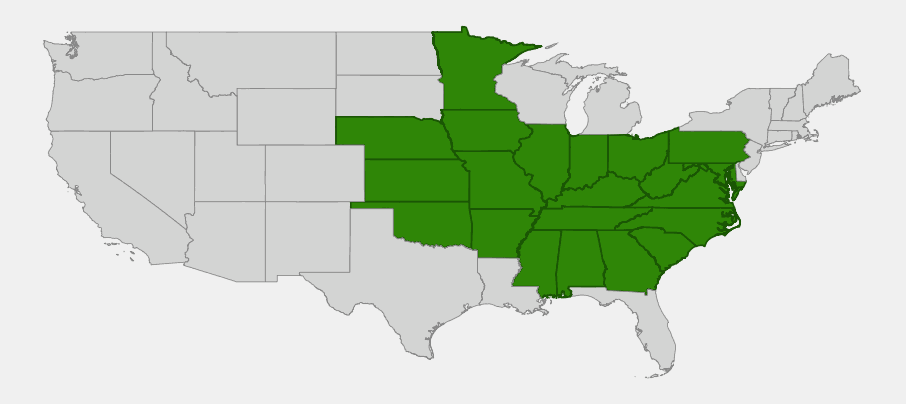
Dwarf larkspur is native to the eastern and central United States. The Lady Bird Johnson Wildflower Center describes its range as Pennsylvania to Iowa, south to Georgia, Alabama, Arkansas and eastern Oklahoma. USDA PLANTS records it in 21 states and the District of Columbia, including southeastern Minnesota, eastern Nebraska and Kansas at its western edge.
It is most abundant in the Ohio Valley and the Interior Low Plateaus of Kentucky, Tennessee, southern Indiana, southern Illinois and southern Ohio, and in the Ozarks of Missouri and Arkansas. In these limestone-rich regions it can be locally abundant on wooded slopes and floodplains. Toward the Atlantic Coast and Deep South it becomes scattered and is mostly found in the Piedmont and mountains.
Typical habitats are rich, moist deciduous forests, wooded ravines and slopes, floodplain terraces, stream banks and limestone or other calcium-rich woods. It favors places that are sunny in early spring before the trees leaf out and shady in summer, the classic niche of eastern spring ephemerals.
📋 Regional plant lists featuring Dwarf Larkspur: New York, Pennsylvania & Northern New Jersey · Ohio & Indiana · Michigan, Wisconsin & Eastern Minnesota · Kentucky & Tennessee · Nebraska, Kansas & Eastern Colorado · Maryland, Virginia & West Virginia · Illinois, Iowa & Missouri · Alabama, Georgia & Mississippi
Growing & Care Guide
Dwarf larkspur is a charming spring ephemeral for woodland gardens. It is easy once established in the right site, but it is poisonous, so place it where children, pets and livestock will not eat it. Buy nursery-propagated plants or seed; do not dig plants from the wild.
Light
Grow it under deciduous trees, where it gets sun in early spring and shade in summer. Partial shade all season also works. Dense evergreen shade is too dark.
Soil & Water
It prefers rich, moist, well-drained soil with plenty of leaf mold, ideally neutral or slightly alkaline, as on limestone. Keep the soil moist during spring growth and bloom. After the plant goes dormant in early summer, it tolerates drier conditions but does not like soil that stays waterlogged.
Planting Tips
Plant tuberous roots in fall, 1 to 2 inches deep, or set out potted plants in early spring. Plant in groups of five or more for a good show. Mark the spot or plant it among summer-active companions such as ferns, wild ginger and woodland sedges, which fill the gap after the larkspur goes dormant.
Pruning & Maintenance
No pruning is needed. Let the foliage yellow and die back naturally, as it feeds the roots for next year. Leave fallen leaves on the bed as natural mulch. Wear gloves when handling the plant if you have sensitive skin, and wash your hands afterward.
Propagation
Grow from seed, which should be sown fresh in late spring or early summer, right after it ripens, or in fall. It needs a period of cold, moist conditions and usually germinates the following spring. Seedlings take two or three years to bloom. In good sites, plants self-sow and slowly form colonies.
Landscape Uses
- Woodland and shade gardens: spring color under deciduous trees
- Spring ephemeral plantings: combine with bluebells, phlox and trout lilies
- Pollinator gardens: early nectar for queen bumble bees and hummingbirds
- Woodland restoration: rich, limestone-influenced forest sites within its range
- Deer-browsed areas: toxic foliage is rarely eaten by deer
Wildlife & Ecological Value
Dwarf larkspur blooms at a time when many pollinators are just becoming active, and its flowers are adapted to a few specific visitors.
For Pollinators
The long nectar spur is suited to long-tongued visitors. Queen bumble bees emerging from hibernation are the main pollinators, and ruby-throated hummingbirds, which return to the East in spring, also visit. Short-tongued bees sometimes chew holes at the base of the spur to steal nectar without pollinating the flower.
For Birds
Apart from hummingbirds, which take nectar, birds make little use of dwarf larkspur. The seeds are toxic and not an important food source.
For Mammals
The plant is toxic to mammals. Deer and rabbits usually avoid it, which helps it persist in heavily browsed woods. Livestock poisoning from larkspurs is well known, especially from western species on rangeland, and eastern larkspurs share the same toxic alkaloids.
Ecosystem Role
As a spring ephemeral, dwarf larkspur uses the brief window of sunlight before the forest canopy closes. Its quick spring growth takes up nutrients that might otherwise wash away from the forest floor, and its decaying leaves return them to the soil in early summer. Colonies are often a sign of rich, relatively undisturbed woodland.
Cultural & Historical Uses
André Michaux described dwarf larkspur in 1803 in his Flora Boreali-Americana, one of the first floras of eastern North America. The genus name Delphinium comes from the Greek delphinion, little dolphin, because the flower buds of some species resemble the shape of a dolphin. “Larkspur” refers to the long spur, said to resemble the hind claw of a lark.
Larkspurs have long been known as poisonous plants. Their diterpenoid alkaloids affect the nervous system and heart, and western larkspurs are among the most important causes of cattle poisoning on rangelands in the United States. Historical records mention the use of larkspur preparations against lice and other external parasites, but because of their toxicity, they should not be used.
Today dwarf larkspur is a valued wildflower of spring woodland walks in the Midwest and upper South, and the flower of rich wooded slopes in the Ozarks and the Ohio Valley. Native plant nurseries increasingly offer it for shade gardens, where it brings true blue and violet tones that are uncommon among spring wildflowers.
Frequently Asked Questions
Is dwarf larkspur poisonous?
Yes. All parts of the plant, especially the young growth and seeds, contain toxic alkaloids. Eating it can cause serious illness or death in people, dogs, cats, horses and cattle. Plant it where children and animals will not chew on it, and contact a doctor, veterinarian or poison control center if any part is eaten.
When does dwarf larkspur bloom?
From March in the South to May in the North. The plant sets seed soon after flowering and goes dormant by early summer.
Why does dwarf larkspur disappear in summer?
It is a spring ephemeral. It grows, flowers and sets seed in the few weeks before trees leaf out, then dies back to its tuberous roots until next spring. This is normal and does not mean the plant has died.
Can I grow dwarf larkspur in my garden?
Yes, in a moist, shady woodland garden with rich soil, ideally under deciduous trees. Buy nursery-propagated plants or seed, never dig from the wild, and keep its toxicity in mind if you have children or pets.
How is dwarf larkspur different from garden delphiniums?
Garden delphiniums and annual larkspurs are taller, often hybrid plants from Europe and Asia. Dwarf larkspur is a native, shorter, spring-blooming woodland species. All share the spurred flower shape and all are toxic.

Looking for a nursery that carries Dwarf Larkspur?
Browse our native plant nursery directory: Alabama & Arkansas · Georgia · Illinois, Indiana, Iowa & Kansas · Kentucky, Maryland, Minnesota, Mississippi & Missouri · Nebraska, North Carolina, Ohio & Oklahoma · Pennsylvania, South Carolina, Tennessee & Virginia · West Virginia