
Purple-Flowered Raspberry (Rubus odoratus)
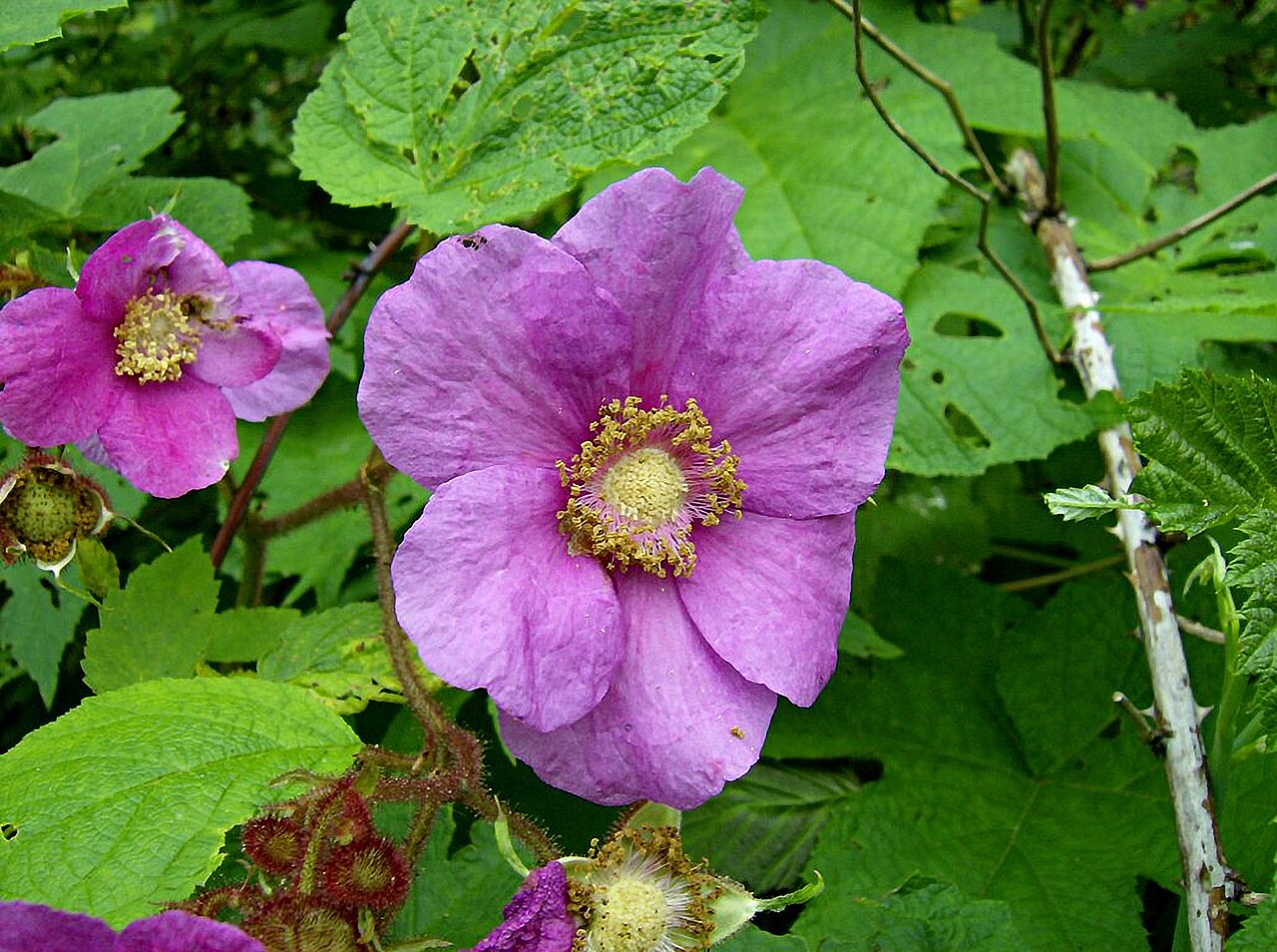
Rubus odoratus, known as Purple-Flowered Raspberry (USDA: purpleflowering raspberry), flowering raspberry or Virginia raspberry, is a thornless native shrub of the rose family (Rosaceae). It grows 3 to 6 feet tall and spreads into broad thickets, with large, maple-like leaves and, from early summer into late summer, big rose-purple flowers that look more like small wild roses than raspberry blossoms.
Unlike most raspberries and blackberries, it has no prickles. Its stems are instead covered with sticky, reddish, gland-tipped hairs, and older canes have peeling, cinnamon-brown bark. The flowers are followed by broad, flattened red berries that are edible but somewhat dry and seedy. The species name odoratus refers to the faintly fragrant flowers and the resinous scent of the glandular hairs on the stems and leaves.
Purple-flowered raspberry grows in moist, partly shaded woodland edges, rocky slopes, ravines and roadside banks from Maine and Quebec south through the Appalachians to Georgia and Alabama, and west to Michigan and Wisconsin. It is an excellent shrub for shady woodland gardens, slopes and wildlife plantings, and this guide covers identification, range, care and its value for pollinators and birds.
Identification
Purple-flowered raspberry is unmistakable in bloom. Even without flowers, the combination of large maple-like leaves, thornless canes and sticky reddish hairs makes it easy to recognize.
Canes & Bark
The upright to arching canes are 3 to 6 feet tall and lack prickles. Young stems, leaf stalks and flower stalks are densely covered with glandular, reddish-purple hairs that feel sticky. Older canes become woody, with thin, papery, cinnamon-brown bark that peels in strips. Like other raspberries, individual canes live only a few years, but the plant spreads by underground stems (rhizomes) and forms broad thickets.
Leaves
Leaves are alternate, simple and large, usually 4 to 10 inches wide, with three to five pointed lobes like a maple leaf. They have toothed edges, a heart-shaped base and a slightly fuzzy texture, and they are held on long, glandular-hairy stalks. In fall they turn pale yellow.
Flowers
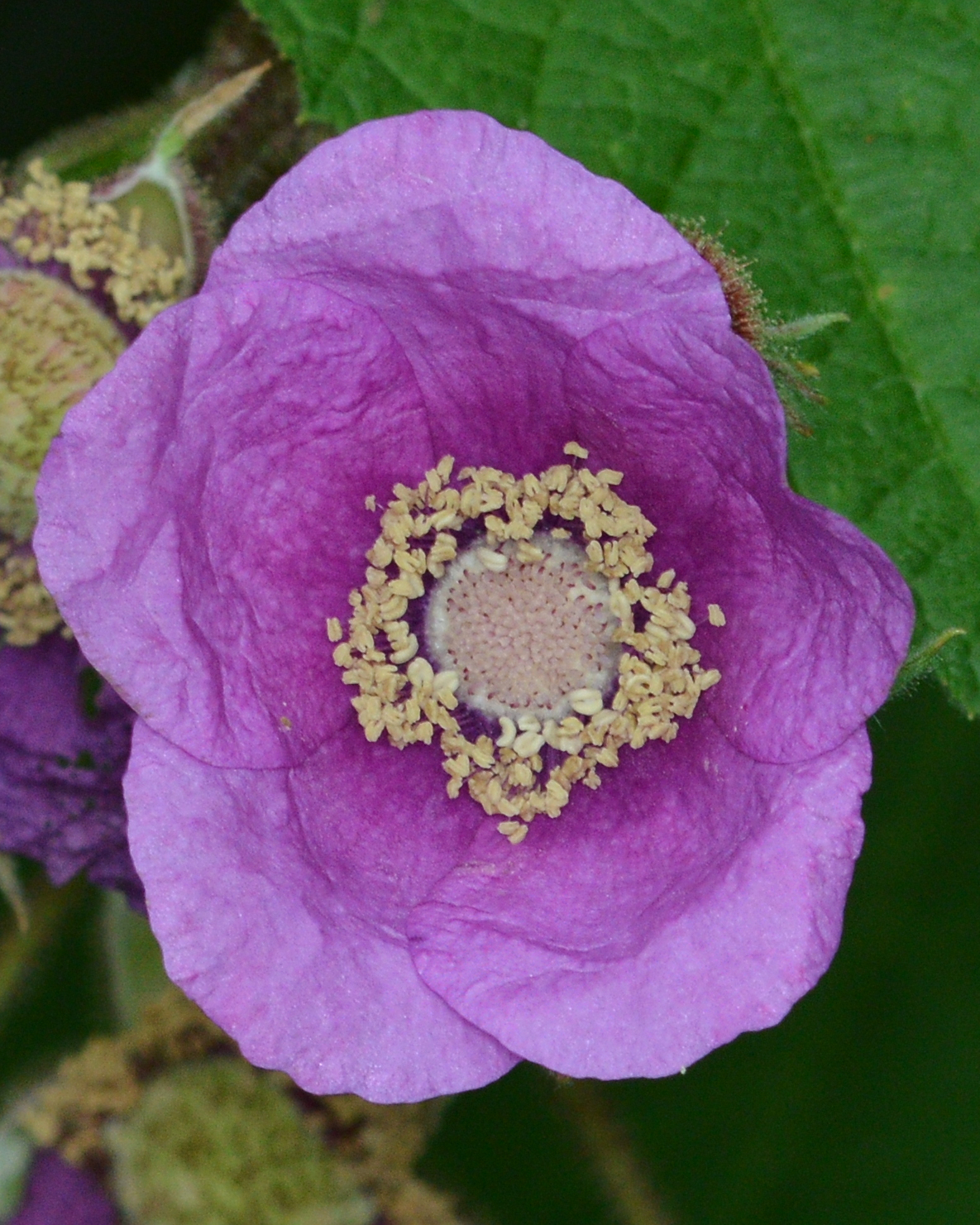
Flowers appear from June into August, and sometimes into September, in loose clusters at the ends of the branches. Each flower is 1 to 2 inches across, with five broad, crinkled, rose-purple to magenta petals around a dense ring of yellow stamens. The sepals and flower stalks are covered with sticky, purple glandular hairs and end in long, slender tips. A few flowers keep opening over a long season.
Fruit
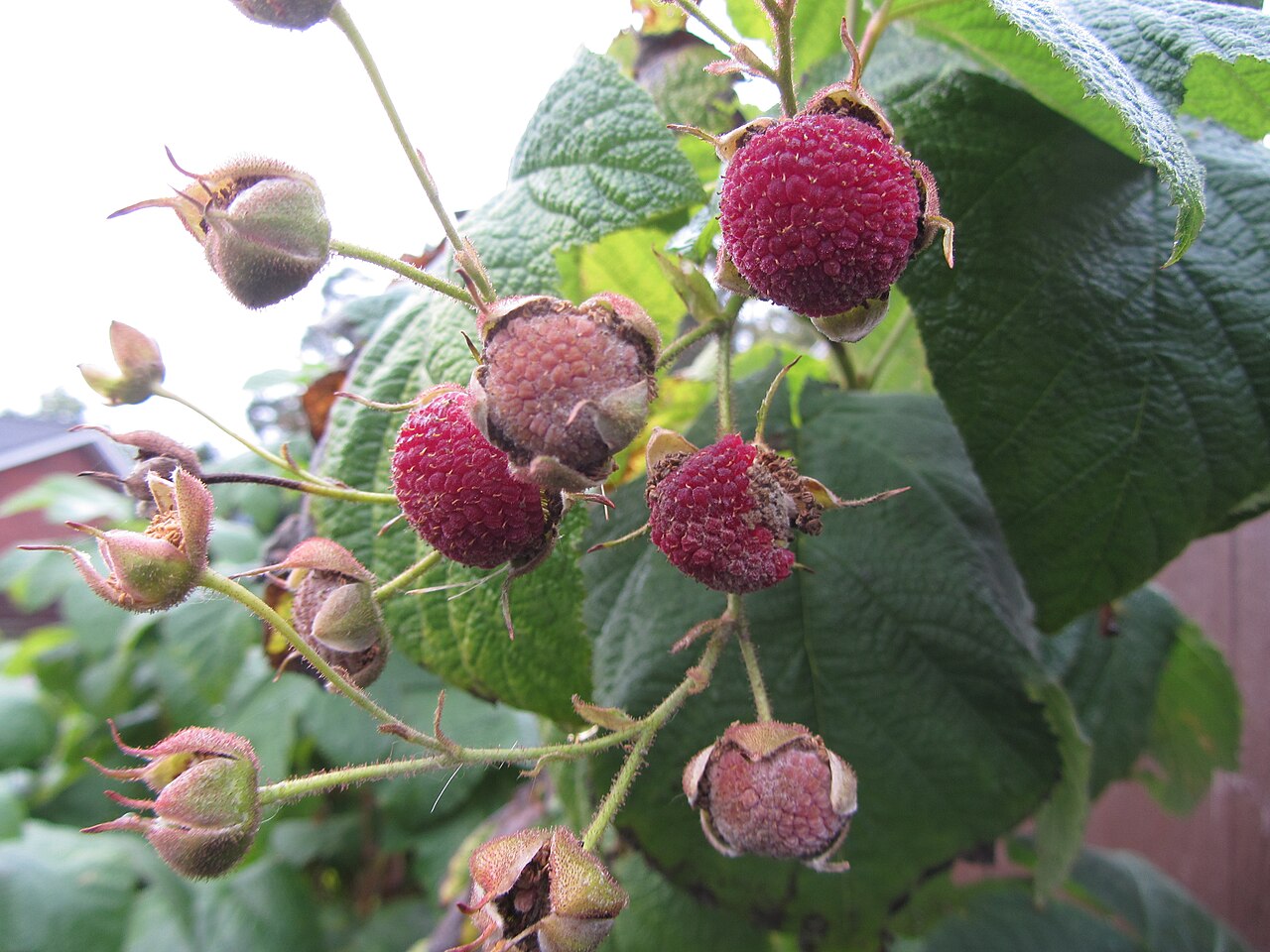
The fruit is a broad, shallow, cap-like red raspberry, about 1/2 to 3/4 inch across, ripening from July into September. Like other raspberries it separates from the core when picked. It is edible, but often somewhat dry, tart and seedy, and plants usually produce only a few ripe berries at a time.
Look-alikes
Thimbleberry (Rubus parviflorus) of the West and the upper Great Lakes is similar, with maple-like leaves and thornless canes, but it has white flowers. The two species overlap only around the upper Great Lakes. Red raspberry (R. idaeus) and black raspberry (R. occidentalis) have prickly canes, compound leaves and small white flowers.
Quick Facts
| Scientific Name | Rubus odoratus (syn. Rubacer odoratum) |
| Family | Rosaceae (rose family) |
| Plant Type | Thornless, suckering deciduous shrub |
| Mature Height | 3–6 ft |
| Mature Spread | 6–12 ft; forms thickets by rhizomes |
| Growth Rate | Fast |
| Sun Exposure | Part shade; tolerates sun with moisture and fairly deep shade |
| Water Needs | Medium; evenly moist, well-drained soil |
| Soil Type | Rocky, gravelly, sandy or deep forest loam |
| Soil pH | About 5.0–7.0 (acidic to near neutral) |
| Bloom Time | June–August (occasionally to September) |
| Flower Color | Rose-purple to magenta |
| Fall Color | Pale yellow |
| Fruit | Flattened red raspberry, July–September; edible |
| Deer Resistant | Moderate; deer browse it, though sticky hairs deter some |
| USDA Hardiness Zones | 3–8 |
Native Range
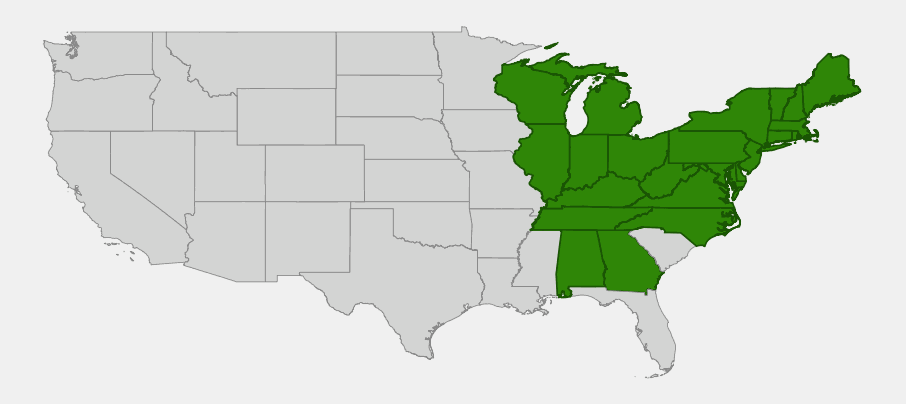
Purple-flowered raspberry is native to eastern North America. The Lady Bird Johnson Wildflower Center gives its range as southern Maine to Michigan, south to North Carolina and Tennessee, and also northern Illinois. USDA PLANTS records it from 23 states and the District of Columbia, including the southern Appalachian states of Georgia and Alabama, and from Ontario, Quebec, New Brunswick and Nova Scotia in Canada. It also appears in Washington State, but there it is an escape from cultivation, not a native plant, and it is not counted in the native range on this page.
It is common in the Northeast, New York, Pennsylvania, the Great Lakes region and the Appalachian Mountains. Farther south it is confined mainly to the mountains, growing in cool, moist coves, rocky slopes and road banks at middle and higher elevations. Toward the western edge of its range in Indiana, Illinois and Wisconsin it is local and uncommon.
Typical habitats are moist woodland edges and clearings, rocky slopes, ravines and stream banks, talus, thickets and shaded road cuts. It often grows where a little more light reaches the ground, such as along trails, forest roads and gaps left by fallen trees.
📋 Regional plant lists featuring Purple-Flowered Raspberry: New York, Pennsylvania & Northern New Jersey · Ohio & Indiana · Michigan, Wisconsin & Eastern Minnesota · Kentucky & Tennessee · Connecticut, Massachusetts & Rhode Island · New Hampshire, Maine & Vermont · Maryland, Virginia & West Virginia · Delaware, Southern New Jersey & Long Island · Illinois, Iowa & Missouri · Alabama, Georgia & Mississippi
Growing & Care Guide
Purple-flowered raspberry is a vigorous, low-maintenance shrub for partly shaded places with moist soil. Its long bloom, bold foliage and thornless canes make it one of the friendliest native brambles for gardens, but it spreads by rhizomes, so give it room or plan to edit it.
Light
Part shade is ideal, such as an eastern exposure, a woodland edge or the dappled light under tall trees. It tolerates full sun in cool climates if the soil stays moist, and it grows in fairly deep shade, though it flowers less there.
Soil & Water
It prefers evenly moist, well-drained, slightly acidic soil rich in organic matter, but it also grows on rocky slopes and gravelly road banks. Water during dry spells in the first year. Established plants tolerate short droughts in shade, though leaves may scorch in hot sun and dry soil. No fertilizer is needed.
Planting Tips
Plant in spring or fall, 3 to 5 feet apart for a mass planting. It is well suited to shady slopes and banks, where its rhizomes help hold soil, to woodland edges and to the back of a shade border. In small gardens, plant it where a path, wall or lawn limits its spread.
Pruning & Maintenance
Canes live a few years and then decline. In late winter, cut out old, dead or weak canes at the base to keep the planting vigorous and tidy. Remove suckers that spread beyond the planting area. Because the canes have no prickles, this is easier than with other brambles.
Propagation
The simplest method is to dig and replant rooted suckers or divisions in early spring or fall. Seeds need cold, moist stratification and germinate slowly and irregularly. Softwood cuttings and root cuttings also work.
Landscape Uses
- Shade and woodland gardens: bold foliage and rose-purple flowers for months in part shade
- Slope and bank stabilization: spreading rhizomes help hold soil on shady banks and road cuts
- Pollinator gardens: a long-blooming bumblebee shrub for summer
- Wildlife plantings: berries feed birds and mammals; thickets give cover
- Naturalized edges: a thornless native bramble for informal hedges and woodland borders
Wildlife & Ecological Value
Purple-flowered raspberry supports a wide range of wildlife through its long flowering season, its berries and the dense cover of its thickets.
For Pollinators
The open flowers provide pollen and nectar for many bees, especially bumblebees, as well as small native bees, syrphid flies and occasional butterflies. Because it blooms for two or three months, it is a dependable summer food source. Rubus species are larval hosts for many moths, and the hollow, pithy canes of brambles provide nesting sites for small carpenter bees and other stem-nesting bees.
For Birds
Many songbirds eat the berries, including catbirds, robins, thrushes, cardinals, cedar waxwings and towhees. Ruffed grouse also eat the fruit, and the thickets offer nesting and escape cover.
For Mammals
Chipmunks, squirrels, raccoons, foxes and black bears eat the berries. White-tailed deer browse the leaves and young shoots, especially where other food is scarce.
Ecosystem Role
Purple-flowered raspberry is an early-successional shrub in eastern forests. It quickly colonizes openings, road banks and edges, holding loose soil and providing food and cover until trees close in. Its thickets shade the ground and protect seedlings of other woodland plants.
Cultural & Historical Uses
Linnaeus described Rubus odoratus in 1753 from North American material. It was introduced to European gardens early in the colonial era and became popular as an ornamental shrub for its large, rose-like flowers and bold leaves. It is still grown in parks and gardens in Europe, where it has escaped locally, and it has occasionally escaped from gardens in other parts of North America outside its native range.
Several Native American peoples, including the Iroquois and others in the Northeast, ate the berries and used the roots, leaves and stems in traditional medicine. Early settlers also ate the berries fresh or cooked them into jam, although they were considered inferior to red and black raspberries.
Because of its maple-like leaves, some botanists once placed it in a separate genus, Rubacer, together with the western thimbleberry. Today it is valued mainly as an ornamental and wildlife shrub. Its common name “thimbleberry,” sometimes used in the East, causes confusion with Rubus parviflorus; using “purple-flowered raspberry” or the scientific name avoids this.
Frequently Asked Questions
Are purple-flowered raspberries edible?
Yes. The red berries are edible raw or cooked, but they are usually tart, seedy and somewhat dry, and plants produce only a few at a time. Most people leave them for wildlife or add them to mixed-berry jams.
Does purple-flowered raspberry have thorns?
No. Its canes have no prickles. Instead, they are covered with sticky, reddish, glandular hairs that may feel slightly tacky.
Does it spread?
Yes. It spreads by rhizomes and can form thickets 6 to 12 feet wide or more. Remove unwanted suckers each spring, or plant it where a path, lawn or wall limits its spread.
Will it grow in shade?
Yes. It grows best in part shade and tolerates fairly deep shade, though flowering is lighter there. In full sun it needs consistently moist soil.
How is it different from thimbleberry?
Both have large maple-like leaves and no prickles. Purple-flowered raspberry has rose-purple flowers and is native to the East, while thimbleberry (Rubus parviflorus) has white flowers and is mainly western, reaching the upper Great Lakes.

Looking for a nursery that carries Purple-Flowered Raspberry?
Browse our native plant nursery directory: Alabama · Connecticut, Delaware & Georgia · Illinois & Indiana · Kentucky, Maine, Maryland, Massachusetts & Michigan · New Hampshire, New Jersey, New York, North Carolina & Ohio · Pennsylvania, Rhode Island, Tennessee, Vermont & Virginia · West Virginia & Wisconsin