
Field thistle (Cirsium discolor)
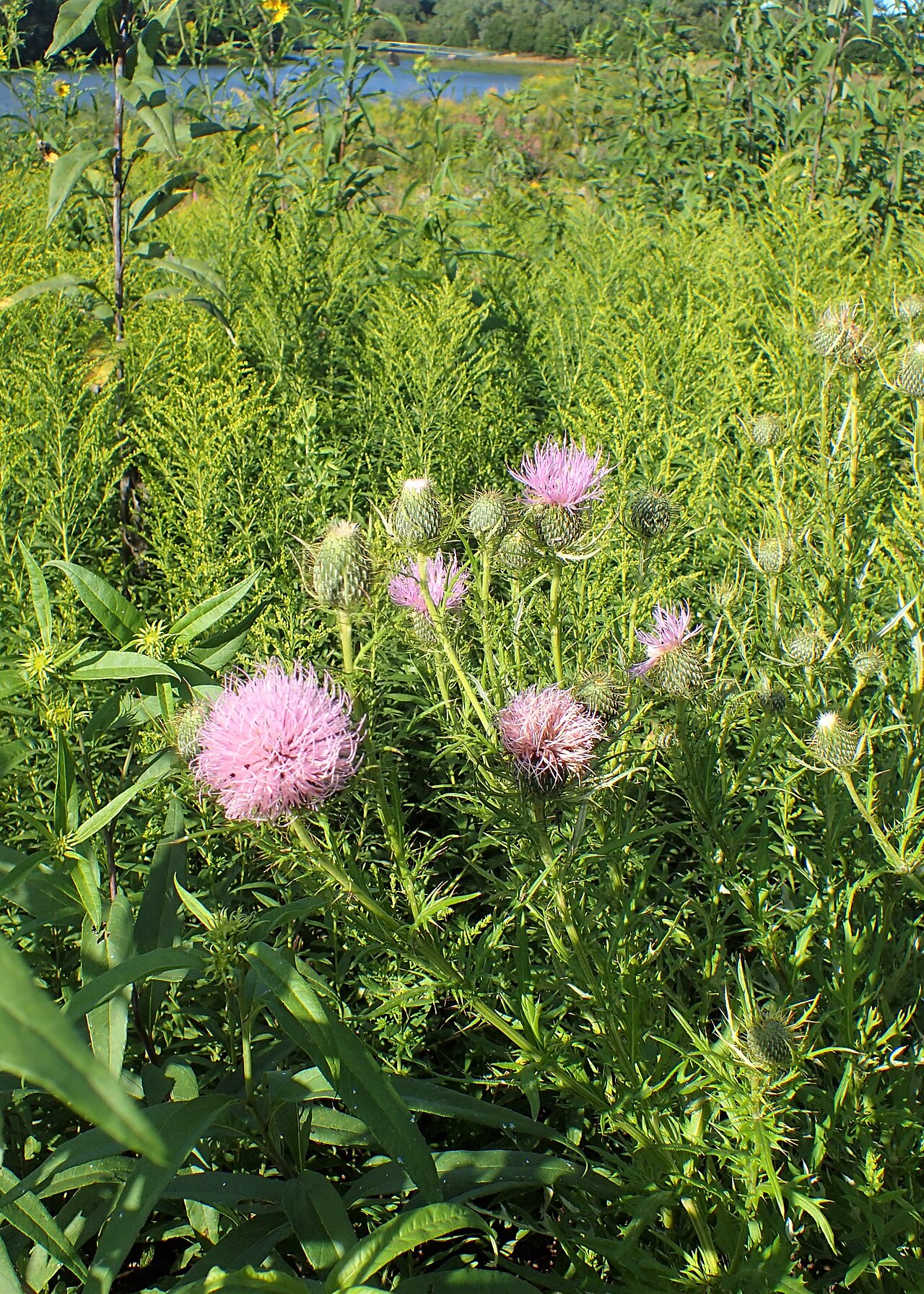
Cirsium discolor, the Field thistle (also called pasture thistle or prairie thistle), is a tall, native thistle of prairies, old fields, open woods and roadsides across eastern and central North America. In late summer and fall it carries large, fluffy heads of pale pink-purple to lavender flowers, 1½ to 2 inches across, on branching stems 3 to 7 feet tall. Its deeply lobed, spiny leaves are green above and covered with a dense coat of white wool underneath, the two-colored (“discolor”) leaves that give the species its name.
Field thistle is not one of the weedy, invasive thistles that farmers and land managers battle. Those are mostly introduced Eurasian species, especially bull thistle (Cirsium vulgare) and Canada thistle (Cirsium arvense), which can form dense stands and spread aggressively. Field thistle is a biennial or short-lived perennial that does not spread by creeping roots, does not form dense colonies, and grows as scattered plants among other native vegetation.
For wildlife, field thistle is one of the most valuable native plants of late summer. Its flowers are packed with nectar and pollen for bumblebees, specialist native bees, butterflies and hummingbirds, and its seeds and soft thistledown are important to American goldfinches. Unfortunately, native thistles are often mistaken for invasive species and destroyed. This guide explains how to identify field thistle, tell it apart from invasive thistles, and include it in native plantings.
Identification
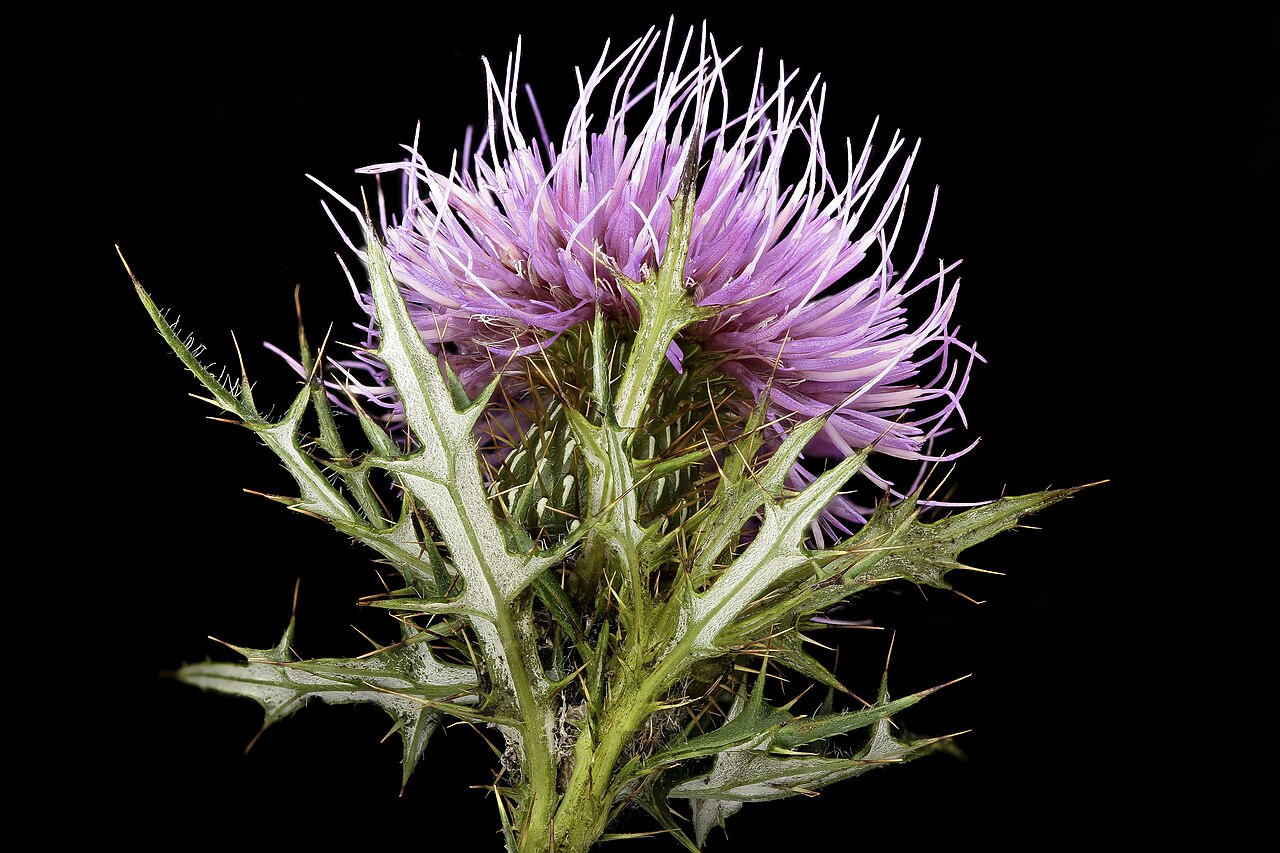
Field thistle is easy to distinguish from invasive thistles once you know what to look for. The most reliable clue is the leaf underside: densely white-woolly in field thistle, green or only lightly hairy in bull thistle and Canada thistle. Field thistle stems are also not lined with spiny wings, unlike bull thistle.
Habit & Stems
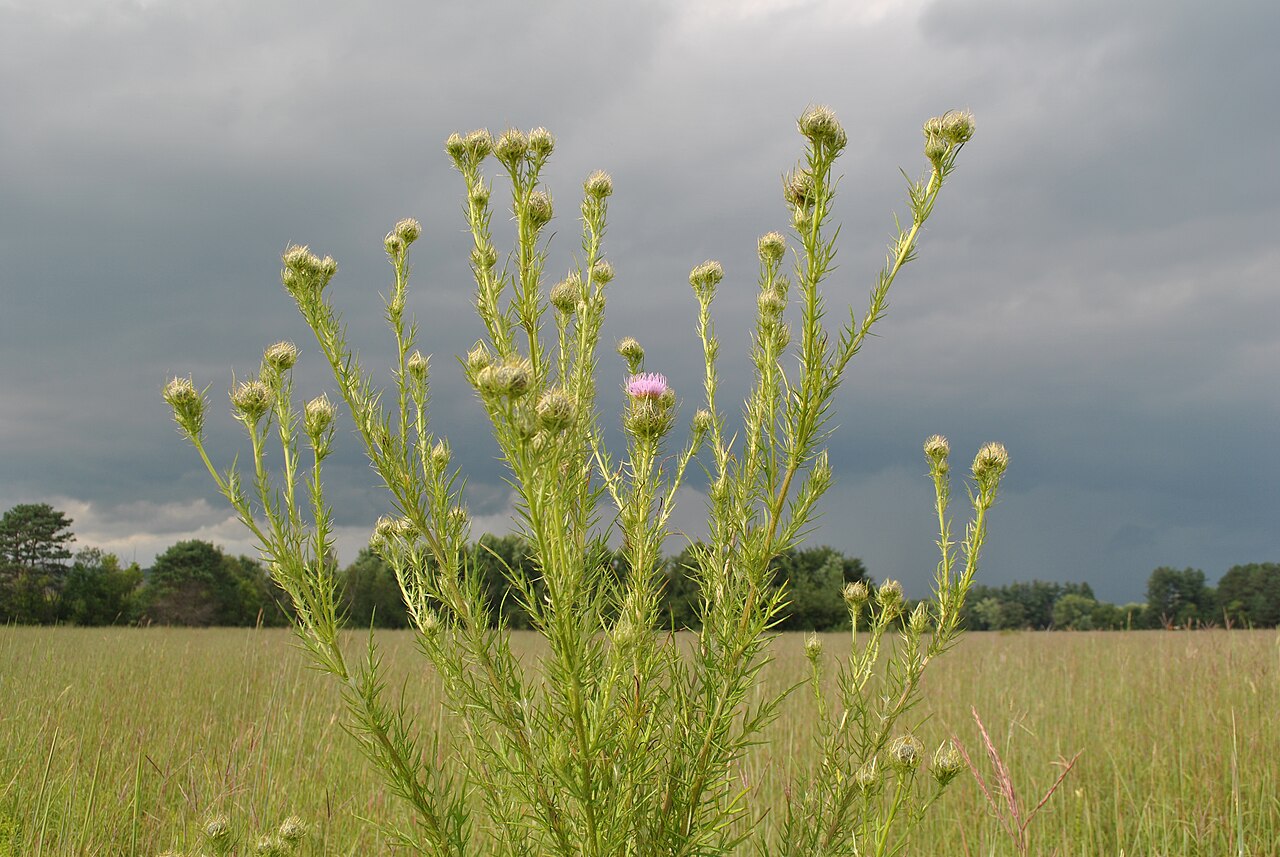
In its first year field thistle forms a low basal rosette of spiny leaves. In the second year (or later) it sends up a stout, branched, leafy flowering stem, usually 3 to 7 feet tall. The stems are grooved and hairy but have no spiny wings. Plants grow from a taproot and do not spread by creeping roots.
Leaves
The leaves are alternate, 4 to 10 inches long, deeply cut into narrow, spine-tipped lobes. The upper surface is green and smooth or slightly hairy, while the lower surface is densely covered with white, felt-like hairs. The bases of the leaves clasp the stem but do not run down it as spiny wings.
Flowers
The flower heads are 1½ to 2 inches across, usually borne singly at the ends of the branches. Each head contains many tubular disk florets in pale pink-purple to lavender, occasionally white. The bracts below the head are tipped with slender, spreading spines, and each bract has a pale, sticky ridge down the middle. Several small, leafy bracts often surround the base of the head. Field thistle blooms from July to October, later than many other native thistles.
Fruit & Seeds
The fruits are small, light brown achenes with a tuft of feathery, white pappus (thistledown) that carries them on the wind. The seed heads open in late summer and fall. Each plant produces many seeds, but field thistle tends to persist as scattered plants rather than forming dense patches.
Field Thistle vs. Invasive Thistles
Bull thistle (C. vulgare) has spiny wings running down the stems, rough, prickly leaf upper surfaces and leaf undersides that are green or only lightly woolly. Canada thistle (C. arvense) has much smaller flower heads (about ¾ inch), spreads aggressively by creeping roots and forms dense patches. Field thistle has large heads, white-woolly leaf undersides, no stem wings and no creeping roots.
Quick Facts
| Scientific Name | Cirsium discolor (syn. Carduus discolor) |
| Family | Asteraceae (aster family) |
| Plant Type | Biennial or short-lived perennial herb |
| Mature Height | 3–7 ft |
| Mature Spread | 1–3 ft |
| Growth Rate | Fast in flowering year |
| Sun Exposure | Full sun to partial shade |
| Water Needs | Low to medium |
| Soil Type | Loam, clay loam, sandy loam; tolerates a wide range |
| Soil pH | About 5.5–7.5 |
| Bloom Time | July–October |
| Flower Color | Pale pink-purple to lavender; rarely white |
| Fall Color | None; seed heads turn fluffy white |
| Fruit | Achenes with feathery white pappus (thistledown) |
| Deer Resistant | Yes; spiny leaves deter browsing |
| USDA Hardiness Zones | 3–8 |
Native Range
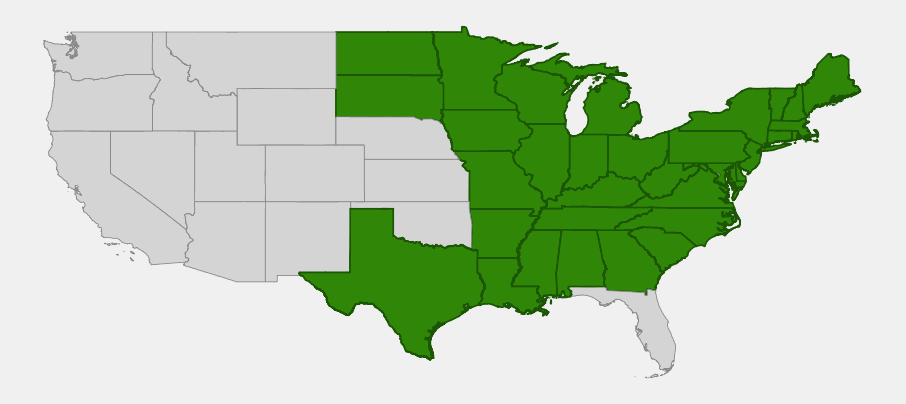
Field thistle is native across much of eastern and central North America. USDA PLANTS records it in 33 states, from Maine south to Georgia and west to the Dakotas, Minnesota, Iowa, Missouri, Arkansas, Louisiana and eastern Texas. In Canada it grows in Manitoba, Saskatchewan, Ontario and Quebec.
It is most common in the Midwest and the Great Lakes states, including Illinois, Indiana, Iowa, Ohio, Wisconsin and Michigan, where it is a characteristic plant of tallgrass prairies, prairie remnants and old fields. Farther east it grows in old fields, meadows, open woodlands and roadsides, and in the South it is more scattered, usually in open, upland sites.
Field thistle grows in a variety of open and partly shaded habitats, including prairies, savannas, open woods, woodland edges, old fields, pastures and roadsides. It prefers moderately moist to dry soils and tolerates a range of soil types, from sand to clay loam.
📋 Regional plant lists featuring Field thistle: New York, Pennsylvania & Northern New Jersey · Ohio & Indiana · Michigan, Wisconsin & Eastern Minnesota · Kentucky & Tennessee · Connecticut, Massachusetts & Rhode Island · New Hampshire, Maine & Vermont · Maryland, Virginia & West Virginia · Delaware, Southern New Jersey & Long Island · Illinois, Iowa & Missouri · Alabama, Georgia & Mississippi
Growing & Care Guide
Field thistle is easy to grow and makes a striking addition to prairie plantings, meadows and wildlife gardens. Because it is a native biennial that does not spread by creeping roots, it is far better behaved than invasive thistles. Still, it is a large, spiny plant, so place it where people will not brush against it, such as the middle or back of a meadow or a pollinator garden.
Light
Plant field thistle in full sun to partial shade. It flowers best in full sun but tolerates some shade at woodland edges.
Soil & Water
It grows in average to dry, well-drained soils, from sandy loam to clay loam. It tolerates drought once established and does not need fertilizer. Rich, moist soils may make it taller and floppier.
Planting Tips
Sow seed in fall or early spring on bare or lightly disturbed soil, or plant nursery-grown seedlings. Seedlings form a rosette the first year and flower in the second year or later. Since plants usually die after flowering, allow some seed to fall each year, or resow periodically, to keep field thistle in your planting.
Pruning & Maintenance
Little care is needed. Wear gloves when handling the spiny plants. Leave the seed heads standing for goldfinches and other birds, and allow some plants to self-sow. Remove unwanted seedlings while they are small rosettes if you want to limit their numbers.
Propagation
Grow from seed. Fresh seed germinates readily, especially after a period of cold, moist stratification over winter. Field thistle is not propagated by division because of its taproot and biennial life cycle.
Landscape Uses
- Prairie and meadow restorations: an important late-summer native forb in tallgrass prairie plantings
- Pollinator gardens: one of the best native nectar plants for bumblebees and butterflies
- Wildlife gardens: seeds and thistledown for goldfinches and other birds
- Naturalized areas and old fields: tolerates poor, dry soils
- Education: a good example of a native thistle that is not invasive
Wildlife & Ecological Value
Field thistle is one of the most wildlife-friendly native plants of eastern and central North America, especially in late summer and fall.
For Pollinators
Its flowers produce abundant nectar and pollen and attract bumblebees, long-horned bees (Melissodes), including thistle specialists, many other native bees, honey bees, and butterflies such as monarchs, swallowtails, fritillaries and skippers. Hummingbirds also visit the flowers. Native thistles are larval host plants for the painted lady butterfly and several other insects.
For Birds
American goldfinches eat the seeds and use the soft thistledown to line their nests. Goldfinches nest late in the summer, at the same time native thistles go to seed. Other seed-eating birds also eat the seeds, and many insect-eating birds forage on the insects that visit the plants.
For Mammals
The spiny leaves deter most browsing by deer and other mammals. Small mammals may eat seeds that fall to the ground.
Ecosystem Role
Field thistle is an important part of native prairie and open woodland communities. Because it is often confused with invasive thistles, it is sometimes removed or sprayed, and native thistles may be declining in some areas as a result. Learning to recognize field thistle helps protect it and the many insects and birds that depend on it.
Cultural & Historical Uses
The species name discolor means “of two colors” and refers to the leaves, which are green above and white below. The genus name Cirsium comes from a Greek word for a kind of thistle. The plant was first described from North American specimens in the early nineteenth century, and older works place it in the genus Carduus.
Ethnobotanical records note that some Native American peoples used native thistles as food and medicine, for example eating young stems or roots. These traditional uses are not recommendations for modern home use.
Today field thistle is valued by prairie restorationists, pollinator advocates and birdwatchers. It is often used to show that “thistle” does not have to mean “weed”. Many native thistles, including field thistle, are important parts of North American ecosystems.
Frequently Asked Questions
Is field thistle invasive?
No. Field thistle is a native biennial or short-lived perennial that does not spread by creeping roots and does not form dense patches. The invasive thistles are mostly introduced species such as bull thistle and Canada thistle.
How can I tell field thistle from bull thistle?
Field thistle leaves are densely white-woolly underneath, and its stems have no spiny wings. Bull thistle has spiny wings along the stems and leaf undersides that are green or only lightly hairy.
Why are native thistles good for pollinators?
Their large flower heads produce abundant nectar and pollen. Field thistle supports bumblebees, specialist native bees, butterflies and hummingbirds in late summer and fall.
Do goldfinches use field thistle?
Yes. American goldfinches eat the seeds and use the soft thistledown to line their nests, which they build in late summer when native thistles go to seed.
Can I plant field thistle in my garden?
Yes, in sunny pollinator gardens, meadows and prairie plantings. It is a large, spiny plant, so place it away from paths and wear gloves when handling it.

Looking for a nursery that carries Field thistle?
Browse our native plant nursery directory: Alabama & Arkansas · Connecticut, Delaware & Georgia · Illinois, Indiana & Iowa · Kentucky, Louisiana, Maine, Maryland, Massachusetts, Michigan, Minnesota, Mississippi & Missouri · New Hampshire, New Jersey, New York, North Carolina, North Dakota & Ohio · Pennsylvania, Rhode Island, South Carolina, South Dakota, Tennessee, Texas, Vermont & Virginia · West Virginia & Wisconsin