
Felt Paintbrush (Castilleja foliolosa)
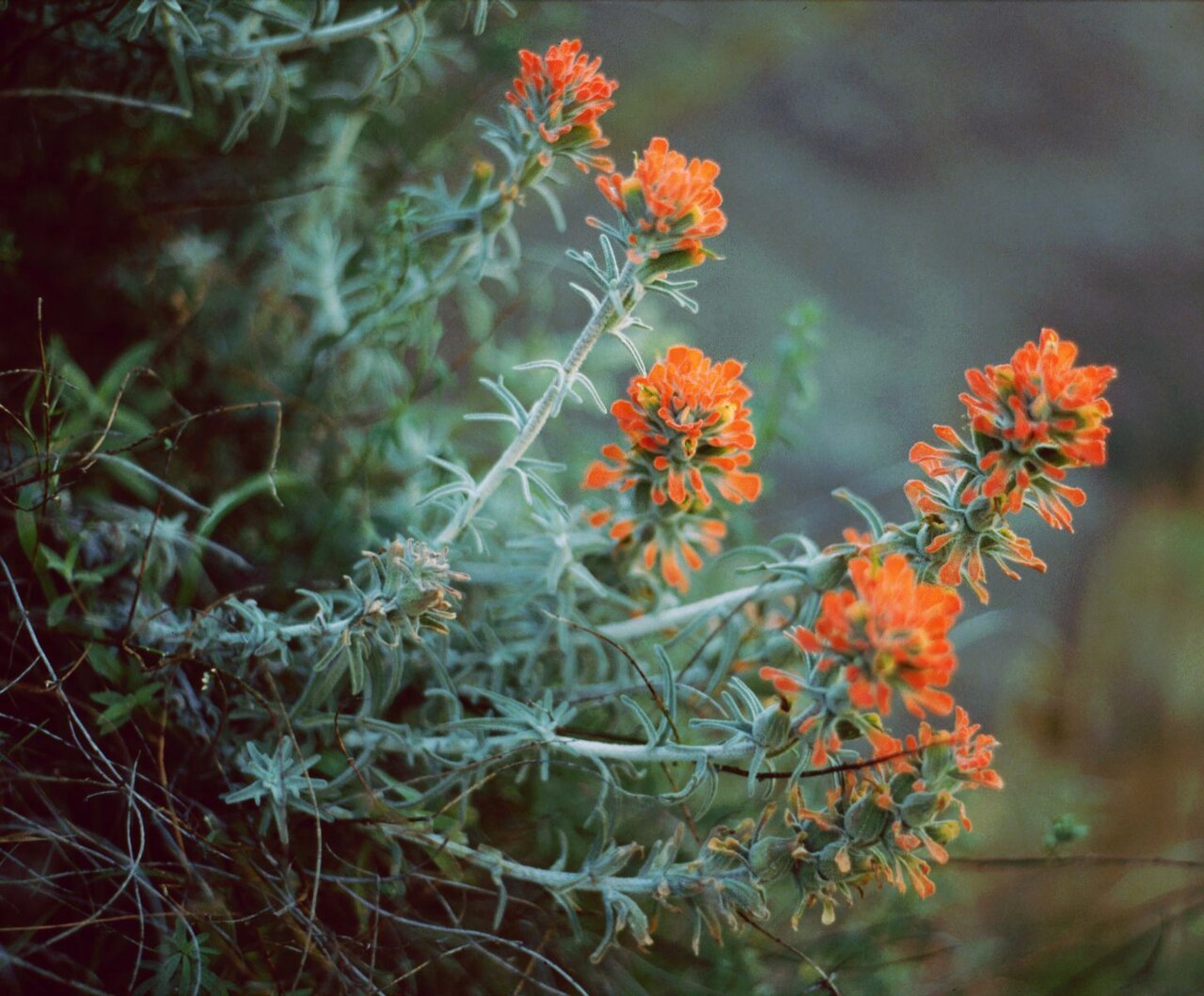
Castilleja foliolosa, known as Felt Paintbrush, chaparral paintbrush or woolly painted-cup, is a bushy native perennial of California’s chaparral and coastal sage scrub, in the broomrape family (Orobanchaceae). It grows 1 to 2 feet tall, and every part of it, stems, leaves and bracts, is covered in a dense coat of branched white to gray hairs that gives the whole plant a soft, felted, silvery look. From late winter into early summer its branch tips carry bright orange-red, or sometimes yellow, flower spikes.
Like other paintbrushes it is hemiparasitic: it has green leaves and makes its own food, but its roots also attach to the roots of neighboring plants, usually shrubs or grasses, and take water and nutrients from them. That makes it a plant to admire in the wild and to grow only with patience. It needs a host plant nearby and is hard to establish in gardens, and dug-up plants almost always die.
USDA PLANTS and Calscape list it under the confusing name “Texas Indian paintbrush,” even though it does not grow in Texas. The Texas paintbrush of Texas roadsides is a different species, Castilleja indivisa. This guide covers identification, range, how (and whether) to grow felt paintbrush, its value to hummingbirds, and its place in California chaparral.
Identification
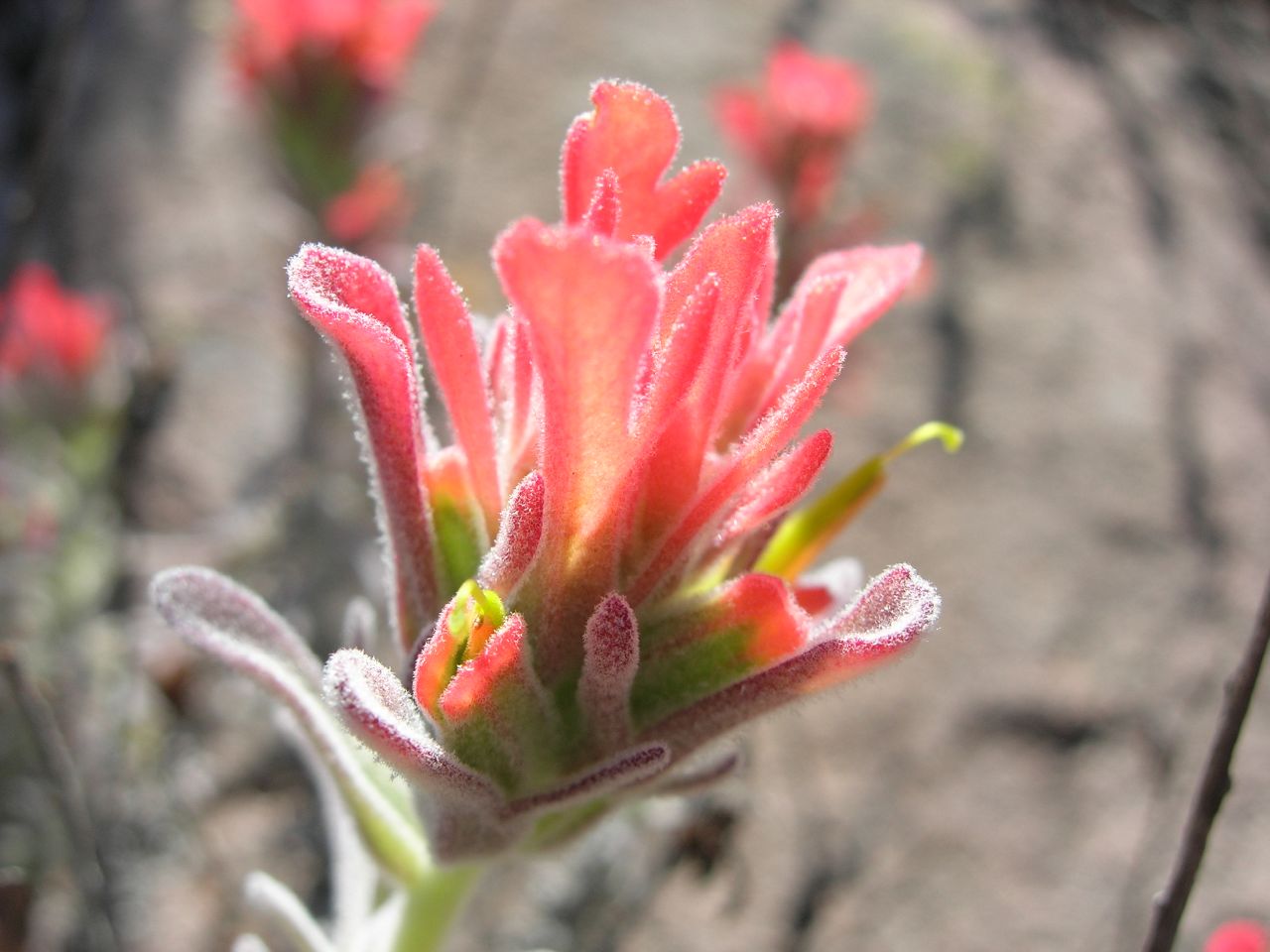
Felt paintbrush is the most woolly-looking paintbrush of lowland California. Its silvery, densely haired, much-branched stems and its bright bracts make it easy to pick out on dry chaparral slopes in spring.
Growth Form
A perennial herb that becomes woody at the base, forming a rounded, bushy clump 1 to 2 feet (30–60 cm) tall with many leafy stems. Plants are often tucked into or beside shrubs, whose roots they tap.
Leaves
The leaves are narrow and linear, up to about 2 inches (5 cm) long, and crowded along the stems. The upper ones sometimes have a pair of short side lobes. Like the stems, they are densely covered in white to gray branched hairs, so they look felted or woolly rather than green.
Bracts & Flowers
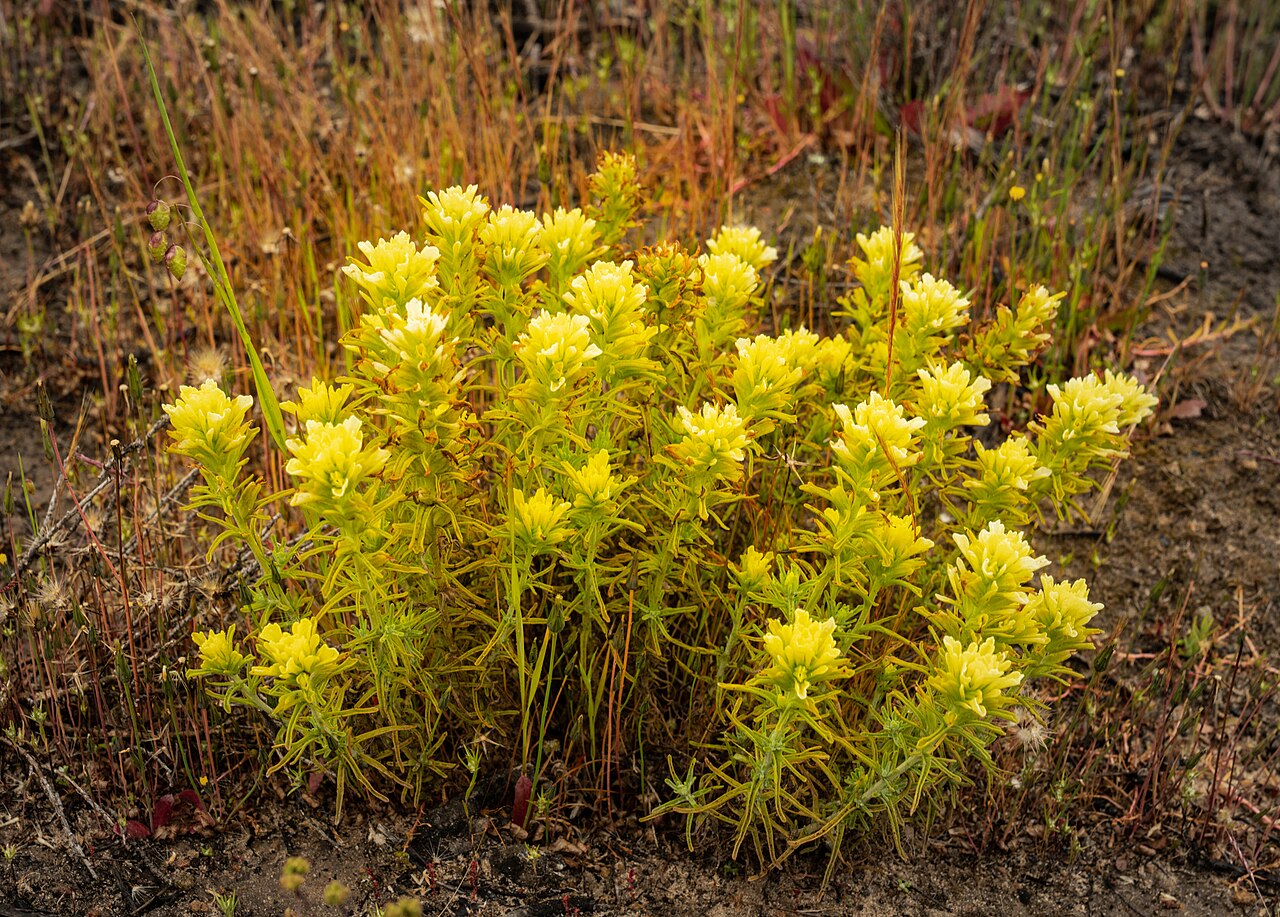
The color in the flower spike comes from bracts, modified leaves that are tipped bright orange-red to scarlet, or in some plants yellow to yellowish green. The true flowers are narrow, greenish, pouch-tipped tubes about an inch long, tucked between the bracts. Bloom time is mainly March to June, starting earlier in mild coastal sites.
Fruit & Seeds
Each flower produces a small capsule about half an inch long that splits to release many tiny seeds with a netted coat.
Similar Species
Scarlet paintbrush (Castilleja miniata) is greener and less hairy and grows in moister mountain meadows. Coast paintbrush (Castilleja affinis) shares much of the same range but has greener, rougher-haired foliage. Woolly paintbrush (Castilleja lanata) of Arizona, New Mexico and Texas is similarly woolly, and the two share that common name, which is why “felt paintbrush” is the clearer name for the California plant.
Quick Facts
| Scientific Name | Castilleja foliolosa |
| Family | Orobanchaceae (broomrape family) |
| Plant Type | Hemiparasitic perennial herb, woody at the base |
| Mature Height | 1–2 ft |
| Mature Spread | 1–2 ft |
| Growth Rate | Slow to establish |
| Sun Exposure | Full sun to light shade |
| Water Needs | Low; summer-dry |
| Soil Type | Dry, well-drained rocky, gravelly or sandy soil |
| Soil pH | About 6.0–7.5 |
| Bloom Time | March–June |
| Flower Color | Orange-red to scarlet bracts; occasionally yellow |
| Fall Color | None; foliage stays silvery gray |
| Fruit | Small capsules with many tiny seeds |
| Deer Resistant | Moderately; the woolly foliage is seldom browsed |
| USDA Hardiness Zones | 8–10 |
Native Range
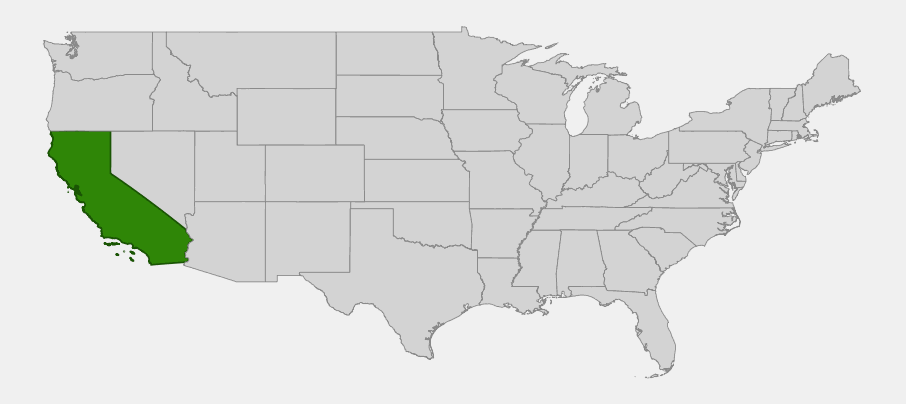
Felt paintbrush is native to California and northern Baja California, Mexico. Within the United States, USDA PLANTS records it only in California. It is widespread in the Coast Ranges from about Humboldt County south to San Diego County, including the Bay Area hills, the Santa Lucia Range, the Transverse Ranges and the coastal hills of southern California, and it is less common along the western foothills of the Sierra Nevada.
It grows in dry, open, sunny places, especially in chaparral and coastal sage scrub, on rocky or gravelly slopes, in openings in oak woodland and in maritime chaparral on old sand dunes, as at Fort Ord on Monterey Bay. It is often found growing up through or beside shrubs such as California sagebrush, chamise and buckwheat, whose roots supply part of its water and nutrients.
It ranges from near sea level to about 5,000 feet. Plants often reappear in good numbers in the years after a chaparral fire, when the shrub canopy is open and light reaches the ground.
📋 Regional plant lists featuring Felt Paintbrush: California & Nevada
Growing & Care Guide
Felt paintbrush is not an easy garden plant. Because it is hemiparasitic, it needs a host plant growing right next to it, and it is hard to establish even with one. Seedlings that do not find a host usually fade away. Treat it as a rewarding experiment for a dry native garden, not a dependable perennial, and never dig plants from the wild: transplanting paintbrush almost always kills it.
Light
Give it full sun or light shade, as on an open chaparral slope. In heavy shade it becomes sparse and flowers poorly.
Soil & Water
Plant it in fast-draining rocky, gravelly or sandy soil. Water lightly to help seedlings and their host get started, then let the planting go summer-dry. Regular summer watering and rich soil tend to rot it. Once established it lives on winter rain.
Planting Tips
Plant or sow it right at the base of a host. Gardeners have had the best luck pairing paintbrushes with established native shrubs and perennials such as California sagebrush, buckwheats or sages, or with bunchgrasses such as purple needlegrass. The occasional nursery plant comes in a pot with its host. Plant the pair together without disturbing the roots.
Pruning & Maintenance
Little care is needed. Cut back dry flower stems after seed has dropped if you want a tidier look, and keep heavier, faster plants from smothering it. Avoid fertilizer, which favors weeds and the host over the paintbrush.
Propagation
Grow it from seed. Sow fresh seed in fall on the soil surface right around the roots of a host plant, or sow it in a pot together with a small host. Expect low and slow success; several attempts are often needed. Stem cuttings and division are not practical because of its dependence on host roots.
Landscape Uses
- Hummingbird gardens: bright tubular flowers in late winter and spring
- Chaparral and coastal sage scrub gardens: paired with sagebrush, buckwheat or sage hosts
- Silver-foliage accents: felted gray stems that stay attractive out of bloom
- Habitat restoration: within its California range, sown with host shrubs and grasses
- Wildflower viewing: a signature spring flower of chaparral trails
Wildlife & Ecological Value
Felt paintbrush is a small plant with an outsized role in spring chaparral, both as a nectar source and as part of the network of roots it shares with its hosts.
For Pollinators
The long, narrow greenish flowers are adapted to hummingbirds, and Anna’s hummingbirds are frequent visitors in coastal California. Bees also work the flowers. Paintbrushes as a group are larval host plants for checkerspot butterflies, whose caterpillars feed on them.
For Birds
Hummingbirds take nectar from the flowers through the spring. The tiny seeds are of little direct value to most birds.
For Mammals
Its woolly, hairy foliage is seldom browsed heavily by deer or rabbits, though young shoots may be nibbled.
Ecosystem Role
As a hemiparasite, felt paintbrush links itself into the root systems of nearby shrubs and grasses. Hemiparasitic plants like paintbrushes can slightly slow the growth of their hosts, which may help keep a mix of species in shrublands and meadows. It is also among the wildflowers that become more visible after chaparral fires.
Cultural & Historical Uses
The genus Castilleja honors the Spanish botanist Domingo Castillejo, and foliolosa means “leafy,” for its crowded leaves. The species was described in the 1830s by William Jackson Hooker and George Arnott Walker-Arnott from plants collected in California.
The name “paintbrush” comes from the look of the flower spikes, as if their tips had been dipped in paint. Indigenous peoples in California and elsewhere in the West used various paintbrush species, for example sucking nectar from the flowers. Paintbrushes can take up compounds from their hosts, so they are not plants to eat or use as home remedies.
Felt paintbrush has also been at the center of a long naming muddle. Several of its common names are shared with other species, and USDA PLANTS calls it “Texas Indian paintbrush.” Using the scientific name, or the clear name “felt paintbrush,” avoids confusing it with the Texas and Southwest species.
Frequently Asked Questions
Is felt paintbrush a parasite?
Partly. It is a hemiparasite: it has green leaves and makes its own food, but its roots attach to the roots of nearby plants and take water and nutrients from them. It needs a host plant to grow well.
Can I grow felt paintbrush in my garden?
You can try, but it is hard to establish. Sow seed in fall right around a host such as California sagebrush, buckwheat, sage or a native bunchgrass, in sunny, fast-draining, summer-dry soil. Expect several attempts. Never dig plants from the wild; transplanted paintbrushes almost always die.
Does felt paintbrush grow in Texas?
No. Despite the USDA common name “Texas Indian paintbrush,” it grows only in California and northern Baja California. The Texas paintbrush of Texas wildflower meadows is Castilleja indivisa.
Do hummingbirds visit felt paintbrush?
Yes. Its tubular flowers are adapted to hummingbirds, and Anna’s hummingbirds are frequent visitors in spring.
When does felt paintbrush bloom?
Mainly from March to June, starting as early as late winter in mild coastal areas.

Looking for a nursery that carries Felt Paintbrush?
Browse our native plant nursery directory: California