
Desert Tobacco (Nicotiana obtusifolia)
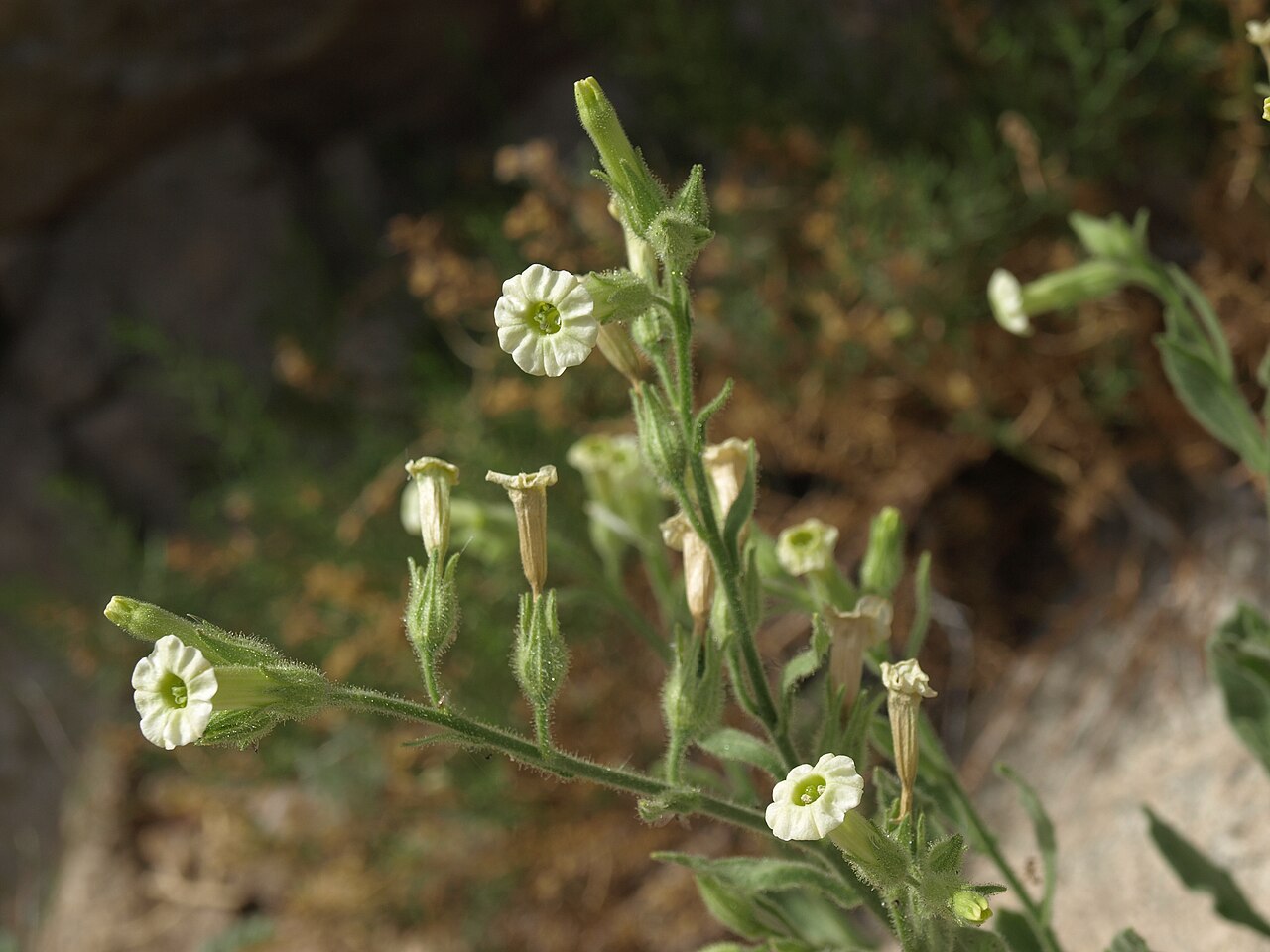
Nicotiana obtusifolia, known as Desert Tobacco, is a wild tobacco of the deserts of the American Southwest and northern Mexico. It belongs to the nightshade family (Solanaceae), the same family as cultivated tobacco, tomatoes and peppers. It is a short-lived perennial, sometimes acting as an annual, that forms a loose, sticky clump 1 to 3 feet tall. The whole plant is covered in glandular hairs that feel tacky and give it a strong, rank smell. Older books call it Nicotiana trigonophylla, and in Spanish it is known as tabaquillo, “little tobacco.”
Its flowers are small, greenish-white to cream trumpets that flare into five rounded lobes. They appear in loose clusters at the stem tips, mainly from late winter to early summer, and again after rains in fall. Desert tobacco grows in rocky places: canyon walls, cliff crevices, the edges of sandy washes and the shelter of boulders, from the Mojave and Sonoran Deserts to the Chihuahuan Desert of West Texas.
Desert tobacco has a long history of use. Native peoples of the Southwest smoked it and used it in ceremonies, and some still do. It is also a genuinely poisonous plant. Like all tobaccos it contains nicotine and related alkaloids, and it should never be eaten. For gardeners in the low desert it is an easy, drought-tolerant plant for rock gardens and wildlife plantings, as long as it is placed away from children and pets that might chew on it.
Identification
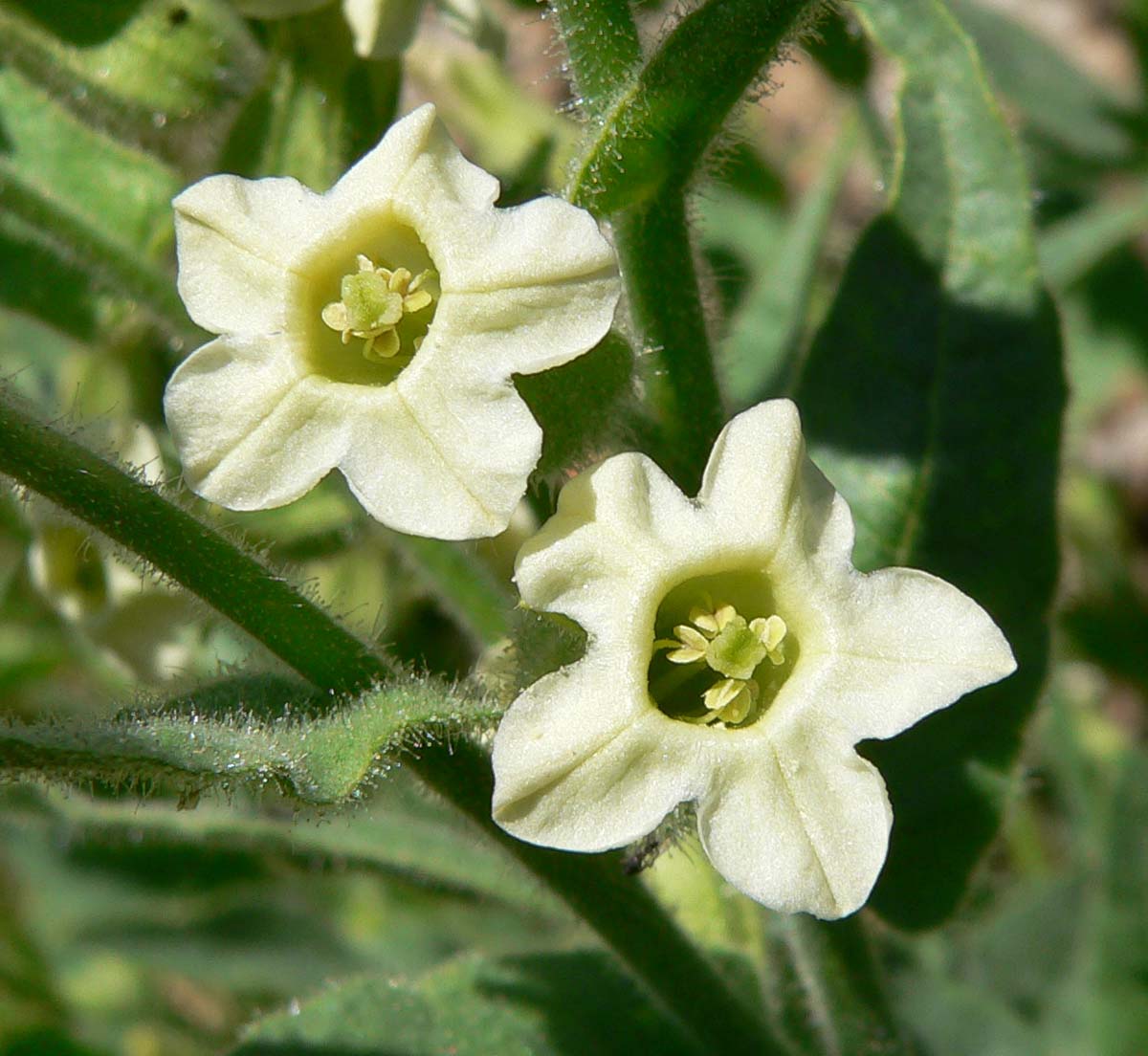
Desert tobacco is easiest to recognize by its combination of sticky, glandular-hairy stems and leaves, clasping upper leaves, and small, pale tubular flowers. Rub a leaf and your fingers will feel tacky and smell strongly of tobacco.
Growth Habit
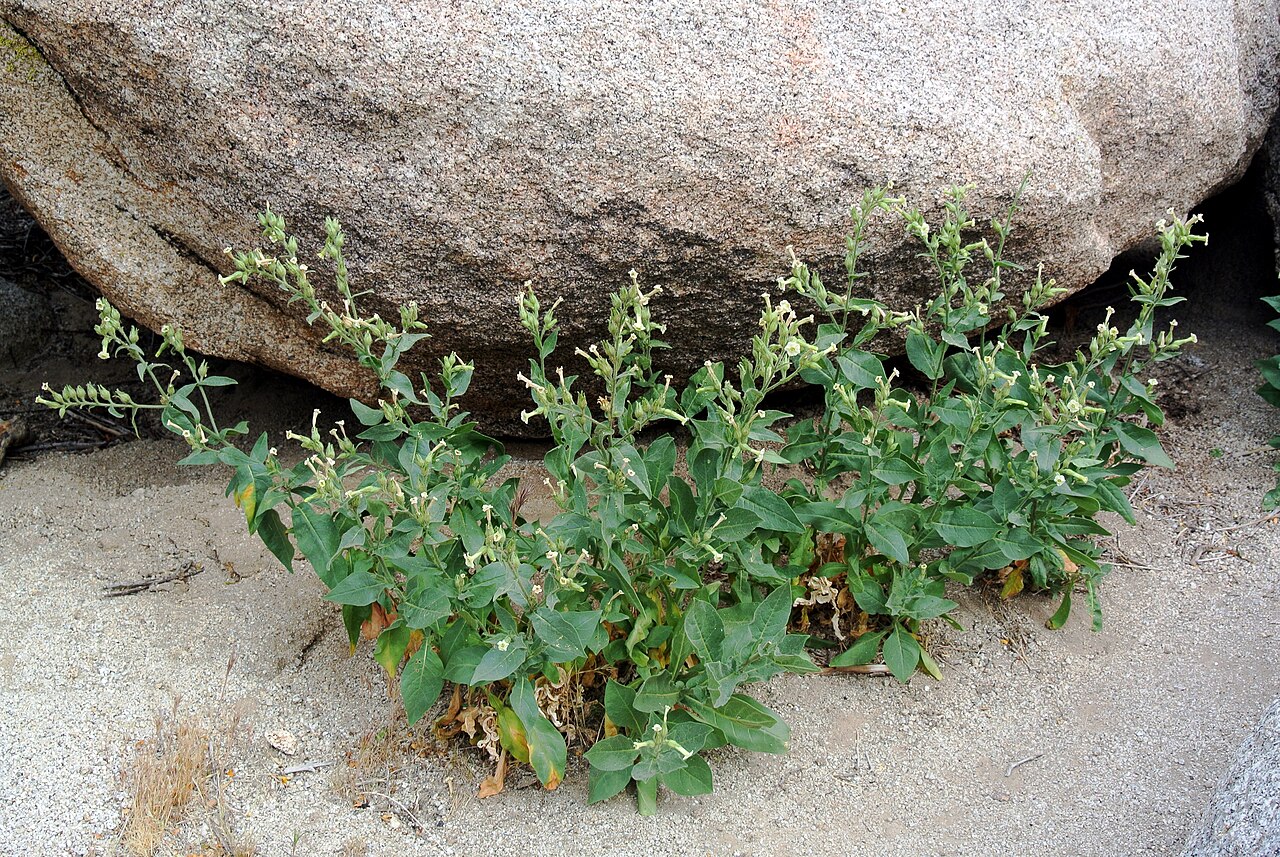
Plants grow from a woody base and taproot and send up several branching stems, usually 1 to 3 feet tall. In good years plants may persist and flower for a few seasons; in dry years they behave more like annuals. The stems are green to grayish, densely covered with short, sticky, gland-tipped hairs that often catch sand and small insects.
Leaves
The lower leaves are oblong to spoon-shaped and stalked, up to about 4 to 6 inches long, sometimes forming a loose basal rosette. Leaves higher on the stem are smaller, unstalked and clasp the stem with ear-like lobes at their bases. The leaf tips are blunt to rounded, which is what the name obtusifolia (“blunt-leaved”) refers to. All leaves are soft, sticky and pale to medium green.
Flowers
The flowers are borne in a loose, branched cluster at the top of the stems. Each is a slender tube about 3/4 inch long, greenish-white, cream or pale yellowish, opening to a small, star-like face of five rounded lobes about 1/2 inch across. The calyx is green, hairy and sticky. Flowering is heaviest from about February to June, with a second flush after late-summer or fall rains, and LBJ Wildflower Center records blooms from November through June in mild years.
Fruit & Seeds
Each flower produces a small, egg-shaped capsule about 1/3 inch long, partly enclosed by the persistent calyx. When ripe, the capsule turns brown and splits open at the top to release hundreds of tiny, dark, finely sculptured seeds. Dried flower stalks with open capsules often remain on the plant for months.
Look-alikes
Coyote tobacco (Nicotiana attenuata), which grows across much of the West, has longer, narrower white flowers and leaves that do not clasp the stem. Tree tobacco (Nicotiana glauca), an introduced South American shrub common in the Southwest, is a tall, smooth, blue-gray shrub with yellow tubular flowers. Sacred datura (Datura wrightii) has similar sticky leaves but huge white trumpet flowers several inches long.
Safety: Poisonous Plant
All parts of desert tobacco are poisonous to people, pets and livestock. The plant contains nicotine and related alkaloids such as anabasine, which can cause vomiting, drooling, tremors, a racing or irregular heartbeat, weakness and, in severe cases, paralysis of breathing. Livestock poisoning from wild tobaccos has been reported in the Southwest when other forage is scarce. Never eat any part of the plant or use it as a home remedy, wash your hands after handling the sticky foliage, and keep it out of reach of children and animals. If someone swallows part of the plant, contact Poison Control (1-800-222-1222 in the U.S.) or a veterinarian right away.
Quick Facts
| Scientific Name | Nicotiana obtusifolia (syn. N. trigonophylla) |
| Family | Solanaceae (nightshade family) |
| Plant Type | Short-lived herbaceous perennial or annual |
| Mature Height | 1–3 ft |
| Mature Spread | 1–2 ft |
| Growth Rate | Fast |
| Sun Exposure | Full sun to light shade |
| Water Needs | Low; very drought tolerant |
| Soil Type | Rocky, gravelly or sandy, well-drained |
| Soil pH | Neutral to alkaline |
| Bloom Time | Mainly February–June; again after fall rains |
| Flower Color | Greenish-white to cream |
| Fall Color | None; stems dry to tan |
| Fruit | Small brown capsule with many tiny seeds |
| Deer Resistant | Yes; toxic and strongly scented |
| USDA Hardiness Zones | 8–11 |
Native Range
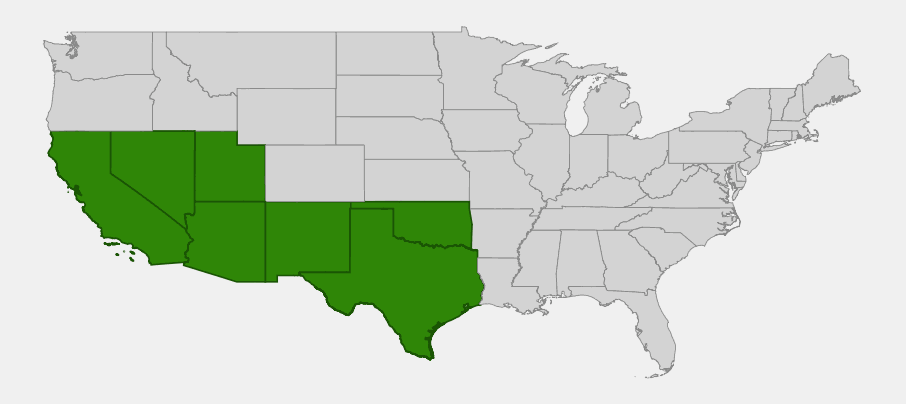
Desert tobacco is native to the southwestern United States and northern Mexico. The Lady Bird Johnson Wildflower Center describes its native distribution as southeastern California and southern Nevada to western Texas and northwestern New Mexico. In the United States it grows in the Mojave, Sonoran and Chihuahuan Deserts and adjacent desert grasslands of California, Nevada, southwestern Utah, Arizona, New Mexico and West Texas. USDA PLANTS also has an outlying record from Oklahoma. In Mexico it ranges south through Baja California, Sonora, Chihuahua and much of the central Mexican highlands.
USDA PLANTS also lists a record from Maryland, far outside the plant’s desert range. That record almost certainly reflects a stray, non-native occurrence, so it is not shown on the range map. Desert tobacco is sometimes grown in botanical gardens, which can lead to occasional escapes outside its natural range.
Within its range, desert tobacco is a plant of rocky places. Look for it in cracks of canyon walls and cliffs, at the base of boulders, along the gravelly edges of washes and arroyos, on rocky slopes and along road cuts, usually from near sea level in the Colorado Desert up to around 5,000 to 6,000 feet in desert mountains.
📋 Regional plant lists featuring Desert Tobacco: Idaho, Eastern Oregon & Eastern Washington · Utah & Western Colorado · Arizona & New Mexico · South & West Texas · California & Nevada
Growing & Care Guide
Desert tobacco is easy to grow in hot, dry gardens and needs almost no care once it has sprouted. It is not common in nurseries, but seed is sometimes offered by native seed suppliers and desert botanical gardens. Because the whole plant is poisonous, place it where children and pets will not chew on it.
Light
Full sun is best. It also tolerates light or afternoon shade, which mimics the shelter of boulders and cliff walls where it grows wild. In deep shade it becomes lanky and flowers poorly.
Soil & Water
Plant it in fast-draining gravelly, rocky or sandy soil. It does not need rich soil or fertilizer. Water seedlings occasionally until they are established; after that, rainfall is usually enough in the low and middle desert. An occasional deep watering in a long dry spell extends flowering. Overwatering and heavy clay soils cause rot.
Planting Tips
Sow seed directly on the soil surface in fall or late winter, pressing it in lightly; the tiny seeds need light to germinate and should not be buried. Plants often do best tucked beside a large rock, wall or path edge, where they get a little extra moisture and protection, just as in the wild. Space plants about 1 to 2 feet apart.
Pruning & Maintenance
Cut back spent flowering stems after seed has ripened if you want a tidier look, or leave them to self-sow. Plants are short-lived, typically lasting one to a few years, but they reseed modestly in gravelly soil. Wear gloves when handling the sticky foliage and wash your hands afterward. Hornworm caterpillars may feed on the leaves; they are part of the plant’s natural ecology and seldom kill it.
Propagation
Grow it from seed. Fresh seed sown on the surface of a sandy mix germinates in warm temperatures within a few weeks; keep it lightly moist until seedlings have several leaves, then transplant carefully, as the taproot dislikes disturbance. Volunteer seedlings can be moved while small.
Landscape Uses
- Desert rock gardens: tucked against boulders, walls and gravel paths
- Wildlife and pollinator gardens: a long-blooming nectar plant and a host for hornworm moths
- Xeriscapes: thrives on rainfall once established
- Ethnobotanical gardens: a living example of a native Southwestern tobacco
- Habitat restoration: for rocky slopes, wash edges and disturbed desert soils
Wildlife & Ecological Value
Desert tobacco is a small plant, but it supports a surprisingly specialized group of insects that can cope with its nicotine.
For Pollinators
The pale tubular flowers produce nectar and are visited by moths, bees and other insects, and occasionally by hummingbirds. Because it blooms over a long season, often when little else is flowering in rocky desert canyons, it is a useful nectar source in desert gardens.
For Birds
The tiny seeds have little food value for birds, but the hornworm caterpillars and other insects that feed on the plant are eaten by desert birds such as cactus wrens, thrashers and flycatchers.
For Mammals
The toxic, strongly scented foliage is generally avoided by deer, rabbits and rodents. Livestock usually ignore it unless other forage is very scarce, which is when poisoning can occur.
Ecosystem Role
Desert tobacco is a larval host plant for sphinx moths, including the Carolina sphinx (Manduca sexta, the tobacco hornworm), whose caterpillars tolerate nicotine. Wild tobaccos, including this species, have been widely used by scientists to study how plants defend themselves chemically against plant-eating insects. By colonizing rock crevices and disturbed gravel, it helps stabilize soil and provides cover for small invertebrates.
Cultural & Historical Uses
Desert tobacco has been used by Native peoples of the Southwest and northern Mexico for a very long time. Tribes in the region smoked the dried leaves in pipes or cane cigarettes, often mixed with other plants, and used it in prayer, ceremonies and healing. Some peoples tended wild stands and gathered the leaves each year. It is still used ceremonially today, and many communities consider it a sacred plant rather than a recreational one.
Spanish-speaking settlers in New Mexico knew a wild tobacco they called punche and smoked it when commercial tobacco was hard to come by. The Spanish name tabaquillo, “little tobacco,” is still used for desert tobacco in Mexico and the Southwest. Its older scientific name, Nicotiana trigonophylla, refers to the triangular shape of some of its leaves.
The strength of wild tobacco should not be underestimated. Its nicotine content varies from plant to plant and can be high, and it is not a safe substitute for commercial tobacco. Today desert tobacco is best appreciated as a tough, long-flowering wildflower of desert canyons, a host for hornworm moths, and a living link to the region’s cultural history.
Frequently Asked Questions
Is desert tobacco poisonous?
Yes. All parts contain nicotine and related alkaloids and are poisonous to people, pets and livestock if eaten. Wash your hands after handling the sticky foliage, and keep it away from children and animals. Contact Poison Control or a veterinarian if any part is swallowed.
Can I smoke desert tobacco?
It is not recommended. Wild tobacco varies greatly in nicotine content and can be much stronger than commercial tobacco. Among many Native communities it is a ceremonial plant, used with care and respect.
How do I tell desert tobacco from tree tobacco?
Desert tobacco is a low, sticky, green plant 1 to 3 feet tall with small greenish-white flowers. Tree tobacco is a tall, smooth, blue-gray shrub with yellow tubular flowers, and it is an introduced plant from South America.
Is desert tobacco an annual or a perennial?
It is a short-lived perennial that often behaves like an annual. In wet years plants may survive and bloom for a few seasons; in very dry years they may flower once and die after setting seed.
Why are there big green caterpillars on my desert tobacco?
They are probably hornworms, the larvae of sphinx moths such as the Carolina sphinx. They are native insects adapted to feeding on tobacco plants. A few caterpillars rarely kill the plant, and the adult moths are pollinators.

Looking for a nursery that carries Desert Tobacco?
Browse our native plant nursery directory: Arizona · California · Nevada, New Mexico & Oklahoma · Texas & Utah